ICC-ES Listing report for self-tapping screws for Canada

Publications

The ICC-ES Listing Report for Self-Tapping Screws for Canada provides third-party evaluation and listing information for self-tapping screws intended for use in Canadian construction applications. The document is intended for designers, engineers, specifiers, and code officials who require verified compliance information to support product approval and specification. The report outlines evaluated products, applicable standards, and conditions of use relevant to Canadian building codes and regulatory requirements. It serves as a reference for understanding the scope of the listing, including performance attributes, installation parameters, and limitations associated with the evaluated self-tapping screw systems. Developed as a compliance and reference document, the ICC-ES Listing Report supports informed decision-making and facilitates code acceptance for self-tapping screws used in wood and hybrid construction in Canada.

Long-Span CLT Floors: the importance of under floor insulation for soundproofing

Publications

This Rothoblaas document explores the role of underfloor insulation in improving acoustic performance in long-span cross-laminated timber (CLT) floor systems. Intended for designers, engineers, and building professionals, the document addresses key soundproofing challenges associated with larger spans and exposed timber structures. The document explains how underfloor insulation contributes to reducing airborne and impact sound transmission, with discussion of system behaviour, material selection, and integration with CLT floor assemblies. It also highlights design and construction considerations that influence acoustic performance, including detailing, installation quality, and coordination with other building systems. Developed as a technical reference, this document supports informed design decisions for long-span CLT floors, helping project teams achieve acoustic comfort while maintaining structural and architectural objectives.

Hybrid buildings: what they are and why they’re gaining ground in the construction industry

Publications

This Rothoblaas document examines the growing use of hybrid building systems and the factors driving their increased adoption across the construction industry. Intended for architects, engineers, and construction professionals, the document provides an overview of how wood is combined with materials such as steel and concrete to achieve performance, efficiency, and design objectives. The document outlines common hybrid building configurations, key structural and construction considerations, and the benefits these systems can offer, including improved constructability, structural efficiency, and project flexibility. It also explores why hybrid approaches are gaining traction, particularly in response to evolving building codes, sustainability goals, and project delivery demands. Developed as an educational resource, this document supports a clearer understanding of hybrid construction strategies, helping project teams evaluate when and how hybrid systems can be effectively applied in contemporary building projects.

Structural retrofitting techniques and fire safety regulations for structures in glulam

Publications

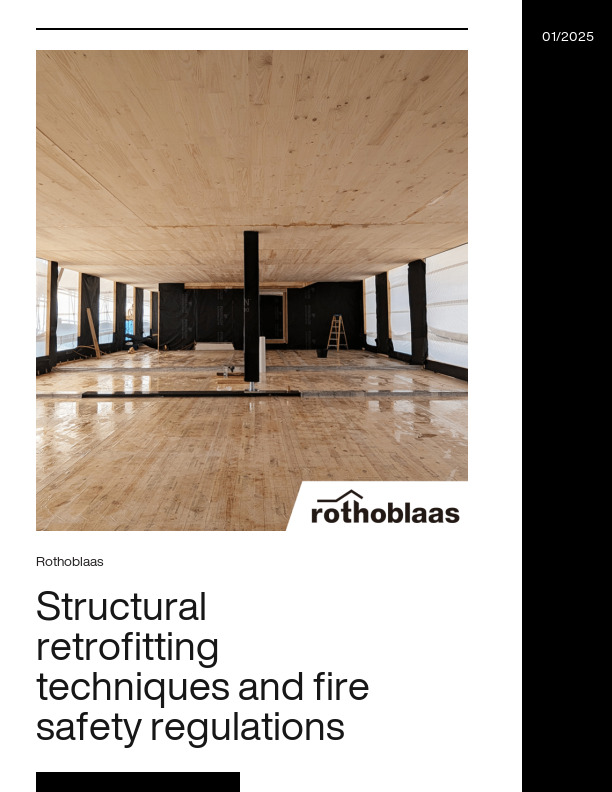
This Rothoblaas document provides an overview of structural retrofitting strategies for glulam buildings, with a focus on meeting fire safety regulations and performance requirements. Intended for engineers, designers, and building professionals, the document addresses key considerations when upgrading or reinforcing existing glulam structures. The document explores common retrofitting techniques, connection solutions, and system-level interventions that can enhance structural capacity while maintaining compliance with fire safety objectives. It also examines how fire regulations influence retrofit design decisions, including material selection, detailing, and protection strategies for glulam elements. Developed as a technical reference, this document supports informed retrofit planning and design, helping project teams balance structural performance, fire safety, and regulatory compliance when working with existing glulam structures.

Timber screws and connections: preventing failure through correct installation

Publications

This Rothoblaas document explores the critical role that correct installation plays in the performance and reliability of timber screws and structural connections. Aimed at designers, engineers, and construction professionals, the document highlights how improper installation practices can compromise load capacity, durability, and overall structural performance in wood construction. The document examines common causes of connection failure, including incorrect screw selection, installation angle, spacing, and edge distances. It also outlines best practices and practical considerations to help ensure timber screws and connections perform as intended, from design through on-site installation. Developed as an educational resource, this document supports improved understanding of connection behaviour in timber structures, helping project teams reduce risk, improve build quality, and achieve reliable performance through proper installation techniques.

Glenora West Block 300

Publications

As interest in mass timber construction continues to grow in a more carbon-friendly world, examples of innovative projects using these sustainable materials are popping up all over Canada. One prime example is Glenora West Block 300. Located in Glenora, one of Edmonton’s oldest and most sought-after neighbourhoods, the three-storey, mixed-use building was constructed using glue-laminated timber (GLT). Completed in 2019, Glenora West Block 300 was the first mass timber office building to be built in Alberta and features 60,000 square feet of office and retail space.

Design Example of Designing for Openings In Wood Diaphragm

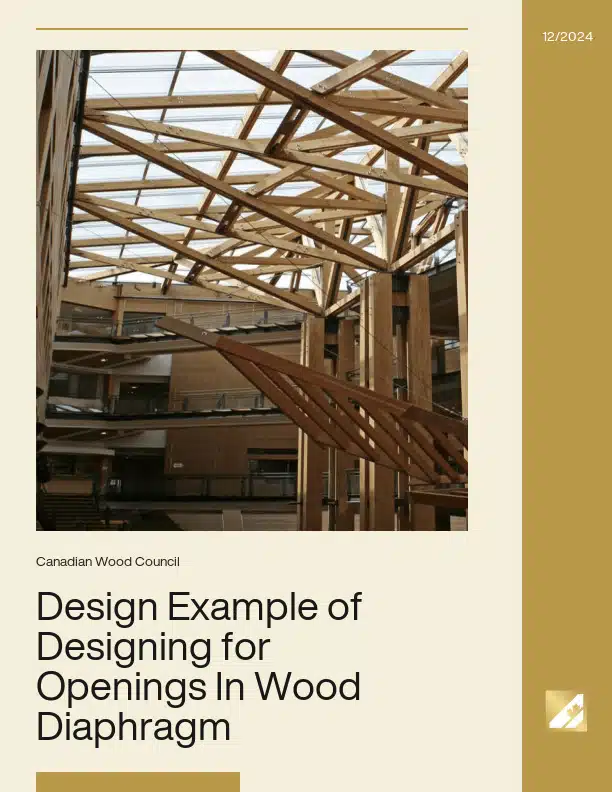
The effects of a single opening size and location on diaphragm shear, chord forces and framing member forces were investigated for a typical wood diaphragm. In conclusion, the maximum shear in the diaphragm with opening is greater than that in the diaphragm without opening. Increasing the distance between the edges of opening and diaphragm can reduce this increase in maximum shear significantly. When the dimension of the opening is no greater than 15% of the corresponding dimension of the diaphragm in both directions, and the distance of opening edge from diaphragm edge is no less than 3 times the larger dimension of the opening and that the portion of diaphragm alongside the opening satisfies the maximum aspect ratio requirement, the increase in maximum shear is less than 10%.

IBS1 – Moisture and Wood-Frame Buildings

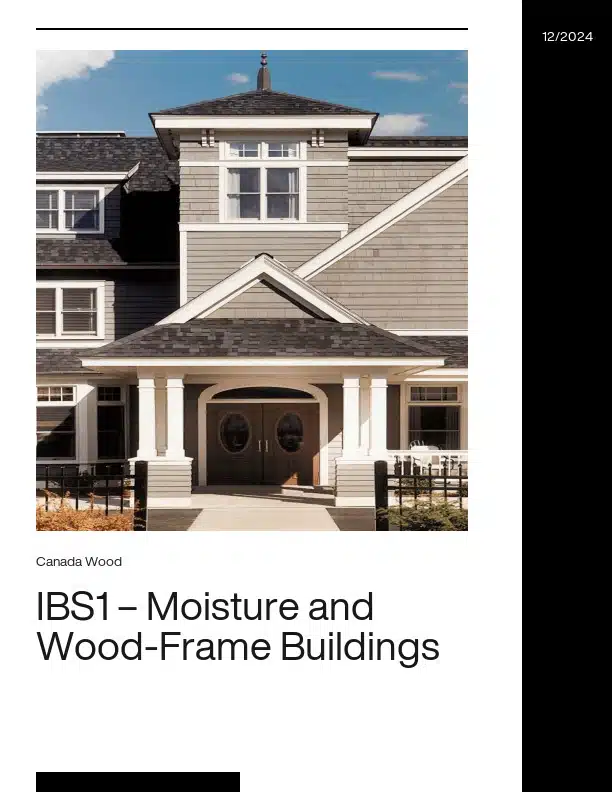
Throughout history, wherever wood has been available as a resource, it has found favor as a building material for its strength, economy, workability and beauty, and its ability to last has been demonstrated again and again. From the ancient temples of Japan and China and the great stave churches of Norway to the countless North American and European buildings built in the 1800s, wood construction has proven it can stand the test of time. The art and technology of wood building, however, has been changing through time. It’s a common misconception that water is wood’s enemy. That’s not necessarily true, since many wood buildings exist in rainy and humid places. It’s a matter of knowing how to manage water in buildings. Protection of buildings from water is the important design criterion, as important as protection from fire or structural collapse. Designers, builders and owners are gaining a deeper appreciation for the function of the building envelope (exterior walls and roof). This includes the performance of windows, doors, siding, sheathing membranes, air and vapour barriers, sheathing, and framing. The capabilities and characteristics of wood and other construction materials must be understood, and then articulated in the design of buildings, if proper and durable construction is to be assured. Wood and water are typically very compatible. Wood can absorb and release large quantities of moisture without problems, and it’s only when wood gets too wet for too long that there may be problems. If buildings are properly constructed to shed water, wood performs well as a building material in all types of climates. As an example, 90% of North American homes are built with wood. The primary focus of this publication is to address the control of rainwater penetration in exterior walls, which is the major source of moisture issues for all building materials, particularly in climates subject to high rainfall.

ONTARIO WOOD BRIDGE REFERENCE GUIDE

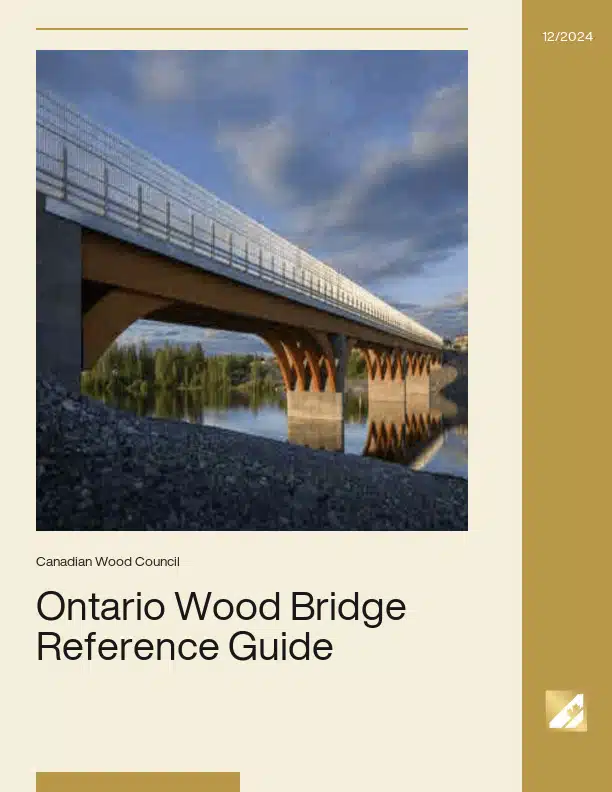
Timber bridges have a long history of construction and use throughout North America, including Ontario, for roadways, railways and logging roads. The Canadian Highway Bridge Design Code (CHBDC), together with the Canadian Wood Council publication Wood Highway Bridges from 1992 are typically referenced by designers of timber bridges in Ontario. This new reference is intended to provide updated background information for designers as they embark on proposing and designing timber highway bridges for primary and secondary roads. This reference is divided into three parts: Part 1 – Wood Bridges – Design and Use Part 2 – Opportunities & Current Limitations Part 3 – Design Examples Part 1 provides background information on topics including wood materials, bridge systems, prefabrication, durability and species availability. Details of costs, construction cycle and sustainability are also provided. Part 1 concludes with examples of a variety of completed highway bridges from North America and Europe. Part 2 of this reference is intended to provide designers and authorities with highlights of the current edition of the CHBDC on subjects related to the wood highway bridges, including areas that will require future development in the code. Additional references to other resources for advancing practitioner knowledge of and advancing the state of the art in wood bridge design are provided. Part 3 has two fully worked design examples of a two-lane 18-m span wood highway bridge designed in accordance with the latest provisions of the CHBDC and the best available information from current literature. Each example is based on a single-span, simply-supported glued-laminated girder bridge. One bridge has a glued-laminated deck and the other has a stress-laminated deck. These examples are intended to help designers understand the key issues as they undertake wood highway bridge design. Durability through detailing and choice of materials is discussed.

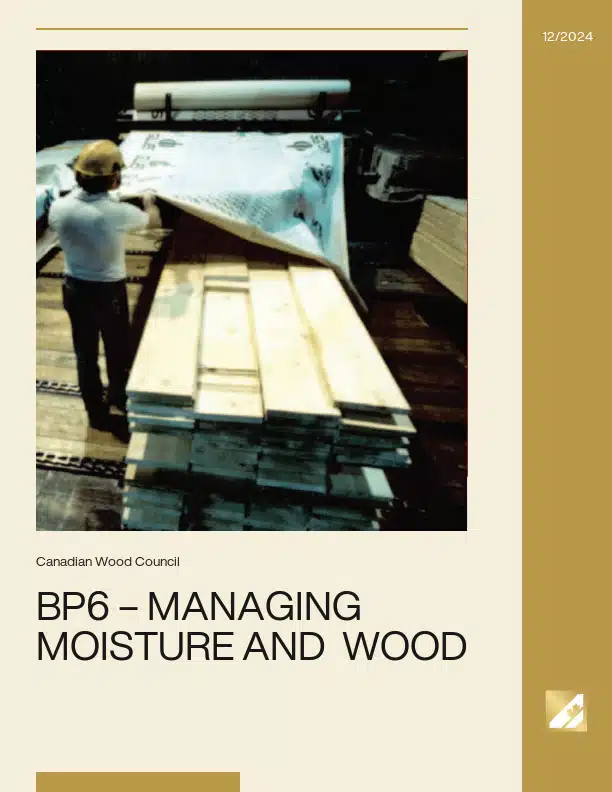
BP6 – MANAGING MOISTURE AND WOOD

Wood, a long-lasting, economical, and renewable resource, is the building material of choice in North American housing. This is largely due to the proven performance of properly designed and built wood frame buildings that have provided strong and lasting housing for a multitude of people. Although wood can withstand much abuse, it needs to be stored and handled properly to perform according to expectations. Managing moisture in structural wood products is essential in order to control swelling and shrinkage and prevent problems associated with mold or decay.

Fire Safety and Insurance In Commercial Buildings

Throughout history, protecting commercial structures from fire has been important. Fire poses risk in terms of safety to occupants, building integrity, business interruption and the economic health of a community. Consequently, reduction in the risk of fire for commercial buildings has been a significant goal for society, achieved through a better understanding of all the factors that contribute to fire risk. Designing and building structures in compliance with building and fire code requirements, and insurance industry guidelines, contributes to the reduction of fire losses. Wood has had a long history of use in commercial construction. Some of the reasons for this are: high strength-to-weight ratio, ease of use and constructability, known performance characteristics, resource abundance and renewability, economy in construction, and architectural aesthetics. Wood construction that makes use of good design and appropriate fire protection measures provides a level of fire safety that is comparable to other types of construction. This document discusses some of the basic factors that affect fire risk and property insurance rates, as well as some common misconceptions regarding what conditions make commercial buildings fire-safe.

Get Access to Our Resources

Stay in the loop and don’t miss a thing!

1
2
3

Get Access to Our Resources

Stay in the loop and don’t miss a thing!

What’s Your Occupation?

Help us personalize the content for you.

What Interests You the Most?

Help us personalize the content for you.

Filters

Expertise Icon
Field of Expertise
Province Icon
Province
Member Type Icon
WoodWork National Partners

Filters

Persona Icon
Persona
Tags Icon
Tags
Annual Reports Plus Icon
Award Book Plus Icon
Case Studies Plus Icon
Free Publications Plus Icon
Magazine Plus Icon
Building Systems Plus Icon
Codes & Standards Plus Icon
Industry News Plus Icon
Why Wood (FAQ) Plus Icon
Wood Products Plus Icon
Acoustics Plus Icon
Design Examples Plus Icon
Engineering Plus Icon
Fire Resistance Plus Icon
Insurance Plus Icon
Mass Timber Plus Icon
Date Icon
Date
Line Separator