Red Deer College Student Residence – Red Deer, Alberta
Red Deer College (RDC) Student Residence is a 5,800-sq.m. (60,000-sq.ft.), five-storey wooden structure with 145 units, designed and completed to meet the 300-bed demand for the Canada Winter Games in early 2019. RDC envisioned a building that would be a welcoming, fun home base for students; the college was well aware that isolation and lack of community support for students have a negative influence on their ability to perform in the classroom and can negatively impact their mental health and well-being. The goal was to create a “residence” that felt more like a home.
Manasc Isaac Architects, led by Vedran Škopac, proposed a hybrid between a student residence and a set of seven distinct “public gathering spaces,” scattered around the perimeter of all five storeys of the building. As part of the plan, Škopac’s team increased the conventional amount of social space by a factor of 10. The residence also functions as a hotel, providing accommodation for short- and longterm visits.
Another design mandate was to incorporate sustainable features, which influenced the decision to utilize a wood structure with a high performance building envelope that maximizes thermal performance and comfort. With a construction budget of $18.5 million, funding allowed for photovoltaic panels cladding the east, south and west faces, which provides approximately 45 percent of all energy the student residence requires. Although the building was not aiming for certification, it was designed to a LEED Gold standard.
As an example of an innovative approach to dormitory housing, Red Deer College Student Residence prioritizes quality of life and sustainability, while using mass timber construction to achieve both goals. These are some of the reasons it won a 2019 Wood Design & Building Canadian Wood Council Award.
This case study examines two wood buildings, both with primary retail commercial occupancies, but which employ different mass timber products to achieve very different effects. Askew’s Uptown Supermarket in Salmon Arm, BC, features an expansive nail-laminated timber (NLT) roof that appears to float above the retail floor (Figure 1.1), while the Whistler Community Services Society Building in Whistler, BC, uses a robust, utilitarian exposed glued-laminated timber (glulam) and cross-laminated timber (CLT) structure as befits the building’s industrial setting (Figure 1.2).
In April 2019 John Horgan, Premier of British Columbia, announced a new directive to require municipalities and the BC government to strongly consider the use of wood in public buildings, both as a structural material and for interior finishes. The goal of this initiative is to increase demand for BC’s wood products and to assist the forest industry in dealing with the significant impacts of climate change. To date, these have included the mountain pine beetle infestation and an increase in the frequency and severity of forest fires, both of which have had widespread negative consequences for the industry across the province.
When announcing the initiative, Premier Horgan stated: “We will expect the result to maximize the potential of the existing timber supply, maintain jobs, incorporate First Nations’ interests, and address the economic, cultural, recreational and other uses of BC’s land base.” New engineered mass timber products, supported by new legislation, now make it possible for wood to be used in a wide range of projects, both urban and rural.
This case study showcases two recent projects that illustrate the value and versatility of wood, both in its response to technical challenges and in its contribution to economic and social sustainability in communities around the province.
In Vancouver, Fire Hall No. 5 (Figure 1.1) is an example of an innovative response to rising land costs and the shortage of affordable social housing; while in the Kootenay village of Radium Hot Springs, a wealth of local wood products, manufacturing capabilities and craft skills combine in a community hall and library that can truly be called a ‘100-mile building’ (Figure 1.2).
Ontario’s first mass timber commercial building in over 100 years, 80 Atlantic pioneers a new urban office typology for potentially many more timber-frame projects across the province, and the country. Comprising four storeys of mass timber above a one-storey concrete podium, the 8,825-sq.m. (95,000-sq.ft.) building completes a courtyard with 60 Atlantic to create a paired commercial development. Revisions to the Ontario Building Code in 2015 made it possible to build commercial wood buildings up to six storeys high. The developer and architect saw this as an opportunity to demonstrate leadership in the rapidly developing field of mass timber, and to attract tenants seeking a premium workplace environment associated with innovation and sustainability. The client requested that the building harmonize with the Liberty Village neighbourhood, noted for its wealth of converted factories and warehouses, which attract high-calibre, creative tenants in this section of downtown Toronto.
In 2009, the British Columbia Building Code (BCBC) was amended to permit residential buildings of up to six storeys to be constructed in wood. Since then, through a five-year code process of consultation and research, the potential for expanding these provisions to other building occupancies has been under consideration at the national code level. Changes introduced in the 2015 edition of the National Building Code of Canada (NBC) and adopted in British Columbia in 2018, have expanded these provisions to office-type buildings, but also permit mixed-type occupancies on the first two storeys. As a result, wood building types now include office, residential, mercantile, assembly, low hazard or storage/ garage uses.
This case study examines two wood buildings, both with primary retail commercial occupancies, but which employ different mass timber products to achieve very different effects. Askew’s Uptown Supermarket in Salmon Arm, BC, features an expansive nail-laminated timber (NLT) roof that appears to float above the retail floor (Figure 1.1), while the Whistler Community Services Society Building in Whistler, BC, uses a robust, utilitarian exposed glued-laminated timber (glulam) and cross-laminated timber (CLT) structure as befits the building’s industrial setting (Figure 1.2).
Canada’s Blueprint for Mass Timber Success Unveiled at Parliament Hill
June 13, 2024 (Ottawa)– Earlier today, The Transition Accelerator unveiled The Mass Timber Roadmap at the Press Conference Room in the West Block on Parliament Hill. The comprehensive report outlines an ambitious and strategic vision for the future of mass timber in Canada and its potential to transform green construction and drive economic growth across the country.
Developed in partnership with Canadian Wood Council (CWC), Forest Products Association of Canada (FPAC), and Energy Futures Lab (EFL), The Mass Timber Roadmap comes after more than a decade of collaborative efforts to unlock and demonstrate potential of mass timber and lays out a visionary plan to increase the mass timber market – both domestic and exports – to $1.2 billion by 2030 and to $2.4 billion by 2035.
This ambitious growth aligns with increasing market demand in North America and around the world. By leveraging the power of mass timber solutions, Canada has a unique opportunity to enable the construction of residential and commercial structures at greater speeds, with lower costs, and with a lighter carbon footprint; all while capturing a share of the rapidly growing global market.
Achieving targets laid out in The Mass Timber Roadmap requires coordinated efforts across three critical action areas and the report provides actionable next steps, including:
Public-Private Collaboration: The Mass Timber Roadmap calls for a partnership between public and private sectors to develop and advance a comprehensive policy package that will enhance the value of Canada’s forest resources while building domestic capacity along the supply chain.
Standardization: There is a need to standardize building archetypes, wood specifications, and connectors throughout the supply chain to streamline processes and reduce costs.
Skills Development: Implementing a robust skills development plan that encompasses all aspects of the supply chain is essential to support the sector’s growth.
Today’s event on Parliament Hill featured the following speakers who highlighted the roadmap’s goals and the promising future for mass timber in Canada, followed by an engaging Q&A session with journalists:
Derek Eaton, Director of Future Economy, The Transition Accelerator
Derek Nighbor, President and CEO, Forest Products Association of Canada (FPAC)
Kate Lindsay, Senior Vice President and Chief Sustainability Officer, Forest Products Association of Canada (FPAC)
Rick Jeffery, President and CEO, Canadian Wood Council (CWC)
“The mass timber sector provides a perfect example of how Canada can add value to its primary resources through innovative technologies and advanced skills. If we act strategically and quickly, we have the opportunity to build an industry that reduces emissions, addresses urgent needs, and positions Canada to win in emerging global value chains.” – Derek Eaton, The Transition Accelerator
“To build a world-class mass timber sector, Canada must adopt a strategic approach to ensure we can compete and win globally. This is about smart policy here at home and bringing more Canadian wood to our cities and to the world. By enabling faster, cost-effective, and environmentally-friendly construction with mass timber we can grow jobs, help address the affordable housing crunch, and reduce emissions.” – Kate Lindsay, Forest Products Association of Canada (FPAC)
“The potential for Canadian wood products to reduce the carbon footprint of the built environment and drive the growth of a sustainable and prosperous wood industry is immense; however, global competition to capitalize on the significant economic opportunities mass timber presents in the transition to a lower-carbon world will require us to act swiftly to stay competitive and meet rapidly emerging domestic demand.” – Rick Jeffery, Canadian Wood Council (CWC)
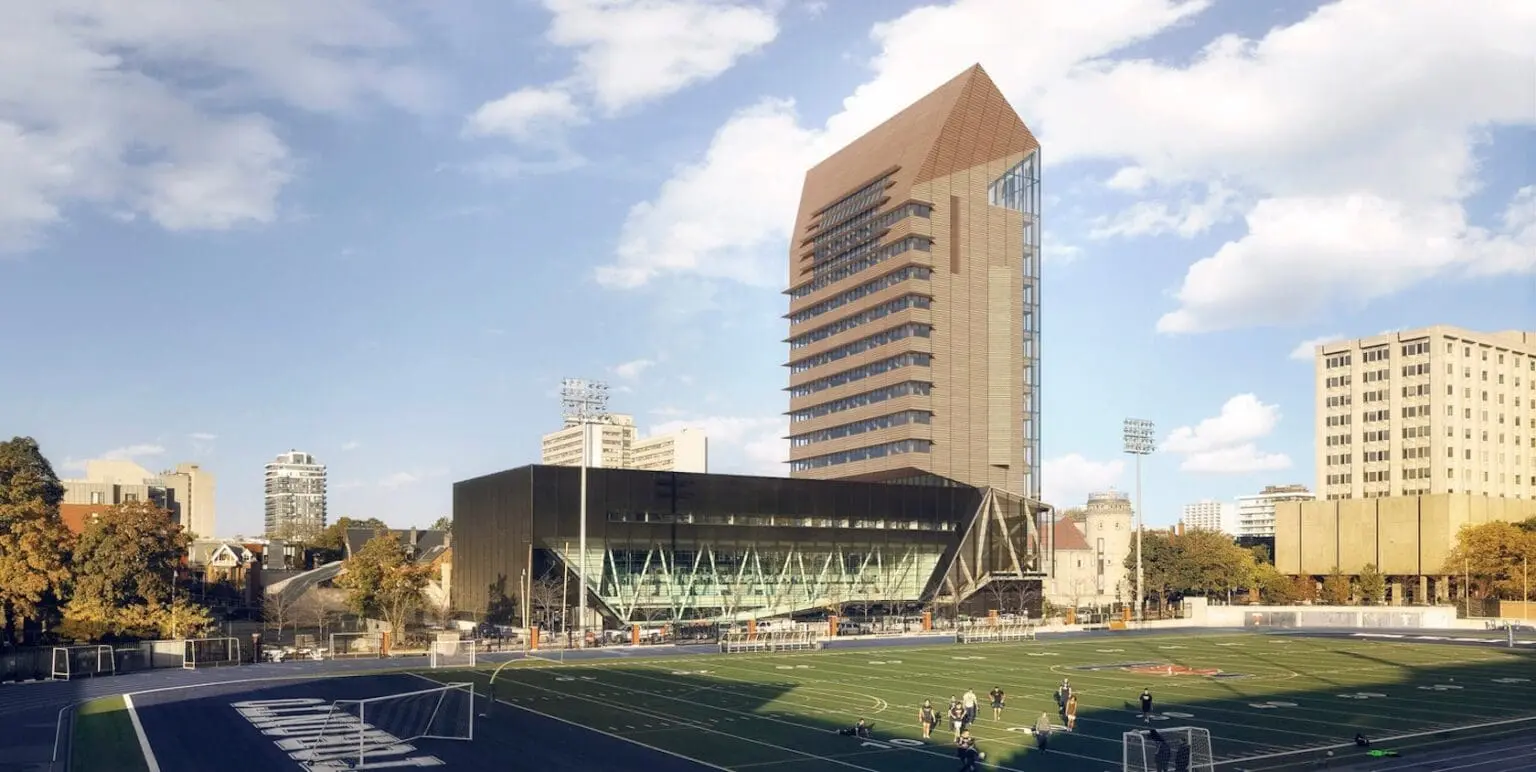
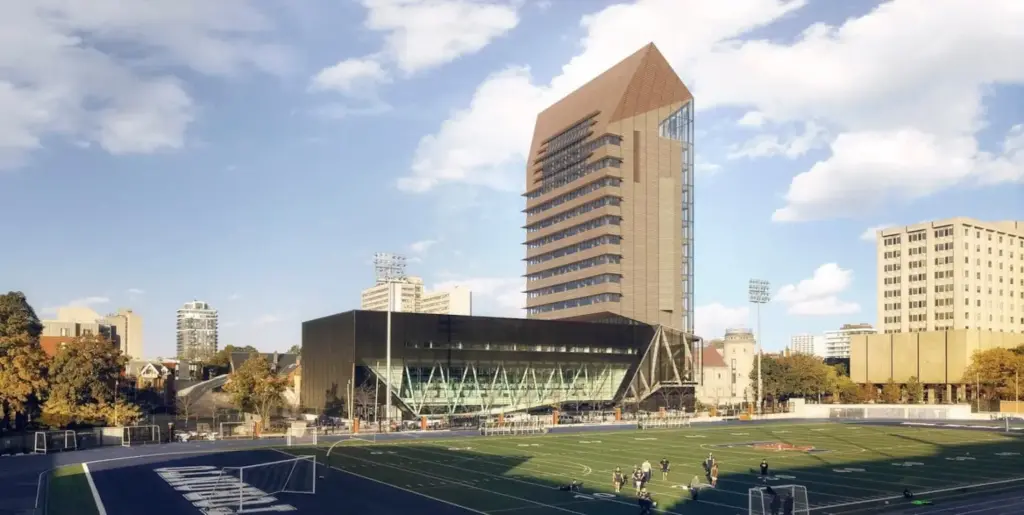
The Goldring Centre – University of Toronto Academic Tower
Province: Ontario City: Toronto Project Category: Institutional Major Classification: D – Offices Height: 14 Storeys Building Area: 176,549 ft2
Description:
The University of Toronto’s new academic tower is a14 storey mass timber building, currently under construction, built with GLT components. Realizing an innovative building of this size and complexity that goes beyond prescriptive height limit of the Ontario Building Code required extensive support and a capable, timber experienced project team. Technical project interactions with WoodWorks staff date back to 2016 and we have tracked 21 direct interactions related to this project. A deeper look at our project data reveals that the project team had an additional 23 indirect interactions with the WoodWorks team (attending events, requesting technical documents, etc.). The project team has 28 projects in their combined experience portfolio, indicating an experienced, supported design team was able to push forward an alternative solutions success storey and one of North America’s tallest wood buildings.
While alternative solutions have been an important feature of the National Building Code of Canada since 2005, there remains a lack of understanding among building professionals on how to approach their use. As the construction industry evolves, with increasing innovation in design and construction capabilities, new ways of building that may not be well addressed by building codes will emerge. At the same time, tools for performance testing and simulation are becoming more widespread. In light of the diverse and evolving building industry, alternative solutions that enable new ways of building are likely to become more commonplace. A critical area where alternative solutions may be employed is in the use of mass timber construction. The introduction of mass timber construction techniques, enabled by a range of engineered wood products, associated connection technologies, and fabrication methods, has resulted in a wide range of possible building solutions that may not have been considered by building codes.
Large-Scale Fire Tests of A Mass Timber Building Structure
The Mass Timber Demonstration Fire Test Program (MTDFTP) included two series of experiments: the pilot scale demonstration tests in summer 2021 in Richmond, BC [1] and the large scale fire tests in summer 2022 in Ottawa, ON. The series of large scale fire tests on a mass timber structure were conducted to study fire safety during construction, fire dynamics and performance in an open plan office space and residential suites, and influence of exposed mass timber on fire severity and duration.
As part of its research to inform the advancement of safe and innovative solutions across Canada’s construction industry, the National Research Council of Canada (NRC) conducted the technical work and science-based large scale fire tests to support the MTDFTP. NRC was responsible for instrumenting the test structure, setting up fire scenarios and fuel loads, conducting the large scale fire tests, analyzing test data and documenting the results.
This report documents the fire scenarios, fuel loads, experimental setups, instrumentation, measurements and procedure used in the large scale fire tests. The experimental data, results of data analysis, key findings and conclusions are provided in the report.
Canadian Nuclear Laboratories: Case Study and Environmental Impact Analysis
This report showcases how Canadian Nuclear Laboratories (CNL) delivered three landmark mass timber buildings at its Chalk River campus while meeting the federal government’s net-zero commitments. It highlights how an Integrated Project Delivery (IPD) approach enabled collaboration across architects, engineers, and builders to achieve cost-neutral, low-carbon construction.
Readers will learn how the project team reduced embodied and operational carbon well beyond federal targets, demonstrated the fire safety and durability of mass timber, and created high-performance workplaces that enhance occupant well-being. With lessons on procurement, codes, and whole-building life cycle assessment, the case study offers a practical roadmap for governments, designers, and developers aiming to accelerate Canada’s transition to sustainable, net-zero infrastructure.
Promoting Health and Wellness with Wood Architecture
The year 2020 will forever be synonymous with COVID-19. After experiencing the pandemic and its ripple effects, few would question the importance of health and wellness. What people may not consider is the impact that our surrounding environments have on our health. Research shows that incorporating wood and other natural elements into buildings can have a positive effect on occupants’ overall health and well-being. The term for this effect is called biophilia, which refers to humanity’s innate need to connect with nature.
Many industries are embracing biophilic design and its benefits. Employers are eager to create inviting spaces for their teams, hospital designs have shifted from cold and industrial-like to bright environments with wayfinding elements, and homeowners are expanding their living spaces with decks, fences, and pergolas so they can gather with friends and family outdoors. The wellness impacts of wood extend beyond the biophilic advantages of finished spaces. Mass timber buildings also benefit workers throughout the construction process by reducing construction time, and prefabricated elements contribute to cleaner, safer building sites.
The team at the Canadian Wood Council/Wood WORKS! is committed to providing design and construction professionals with the tools and information needed to build with wood. We’re going taller, we’re getting bigger, and, from coast to coast, we’re not stopping. Building with wood is the right choice, for the environment and for everyone’s well-being.
Advancing Mass Timber Systems in Vancouver Schools
This case study examines the design and construction of two elementary schools in Vancouver, British Columbia in which mass timber was chosen as the primary construction system for the first time. W k ’wan’ s t syaqw m Elementary School (formerly Sir Matthew Begbie Elementary School) and Bayview Elementary School, located on the east and west sides of the city respectfully, were part of a pilot project by the Vancouver School Board (VSB) aimed to assess the potential for expanding the use of mass timber in future school projects (Figures 1.1 and 1.2). To this end, the documentation of: the opportunities presented, the challenges faced and the lessons learned, is a vital step in the evaluation process.
Across Canada, the low-rise non-residential sector—think offices, retail stores, warehouses, and restaurants—presents a major growth opportunity for structural wood systems, including light wood-frame, heavy timber, mass timber, and hybrid construction.
Together, retail, office, and light industrial warehouse buildings account for nearly 75% of new floor space in this market each year. Yet despite their scale, these segments continue to show low uptake of structural wood.
As retailers adapt to the shift toward online shopping and businesses compete to attract talent, the design and performance of their buildings matter more than ever. Wood offers a sustainable, visually appealing solution that enhances employee well-being and elevates commercial spaces.
This new technical publication explores the market potential, challenges, and the role wood can play in redefining this sector.
Red Deer College (RDC) Student Residence is a 5,800-sq.m. (60,000-sq.ft.), five-storey wooden structure with 145 units, designed and completed to meet the 300-bed demand for...
This case study examines two wood buildings, both with primary retail commercial occupancies, but which employ different mass timber products to achieve very different...
Ontario’s first mass timber commercial building in over 100 years, 80 Atlantic pioneers a new urban office typology for potentially many more timber-frame projects across...
In 2009, the British Columbia Building Code (BCBC) was amended to permit residential buildings of up to six storeys to be constructed in wood. Since then, through a five-year...
June 13, 2024 (Ottawa)– Earlier today, The Transition Accelerator unveiled The Mass Timber Roadmap at the Press Conference Room in the West Block on Parliament Hill. The...
While alternative solutions have been an important feature of the National Building Code of Canada since 2005, there remains a lack of understanding among building...
The Mass Timber Demonstration Fire Test Program (MTDFTP) included two series of experiments: the pilot scale demonstration tests in summer 2021 in Richmond, BC [1] and the...
Canadian Nuclear Laboratories: Case Study and Environmental Impact Analysis This report showcases how Canadian Nuclear Laboratories (CNL) delivered three landmark mass timber...
The year 2020 will forever be synonymous with COVID-19. After experiencing the pandemic and its ripple effects, few would question the importance of health and wellness. What...
This case study examines the design and construction of two elementary schools in Vancouver, British Columbia in which mass timber was chosen as the primary construction...
Across Canada, the low-rise non-residential sector—think offices, retail stores, warehouses, and restaurants—presents a major growth opportunity for structural wood...