

Local Government support for Modern Methods of Construction
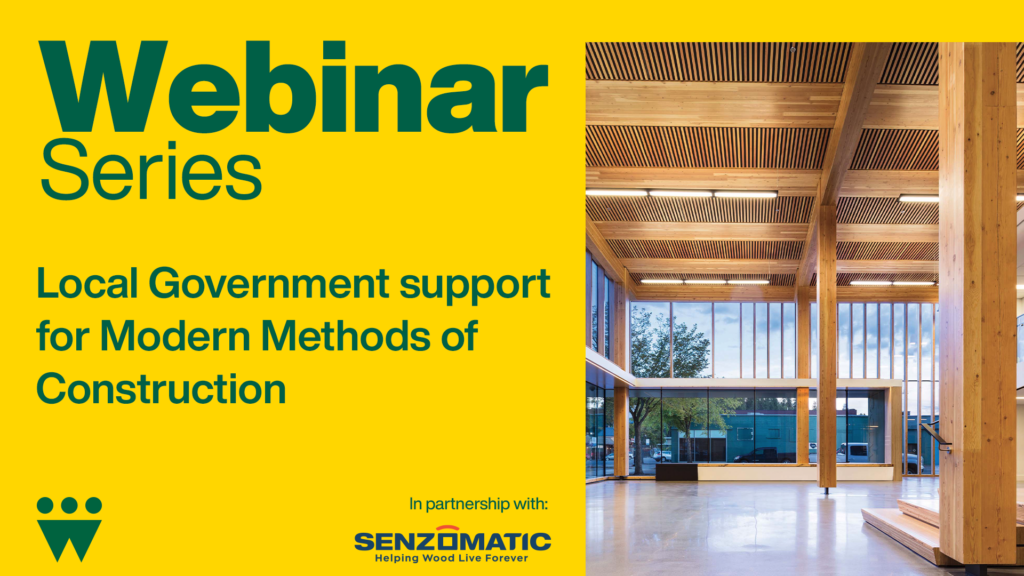
Course Overview Learn how leading cities across BC are supporting the adoption of modern methods of construction. This session will explore what policies and incentives cities have adopted to support mass timber in the planning and development approval process, how building departments are revising their permitting processes to support offsite and prefab construction, and how recent Official Community Plan (OCP) amendments have included more land use categories to support mass timber in mid and high rise applications. It will also examine how mass timber helps meet other City objectives, from low carbon emission goals for new construction to rapid housing targets, and highlight new and exciting projects in each of these cities that are in planning, under construction, or recently completed using mass timber. Learning Objectives Identify municipal policies, incentives, and planning tools that support the adoption of mass timber construction. Understand how permitting and development approval processes are evolving to accommodate offsite, prefabricated, and mass timber construction methods. Learn how Official Community Plans and land-use policies can create opportunities for mass timber in mid- and high-rise development. Assess how mass timber construction can help municipalities achieve broader objectives related to housing delivery, sustainability, and emissions reduction. Course Video Speakers Bio Annabelle Hamilton Executive Director WoodWorks BC | Canadian Wood Council Annabelle oversees WoodWorks BC, the market development program of the Canadian Wood Council. After completing her postgraduate degree in Northern Ireland, she worked with several multi-family development companies, managing multi-million-dollar projects across the full lifecycle – from acquisitions and municipal approvals through to construction completion. She now leads the WoodWorks BC team in advancing innovative solutions that support the adoption of wood products in multi-family and non-residential projects across British Columbia. Scott Groves Director Corporate Projects Township of Langley Scott Groves is the Director of Corporate Projects for the Township of Langley, where he leads the planning, design, and delivery of major community buildings and parks projects. An experienced civil engineer, he has spent his career in local government advancing complex capital initiatives, including arenas, community centres, fire halls, civic facilities, and large park and sports infrastructure that serve residents across the region. Before joining the Township of Langley, Scott held senior roles with several Metro Vancouver municipalities, directing capital projects, facilities, and strategic civic lands initiatives, and contributing to Olympic‑related infrastructure and major transportation projects. He holds a Bachelor of Applied Science in Civil Engineering from the University of British Columbia and is known for his collaborative approach to community building and his commitment to delivering high‑quality public spaces. Stacy McGhee Manager, Strategic Facilities Planning District of Saanich Stacy McGhee is a registered architect in the province of British Columbia. His work experience spans a wide range of building types, project sizes and procurements. Stacy’s work in both public and private sectors has given him a unique perspective of consultant and owner viewpoints enabling him to manage projects with a clearer mandate and sound contractual understanding. Stacy’s private sector work includes luxury hotels, commercial offices, historic renovation and healthcare. Since 2009, Stacy’s public sector work includes six years with the Province of BC working with BC Corrections to modernize facilities and to undertake large, multi-year P3 projects building $200M+ facilities in Surrey and the Okanagan near Oliver. Since joining the District of Saanich in 2015, Stacy has led the District’s Strategic Facilities Planning program which first produced the District’s first Strategic Facilities Master Plan followed by the recommended and prioritized implementations of a replacement for Fire Station #2 and the redevelopment of the Saanich Operations Centre. Stacy is a Fellow of the Royal Architectural Institute of Canada and a LEED registered professional.
Cornerstone Timberframes and BuildingIN: Innovation in Wood Construction and Housing Development

Course Overview This session explores two distinct but complementary perspectives on advancing the built environment in Canada. Tanya Bachmeier, CEO of Cornerstone Timberframes, shares the evolution of her company from a traditional residential timber framing business to a multifaceted manufacturer delivering both custom timber frame structures and commercial mass timber projects. Drawing on decades of industry experience, she discusses the challenges, opportunities, and lessons learned while adapting to changing markets and emerging wood construction technologies. The session also features Rosaline Hill, Principal Architect and Senior Planner at RHJ Architecture + Planning, who introduces BuildingIN, an initiative developed to address Canada’s housing supply challenges. Drawing on extensive experience in infill housing design and planning, Rosaline examines the barriers that limit housing development in existing communities and presents strategies to support sustainable, community-supported growth. Together, these presentations highlight the importance of innovation, collaboration, and practical solutions in shaping the future of wood construction and housing development across Canada. Learning Objectives Identify key business, workforce, and industry factors that support growth and innovation in the wood construction sector. Explain the benefits of heavy timber and mass timber construction and the importance of industry collaboration and knowledge sharing. Recognize common barriers to housing supply in Canadian communities and the role of infill development in addressing housing needs. Evaluate how planning, design, and housing policy tools can support sustainable, community-supported urban growth. Course Video Speakers Bio Tanya Bachmeier CEO Cornerstone Timberframes Tanya Bachmeier, CEO of Cornerstone Timberframes, will share her insights on the evolution of the timber industry, drawing from over three decades of experience with one of Canada’s leading heavy timber structure manufacturers. Growing up in a family deeply rooted in construction, Tanya has been immersed in the craft from a young age. Her journey from working alongside her father and uncle in the business to leading Cornerstone Timberframes as its CEO is a testament to her dedication, vision, and passion for the industry. In her speech, Tanya will explore how she and her partner have transformed Cornerstone into a multifaceted manufacturer, with a dual focus on traditional residential timber frames and cutting-edge commercial mass timber projects. She will discuss the challenges and opportunities of being a woman in a male dominated industry, finding a place in the emerging world of mass timber and emphasizing the importance of innovation while staying true to the craft’s roots. Through her unique perspective, Tanya will offer valuable lessons on leadership, adaptability, and the future of timber construction in Canada and beyond. Rosaline Hill Principal Architect, Senior Planner, Development Consultant RJH Architecture & BuildingIN Most people prefer to live in low-rise areas, on tree-lined streets, close to transit, in communities that are well serviced and walkable. Few municipal housing strategies target this vision or focus on existing low-rise neighbourhoods. But this housing niche holds the potential to transform our cities and pull us out of housing crisis. Low-rise multi-unit repeatable infill housing in existing urban neighbourhoods is the key to housing supply and municipal fiscal sustainability. At the same time, it is the most affordable way to dramatically reduce household emissions. Housing, fiscal and environmental sustainability, with new homes in the kinds of neighbourhoods people love – it is a win for all. So why aren’t developers building this? They are not allowed, or can’t make a profit doing it. But municipalities can change that! The BuildingIN team has leveraged housing industry knowledge to understand the financial and regulatory barriers to this housing solution. Using GIS, we map our advanced housing market response forecasting to show cumulative outcomes for housing, fiscal and emissions reductions across low-rise urban areas. With this powerful simulation tool, we have reverse engineered a solution for municipalities. As a winner of the CMHC Housing Supply Challenge, BuildingIN is able to provide municipalities with a full suite of services; to quickly implement regulatory changes and establish necessary investment strategies, so that developers will build the housing we need and want, over and over and over again. We enable municipalities to plan with certainty and make evidence based decisions, instead of the age-old ‘make some adjustments’ then ‘wait and see’ approach. Our team has been researching, testing, and simulating solutions for neighborhoods for the past 6 years. This has led us to the creation of BuildingIN – a transformational solution to our country’s housing supply challenge.
Bringing Mass Timber Mainstream: Unpacking Market Challenges and Opportunities

Course Overview The positive influences of design innovation, advanced materials, new building codes, and the evolving priorities of society are driving change in the construction sector that is expanding the use of advanced wood construction. Change, however, often presents new challenges, and the more widespread adoption of new technologies can be impeded by knowledge gaps and market forces. This expert panel will examine several important factors that can impact the decision to build with wood including insurance, financing and supply chain considerations, and identify both the challenges and opportunities they present. Learning Objectives Identify key market barriers to the adoption of mass timber construction, including insurance, financing, supply chain limitations, and knowledge gaps. Understand how project feasibility for mass timber is influenced by revenue uncertainty, cost premiums, and risk tolerance in development decisions. Learn strategies to de-risk mass timber projects through early collaboration, improved data sharing, supply chain planning, and policy incentives. Course Video Speakers Bio David Messer Director Climate Smart Buildings Alliance (EllisDon) David Messer is the Director of the Climate Smart Buildings Alliance, a joint initiative of EllisDon, RBC, Mattamy Homes and Atkins Réalis aimed at leading and accelerating the transition to a net zero buildings sector. Through CSBA David is leading projects aimed at increasing and removing barriers for the use of lower carbon building materials, as well as projects to increase building standards and the pace of building retrofits. David was previously the Executive Director of the Guelph-Wellington Smart Cities Office where he led two initiatives aimed at accelerating the circular economy, Our Food Future, an Infrastructure Canada funded smart cities project, and COIL (Circular Opportunity Innovation Launchpad), a circular business accelerator that worked with over 160 organizations to scale circular solutions in the food, environment and construction/demolition sectors. David has a long history of working on technology, policy and systems change as part of the Governments of Ontario and Alberta, within industry associations and as a consultant in the private sector. Scott Cameron President Skov Mass Timber Scott has over 30 years of experience in construction. Starting as a laborer and working his way through to General Superintendent, Project Director and an independent Consultant on Mass Timber Construction. As an accomplished public speaker, leader, and mentor, he has led many high performing teams and prides himself on being a collaborative problem solver. With decades of experience in ICI and residential construction, Scott has shifted his focus to multifamily Mass Timber construction to confront the housing crisis. Having been involved in many institutional and commercial Mass Timber projects, multiple 6 storey Multi Family projects, and the only two completed Encapsulated Mass Timber buildings in Canada after the 2018 code changes, Scott is one of the leading experts in North America on Mass Timber. As an outspoken advocate for Mass Timber, Scott promotes education and information sharing within the Mass Timber community. Having worked in B.C. and Ontario, Scott provides interactive presentations on Mass Timber construction to Developers and GC at project inception. The goal is not only to help navigate the unknowns when deciding between Mass Timber and conventional construction, but also to support the construction process to save time and cost. This led to SKOV Mass Timber Ltd, a consulting firm focused on Mass Timber to support Developers and GCs through the preconstruction process to project completion. With his experience, the aim is to bridge the skill gaps with education, information, and support for constructability reviews, schedule development, trade sequencing and support through the construction process. He is currently working with a Construction Management firm in BC on a portfolio of Mass Timber projects and supports other developers and GCs nationwide through preconstruction. Kevin Grosskopf Professor, University of Nebraska–Lincoln, Durham School of Architecture, Engineering & Construction University of Nebraska Dr. Kevin R. Grosskopf is a Professor at the Charles W. Durham School of Architectural Engineering and Construction at the University of Nebraska. Dr. Grosskopf received his Ph.D. from the M.E. Rinker, Sr. School of Building Construction at the University of Florida in 1998. He has served in various capacities in the commercial and utility industry and is a licensed Building Contractor in the State of Florida. Dr. Grosskopf has developed research expertise in building safety and sustainability including IAQ, energy efficiency, and, post-disaster response and recovery. More recently, Dr. Grosskopf transitioned to related areas in building prefabrication and construction workforce development. Dr. Grosskopf has received $8.1M in grants and endowments, including highly competitive contract awards from the Department of Energy (DOE), the Department of Defense (DoD), the Environmental Protection Agency (EPA), the Occupational Safety and Health Administration (OSHA), and, the Department of Labor (DOL). In addition, Dr. Grosskopf has written (or contributed to) 4 books, 35 research reports and more than 100 peer-reviewed journal and conference papers, including top tier journals of the ASCE, ASTM and ASHRAE. Dr. Grosskopf has also given more than 100 invited presentations including guest lectures and presentations in more than 20 countries. Dr. Grosskopf formerly served as the Associate School Director for ACCE-accredited construction management and ABET-accredited construction engineering programs on both Lincoln and Omaha campuses. Dr. Grosskopf has also served as P&T chair for construction programs. Dr. Grosskopf has served on the ASC National Board and has coordinated two ASC Annual International Conferences (2009 and 2011). Annabelle Hamilton Executive Director WoodWorks BC Annabelle is the Executive Director of WoodWorks BC Team, overseeing active engagement, technical support and strategic development of initiatives that support the growth and awareness of Mass Timber in the BC market. Prior to joining WoodWorks, Annabelle built her career in the private sector, working for several Vancouver based multi-family Developers successfully leading projects from concept to completion.
Green Construction through Wood: Accelerating Mass Timber Adoption in Canada

Course Overview Advancing mass timber construction is critical to achieving Canada’s climate, housing, and economic goals. This course explores how innovative wood-based building systems – supported by programs such as Construction through Wood (GCWood) – are transforming the construction sector by enabling low-carbon, high-performance buildings. Drawing on insights from federal initiatives, industry leaders, and regional experts across Canada, the session examines the technical, regulatory, and market barriers to adoption, including fire performance, seismic design, supply chain capacity, and workforce readiness. It also highlights emerging opportunities in prefabrication, modular construction, and hybrid systems, while showcasing policy tools, demonstration projects, and the national Mass Timber Roadmap that are accelerating uptake. Designed for architects, engineers, contractors, and policy professionals, this course provides a comprehensive overview of the strategies and collaborative efforts required to scale mass timber construction across diverse Canadian markets. Learning Objectives Understand the role of mass timber in achieving net-zero emissions, addressing housing demand, and supporting the forest economy. Identify key barriers to mass timber adoption, including technical performance, regulatory challenges, supply chain limitations, and market awareness. Evaluate how programs such as GCWood and demonstration projects support innovation, de-risk technologies, and advance building codes. Course Video Speakers Bio Jean-Francois Levasseur Director, Industry Relations & Innovation Programs / Directeur, Relations avec l’industrie et programmes d’innovation Natural Resources Canada Graduating from the University of Ottawa’s Chemical Engineering program, Jean-Francois started his career in a variety of increasing roles in Kraft pulp mills, including mill process and environmental engineer positions. He then joined Environment and Climate Change Canada where he led on numerous aspects of environmental regulatory regimes applicable to Canada’s forest sector. At Natural Resources Canada since 2009, he has led in the design and implementation of various funding programs supporting strategic R&D, innovation and capital investments that accelerate the transformation of the Canadian forest sector towards the Bioeconomy: the Pulp & Paper Green Transformation (PPGTP); the Forest Innovation Program (FIP); the Investments in Forest Industry Transformation program (IFIT), and; the Green Construction through Wood program (GCWood). Together, these programs provided more than $1B to support energy efficiency improvements, green energy production, and the commercialization of innovative products, transformative technologies and new wood based green building and mass timber demonstrations. Scott Jackson Director, Conservation Biology Forest Products Association of Canada As the Director of Conservation Biology, Scott works with member companies, governments and partners to develop and communicate policy positions on a range of files related to forest management, biodiversity conservation, including fish, wildlife and at-risk species, and climate change mitigation and adaption. He also supports FPAC’s efforts to promote the forest sector’s commitment to science-based sustainable forest management, as well as its contributions to Canada’s social and economic standing. Scott has been working for over 20 years in the field of forest management and natural resource policy. Most recently, he has worked as an independent consultant and as the Director of Indigenous and Stakeholder Relations with Forests Ontario, a not-for-profit organization committed to forest restoration, stewardship, education and awareness. Scott has an undergraduate degree in Environmental Science (Biology) from Queen’s University and a Master of Forest Conservation degree from the University of Toronto. Steven Street Executive Director WoodWorks Ontario In his current role as Executive Director of WoodWorks Ontario, Steven leads a dynamic team, bringing value and new opportunities to the program’s partners in the wood industry. With many high-profile projects moving wood construction into the mainstream, knowledge transfer and market acceptance have never been more important to the wood industry. The construction sector has entered a new era of rapid industrialization, shifting from site-built to factory-built methodologies. Building code advances in the last few years are catalyzing the types of materials, approaches and buildings available for development. In this age of great change we can influence how we build, with new sustainability targets and an obligation to reduce the carbon footprint of the built environment. Shawn Keyes Executive Director WoodWorks BC Shawn is an accomplished structural engineer and the Executive Director of WoodWorks BC. With a rich background in engineering, project management, and business administration, Shawn offers dynamic leadership, overseeing a multi-disciplinary team of experts advancing wood construction across the province. He joined WoodWorks in 2022 after a decade-long, distinguished career in consulting where he worked on pioneering timber projects across Canada at a leading design firm. Shawn is a licensed professional engineer in BC and ON. He holds masters degrees in both engineering and business, with a M.Eng. from Carleton University and an MBA from UBC’s Sauder School of Business. Rory Koska Executive Director WoodWorks Alberta Rory Koska has over 30 years of experience in the design and building industry in Alberta. He is a graduate of the Architectural Technologies at NAIT. Rory worked with Igloo Building Supplies Group Ltd as a senior truss designer on residential and commercial buildings and later ran his own consulting firm. Rory has led the WoodWorks Alberta program for over 15 years and has brought the program through many milestones. The Alberta regional program has evolved into a conduit between industry innovation and the design community. Under Rory’s direction the WoodWorks Alberta program has established itself an invaluable resource for communities and the construction industry interested in building with wood. David Porter Program Coordinator WoodWorks Atlantic In 2019, David joined the Maritime Lumber Bureau as the Program Coordinator for the WoodWorks Atlantic program. He works with architects, engineers, developers, building/fire officials and government, to increase the use of wood in non-residential projects. He has been involved in the design and construction of many wood projects built in Atlantic Canada, providing technical support for both light wood frame and mass timber. Simon Bellavance Technical Advisor Cecobois Simon T. Bellavance holds a bachelor’s degree in wood engineering from Laval University, specializing in wood structures. Before becoming a technical advisor at Cecobois, he served as the technical lead for value-added wood products at Chantiers Chibougamau. In addition to his responsibilities in quality control and continuous improvement, he participated in several research and development projects for the
Online Tools for Wood Construction – CodeCHEK, FRR & STC & EMTC Calculator

Course Overview This presentation highlights the Canadian Wood Council’s suite of free, web-based fire design tools, CodeCHEK, FRR & STC Tool, and Exposed Mass Timber Calculator. CodeCHEK enables project teams to evaluate code-compliant opportunities for wood construction by assessing key building characteristics, such as height, area, sprinkler presence and more, highlighting potential pathways for alternative solutions, and clarifying where wood elements may be permitted in buildings otherwise required to be of noncombustible construction. The FRR & STC (fire-resistance rating & sound transmission class) Tool helps designers in the determination of generic fire-resistance rating designs of lightweight wood-frame wall, floor, and roof assemblies using the Component Additive Method described in Appendix D of the NBC, which is referenced as an acceptable solution in Section 3.1 of the NBC and can be used for Part 3 and 9 buildings. In addition, the tool provides the sound transmission class (STC) value that is associated with each wall or floor assembly for which STC information is available. The Exposed Mass Timber Calculator helps users assess whether mass timber compartment exposure/encapsulation designs align with the 2025 National Building Code of Canada provisions by evaluating compartment inputs against applicable criteria and generating warnings when configurations are not code-consistent, positioning it as a practical screening and learning aid that complements (but does not replace) detailed code analysis and professional judgment. Learning Objectives Evaluate code-compliant opportunities for wood construction using the CodeCHEK tool by analyzing key building parameters (e.g., height, area, and sprinklering) and identifying potential pathways for alternative solutions. Apply the FRR & STC Tool to design compliant assemblies by determining fire-resistance ratings and sound transmission performance of lightweight wood-frame wall, floor, and roof systems using the Component Additive Method. Assess mass timber exposure and encapsulation strategies using the Exposed Mass Timber Calculator to verify alignment with 2025 National Building Code of Canada provisions and support early-stage design decision-making. Course Video Speakers Bio Noah Fetterly Technical Specialist, Codes and Standards-Fire Canadian Wood Council Noah Fetterly is a Technical Specialist, Codes and Standards – Fire at the Canadian Wood Council (CWC), where he contributes technical expertise to national code development, fire safety research, and guidance for wood and mass timber construction. He holds a background in Fire Protection Engineering Technology, having graduated from Seneca College, and began his career working with fire alarm systems inspections and testing. At CWC, Noah supports technical communications, research initiatives, and industry tools related to fire performance and encapsulated mass timber construction, helping ensure alignment with the National Building Code of Canada and related standards. He is an active contributor to technical discussions involving fire safety, mass timber design, and regulatory compliance.
Offsite Manufacturing: Driving Efficiency, Quality, and Sustainable Construction

Course Overview Offsite construction is transforming the building industry by shifting key processes from traditional sites to controlled factory environments. This approach enhances productivity, quality, and sustainability, addressing challenges like labor shortages and environmental impact. The delivery process emphasizes early collaboration, integrated design, and robust project management to optimize efficiency and risk management. Durability and energy efficiency are achieved through advanced material selection, moisture management, and airtight, highly insulated assemblies. Construction logistics, quality control, and commissioning are tailored for offsite methods, ensuring rapid, reliable project delivery. Life cycle analysis shows offsite construction can reduce embodied carbon and waste, supporting climate goals. Canada’s evolving policies and market trends position offsite construction as a key solution for affordable, sustainable housing. Learning Objectives Explain the difference between predesigned and custom steel hangers, and describe situations where a custom connection offers practical advantages in mass timber construction. Describe in plain terms how structural loads travel through a steel hanger assembly, from the supported beam through to the primary supporting member. Recognize why eccentricity occurs in hanger connections and understand, at a conceptual level, how it affects the design of the surrounding structure. Understanding the role the Ontario Structural Wood Association plays in advancing offsite construction in Ontario, including industry coordination, advocacy, and best practices. Course Video Speakers Bio Cassandra Lafond Senior Scientist and Project Leader FPInnovations Cassandra Lafond is a Senior Scientist and Project Leader at FPInnovations, specializing in wood construction systems and industrialized building solutions. Her work combines applied research, innovation, and industry practice to support the advancement of sustainable wood construction. She is particularly focused on the development of practical building solutions that help accelerate the adoption of efficient and scalable offsite construction approaches. Dorian Tung Manager of Technology Assessment FPInnovations Dorian Tung is currently the Manager of Technology Assessment at FPInnovations. Prior to this, he worked as a structural consultant in Canada and the US. As a manager, he has been working with scientists on projects related to structure, seismic, durability, energy, fire, acoustic, and vibration. With the evolving ecosystem, Dorian is active in many working groups to facilitate discussions, remove duplicates, accelerate processes, with the goal to maximize impacts for the forest industry NOW using research data. He is also the editor of the Offsite Wood Construction Handbook published by FPInnovations. Sadegh Mazloomi Senior Scientist FPInnovations Sadegh (pronounced Saa-dek) is a Senior Scientist at FPInnovations working on different timber engineering topics, including building vibration and acoustics, as well as non-destructive testing of mass timber structures. He is also experienced in the development of sampling and testing plans for lumber and engineered wood products.
From Forest to Form: Sourcing Local Wood for BC Projects

Course Overview Wood and mass timber are increasingly being specified for all kinds of buildings and spaces in BC, including mid-rise and taller residential apartments, schools, and healthcare facilities. Does this mean BC will cut down more trees? On this panel, hear BC’s Chief Forester discuss the province’s forest management practices and wood supply. Learn from a recently completed project that effectively sourced local wood materials and discover the tools and resources available to assist in procuring wood products from BC’s forests. Learning Objectives Explain how British Columbia’s forest management framework governs timber supply, old-growth protection, and sustainable harvesting for wood construction projects. Identify key challenges and opportunities in sourcing local wood for BC buildings, including certification systems, Indigenous rights, supply-chain transparency, and societal expectations. Recognize strategies designers and project teams can use to responsibly procure BC wood, including collaboration with vertically integrated suppliers, community forests, and forest stewards. Course Video Speakers Bio Helen Goodland Principal, Head of Research and Innovation Scius Advisory Inc. Helen Goodland is an architect registered in the UK and has an MBA from the University of BC. As head of research and innovation for Scius, she brings over 30 years of experience working on transformative solutions for the real estate and construction industries in Canada and around the world. Helen is firmly committed to achieving truly sustainable buildings within the next decade. She is also passionate about advancing leadership opportunities for women in construction technology. To this end, she participates on numerous boards and committees. Currently she serves on the Board of Directors of Building Transformations (formerly CanBIM), the BC Digital Advisory Council, the BCIT Mass Timber Education Advisory Board and the University of Victoria’s Green Civil Engineering Advisory Council. She is also past chair of the UN Sustainable Buildings Initiative’s Materials Technical Committee. Shane Berg Assistant Deputy Minister and Chief Forester Ministry of Forests, Province of British Columbia Shane Berg is an Assistant Deputy Minister, and the Chief Forester, for the Province of BC with the Ministry of Forests. Shane obtained his BSc. in Forestry from the University of Alberta and has more than 35 years of experience working within BC’s Public Service. Shane is a registered professional forester (RPF) and has worked throughout the province, beginning as a silviculture technician in Invermere, a silviculture forester in Grand Forks, a forest planning manager in Squamish, and eventually taking on district manager roles over a span of 14 years with the BC Forest Service in northern BC (Hazelton) and the southern interior (Kamloops). He spent six years working as a regional executive director with the Ministry of Aboriginal Relations and Reconciliation until he returned to FLNR as an executive director and the deputy chief forester in 2017, a role that he held until has appointment as BC’s 18th chief forester in June of 2022. The mantra for the Office of the Chief Forester is “Caring for BC’s Forests”…and Shane’s goal as chief forester is to promote BC as a world leader in sustainable forest management. Ayme Sharma Associate Principal ZGF Architects Ayme leads ZGF Vancouver’s Building and Project Performance Team, drawing on almost 20 years of professional experience in architecture centered on building performance and environmental stewardship. Trained as both an ecologist and an architect, Ayme brings deep expertise in embodied carbon, healthy materials, high-performance envelope design including Passive House and LEED certification. Her current research delves into linking the biogenic value of wood to sustainable forest management practices in BC to understand carbon and ecosystem benefits. Ayme has cultivated an extensive network of wood industry partners that spans the entire supply chain-from First Nations forest stewards to both small- and large-scale product fabricators. Ayme brings expertise in designing one of the first CLT elementary schools in British Columbia that promotes student health and well-being. Rebecca Holt Senior Director, Sustainability hcma Rebecca Holt is an urbanist and passionate advocate for our planet. She spent her career collaborating with design teams, organizations, and researchers on strategies for high-performance buildings, neighborhoods, and cities. She leads hcma’s Impact Team, shaping how we practice, operate, and advocate. A subject matter expert with a foundation in building performance assessment and climate-responsive design, Rebecca brings decades of experience in design guidance. She is a strategist and steward of process dedicated to outcomes that respect the planet and include everyone.
Scaling Housing With Prefabricated Timber: Regulations-Ready Mid-Rise Prototypes

Course Overview British Columbia faces an urgent housing shortage and mounting pressure to accelerate delivery of multi-unit housing. Recent code changes enabling mass timber up to 18 storeys create a unique opportunity to rethink how housing is designed, permitted, and built. This session will present findings from the Housing Growth Innovation Program’s Prefabricated Timber Housing Systems project. Attendees will learn how pre-engineered, regulations-ready modular timber prototypes can streamline design and approvals, reduce embodied carbon, and speed construction through off-site manufacturing. The session will share strategies for integrating computational design, compliance analytics, and supply-chain insights to create adaptable, scalable mid-rise housing solutions. Geared to architects, developers, policymakers, and builders, participants will gain insight into how prefabrication and digital tools can de-risk projects, reduce permitting delays, and accelerate the delivery of sustainable, affordable homes in B.C. and beyond. Learning Objectives Explain how pre-engineered, regulations-ready prefabricated timber systems can support faster delivery of mid-rise, multi-unit housing under recent B.C. code changes. Identify key structural, building-services, and envelope strategies used in modular mass timber housing prototypes to improve constructability, adaptability, and permitting certainty. Recognize how digital tools, computational design, compliance analytics, and supply-chain benchmarking, can de-risk housing projects and support scalable, low-carbon construction. Course Video Speakers Bio Adrian Watson Principal, Design Director Perkins&Will Adrian Watson is Principal and Design Director at Perkins&Will, where he leads complex, high-profile projects that integrate sustainability, innovation, and design excellence. With over 30 years of experience, Adrian has shaped award-winning buildings and master plans across sectors, including higher education, infrastructure, civic, and housing. In his role as Design Director for the Vancouver and Calgary studios, Adrian leads a team of over 160 architects and designers. He is committed to the development design processes that look to the future, whilst believing that design excellence is attained by doing simple things very well. Yann Tregoat Architect Perkins&Will Originally from France, Yann’s early career was spent in Amsterdam and Paris, working on the Paris 2024 Olympic Games Aquatic Centre. Through urban environment and professional exposure, he has developed a strong interest in mass timber and parametric design, as well as innovative sustainable building solutions. Since moving to Vancouver in 2021, he has worked on various mid-to-large-scale projects, from private development to civic buildings. He brings his own life and professional experience from Europe to his work while learning and further expanding his design expertise at Perkins&Will. Yann has two master’s degrees in both Architecture and Structural and Civil Engineering from the Institute of Applied Science of Strasbourg, France. Solomon Fung Associate Principal Introba Solomon Fung is an Associate Principal at the multidisciplinary engineering firm Introba. Based out of their Vancouver office, he brings 15 years of experience to the mechanical team with a diverse project portfolio including mid- and high-rise mixed-use residential buildings, affordable housing, commercial & office buildings, passive house design, and healthcare. With a keen interest in innovation, Solomon leads his team in pursuit of simple solutions that are replicable for the industry. Brent Olund Partner, Principal Credos Brent Olund is a Professional Engineer, a Gold Seal Project Manager, and holds an MBA from the Richard Ivey School of Business. Brent’s 28 years in the construction industry to date started with industrial, commercial, and marine construction and included many years of focus on residential concrete high-rises, educational buildings, and mass timber construction. Brent is a nationally recognized expert and thought leader in the field of planning and control of mass timber structures, has worked with design teams through validation of several upcoming mass timber building assembly systems, and has designed and patented a new lateral structural system for use in these buildings. Brent believes that the highest purpose of his efforts is helping solve the housing crisis by implementing building systems toward improved productivity of construction. Andrew Blackie Structural Designer ASPECT Structural Engineers Andrew enjoys a diverse engineering background, ranging from adaptive reuse of heritage buildings through to the development of modular construction systems. As a common thread across his body of work, he brings expertise in digital workflows and parametric design to deliver an efficient, modern form of building design. Andrew graduated with a Master’s in Structural & Architectural Engineering from the University of Strathclyde in 2016 and has since gained almost a decade of experience between the UK and Canada. He joined ASPECT in 2025, where he has been developing strategies to deploy mass timber at scale and at pace. Andrew’s focus is bridging the gap between conventional and off-site construction, easing the transition away from carbon-intensive materials through a kit-of-parts approach to building structures. Halil Erhan Professor of Interactive Systems and Design Director of Computational Design Lab SFU School of Interactive Arts and Technology Dr. Halil Erhan completed his undergraduate studies at Middle East Technical University (METU) before earning a master’s degree at Clemson University, where he specialized in integrating 3D models into building design. He received his Ph.D. in Design Computation from Carnegie Mellon University, with a focus on generating design requirements. Currently, Dr. Erhan serves as a professor at Simon Fraser University and leads the Computational Design Laboratory. His interdisciplinary research approaches design as a cognitive and collaborative problem-solving process, aiming to develop effective tools that enhance the capacities of creative practitioners. He and his team create and test innovative, human-centered computational design tools. Dr. Erhan founded a research initiative called “Design Analytics,” which uses data from Performance Predictions to facilitate design space exploration through interactive visualizations. He collaborates with industry partners to encourage the adoption of new tools in the AEC sector.
Challenging Convention With Innovative Timber Applications

Course Overview This dynamic session explores cutting-edge applications of mass timber in Canadian construction through three compelling case studies that showcase how timber is revolutionizing the building industry. Attendees will discover Spearhead’s visionary approach to next-generation manufacturing through their innovative glulam facility in British Columbia. This groundbreaking project challenges conventional thinking and reimagines timber production processes, setting new standards for what’s possible in wood manufacturing. The session will also feature Intelligent City’s remarkable achievement—Canada’s first tall timber Passive House facade. This case study reveals how mass timber building envelopes can deliver exceptional environmental performance while meeting the most demanding energy efficiency standards, creating sustainable structures that perform as beautifully as they look. Finally, the session will present ETRO’s 837 Beatty project, where heritage preservation meets modern timber innovation. This thoughtful integration creates a harmonious dialogue between historical architecture and forward-thinking construction methodologies, demonstrating timber’s versatility across different building contexts. Learning Objectives Describe innovative timber applications across three case studies, including prefabricated mass timber envelope systems on tall wood buildings, next-generation glulam manufacturing, and heritage adaptive reuse with new timber additions. Identify key technical considerations for prefabricated timber building envelopes—panel sizing, air/water tightness strategies, moisture risk reduction through rapid enclosure, and crane sequencing/logistics constraints. Recognize construction and detailing approaches highlighted in the case studies, including NLT and glulam integration, concealed connection strategies (e.g., glued-in rod concepts as discussed), and coordination methods that support efficient, low-carbon timber delivery. Course Video Speakers Bio Shaun St-Amour Retrofit (Revive) Manager ETRO Construction Shaun brings a unique combination of expertise, leadership, and passion for high-performance buildings. With extensive knowledge of high-performance building standards and hands-on experience with sustainable materials and methods, he bridges the gap between design intent and construction execution. Beyond ETRO, Shaun contributes to the Passive House Accelerator, organizes Zero Carbon Building Tours with ZEBx, and hosts building science meet-ups. His expertise plays a key role in driving decarbonization, resiliency, and efficiency in both new and existing buildings. Josh Hall Partner, Director of Business Development Spearhead Josh is a Partner and Director of Business Development at Spearhead, where he helps shape the company’s vision and strategic direction. With over fifteen years of experience spanning architecture, digital fabrication, and commercial construction, his knowledge of design, process, and project delivery plays a key role in guiding Spearhead’s continued growth and evolution. Josh holds a Master of Architecture from the University of British Columbia and a Bachelor of Architectural Science from the British Columbia Institute of Technology. Shawn Keyes VP, Strategic Growth & Business Development Intelligent City Shawn is a structural engineer and commercial executive with more than a decade of experience leading innovation in mass timber and industrialized construction. As Vice President of Strategic Growth at Intelligent City, he leads commercialization, market strategy, and partnerships to scale the company’s prefabricated housing systems. Previously, Shawn served as Executive Director of WoodWorks BC, where he led a strategic transformation that strengthened partnerships, technical leadership, and influence across the development, AEC, and policy sectors. Before that, he spent over six years at Fast + Epp, developing deep expertise in mass timber and hybrid structural systems. Shawn’s teams have supported more than 150 mass timber projects across Canada, and he has served on advisory councils for BC Housing, BCIT, and the BC Office of Mass Timber Implementation. He holds an MBA from UBC Sauder, a Master of Engineering from Carleton University, and is a licensed Professional Engineer in BC and Ontario.
Tall Timber and Affordable Housing: A Case Study

Course Overview As cities face growing pressures around affordability, climate resilience, and livability, innovative projects like Catalyst’s 18-storey CLT rental development in North Vancouver offer necessary solutions. Targeted toward architects, engineers, developers, and municipal leaders, this session explores sustainable mass timber construction and affordable housing. Attendees will gain insights into using CLT in construction and the unique challenges. In-depth review of challenges such as structural grid constraints, moisture protection, and prefabricated balcony systems, and how the team transformed these into creative solutions. Furthermore, it will provide insight into integrated mixed-use programming, BIM-enhanced coordination, and the permitting process for tall wood buildings, with practical takeaways for implementing similar projects in other cities. Learning Objectives Identify how and why hybridization is commonly required at height when it comes to mass timber buildings. Explain key technical constraints and solutions for tall CLT buildings, including structural grid/panelization limits, diaphragm load paths to the core, rolling shear considerations, and balcony-to-envelope integration strategies. Apply practical construction and coordination lessons for tall mass timber—moisture management, prefabricated enclosure sequencing, BIM-based clash detection, and early supplier/contractor involvement—to reduce risk and protect the CLT during construction. Course Video Speakers Bio Rhys Leitch Principal Integra Architecture Inc. Rhys Leitch has been a principal at Integra since 2018, he has worked on award-winning projects ranging from sustainable design, high-end single-family, multi-family, and mixed-use residential developments. Originally from Australia, Rhys brings a unique approach to contemporary west coast architecture, paying special attention to the way materials, massing, and design respond to the context of a site. Recently his focus has been CLT mid and high rise projects, pushing the boundaries in different mass timber housing typologies. Sean Binns Project Director Kindred Construction Sean is a proven construction leader with over 20 years of experience delivering major residential and commercial projects across the UK and Canada. As Project Director at Kindred Construction, he leads complex builds and champions innovation in mass timber, Passive House, and modular construction. A mentor and speaker, Sean fosters industry talent through strong partnerships with local universities. Harrison Glotman Principal Glotman Simpson Consulting Engineers Harrison Glotman is a Principal at Glotman Simpson with several years of experience working on complex projects across Canada and the U.S. Prior to joining Glotman Simpson, Harrison worked on high-end homes and retrofits in some of the most iconic buildings in New York and San Francisco. He completed his Master of Science in Structural Engineering with a full scholarship to Stanford University where he specialized in seismic engineering. The knowledge gained through this degree has proven to be incredibly valuable in building design on the West Coast.
The Business Case for Mass Timber

Course Overview Mass timber is redefining how we design and deliver buildings. This session spotlights two projects at the forefront: The Exchange office building in Kelowna and a planned residential tower in Vancouver. Alongside these case studies, the speakers will present a business case analysis, breaking down costs, risks, and opportunities. Together, the speakers will share how mass timber is being applied today, the lessons learned, and why it is becoming a viable choice for development in today’s market. Learning Objectives Explain how mass timber systems are being applied in commercial and residential projects to achieve cost competitiveness with concrete construction. Identify key design, supply chain, and construction decisions that influence risk, schedule, and cost outcomes in mass timber buildings. Evaluate the business case drivers – cost, schedule, risk, and market acceptance – that affect developer decision-making for mass timber projects. Course Video Speakers Bio Annabelle Hamilton Executive Director WoodWorks BC Following the completion of her postgraduate degree from Ulster University in Northern Ireland, Annabelle has worked for several multi-family development companies, overseeing various multi-million dollar projects through the project lifecycle from acquisitions and municipal approvals to construction completion. Graham Brewster Director of Development Wesgroup Properties Graham is Director of Development at Wesgroup Properties, one of Western Canada’s largest private real estate organizations. Graham is leading Wesgroup’s mass timber exploration and execution, with an eye to not only build better buildings, but building the understanding to build a robust and sustainable industry in BC. Tim McLennan CEO Faction Projects As co-founder and CEO of Faction Projects Inc., Tim oversees a vertically integrated group of companies including Faction Architecture Inc., Faction Construction, and multiple subsidiaries—delivering full-spectrum project services from concept to construction. He leads the company’s long-term strategy, corporate governance, and financial stewardship. His leadership drives innovation across the group’s project delivery platforms—anchoring Faction’s reputation for integrated, regionally responsive, and technically advanced solutions. Neil McGowan Partner, Senior Advisor BTY Group Neill is a Partner at BTY and is responsible for providing planning and cost consulting services to financial institutions, government agencies, real estate developers and contractors. He has over 35 years of experience in British Columbia providing cost and risk advisory services. Neill is a sustainability leader and has led BTY’s team on a wide variety of projects advancing the understanding of capital and life-cycle costs of energy conservation and GHG-reduction measures for government and institutional clients.
How We Will Make Construction More Affordable

Course Overview Follow a panel of leading developers as they explore innovative strategies to reduce construction costs. Drawing from their extensive portfolios, the panelists will discuss offsite manufacturing, prefabrication, hybrid construction, and repeatable solutions that are transforming the construction industry. Discover practical approaches that streamline project delivery and drive affordability in future developments. Learning Objectives Identify strategies used to reduce construction costs through prefabrication, modular construction, and offsite manufacturing. Explain how hybrid wood systems, including CLT and lightweight panelized assemblies, are applied in mid-rise and multi-residential projects. Evaluate how standardization, repeatable building solutions, and factory-based production can improve housing affordability and project delivery efficiency. Course Video Speakers Bio Samantha Eby Executive Director ReHousing Samantha Eby is the Executive Director of ReHousing, a non-profit organization dedicated to housing creation through applied research, consultation, and education. Her work through ReHousing, developed in partnership with Michael Piper and Janna Levitt, was awarded the 2023 CMHC President’s Medal for Outstanding Housing Research. Samantha holds a Master of Architecture from the University of Toronto and a Bachelor of Architectural Studies from the University of Waterloo School of Architecture. As an architect and researcher, she explores the intersection of design, policy frameworks, and ownership models, focusing on their impact on housing projects. In 2020, she was awarded the Canada Council for the Arts Prix de Rome for Emerging Practitioners. Alongside her role at ReHousing, Samantha is a sessional instructor at the University of Toronto and an adjunct professor at the University of Waterloo School of Architecture. Mike Maxwell President Maxwell Building Consultants Mike was drawn to Waterloo for his degree from Laurier University and has seen local real estate development potential ever since. A combination of zoning bylaw rules, site data chart statistics and construction knowledge produce unique results for projects that he is involved with. He loves the math and the problem solving. In an advisory position with local governments, not-for-profit organizations, and CMHC, Mike has created strong partnerships to move the cause of affordable housing forward. Tobias Oriwol Senior Vice President, Investments Tricon Residential Tobias Oriwol is responsible for providing strategic oversight and day-to-day investment management for Tricon Residential’s Canadian purpose-built rental apartment platform, including sourcing new investment opportunities, acquisition execution, and capital raising. Prior to joining Tricon, Tobias worked at Forum Equity Partners in Toronto. Before that, he worked at Brookfield Asset Management, in both Toronto and New York, where he focused on residential housing investments and developments across market rate and affordable rental apartments, student housing, senior housing, and for-sale condominiums. Tobias has a Master’s degree in urban planning from Harvard University and an undergraduate degree in Urban Studies from Stanford University. He is also a two-time Canadian Olympian, having reached the semi-finals in both the 2008 and 2012 Summer Olympic Games. Geoff Cape CEO Assembly Corp (previously R-Hauz) For almost 35 years, Geoff Cape has been at the forefront of promoting urban innovation and environmental sustainability across diverse platforms. As CEO of Assembly Corp, Geoff has a long background in real estate and urban planning. Geoff began with a hammer, framing new builds and restoring century homes off the east coast at the age of 19. He has been a builder, planner, operator, and a long time advocate for sustainable cities, and green infrastructure. Geoff is most well known for starting Evergreen in 1991, and transforming the 42 acre site at Evergreen Brick Works in Toronto, into an internationally recognized centre for environmental excellence. Selected in 2018 as a Member of the Order of Canada, and in 1999 as “Top 40 Under 40”, Geoff has also been honoured with the Queen Elizabeth II Golden Jubilee Medal in recognition of “Canadians who have made outstanding and exemplary contributions to their communities or to Canada as a whole.” In 2007, Geoff won the prestigious Schwab Foundation’s “Social Entrepreneur of the Year” award. Geoff was founding Chair of the Sustainability Institute, past Board member of Sustainable Development Technology Canada, and the Peter F. Drucker Foundation Selection Committee. Geoff has been a regular participant and speaker at the World Economic Forum in Davos, Switzerland and on their “Future of Urban Development Advisory Board” and “Technology Pioneers Selection Committee”. Geoff is a Global Fellow of the Rockefeller Foundation. Geoff lives in the Annex neighbourhood in Toronto with his wife Valerie and three boys Toma, Ben and Sebastien, and cycles to work every day—even in blinding snow storms.


