

CLT Firestopping Testing

GHL CONSULTANTS LTD (GHL) has witnessed the testing of firestop systems installed within CLT assemblies to CAN/ULC-S115 2011 at Intertek Laboratories in Coquitlam on February 15 to 17, 2016. This report is supplemental to the attached test report in Appendix A produced by Intertek and serves four purposes: To confirm that we witnessed the tests noted. To provide our observations in addition to those recorded by Intertek. To identify some reliable and sound interpolations of the data to support firestop judgments. To identify, based on these tests and other tests of CLT assemblies (also included as appendices) witnessed by our office, some clear concepts that assist in application of the data to joint configurations. The testing performed by Intertek on February 15 to 17 consisted of horizontal through penetrations within CLT floor assemblies being exposed to the standardized time temperature curve of CAN/ULC S101. The through penetrations tested were of cast iron, schedule 40, copper and plastic pipes, bundled cables and a drop in Hilti firestop device
Residential Prescriptive Exterior Wood Deck Span Guide

The intent of this document is to provide guidance on joist spans, built-up beam sizes, and supporting column sizes for exterior wood decks. The following items which are typically included in an exterior wood deck are not addressed and are beyond the scope of this document: deck footings; deck railings and guards; attachment of the deck to houses; lateral bracing of a deck. Design tables are provided for lumber which is not incised (Tables 2a, 2b, 4a, 4b, 6a and 6b) and lumber which is incised (Tables 3a, 3b, 5a, 5b, 7a and 7b). Tables are provided in both metric and imperial units.
Shear Testing of Cross-Laminated Beams
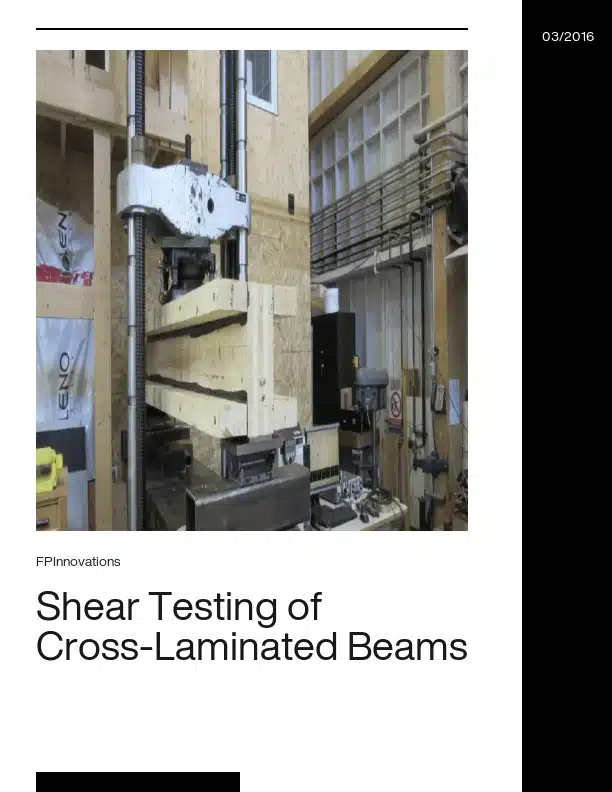
This testing program was carried out by the Advanced Building Systems (ABS) Department of FPInnovations in response to a request made by Mrs. Julie Frappier of Nordic Engineered Wood and Mr. Étienne Lalonde of Canadian Wood Council (CWC) for the evaluation of the shear stress resistance of one hundred fifty two (152) cross-laminated timber (CLT) beams. All specimens were manufactured by Nordic Engineered Wood and delivered to FPInnovations’ testing facilities in Québec City. The main objective of this study was to evaluate the in-plane shear stress of CLT depending of its orientation and the number of plies. Specific Gravity and Moisture Content measurements were also determined for each specimen.
Wood Innovation and Design Centre
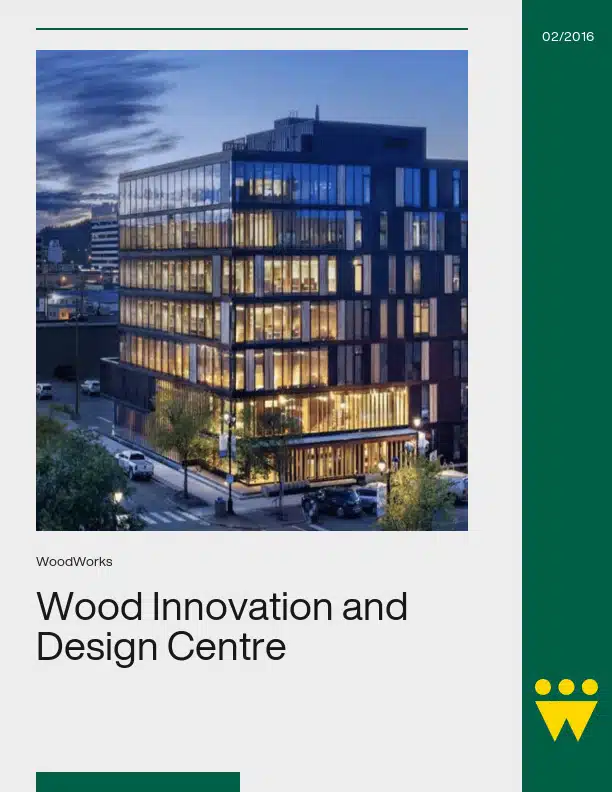
With a height of 29.5 metres, the Wood Innovation and Design Centre (WIDC) is the tallest contemporary wood building in North America. Located in the city of Prince George in northern British Columbia, the WIDC was conceived as a showcase for local wood products and as a demonstration of the province’s growing expertise in the design and construction of large wood buildings. The building has eight levels (six storeys, plus a ground floor mezzanine and a rooftop mechanical penthouse). The lower levels will accommodate faculty and students enrolled in the new Master of Engineering in Integrated Wood Design (MEng), to be launched by the University of Northern British Columbia (UNBC) in January 2016 and the new Centre for Design Innovation and Entrepreneurship to be launched by Emily Carr University of Art and Design in fall 2016. Academic facilities include a research/teaching lab that will support the design, fabrication and testing of wood products; a 75-seat lecture theatre; classrooms; a student lounge; gathering and meeting areas; and a learning resource centre. The upper floors will provide office space for public and private sector organizations associated with the wood industry. Over the long term, the WIDC will advance wood education and innovation in the province, enhance expertise in wood manufacturing, product development and engineering – all of which will help to expand opportunities for international exports of products and services. In addition, its striking presence in the heart of the city will assist in the revitalization of downtown Prince George. This case study describes the most important innovations that were implemented to meet design and safety criteria in what is a new class of buildings for British Columbia. These innovations included: A set of site-specific regulations to ensure life safety and structural integrity; The use of vertical cross-laminated timber (CLT) elements (including mechanical, elevator and stair shafts) to provide lateral stability to the structure; The use of double layer CLT floors to meet structural requirements and contribute to acoustic isolation and efficient services distribution; The use of superimposed (end grain-to-end grain bearing) columns to control shrinkage over the height of the building; and, The use of high strength proprietary connectors to speed construction and improve structural performance.
Permanent Wood Foundations 2016

Measurement of Airborne Sound Insulation of Wall & Floor Assemblies

The following report contains the Transmission Loss (TL) results measured in accordance with ASTM E90-09 of 8 cross-laminated timber (CLT) wall assemblies and the TL results and normalized impact sound pressure level results measured in accordance with ASTM E492-09 of 26 CLT floor assemblies and 3 glulam floor assemblies. Reference tables containing the specimen number, sketch, short description, rating(s) as well as the page number of all the assemblies tested are found starting on page 16. The wall assemblies were built and tested between November and December 2014. The specimen descriptions and the reported mass per area of the 8 wall assemblies that were previously published under report numbers A1-006070.1 to A1-006070.8 have been revised in this report. The floor assemblies were built and tested between December 2014 and June 2015. The specimen description and the reported mass per area of floor specimen A1-006070-11F that were previously published under report number A1-006070.9 have been revised in this report. The following discussion section contains analyses and graphical comparisons of the tested wall and floor assemblies used to highlight key findings: In-situ TL vs. Laboratory TL Results 2. TL Results of Current Bare Assemblies vs. Previous Assemblies 3. TL Results of Walls vs. Floors 4. TL Results of CLT Walls 5. TL Results of CLT Floors 6. TL Improvement of Toppings and Resilient Membranes 7. TL Difference of Poured vs. Precast Concrete Topping 8. TL Interpolation for Floor Toppings 9. TL Improvement of Floor Coverings 10. TL Improvement of Hung Ceilings 11. TL Results of Glulam Floors The last three pages of this report contain additional test setup information for each facility. APPENDIX: ASTM E90-09 – Airborne Sound Transmission – Wall Facility APPENDIX: ASTM E90-09 – Airborne Sound Transmission – Floor Facility APPENDIX: ASTM E492-09 – Light Impact Sound Transmission – Floor Facility
CLT Diaphragm Properties
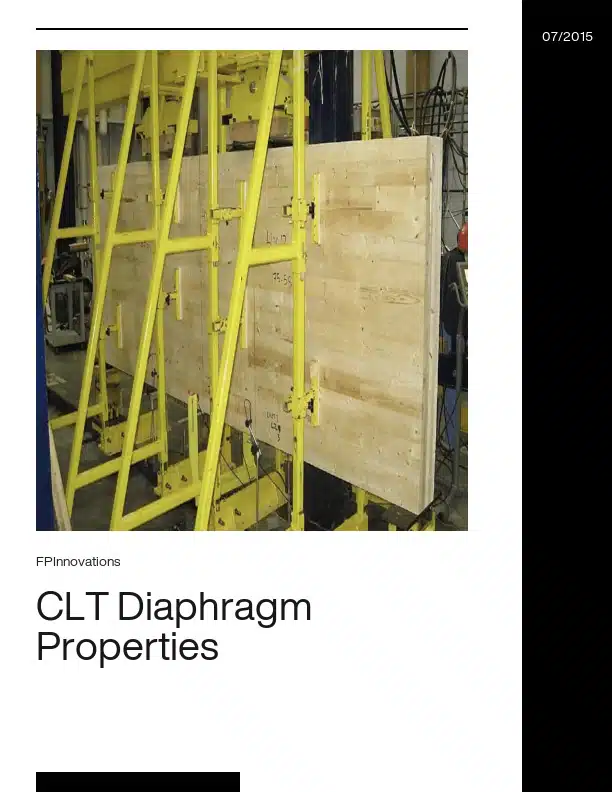
A testing program related to the evaluation of the mechanical properties of CLT diaphragms used in construction was carried out by the Advanced Building Systems (ABS) Department of FPInnovations in response to a request made by the Client, Nordic Engineered Wood Products. The main objective of this study was to determine the in-plane stiffness and potentially strength properties of CLT panels used in diaphragm applications. The test matrix consisted of three (3) series of two (2) specimens each. The CLT specimens were tested under third-point loading during the program. All specimens were manufactured by Nordic Engineered Wood Products and delivered to FPInnovations’ testing facilities in Québec City. The CLT panels were made of nominal 2×4 Black Spruce lumber (CLT Grade E1 – ANSI PRG 320).
Shear Modulus of CLT in plan loading
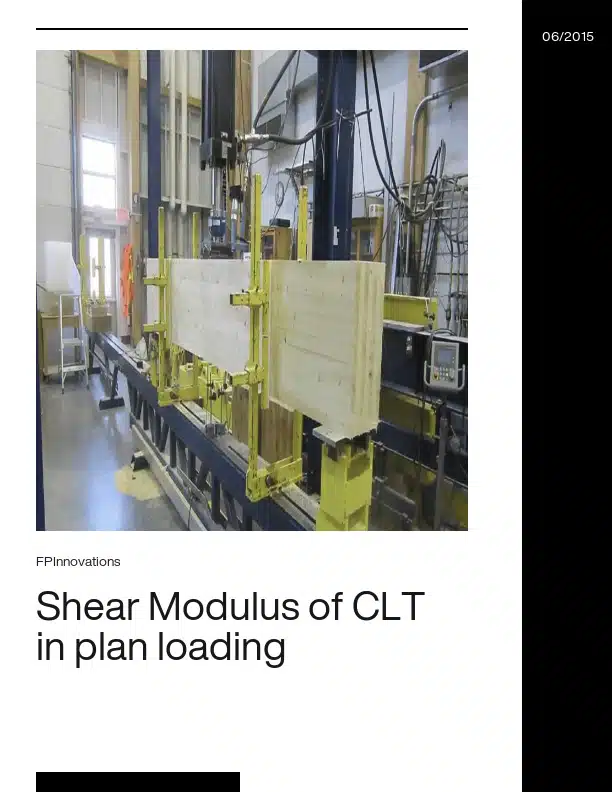
A testing program was carried out by the Advanced Building Systems (ABS) Department of FPInnovations in response to a request made by Mrs. Julie Frappier of Nordic Engineered Wood Products for the evaluation of the effective shear modulus of eight (8) different Cross-laminated Timber (CLT) configurations or series. The test matrix consisted of a total seventy (70) specimens and each specimen was submitted to four (4) bending tests, resulting in a total two hundred and eighty (280) tests. All specimens were manufactured by Nordic Engineered Wood Products and delivered to FPInnovations’ testing facilities in Québec City.
Monotonic Quasi-Static Testing of CLT Connections
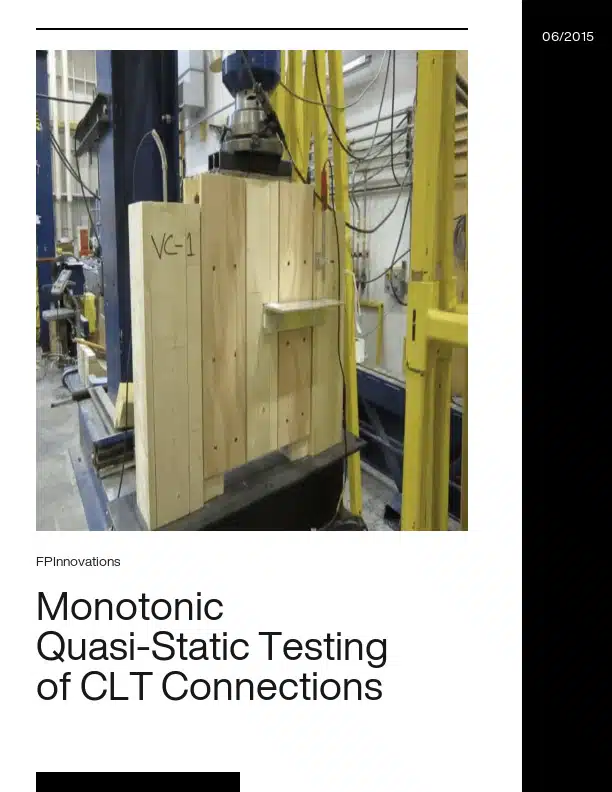
This testing program was carried out by the Advanced Building Systems (ABS) Department of FPInnovations in response to a request from Mrs. Julie Frappier from Nordic Engineered Wood for the evaluation of the mechanical properties of three (3) different assemblies for attaching Cross Laminated Timber (CLT) panels. Each of the assemblies consisted of six (6) specimens for a total of eighteen (18) tests. All specimens were manufactured by Nordic Engineered Wood and delivered to FPInnovations’ laboratory in Québec City. The key objective was to evaluate the mechanical properties pertinent for the design of CLT panel connections exposed to in-plane loading such as diaphragms or shear walls. The evaluation of the ultimate loading capacity (𝐏𝐮𝐥𝐭) and the stiffness (K) of the connections are thus the main focus of this study.
Fire Safety Design In Buildings
In a recent survey of building specifiers, the majority perceived wood to be the most environmentally friendly building material. Compared to other major building materials, this is due mainly to: the renewability of wood the low energy consumption required for production the low levels of pollutant emission during manufacture Lately, environmental considerations have acquired more importance in the specification of materials. Technical and economic aspects of building materials have always been primary considerations for specifiers. Increasingly, however, they are considering the environmental effects when selecting appropriate building materials for their designs. Architects, engineers and designers require accurate information to assess the true environmental consequences of the materials they specify. The environmental impacts of various building materials have been examined by a Canadian Research Alliance using the internationally accepted method called Life-Cycle Analysis (LCA). The Alliance consists of researchers from the wood, steel and concrete industries as well as university groups and consultants.
Fire Safety and Security: A Technical Note on Fire Safety and Security on Construction Sites In British Columbia

The construction phase of any building represents a relatively short period of time in the lifespan of the structure during which a unique set of risk scenarios are present. The risks and hazards found on a construction site differ in both nature and potential impact from those in a completed building. This occurs during a time in which the fire prevention and protection elements that are designed to be part of the completed building are not yet in place. For these reasons, construction site safety includes some unique challenges. However, an understanding of the hazards and their potential risks is the first step towards fire prevention and mitigation. While there are many types of hazards and risks that require consideration during the construction of all buildings, this Technical Note focuses solely on fire-related aspects.
Fire Safety and Security: A Technical Note on Fire Safety and Security on Construction Sites In Ontario

The construction phase of any building represents a relatively short period of time in the lifespan of the structure during which a unique set of risk scenarios are present. The risks and hazards found on a construction site differ in both nature and potential impact from those in a completed building. This occurs during a time in which the fire prevention and protection elements that are designed to be part of the completed building are not yet in place. For these reasons, construction site safety includes some unique challenges. However, an understanding of the hazards and their potential risks is the first step towards fire prevention and mitigation. While there are many types of hazards and risks that require consideration during the construction of all buildings, this Technical Note focuses solely on fire-related aspects.


