

Grizzly Paw Brewing Company

In 1996, The Grizzly Paw Brewing Company began brewpub restaurant operations in Canmore, Alberta, at the doorstep of Banff National Park. Since then, the business has attained microbrewery status, and success and growth have led to the need for a brewery building to meet present and future needs for supplying beer and carbonated drinks to Canmore, Banff, Calgary, and other communities across Alberta. The purpose of the new brewery is to augment the capacity of the existing brewpub by a factor of 8 to 10 to meet increasing demand for the Grizzly Paw brands. The new building will also have hospitality space suited to tours and receptions once the brewing facility is running smoothly. The building is located on a one-acre site in a commercial zone at the gateway to Canmore (Figure 1). The brewery was initially designed to be a steel building, but preliminary cost estimates were over-budget. An alternative conceptual design was made based on exposed heavy timber construction. The resulting timber building met all the building science challenges, saved money, and better met the Rocky Mountain architectural design motif of Canmore. It provides a pleasing appearance that will attract additional publicity and be very conducive to guided tours through the brewery.
Richmond Olympic Oval

The Richmond Olympic Oval is the largest structure to be built for the Vancouver 2010 Olympic Winter Games. Designed to accommodate the long track speed-skating events before an audience of more than 8000 spectators, the building features a 6 acre (2.5 hectare) free spanning roof that is a precedent setting example of British Columbia’s and Canada’s advanced wood engineering and prefabrication capabilities. The building is located a short distance from Vancouver’s International Airport in the City of Richmond, where after the Games, it will be transformed into a multi-sports training and recreation facility at the centre of a new residential and commercial neighbourhood. Construction of the project began in 2005, and the building was opened on time and under budget in December 2008.
Slave Lake Government Centre and Library
Located 250 km north of Edmonton, the Town of Slave Lake, Alberta, is home to 7,000 residents and serves as a regional hub for a population of 25,000. It’s economic base includes tourism, oil, gas and forestry industries. The new Slave Lake Government Centre and Library was designed and built to consolidate a number of government services, in outdated facilities, that were distributed throughout the community of Slave Lake. The new building, which is a combination of renovated space and new construction (Figure 1), has streamlined the delivery of public services in Slave Lake and provided a central place where citizens can meet, interact and conduct daily business in one stop.
Full Scale Exterior Wall Test on Nordic CLT System, by the National Research Council

This report describes a full-scale exterior wall fire test conducted on December 16, 2014 on a Nordic cross-laminated timber (CLT) wall system. The test was conducted in accordance with CAN/ULC-S134-13, Standard Method of Fire Test of Exterior Wall Assemblies.
Engineering Guide for Wood Frame Construction 2014

The Engineering Guide for Wood Frame Construction has been produced by CWC to provide guidance to engineers, building designers, building officials, builders, and students of these disciplines on the structural design of wood elements and connections for wood frame buildings that fall within the scope of Part 9 of the NBC. The Guide was revised, in this 2014 Edition, in order to conform to changes in the 2015 edition of the NBC.
Fire Safety Challenges of Tall Wood Buildings

Acknowledging the growing importance of designing sustainable buildings and addressing overpopulation concerns, the development of engineered wood products has introduced the possibility of constructing high-rise timber structures that can improve both these conditions. However, as a combustible material, one of the biggest barriers to construction of tall timber buildings is the potential fire risk resulting from the combustible structure. In November 2012, the Fire Protection Research Foundation commissioned the Fire Safety Challenges of Tall Wood Buildings study to address this concern. Phase I of this two-phase study seeks to collect the available knowledge of fire safety in timber structures and identify gaps in knowledge that would further the understanding of fire performance of tall timber buildings. Results of the study, including a summary of timber construction and fire dynamics, is presented herein.
The Case for Tall Wood Buildings

Wood is the most significant building material we use today that is grown by the sun. When harvested responsibly, wood is arguably one of the best tools architects and engineers have for reducing greenhouse gas emissions and storing carbon in our buildings. The Case for Tall Wood Buildings expands the discussion of where we will see wood and specifically Mass Timber in the future of the world’s skylines. As we pursue the solar and green energy solutions that Thomas Edison spoke of over 80 years ago, we must consider that we are surrounded by a building material that is manufactured by nature, a material that is renewable, durable and strong. This report introduces a major opportunity for systemic change in the building industry. For the last century there has been no reason to challenge steel and concrete as the essential structural materials of large buildings. Climate change now demands that we do. The work of thousands of scientists with the United Nations Intergovernmental Panel on Climate Change (IPCC) has defined one of the most significant challenges of our time. How we address climate change in buildings is a cornerstone in how the world will tackle the need to reduce emissions of green house gases and indeed find ways to store those same gases that are significantly impacting the health of our planet. Just as the automobile industry, energy sector and most other industries will see innovations that challenge the conventions of the way we will live in this century, the building industry must seek innovation in the fundamental materials that we choose to build with. In a rapidly urbanizing world with an enormous demand to house and shelter billions of people in the upcoming decades we must find solutions for our urban environments that have a lighter climate impact than today’s incumbent major structural materials. This report is a major step in that direction. Indeed it introduces the first significant challenge to steel and concrete in tall buildings since their adoption more than a century ago.
Wood Reference Handbook

The Wood Reference Handbook is much more than a guide to the architectural use of wood in building construction – it is a beautifully assembled homage to fine wood craftsmanship throughout the world.
Introduction to Wood Building Technology

Engineers, architects, building code officials, builders, developers, students and professors all turn to Introduction to Wood Building Technology – the most current guide to the construction of wood buildings.
Canadian Lumber Properties
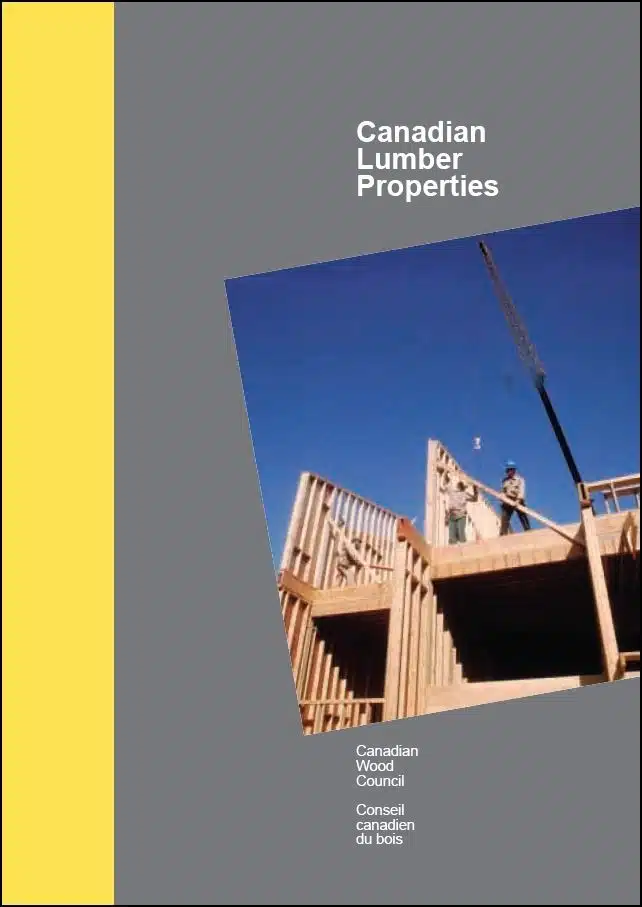
Canadian Lumber Properties is a source of information on the structural properties of Canadian softwood lumber derived from full-size (“in-grade”) tests.
Wood Highway Bridges
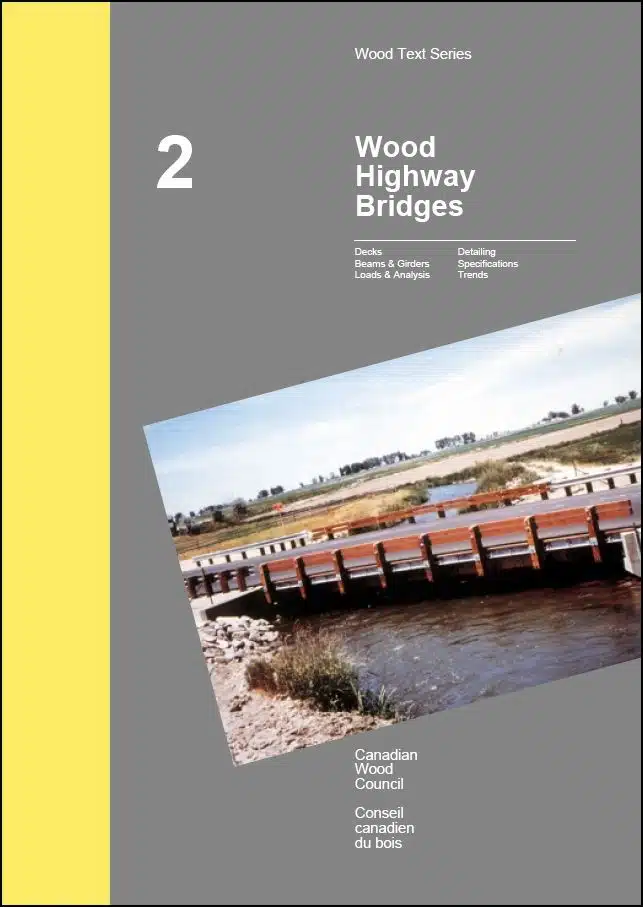
Wood Highway Bridges demonstrates how wood bridges can be designed to be assembled rapidly, resist deterioration caused by de-icing chemicals, and utilize stress-laminating in decks to provide long-term performance.
Wood Piles
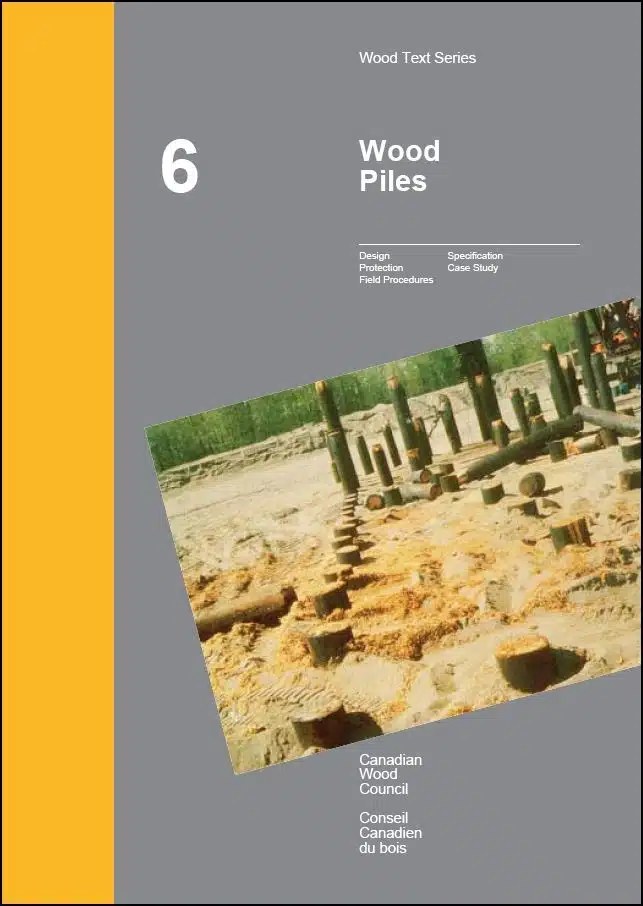
Wood Piles provides clear and concise coverage of a topic that is often considered obscure However, wood piling has been used around the world to support heavy loads for centuries – and it is still in use today


