

Canadian Wood Council’s 2024 Annual Report Now Available

The Canadian Wood Council is pleased to share it’s 2024 Annual Report, offering a clear view of the progress, resilience, and impact achieved over the past year. In his message, Chairman Kevin Pankratz reflects on the Council’s strategic leadership during a year marked by economic pressures and shifting market conditions. Emphasis is placed on the value of collaboration, strong governance, and industry alignment as essential to maintaining momentum and ensuring long-term competitiveness. The report reinforces the importance of maintaining a united voice across our membership and fostering clarity in our purpose as a national federation. From the President & CEO’s perspective, Rick Jeffery outlines how the organization navigated 2024 with focus and adaptability—delivering trusted technical guidance, growing influence in codes and standards, and expanding national education and outreach efforts. With renewed government investment and increased awareness of low-carbon construction, the Council is well-positioned to lead the next chapter of growth for Canada’s wood sector. View the full report: English | Francais
Wood Design & Building Magazine, vol 24, issue 97
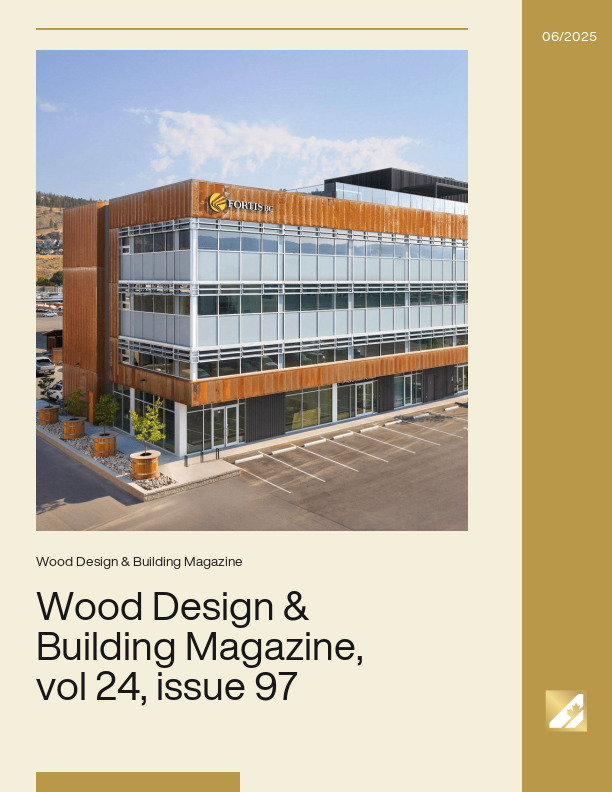
In wood construction, success is rarely improvised. It’s the earned result of early design coordination, clearly communicated expectations, and a shared commitment to getting the details right—from design concept through to completion. Whether a project’s priority is accelerated construction timelines, lasting architectural impact, future disassembly and reuse, or all these things and more, the through line is thoughtful, deliberate planning. As a structural system, timber calls for a high degree of coordination—especially as its applications continue to evolve and expand. It rewards teams who design with intent: those who understand that every exposed surface carries architectural weight, that detecting clashes early in the design phase avoids costly rework during construction, and that planning for a building’s end-of-life is just as essential as designing its first impression. Society’s growing demand for low-carbon construction brings new urgency—and opportunity—to these conversations. As we continue to advance prefabricated, high-performance, and demountable wood building systems, the need for early alignment—between architect and engineer, builder and client—is not just integral to the success of individual projects, but to the advancement of the industry as a whole. This issue of Wood Design & Building leans into that reality. As construction methods evolve, we examine how clear communication and coordination don’t just mitigate risk—they drive better outcomes for the built environment. In a construction landscape that values speed, efficiency, and low-carbon outcomes, it’s advanced planning and clear communication that turn ambition into meaningful results. We’re not just building with wood. We’re building with purpose, intention, and care. And that process starts long before the first beam or panel is lifted into place.
2025 Wood Design & Building Awards Call for Submissions Now Open

OTTAWA, ON, 23 APR 2025 – The Canadian Wood Council is accepting submissions for the 2025 Wood Design & Building Awards. Now in its 41st year, this annual program invites architects, designers, and project teams from across North America and around the world to submit their most inspiring wood projects for consideration. “At its core, this program is a celebration of architectural excellence,” says Martin Richard, VP Market Development & Communications at the Canadian Wood Council. “Each year, we’re inspired by the many ways designers harness wood’s versatile beauty—from bold, expressive forms to quietly transformative spaces.” Over the decades, we’ve seen the creativity and talent of hundreds of project teams bring important changes to the built environment—elevating wood from a niche material to a sustainable, mainstream design ambition. While the awards program has always shone a light on architectural excellence in wood, winning projects in recent years also frequently demonstrate innovation, technical achievement, and a strong commitment to sustainability. Submissions will be reviewed by a distinguished jury of Canadian and American architects. Projects will be evaluated based on creativity, design excellence, and the innovative and appropriate use of wood to achieve project objectives. Award categories for 2025 include: The program also includes several specialty awards: Winners will receive a custom wood trophy and be recognized through a media announcement, social media, a feature profile on the Wood Innovation Network, and editorial coverage in Wood Design & Building Magazine (digital edition). Key DatesEarly Bird Deadline: May 31, 2025Final Submission Deadline: June 27, 2025 For more information and to submit your project, please visit: https://cwc.ca/wood-design-and-building-awards/
Wood Design & Building Magazine, vol 24, issue 96
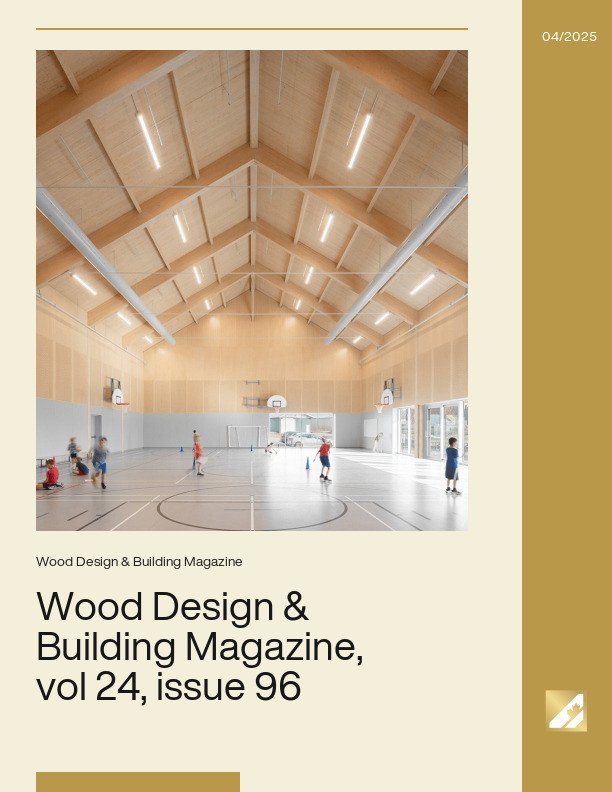
Buildings that stand the test of time aren’t just durable—they are cherished. When we invest in quality materials and good design, we can create buildings that people connect with. As you’ll discover in this issue, many heavy timber warehouses and factories constructed in the early 1900s remain a vital part of our cities today—not because they still serve their original purpose, but because people valued them enough to adapt, restore, and reuse them, giving them a new purpose. Fast forward a hundred years and resilient structures include many new forms. Modular construction, for example, has seen significant growth in recent years as this form of construction has transformed from a building method once considered inferior, into a method relied upon to deliver high-performance durable buildings. Alongside our features on historic timber buildings and modular construction, this issue also highlights notable projects and emerging trends shaping today’s built environment. From innovative mass timber structures to forward-thinking design solutions, we explore how thoughtful craftsmanship and smart engineering continue to define the spaces we build—and the ones we keep.
Wood Design & Building Magazine, vol 24, issue 95
The Exchange

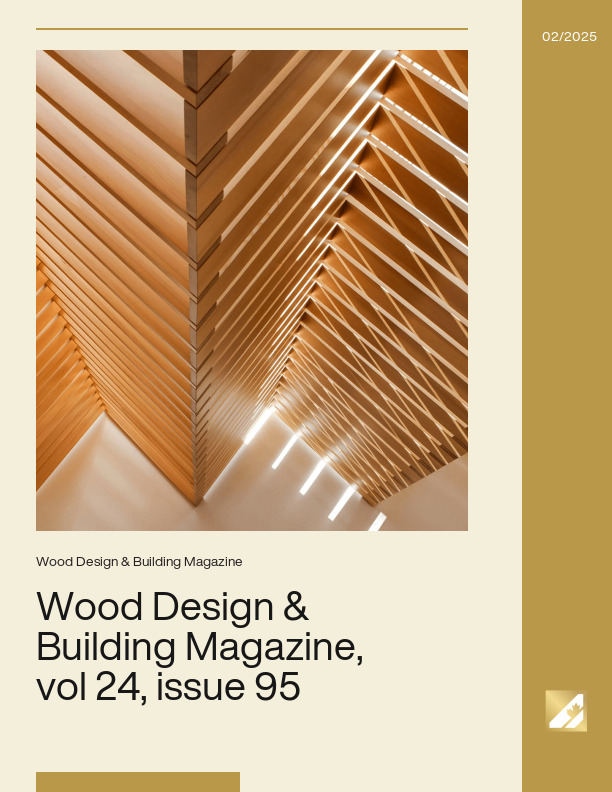
ARCHITECT: Faction Architecture Inc. STRUCTURAL ENGINEER: RJC Engineers DEVELOPER: Faction Projects Inc. CONSTRUCTION MANAGER: Faction Construction BUILDING CODE CONSULTANT: GHL Consultants Ltd. PHOTOS: Courtesy of naturally:wood In Kelowna, British Columbia’s evolving industrial north end, The Exchange stands as a forward-thinking demonstration of what’s possible when architectural ambition meets technical precision. Designed and developed by Faction Architecture and Faction Projects, the building blends mass timber with conventional materials in a hybrid system that highlights both structural performance and environmental responsibility. At the heart of the structural system is nail-laminated timber (NLT), used for both floor and roof assemblies. NLT is a mass timber product formed by mechanically fastening dimensional lumber together to create solid panels—an approach well-suited to exposed timber applications that value durability, texture, and straightforward fabrication. For this project, the team fabricated the panels in-house using locally sourced materials and trades. While this gave them greater control over cost and scheduling, it also introduced design and compliance challenges. The team opted for a fluted NLT profile to enhance visual appeal and improve acoustic performance. Because the panel design differed from prescriptive norms, it required approval as an alternative solution under the BC Building Code. Extensive analysis was conducted to demonstrate compliance with fire-resistance, vibration, and load-bearing requirements. Informed by existing NLT fire test data, the design team minimized voids between laminations to enhance charring behaviour and performed physical load testing at Okanagan College to confirm strength and stiffness performance. Complementing the NLT panels is a glulam post-and-beam system that forms the substructure, supported by concrete elevator and stair cores. Together, these elements support a program that includes retail and light industrial space at grade, with two to three storeys of open-plan office space above. A rooftop patio offers sweeping views, reinforcing the project’s appeal to creative businesses and environmentally conscious tenants. The Exchange also showcases a thoughtful approach to the building envelope, a key factor in achieving Step 3 of the BC Energy Step Code—the highest step currently applicable to non-residential buildings in the region. The high-performance envelope includes a combination of weathering steel and corrugated metal cladding, high-performance glass windows, semi-rigid exterior insulation, breathable weather barrier, plywood sheathing, lumber studs, batt insulation, gypsum board and a polyethylene vapour barrier. The light-frame wood walls contribute to envelope performance in two important ways: 1) wood has lower thermal conductivity than other materials, so thermal bridging is dramatically reduced, and 2) the stud wall configuration allowed for thicker insulation in the cavities between studs. This integrated approach—combining exposed timber construction, envelope efficiency, and locally supported fabrication—enabled the project team to deliver a space that performs as well technically as it does aesthetically. And with over 90% of the leasable area spoken for at completion, it’s clear that tenants are responding to both the look and the logic of the building. The Exchange sets a precedent for accessible mass timber construction in smaller markets, particularly in contexts where a streamlined fabrication process and strong design-control loop can help close the gap between sustainable ambition and budgetary constraints. As Faction Projects continues work on the remaining phases of the development, The Exchange stands as both a technical prototype and a commercial success—proof that high-performance, low-carbon construction can be as practical as it is inspiring.
The 2025 Ottawa Wood Solutions Conference will be presented on February 5, 2025 at the National Arts Centre

December 19, 2024 (Ottawa) – The 2025 Ottawa Wood Solutions Conference will be presented on Wednesday, February 5, 2025, from 8:00 am to 5:00 pm, at the National Arts Centre, located at 1 Elgin St. in Ottawa. First launched over 20 years ago to serve design and construction professionals interested in building with wood, this event has evolved from a niche gathering into a cornerstone of professional education, driven by the growing demand for sustainable wood construction. The program offers a range of presentations—from technical deep dives to inspiring case studies—catering to participants at every stage of their professional journey, from newcomers to seasoned experts. Attendees can also take advantage of valuable opportunities to connect, collaborate, and expand their professional networks within the wood community. Conference organizers are delighted to welcome Christophe Ouhayoun of KOZ Architects (France) to share insights into the innovative, collaborative development of the Paris Olympics Athletes’ Village. His presentation will also explore the current effort underway to convert these structures into much-needed permanent housing, highlighting this progressive mass timber development as a model of adaptability and sustainability. Another program highlight pays tribute to the venue itself. Donald Schmitt, CM, of Diamond Schmitt Architects will present on the revitalization of the National Arts Centre, offering a behind-the-scenes look at the timber structure and prefabrication process that transformed this iconic building into a modern landmark. Other technical presentations include managing sound and vibration in mass timber buildings and growing Canadian capacity for industrialized wood construction, advancing wood products in our changing climate, and a discussion of the value of conventional wood frame construction in small communities where it provides job opportunities, with a specific focus on Indigenous housing projects. Early Bird registration of just $99+HST is available until the end of December. In the new year, registration for the conference will be $149 +HST. Delegates can find the Ottawa Wood Solutions Conference on Eventbrite or jump directly to online registration with this link: https://www.eventbrite.ca/e/2025-ottawa-wood-solutions-conference-tickets-1080654991169 A limited number of discounted passes are available for post-secondary educators and students in AEC+D programs of study. Please contact Kelsey Dayler for more information [email protected].
Wood Design & Building Magazine, vol 23, issue 94
2024 Catherine Lalonde Memorial Scholarships Celebrate Students Driving Innovation in the Wood Industry

Ottawa, ON, December 12, 2024 – The Canadian Wood Council (CWC) announced the recipients of the 2024 Catherine Lalonde Memorial Scholarships: Laura Walters (McMaster University) and Jiawen Shen (University of British Columbia). Both students were recognized for their academic excellence and impactful research projects in the structural wood products industry. Established nineteen years ago, the memorial scholarships are awarded each year to graduate students whose wood research exemplifies the same level of passion for wood and the wood products industry that Catherine Lalonde tirelessly demonstrated as a professional engineer and president of the CWC. Laura Walters Laura is a 3rd-year graduate student pursuing a Master of Applied Science in Civil Engineering under a joint collaboration between McMaster University and the University of Northern British Columbia (UNBC). Her research project explores the use of pre-engineered beam hangers in mass timber post-and-beam systems, with a focus on the implications of design and modelling assumptions on the evaluation of structural load paths. Her work provides valuable insights into the design considerations and assumptions required for more accurate and reliable design of mass timber columns when pre-engineered beam hangers are used. Jiawen Shen Jiawen is a 1st year graduate student pursuing a Master in Wood Science at the University of British Columbia. Her research project focuses on the development of binderless composite bark-board cladding and insulation panels that are durable, ignition resistant, carbon neutral, and manufactured from an underutilized by-product that would otherwise be burned, landfilled, or used for low-value purposes. Collaborating with a Vancouver-based architecture firm on this project, her work is key to advancing the commercial application of these innovative cladding products. “This year marks a historic milestone for the Catherine Lalonde Memorial Scholarship program as, for the first time, it is awarded to two exceptional women,” said Martin Richard, VP of Market Development and Communications at the CWC. “Their achievements highlight the outstanding talent driving innovation in wood research and construction. We are inspired by their contributions and the growing diversity shaping the future of wood-based solutions.”
BUILDEX and Canadian Wood Council Bring Cutting Edge Wood-Based Design and Construction to All Professionals of the Built Environment

Vancouver, BC, September 19, 2024 – Informa Connect and the Canadian Wood Council announce their collaboration, WoodWorks at BUILDEX, integrating WoodWorks’ technical expertise and wood products industry representation into BUILDEX Vancouver, February 26 – 27, 2025. This initiative builds on a shared commitment to advancing Canada’s built environment and expands BUILDEX’s focus on innovative materials, design, and construction practices. WoodWorks at BUILDEX offers an exceptional opportunity for all professionals of the built environment to immerse themselves in the latest innovations in wood-based design and construction through: Rick Jeffery, President and CEO, Canadian Wood Council, emphasized the importance of this collaboration: “Working with Informa Connect to bring WoodWorks to BUILDEX Vancouver in 2025 allows us to concentrate on one of our core strengths—delivering industry-leading educational content, technical support, and access to leading wood product providers—at Canada’s most progressive design, construction and real estate event.” Sherida Sessa, SVP for North America at Informa Connect, added “British Columbia is recognized as a global leader in wood-based design and construction, and this partnership solidifies BUILDEX as a key destination for technical expertise, innovation and leadership in the wood products industry.” WoodWorks at BUILDEX amplifies BUILDEX Vancouver’s core offering to Canadian and North America’s design and construction leaders: timely market insights, respected technical knowledge, transformative networking, and exposure to the materials and technologies at the forefront of Canada’s built environment. BUILDEX Vancouver will take place February 26 – 27, 2025, at the Vancouver Convention Centre West, attracting over 8,500 developers, architects, engineers, builders, designers, suppliers, and real estate professionals. Register now at www.BUILDEXVancouver.com to secure your place and witness the latest in progressive design and construction trends.
Mass Timber Insurance Action Plan Phase 1 Report – Test
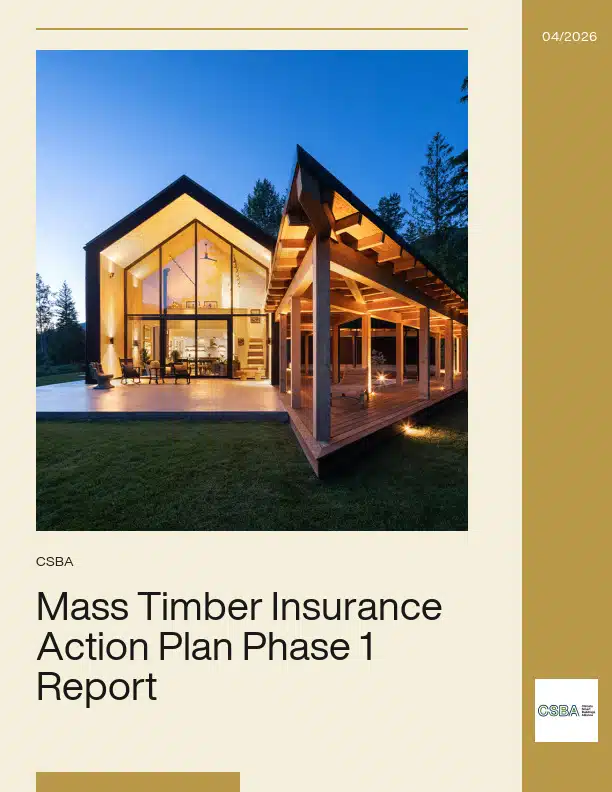
Mass Timber Insurance Action Plan – Phase 1 Report examines one of the most significant barriers to scaling mass timber construction in Canada: access to affordable and reliable insurance. While mass timber offers clear advantages in sustainability, performance, and long-term value, course-of-construction insurance rates remain disproportionately high—often several times those of concrete and steel—driven largely by limited data and insurer unfamiliarity rather than demonstrated risk. Led by the Climate Smart Buildings Alliance and the Canadian Wood Council, and supported by Natural Resources Canada, this report summarizes the findings from Phase 1 of a national action plan developed in collaboration with insurance and building industry stakeholders. It evaluates the feasibility of four targeted solutions focused on data sharing, insurer-relevant research, contractor verification, and expanding insurance capacity. Bringing together technical insight and industry perspectives, the report outlines practical pathways to reduce risk perception, improve market confidence, and unlock greater adoption of mass timber construction across Canada.
Canadian Wood Council and George Brown College’s Brookfield Sustainability Institute to co-host WoodWorks Summit in Toronto

Ottawa, Toronto | 27 March 2024] – The Canadian Wood Council (CWC) and George Brown College’s Brookfield Sustainability Institute (BSI) are thrilled to announce a strategic partnership aimed at fostering education in sustainable construction practices. Under this partnership, the CWC and BSI will join forces on various initiatives dedicated to accelerating the adoption of sustainable wood construction. Central to this effort is the WoodWorks Summit, which the organizations will co-host in Toronto October 21-25, 2024. The Summit promises to be a dynamic collection of events that will bring together industry leaders, practitioners, academics, and policymakers to explore the latest advancements, challenges, and opportunities in wood construction and sustainability. “We are excited to embark on this collaborative journey with the Brookfield Sustainability Institute,” said Martin Richard, VP of Market Development and Communications at the Canadian Wood Council. “Together, we aim to drive innovation, share knowledge, and accelerate the adoption of sustainable wood construction.” The WoodWorks Summit will feature an engaging lineup of events, including keynote speeches, panel discussions, tours, and networking sessions. Attendees can expect to engage with cutting-edge research, best practices, and real-world case studies, all aimed at demonstrating the use of wood as an innovative, high-performance, sustainable building material. “Our partnership with the Canadian Wood Council underscores our commitment to advancing sustainability in the built environment,” remarked Jacob Kessler, Director of Business Development & Account Management at the Brookfield Sustainability Institute. “By combining our expertise and resources, we can make significant strides to empower the design and construction community with the practical knowledge and technical resources needed to create healthier, more resilient communities with a reduced carbon footprint.” Through this collaboration, the CWC and BSI aim to catalyze positive change within the construction industry. For more information about the WoodWorks Summit, please visit www.woodworkssummit.ca.


