As part of its work related to wooden buildings, FPInnovations recently published a comprehensive technical Guide for designing timber-concrete composite floors in Canada. This construction technique could be an economically profitable solution for longer-span floors since the mechanical properties of the two materials act in complementarity. The presentation overview of the recently published guide, which contains numerous illustrations and formulas to help the user in the design of his project. The connection systems, the ultimate and service limit states, the vibratory performance of the floor and the fire resistance is presented.
Learning Objectives
Discovering the recently published timber-concrete design guide for timber-concrete composite (TCC) floor in Canada.
Leaning the different types of connection systems for TCC floor.
How to design for serviceability and ultimate limit states.
Learning the fundamental theory of TCC floor.
Course Video
https://vimeo.com/1109794527?share=copy#t=0
Speaker Bio
Samuel Cuerrier Auclair, P.Eng., M.Sc. Scientist, Building Systems Group FPInnovations
Samuel Cuerrier Auclair completed his master thesis in 2016 at Laval University where the subject was to optimise the ductility of timber-concrete composite beams. He started to work at FPInnovations in 2015 as a scientist in building system group. He participated on the research project of several subjects as timber-concrete composite floor, the structural performance of mass-timber shear wall, the vibration performance of mass-timber floor, the acoustic performance of building and more recently on wind-vibration of tall timber building.
Benefits of Building with Mass Timber
Course Overview
Building with mass-timber elements affords a contractor many benefits including quality, accuracy and time. But contractors are often unaware of these benefits until immersed in a new project. With the conversion experience had by Willmott Dixon the company advanced its skills has served to inform their clients and the designers with whom they work.
Learning Objectives
How a large construction company – transitioned to include mass timber projects in its portfolio.
How to evaluate key business considerations — cost, time, environment.
How building with mass timber can change the construction planning process — engaging with design teams and clients.
How mass-timber projects came to fruition.
Course Video
https://vimeo.com/1109778977?share=copy#t=0
Speaker Bio
Duncan Purvis
With nearly a quarter of a century of experience in the construction industry in operational, commercial, sales, bid writing, marketing and most aspects of the delivery of complex construction projects and offers a 100% customer journey that is built on true trust. With many construction projects from Four Seasons Miami, Natural History Museum London, Pfizer’s European headquarters and many more high-prestige projects. Duncan is proudest of the Multiple Schools projects, that with his Structured Timber Solution, are providing high quality teaching environments that are not only fully sustainable and highly efficient, but also work out as some of the most economical teaching spaces available in Europe.
Optimizing Outcomes: Leveraging Design Assist for Excellence
Course Overview
Join Melissa Kindratsky, a seasoned engineering expert and Head of Engineering at Kalesnikoff, as she shares insights and strategies on leveraging Design Assist to achieve optimal outcomes in mass timber construction projects. This presentation will delve into the key principles and methodologies essential for employing Design Assist to drive excellence in project execution, with a focus on enhancing collaboration between designers, suppliers/manufacturers, builders, and stakeholders. Melissa will draw from her extensive experience in the industry, providing practical guidance and real-world examples to highlight the advantages and best practices of Design Assist, ultimately showcasing its potential for elevating project efficiency, innovation, and overall success.
Learning Objectives
Understand how the development of a mass timber project differs from that of buildings designed in concrete or steel.
Understand the enhanced role the material supplier / manufacturer plays in the successful delivery of mass timber projects.
Explore how engaging the mass timber manufacturer early on for design assistance can help optimize the structural design of the project for maximum structural and material efficiency.
Learn how design assist collaboration with the fabricator can also facilitate cost certainty, faster and more accurate building completion, shorter construction timelines, and less labor for installation.
Course Video
https://vimeo.com/1046524670
Speaker Bio
Melissa Kindratsky P.Eng., LEED AP BD+C Head of Engineering Kalesnikoff
Melissa has over 20 years of experience practicing as a structural engineer with a focus on timber structures. She has a particular expertise and passion for connection design and structural concept development and has played a key role in the design and detailing of several notable mass timber projects, including: 2150 Keith Drive, Humber College Student Residence, New Westminster Aquatic and Community Center, and many more.
The provision of fire safety in a building is a complex matter; far more complex than the relative combustibility of the main structural materials used in a building. To develop safe code provisions, prevention, suppression, movement of occupants, mobility of occupants, building use, and fuel control are but a few of the factors that must be considered in addition to the combustibility of the structural components.
Fire-loss experience shows that building contents play a large role in terms of fuel load and smoke generation potential in a fire. The passive fire protection provided by the fire-resistance ratings on the floor and wall assemblies in a building assures structural stability in a fire. However, the fire-resistance rating of the structural assemblies does not necessarily control the movement of smoke and heat, which can have a large impact on the level of safety and property damage resulting from fire.
The National Building Code of Canada (NBC) categorizes wood buildings as ‘combustible construction’. Despite being termed combustible, common construction techniques can give wood frame construction fire-resistance ratings up to two hours. When designed and built to code requirements, wood buildings provide the same level of life safety and property protection required for comparably sized buildings defined under the NBC as ‘noncombustible construction’.
Wood has been used for virtually all types of buildings, including; schools, warehouses, fire stations, apartment buildings, and research facilities. The NBC sets out guidelines for the use of wood in applications that extend well beyond the traditional residential and small building sector. The NBC allows wood construction of up to six storeys in height, and wood cladding for buildings designated to be of noncombustible construction.
When meeting the area and height limits for the various NBC building categories, wood frame construction can meet the life safety requirements by making use of wood-frame assemblies (usually protected by gypsum wallboard) that are tested for fire-resistance ratings. The allowable height and area restrictions can be extended by using fire walls to break a large building area into smaller separate building areas.
The recognized positive contribution to both life safety and property protection which comes from the use of automatic sprinkler systems can also be used to increase the permissible area of wood buildings. Sprinklers typically operate very early in a fire thereby quickly controlling the damaging effects. For this reason, the provision of automatic sprinkler protection within a building greatly improves the life safety and property protection prospects of all buildings including those constructed of noncombustible materials.
The NBC permits the use of ‘heavy timber construction’ in buildings where combustible construction is required to have a 45-minute fire-resistance rating. This form of heavy timber construction is also permitted to be used in large noncombustible buildings in certain occupancies. To be acceptable, the components must comply with minimum dimension and installation requirements. Heavy timber construction is afforded this recognition because of its performance record under actual fire exposure and its acceptance as a fire-safe method of construction. In sprinklered buildings permitted to be of combustible construction, no fire-resistance rating is required for the roof assembly or its supports when constructed from heavy timber. In these cases, a heavy timber roof assembly and its supports would not have to conform to the minimum member dimensions stipulated in the NBC.
Mass timber elements may also be used whenever combustible construction is permitted. In those instances, however, such mass timber elements need to be specifically designed to meet any required fire-resistance ratings.
NBC definitions:
Combustible means that a material fails to meet the acceptance criteria of CAN/ULC-S114, “Test for Determination of Non-Combustibility in Building Materials.”
Combustible construction means that type of construction that does not meet the requirements for noncombustible construction.
Heavy timber construction means that type of combustible construction in which a degree of fire safety is attained by placing limitations on the sizes of wood structural members and on thickness and composition of wood floors and roofs and by the avoidance of concealed spaces under floors and roofs.
Noncombustible construction means that type of construction in which a degree of fire safety is attained by the use of noncombustible materials for structural members and other building assemblies.
Noncombustible means that a material meets the acceptance criteria of CAN/ULC-S114, “Test for Determination of Non-Combustibility in Building Materials.”
For further information, refer to the following resources:
National Building Code of Canada
CAN/ULC-S114 Test for Determination of Non-Combustibility in Building Materials
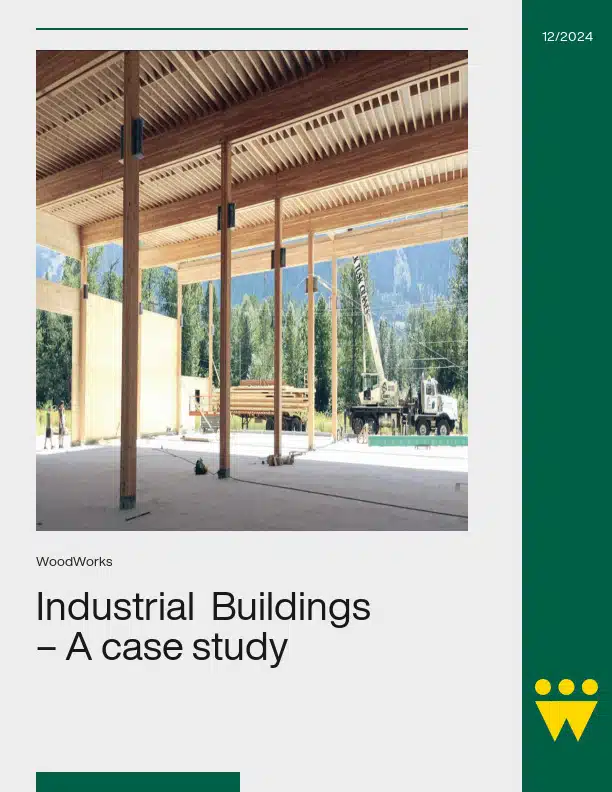
Over the past two decades, new engineered mass timber products and construction techniques have changed the way we think about wood as a building material. Historic perceptions about strength, durability and fire performance have been overturned by scientific evidence and full-scale testing of prototype structures.
As a result, mass timber has begun to make its mark in the residential and commercial sectors, particularly on Canada’s West Coast. However, the market for industrial buildings continues to be dominated by tilt-up concrete and steel-frame construction, both of which have a significant environmental footprint. Tiltup concrete in particular has inherent disadvantages; concrete cannot be poured in the freezing conditions typical of Canadian winters, nor can it be easily insulated to reduce the operating energy requirements of the building.
However, the National Building Code of Canada states that a roof assembly in a building of up to two storeys is permitted to be of heavy timber construction regardless of the building area or the type of construction required, provided the building is sprinklered. In addition, the structural members in the storey immediately below the roof assembly are also permitted to be of heavy timber construction. These requirements apply equally to industrial buildings, meaning that heavy timber is a viable alternative to the materials traditionally used, and single storey industrial buildings may be constructed entirely of heavy timber.
This case study examines three recently completed industrial buildings in southern British Columbia, each of which uses engineered mass timber products and systems in a distinct and different way. Together, they offer insights into how industrial construction might evolve to offer greater environmental performance, speed and flexibility of construction, at little additional cost over traditional methods.
From Trees to Keys: Scaling Industrialized Wood Construction
Course Overview
This session brings together a panel of experts to discuss lessons learned and visions for wood-based manufactured housing solutions. The panel will address key challenges in scaling modular and panelized wood construction, including design for manufacture and assembly, systems integration, workforce transformation, and product standardization. Innovators throughout the supply chain will explore requirements for bringing scalable mass timber housing into the mainstream, from procurement to policy and from urban infill to supply chain readiness. The discussion will focus on how factory-built housing and wood innovation can contribute to addressing Canada’s housing crisis.
Learning Objectives
Assess practical lessons learned from implementing modular, panelized, and mass-timber housing projects, including challenges related to design coordination, manufacturing constraints, and on-site assembly.
Explain how integrated approaches across structure, envelope, and mechanical systems enable scalable, high-performance wood-based housing solutions, drawing on examples from factory-built and turnkey delivery models.
Evaluate the roles of standardization, procurement models, workforce capabilities, and policy alignment in advancing wood-based manufactured housing as a viable response to Canada’s housing crisis.
Hailey is a structural engineer and has focused her career specializing in sustainable architecture and the advancement of timber building systems. Hailey spent several years of her career in research on the behaviour and fire safety of mass timber, as a structural designer with Entuitive in Toronto, and working to develop affordable housing products built of high-performance timber panels, contributing to the successful completion of several turnkey housing projects with Assembly Corp. (previously R-Hauz). In her current role as a Technical Manager for the Canadian Wood Council’s WoodWorks program, Hailey works with the team to aid project teams with technical support and to bring resources and education to industry stakeholders, advocating for the successful implementation of a beautiful and sustainable building material in our built environment.
Ben Chicoine President Fab Structures
Ben Chicoine is an accomplished entrepreneur with over 20 years of hands-on experience in the construction industry. As the co-founder of Fab Structures, he has built a multi-million dollar company specializing in mass timber and panelized construction, with energy efficiency at its core. Certified in Passive House design, Ben now consults on high-performance building strategies, championing innovative solutions that push the boundaries of sustainable construction in Canada.
Kyle Power Director of Construction Assembly Corp.
Kyle is Director of Construction at Assembly. He brings 15+ years of end-to-end construction management experience with Canada’s largest general contractor. Kyle held key leadership roles in the delivery of several high-profile projects in the GTA, including commercial high rise, complex retail renovations, and high rise residential. He is responsible for successful project construction delivery from the pre-construction planning stages to close-out. Kyle successfully executes the construction of Assembly’s unique end-to-end housing product and the delivery strategy underpinning its mission of creating faster, more sustainable housing.
Cara Sloat Mechanical Principal Hammerschlag and Joffe Inc.
Cara Sloat brings over 20 years of increasingly complex experience in high-performance mechanical design and energy efficiency expertise to Hammerschlag and Joffe. She has worked extensively with decarbonizing building portfolios, including for Fortune 50 companies, and has worked in high-performance mechanical system design, with a career focus on energy efficiency, energy exchange, and indoor environmental quality. In our current housing crisis, she is also passionate about finding better mechanical solutions for the Canadian housing market. She delivers projects at every scale, and believes every building deserves a quality and well thought out mechanical system. She has LEED certified over half a million square feet of new construction real estate projects, and provided energy audits for over 5 million square feet of commercial properties, identifying millions in potential energy savings.
Low Carbon Buildings AND Energy Systems? Yes, We Wood.
Course Overview
As Toronto grows, so does the need for housing and energy. The use of wood products presents a tremendous opportunity to meet these essential needs while reducing greenhouse gas emissions and growing the local and regional economies. This panel will discuss opportunities to use wood for construction mass timber affordable housing and generation of low carbon heat and power in Toronto.
The panel that ensues will explore how the strategic adoption of innovative biomass district heating systems in urban settings can reduce the carbon footprint of cities while delivering both economic and environmental benefits to rural communities. Experts from Sweden and Canada will discuss how utilizing forest residuals for urban energy needs not only cuts carbon emissions in cities but also supports sustainable forest management and strengthens rural economies. The discussion will explore how Sweden’s successful large-scale implementation of biomass district heating can be replicated in Canadian cities like Toronto, providing a renewable, low-carbon energy solution that bridges the needs of both urban and rural communities.
Learning Objectives
Understand how wood construction, including mass timber, can contribute to lower embodied carbon in urban development projects.
Explain the relationship between building emissions, housing demand, and the need for faster low-carbon construction solutions.
Describe how forest biomass and district energy systems can support low-carbon heat and power generation in cities.
Course Video
https://vimeo.com/1022193338
Speakers Bio
David MacMillan Manager, Environment & Climate Division City of Toronto
Katherine joined Enwave in 2024 to lead the launch of a new business platform focused on integrating clean electricity solutions with Enwave’s district networks, customer sites and electrical grids. Katherine brings over 15 years of experience in Ontario’s electricity sector, most recently as the Director of Innovation, Research & Development with the Independent Electricity System Operator (IESO).
Katherine is recognized across the Canadian energy sector for her leadership in advancing innovative clean electricity solutions, and for her ability to broker productive, effective partnerships between the private sector, utilities, and provincial and federal government.
Katherine teaches in the Master of Law, Energy & Infrastructure program at Osgoode Hall and is a member of the Clean 50. Enwave is Canada’s single largest owner and operator of district energy, providing heating and cooling services to buildings through networks in Toronto, Windsor, London and PEI.
Leveraging innovative solutions such as deep lake water cooling, biomass, energy from waste, sewer heat recovery, solar PV and storage, Enwave provides affordable, reliable, clean thermal energy and electricity to its real property and utility customers and partners.
Gabriella Sicheri Vice President, Development CreateTO
As Vice President, Development at CreateTO, the City of Toronto’s real estate agency, Gabriella Sicheri leads complex master planning projects, including the Bloor-Kipling Six Points 17-acre site created through the decommissioning of the Six Points Interchange. In her role, Gabriella reimagines the use of underutilized City assets in a way that will create meaningful space for end users and their communities, while generating important City-Building outcomes for the City.
With over 18 years of experience in the public real estate sector, Gabriella has lead important City-building initiatives and key civic projects across Toronto. Prior to joining Build Toronto (now part of CreateTO), Gabriella worked for the Toronto District School Board, where she negotiated, executed and managed complex redevelopment projects, land transactions and a leased portfolio of three million square feet to leverage public assets and generate revenue in creative ways to support new building construction and renovation.
In 2019, Gabriella was recognized as an Urban Land Institute Women’s Leadership Initiative (WLI) Championship Team Member, which represents outstanding women leaders and influencers in real estate and development in the Greater Toronto Region.
Gabriella holds a degree from the University of Toronto and a Masters in Environmental Studies from York University.
Ian Dunn President and CEO OFIA
Ian has a long history in Ontario’s natural resource sector. Before the OFIA, he worked as a consulting forester and environmental scientist, undertaking projects for clients in the oil and gas, mining and exploration, nuclear energy, government, and forestry sectors.
Since joining the OFIA in 2015, Ian has served in various forestry, manufacturing, and environmental policy roles. Appointed as the OFIA’s President & CEO in 2021, Ian currently oversees Association strategy, governance, public relations, and business administration. Working closely with Association membership, Ian developed a comprehensive strategic plan for the OFIA, representing a new direction and approach for the Association.
Ian championed the development and continued implementation of Ontario’s Forest Sector Strategy and Biomass Action Plan, focusing on competitive measures designed to attract capital investment and strengthen the sector. He represents the OFIA softwood lumber producer’s interests in the ongoing trade dispute with the United States, developing strategies with members, and coordinating legal efforts with counsel.
He actively engages in forest management planning and conservation-related files, including parks and protected areas, species at risk, carbon markets and pricing, and Indigenous relations. Serving as a public appointee to Ontario’s Species at Risk Program Advisory Committee (SARPAC), and the Boreal Caribou Conservation Agreement Working Group, Ian provides strategic advice to the province on its species at risk program.
In 2019, Ian was recognized by Canadian Forest Industries magazine as one of the “”Top 10 under 40″” within the forest sector. He frequently speaks on behalf of the Association to the media, including interviews with the CBC, CTV News and Consumer Alert, Toronto Star, Northern Ontario Business, and many other local radio stations and newspapers. He has provided guest lectures at the University of Toronto and Lakehead University on forest policy and current issues in forest management.
Ian is a registered professional forester and has been a full member of the Ontario Professional Foresters Association since 2013. He lives in Toronto with his wife and two children.
Tom Antle Director of Engineering TorchLight Bioresources
Tom Antle is the Director of Engineering at TorchLight Bioresources. He holds a BASc in Mechatronic Engineering from the University of British Columbia and a dual MSc in Sustainable Energy Systems from KTH in Stockholm, Sweden, and Aalto University in Helsinki, Finland. He has been a Development Engineer at Stockholm Exergi, one of the world’s largest low carbon heating utilities, and a Project Manager and Reliability Engineer in British Columbia’s pulp industry. At Torchlight, he focuses on developing new biomass combined heat and power (CHP) plants and integrating BECCS (bioenergy with carbon capture and storage) into both new facilities and existing pulp mills. His major projects include the Rocky Mountain Carbon BECCS plant and the Heat New Glasgow district heating CHP. Tom is dedicated to leveraging biomass fuels to drive national decarbonization while promoting economic growth in Canada’s forestry economy. He is based in Coquitlam, BC.
Building Confidence in Low Carbon Construction: De-risking Mass Timber
Course Overview
This presentation explores how insurance can unlock opportunity by aligning risk strategies with sustainability goals. It will provide an analysis of the Canadian and Global insurance market and explain why mass timber has become such a hot topic for insurers. Critical risk mitigation strategies will be discussed as well as various options on how to address many of the more common moisture management problems encountered in construction.
Learning Objectives
Why is Mass Timber a focus area of the insurance industry?
How do I design and position my project to achieve cost effective risk transfer?
What are some of the most common types of insured loss and how do I avoid them?
Course Video
https://vimeo.com/1154033104
Speakers Bio
Alicia Clendenan SVP – National Director of Sustainable Construction Aon
Alicia is a socially conscious business professional with a passion for complex construction and infrastructure projects. She leads Aon’s Sustainable and Alternative Construction practice across Canada and has more than 15 years of risk and insurance advisory experience. She also serves as Aon’s global mass timber working group chair and is involved in a number of industry initiatives aimed at reducing barriers to insurance for mass timber construction as well as enhancing both the breadth of coverage offered by insurers and improving the industry adopted best practices for risk mitigation in construction.
Mass Timber Insurance Action Plan – Phase 1 Report examines one of the most significant barriers to scaling mass timber construction in Canada: access to affordable and reliable insurance.
While mass timber offers clear advantages in sustainability, performance, and long-term value, course-of-construction insurance rates remain disproportionately high—often several times those of concrete and steel—driven largely by limited data and insurer unfamiliarity rather than demonstrated risk.
Led by the Climate Smart Buildings Alliance and the Canadian Wood Council, and supported by Natural Resources Canada, this report summarizes the findings from Phase 1 of a national action plan developed in collaboration with insurance and building industry stakeholders. It evaluates the feasibility of four targeted solutions focused on data sharing, insurer-relevant research, contractor verification, and expanding insurance capacity.
Bringing together technical insight and industry perspectives, the report outlines practical pathways to reduce risk perception, improve market confidence, and unlock greater adoption of mass timber construction across Canada.
Building Code Evolution: Understanding the Latest Mass Timber Provisions
Course Overview
WoodWorks and the BC Office of Mass Timber Implementation present a brief, but detailed technical webinar focusing on the recently adopted provincial code provisions.
Learning Objectives
Beyond the introduction of a new, 18 storey limit, you will:
Learn the additional changes for various different occupancies, building heights, and construction requirements that will help you enhance your future projects with exposed or encapsulated mass timber.
Gain insights into the national landscape, understanding how these code amendments might reverberate across other provinces in Canada.
Course Video
https://vimeo.com/953686398/35b4c6d5f9
Speaker Bio
Cameron McDonald Technical Solutions Lead, Office of Mass Timber Implementation Ministry of Jobs, Economic Development and Innovation
Cam is a former level 3 building official and BOABC member. He now works in the Office of Mass Timber Implementation, under the Ministry of Jobs, Economic Development and Innovation, as the Lead of Technical Solutions and played an active role in the development of the new code provisions for EMTC in BC.
Derek Ratzlaff, P.Eng., Struct.Eng., PE Technical Director, WoodWorks BC Canadian Wood Council
Derek began his career in the wood industry in high school working on single and multi-family light wood construction, after university and almost 20 years of structural consulting experience, Derek has worked in all types of wood construction and played key roles in the delivery of iconic BC wood structures, the Richmond Olympic Oval and Grandview Heights Aquatic Centre. He brings his experience in design and construction to support the industry as the Woodworks BC Technical Director.
Unlocking Insights: Mass Timber Fire Performance
Course Overview
Coming Soon
Learning Objectives
The presentation will be focused on providing a summary of the Mass Timber Demonstration Fire Test Program’s results and include the following segments:
Introduction and background on what led to the demonstration fire tests.
Overview of research prior to the demonstration fire tests and the contribution of the demonstration fire tests to the understanding of the fire performance of mass timber construction.
Review of the five fire scenarios including the design, videos of the tests, and discussion of the results.
Overview of National Research Council’s report including data collection, analysis, and conclusions.
Q&A session to allow participants the opportunity to seek clarification or additional information.
Course Video
https://vimeo.com/1046525052
Speaker Bio
Steven Craft, PhD, P.Eng. Founding Partner CHM Fire Consultants Ltd
Dr. Steven Craft is a founding partner of CHM Fire Consultants Ltd located in Ottawa and Toronto, ON. He served as an Adjunct Professor in the Fire Safety Engineering Program at Carleton University from 2010- 2019 and was a Research Scientist with Canada’s National Forest Products Research Institute (FPInnovations) from 2006-2011. He has an undergraduate degree in Forest Engineering from the University of New Brunswick and a PhD in Fire Safety Engineering from Carleton University. He is the Chair of the ULC Fire Test Committee, is a Vice-chair of ASTM Committee on Fire Standards and is on the Technical Committee for the Canadian Wood Design Standard, CSA O86, where he Chairs the Task Group on Fire Resistance. Dr. Craft has been involved in over 20 significant mass timber building projects across Canada and multiple large-scale fire tests on mass timber construction.
Guidance for Using Alternative Solutions
Course Overview
Unlock construction innovation with our webinar, Guidance for Using Alternative Solutions. Navigate the unique pathway outside of traditional building solutions with a focus on the process in BC. Learn who to engage and when. Our experts provide insights into effective communication, the right information to include, and crafting compelling rationales for both designers and municipalities. Revolutionize your approach to construction compliance and embrace a new era of building possibilities!
Learning Objectives
Understand the process and benefits of using alternative solutions for mass timber construction within the framework of current building codes – how can alternative solutions be proposed to incorporate mass timber effectively.
Analyze the integration of mass timber with traditional building systems and materials to achieve compliance and enhance building performance – achieve code compliance and optimal structural, fire safety, and environmental performance.
Evaluate the challenges and strategic approaches involved in navigating the approval process for mass timber alternative solutions – procedural, technical, and regulatory challenges and strategies to address them.
Discuss the future implications and potential regulatory changes for mass timber construction as alternative solutions become more mainstream.
Course Video
https://vimeo.com/1046523397
Speaker Bio
Derek Newby Managing Director Perkins & Will – Vancouver and Calgary
Joe Krevs, P.L. Eng. Code Consultant Ratio Code Consultants Ltd.
Jeff Mitchell, M Eng, P Eng, CP Principal GHL Consultants
Kevin To, M Eng, P Eng, ing, CP Code Consultant GHL Consultants
...timber-concrete composite floor, the structural performance of mass-timber shear wall, the vibration performance of mass-timber floor, the acoustic performance of building and more recently on wind-vibration of tall timber building....
Benefits of Building with Mass Timber
...large construction company – transitioned to include mass timber projects in its portfolio. How to evaluate key business considerations — cost, time, environment. How building with mass timber can change...
Optimizing Outcomes: Leveraging Design Assist for Excellence
...buildings designed in concrete or steel. Understand the enhanced role the material supplier / manufacturer plays in the successful delivery of mass timber projects. Explore how engaging the mass timber...
...stipulated in the NBC. Mass timber elements may also be used whenever combustible construction is permitted. In those instances, however, such mass timber elements need to be specifically designed to...
Over the past two decades, new engineered mass timber products and construction techniques have changed the way we think about wood as a building material. Historic perceptions about strength, durability...
From Trees to Keys: Scaling Industrialized Wood Construction
...on the behaviour and fire safety of mass timber, as a structural designer with Entuitive in Toronto, and working to develop affordable housing products built of high-performance timber panels, contributing...
Low Carbon Buildings AND Energy Systems? Yes, We Wood.
...gas emissions and growing the local and regional economies. This panel will discuss opportunities to use wood for construction mass timber affordable housing and generation of low carbon heat and...
Building Confidence in Low Carbon Construction: De-risking Mass Timber
...explain why mass timber has become such a hot topic for insurers. Critical risk mitigation strategies will be discussed as well as various options on how to address many of...
Mass Timber Insurance Action Plan – Phase 1 Report examines one of the most significant barriers to scaling mass timber construction in Canada: access to affordable and reliable insurance. While...
Building Code Evolution: Understanding the Latest Mass Timber Provisions
Course Overview WoodWorks and the BC Office of Mass Timber Implementation present a brief, but detailed technical webinar focusing on the recently adopted provincial code provisions. Learning Objectives Beyond the...
Unlocking Insights: Mass Timber Fire Performance
...the Task Group on Fire Resistance. Dr. Craft has been involved in over 20 significant mass timber building projects across Canada and multiple large-scale fire tests on mass timber construction....
Guidance for Using Alternative Solutions
...current building codes – how can alternative solutions be proposed to incorporate mass timber effectively. Analyze the integration of mass timber with traditional building systems and materials to achieve compliance...
AcoustiTECH’s innovative and effective acoustic solutions made New York’s first mass timber residential project a triumph of modern design and sound comfort. Discover how...
Setting a new standard in Canada’s tallest mass timber structure, Soprema Insonomat system provided an ideal balance of sustainability, safety, and superior sound...