en-ca

Searching for: Wood

Searching results for “Wood”
384 results found...
Sort By Dropdown Icon

Canadian Wood Council’s WoodWorks Program Welcomes BarrierTEK as National Partner

Ottawa, Ontario – September 9, 2025 — The Canadian Wood Council (CWC) is pleased to welcome BarrierTEK as a new national partner of its WoodWorks program. This collaboration aligns two organizations committed to supporting safe, innovative, and low-carbon construction practices across Canada through education, technical excellence, and strategic market development.

As the construction sector responds to climate imperatives, shifting societal expectations, and progressive building codes, the role of wood in the built environment continues to expand. By combining traditional wood systems with value-added solutions like fire-retardant treatments, project teams can expand the application of wood in diverse building types without compromising performance or design flexibility. This partnership will help raise awareness of the full range of tools and technologies available to support safe, code-compliant wood construction while reinforcing wood’s reputation as a versatile, safe, high-performance building material.

“WoodWorks is proud to collaborate with BarrierTEK to help build industry knowledge and confidence in the proven fire performance of wood construction,” says Martin Richard, Vice President of Market Development and Communications at the Canadian Wood Council. “This partnership supports our broader goal of advancing wood use in all forms by equipping professionals with practical, performance-based solutions.”


Canadian Wood Council’s WoodWorks Program Welcomes BarrierTEK as National Partner


“At BarrierTEK, our mission has always been to make fire safety more accessible without compromising the sustainability or affordability of wood construction,” says Ewan Davie, VP Sales at BarrierTEK. “Working alongside WoodWorks allows us to contribute to the national conversation on wood construction and demonstrate how innovation in fireperformance can enhance—not limit—wood’s role in shaping modern construction practices.”

Through shared outreach, resource development, and technical education across the country, this national partnership aims to equip architects, builders, and developers with the knowledge they need to confidently design and build with wood.

About the Canadian Wood Council
The Canadian Wood Council (CWC) is Canada’s unifying voice for the wood products industry. As a national federation of associations, our members represent hundreds of manufacturers across the country. Our mission is to support our members by accelerating market demand for wood products and championing responsible leadership through excellence in codes, standards, and regulations. We also deliver technical support and knowledge transfer for the construction sector through our market leading WoodWorks program.

About the National WoodWorks Program
The Canadian Wood Council’s WoodWorks Program a national outreach initiative dedicated to advancing the use of wood in construction by providing educational opportunities and direct technical support. The program helps architects, engineers, developers and other industry professionals expand their capacity for wood design and construction, contributing to a more sustainable built environment.

About BarrierTEK
BarrierTEK is a Canadian company based near Edmonton, Alberta, at the forefront of enhanced fire performance of wood construction since 2010. Their team of chemists, engineers, and researchers collaborates with builders, code officials, and fire prevention authorities to develop cost-effective, non-toxic, factory-applied fire-retardant treatments for dimensional lumber, I-joists, OSB/plywood panels, attic trusses, and sheathing. These solutions meet or exceed Canadian and NFPA fire safety standards—while being LEED‑compliant and compatible with conventional construction processes—and are designed to reduce the risk and severity of high‑intensity fires in both single‑family and multi‑family wood buildings, delivering measurable benefits like lower insurance premiums and enhanced community safety.

Mass Timber Demonstration Fire Tests Program

The Canadian Wood Council partnered with federal and provincial governments and organizations, as well as key experts, to conduct a series of five fire research burns on a full-scale mass timber structure in Ottawa. The five tests occurred in June 2022. The project supports market acceptance of tall and large mass timber buildings in Canada and encourages the construction of buildings that include mass timber.

With the most certified sustainable forests in the world, Canada is a champion of sustainable forest management and in a position to solidify our global leadership in the bioeconomy and forest sector by advancing mass timber adoption. Mass timber is revolutionizing the building industry as a renewable, nature-based construction material. Recognizing mass timber’s vital role in achieving a low carbon, built environment, the Canadian Wood Council and its partners are dedicated to advancing its adoption.


Click here for the final report


Purpose
The project was designed to support market acceptance of tall and large mass timber buildings in Canada and encourage the construction of buildings that include mass timber. By designing and executing a series of demonstration fire research tests on a full-scale mass timber structure, and collecting data from tests, the project:

  • Demonstrated mass timber fire performance to key stakeholders including building officials, fire service and insurance industry
  • Encouraged building code advancements that will allow for taller and larger wood buildings Support the adoption of the 2020 National Building Code introducing new provisions to allow 12 storey mass timber buildings
  • Supported future code change proposals and the development of alternative solutions
  • Encouraged the development of / provide data and information to support the transition toward performance-based codes, long-term strategy
  • Promoted the adoption of mass timber by developing educational materials for targeted audiences
  • Supported the maximum use of exposed mass timber elements (visual aesthetic), leading to cost competitive projects and health and wellness benefits
  • Demonstrated the ability of different mass timber assemblies to maintain structural integrity under, during and post-construction fire scenarios in a way that is comparable to (or superior to) conventional materials.
  • Supported the transition to Performance-based codes

Mass Timber Demonstration Fire Tests Program


Summary of the Mass Timber Demonstration Fire Test #5


Objectives
While there is evidence, research, and case studies that demonstrate the comparable, safety and performance of mass timber construction compared to construction using conventional materials like steel and concrete, misconceptions still circulate. By designing and executing a series of demonstration fire research burns on a full-scale mass timber structure, and collecting data from these burns, our objective was to:
  • Showcase, through fire demonstration tests, that mass timber construction is a safe and viable alternative to other more conventional construction systems (steel & concrete) for constructing large or tall buildings;
  • Support the implementation and adoption of the 2020 edition of the National Building Code of Canada;
  • Support future code change proposals to extend the use of mass timber to other building types, heights, and sizes;
  • Support the transition to Performance-based codes;
  • Use the results and finds from the demonstration tests to develop viable solutions to mitigate construction fire risk.


Targeted Audiences
Various key stakeholders within the construction sector need to be educated through science-based tests that mass timber building systems can be designed to provide a safe building environment when subjected to fire. The key groups targeted by the project include, but are not limited to:

  • Building Code Officials & Regulators
  • Fire Services Professionals
  • Insurance Professionals
  • Building & Construction Industry
  • Sustainability Specialists
  • Building Occupants & Owners


Funders & Stakeholders

  • Natural Resources Canada
  • BC Forestry Innovation Investment
  • Government of British Columbia – Office of Mass Timber Implementation (OMTI)
  • Ontario – Ministry of Northern Development, Mines, Natural Resources and Forestry
  • Alberta – Agriculture, Forestry & Rural Economic Development
  • Québec – Ministère des Forêts, de la Faune et des Parcs
  • Canadian Wood Council
  • FPInnovations


Full Scale Fire Testing and Research
The National Research Council of Canada (NRC) provided support for the technical work and science-based fire tests, as part of its research to inform the advancement of safe and innovative solutions across Canada’s construction industry.


Key Consultants & Contractors

  • GHL Consultants Ltd.
  • CHM Fire Consultants Ltd.
  • ISL Engineering
  • Timmerman Timberworks Inc.


Key Suppliers & Manufacturers
Five mass timber product manufacturers supplied the mass timber materials:

  1. Western Archrib:
    ◦ Glulam beams and columns
    ◦ Westdek panels for the roof
  2. Element5 Modern Timber Buildings
    ◦ Glulam beams and columns
    ◦ CLT floor
  3. Structurlam Mass Timber Corporation
    ◦ Glulam beams and columns
    ◦ CLT floor and walls
  4. StructureCraft: Timber engineering & Construction:
    ◦ DLT floor and roof
  5. Nordic Structures
    ◦ Glulam beams and columns
    ◦ CLT roof and walls


Several key material suppliers also supported the program:

  1. MTC
    ◦ Connectors and fasteners
  2. Rockwool
    ◦ Fire Proof Insulation
  3. Hilti
    ◦ Fireproof material


The structure for the Ottawa Fire Test was built by Timmerman Timberworks Inc.

Canadian Wood Council and Canadian Institute of Steel Construction Partner to Advance Steel-Timber Hybrid Construction

Ottawa, ON — September 4, 2025 — The Canadian Wood Council (CWC) and the Canadian Institute of Steel Construction (CISC) are pleased to announce a strategic partnership to accelerate the adoption of steel-timber hybrid structural solutions in Canada.

Steel-timber hybrid construction is emerging as a sustainable and efficient approach to modern building design. By combining the strength and durability of steel with the renewable, low-carbon benefits of wood, hybrid systems—such as steel-timber composite floors—can deliver superior structural performance, improved cost efficiency, and faster construction timelines. These benefits are particularly valuable for larger and taller buildings where structural demands are greatest.

To advance this opportunity, CWC and CISC have established a joint Technical Steering Committee. This committee will oversee the strategic use of funds contributed by both organizations to maximize industry impact. Its primary mandate is to support designers, engineers, and builders by developing technical guidance, best practices, and publications that will enable practical, code-compliant solutions for hybrid systems.

“By working together, we aim to provide the industry with the resources it needs to deliver innovative, cost-effective, and sustainable building solutions,” said Robert Jonkman, Vice-President, Engineering, Canadian Wood Council.

“This partnership reflects our shared commitment to advancing construction practices that meet today’s affordability and performance challenges,” added Logan Callele, Director of Engineering, Canadian Institute of Steel Construction.

Further details on upcoming resources, publications, and industry engagement opportunities will be shared in the coming months.

For more information, visit: www.cwc.ca

For media inquiries, please contact:
Martin Richard,
VP, Communications and Market Development
Canadian Wood Council
mrichard@cwc.ca | 1-613-725-4339

About the Canadian Wood Council (CWC)

The Canadian Wood Council is the national association representing manufacturers of Canadian wood products used in construction. Through technical expertise, market development, and education, CWC promotes the responsible use of wood, advancing building practices that are innovative, sustainable, and aligned with Canada’s climate goals.

About the Canadian Institute of Steel Construction (CISC)

The Canadian Institute of Steel Construction is the national industry organization representing the structural steel, open web steel joist, and steel plate fabrication industries. CISC works to advance the use of steel in construction through advocacy, education, research, and the development of design and construction resources.

Introduction to Wood Design

Resource Description

This comprehensive course package provides educators with a ready-to-use framework for teaching structural wood design, aligned with CSA O86 and the Wood Design Manual. Suitable for advanced undergraduate or graduate engineering students, the materials include:

  • Lecture Notes: Covering eight key topics with examples and explanations.
  • Assignments & Exams: Five assignments, two midterms, and a final exam (or optional project) to reinforce learning.
  • Design Notes & Tutorials: Step-by-step guidance for practical applications of wood design concepts.
  • Project: Optional real-world design project to apply knowledge.
  • 3D Models & Softwar: Visualization tools and WoodWorks Connections tutorials support interactive learning.
3D Models & Software: Visualization tools and WoodWorks Connections tutorials support interactive learning.

Acknowledgments

Lead Authors
Dr. Niel Van Engelen

Reviewers
Canadian Wood Council

Usage and Citation Guidelines

These teaching materials were developed byDr. Niel Van Engelen with partial funding support from the Canadian Wood Council. The content is provided free of charge for teaching and educational purposes only. Any commercial use, redistribution, or modification outside of academic teaching is strictly prohibited.
When using these resources in any context that requires citation, please use the format below.

Author(s). (Year). Title of module [Teaching Module]. Funded and published by the Canadian Wood Council.

Wood Bridge Design

Resource Description

This comprehensive pedagogical resource presents two detailed mass timber projects, developed to support educators in teaching advanced wood construction concepts.

The first project is a 3-storey mass timber office building featuring a Glulam post-and-beam main structural system supporting CLT floor and roof panels. The case study includes extensive engineering calculations for the primary structure, detailed analyses and design of CLT shear walls, and full calculations for all major connections. Sample construction documents are provided at the end of the case study, offering practical examples of how the design can be implemented. The resource is complemented by a fully detailed architectural and structural Revit model, providing a complete digital representation of the project. An accompanying Design Example illustrates practical applications of the design principles, helping students connect theoretical concepts with real-world practice.

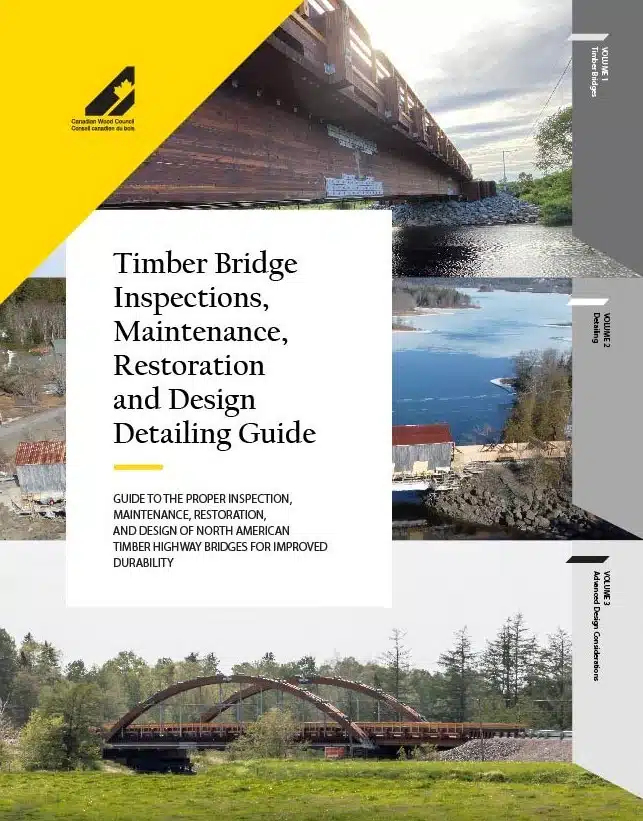
The second component focuses on timber highway bridge design. Key reference materials include Wood Highway Bridges (CWC), the Canadian Highway Bridge Design Code 2014 (CHBDC), CAN/CSA O86-14, and the Ontario Wood Bridge Reference Guide. The material covers wood bridge systems—including decks, superstructures, and substructures—with examples from Canada, the United States, and Europe demonstrating a variety of timber bridge types and designs. Durability considerations are emphasized, including protective roofing, preservative treatments, moisture control, proper detailing for drainage and airflow, and the use of corrosion-resistant connectors. A detailed design example of an 18 m single-span vehicular bridge is included, featuring transverse glulam deck panels on glulam girders. Structural analyses for deck panels and girders, stiffener beams, diaphragms, and major connections are provided, with calculations and code-based design methods aligned with CHBDC standards.

Together, these projects provide educators with a robust, ready-to-use teaching package that integrates theoretical knowledge, engineering calculations, construction documentation, and digital modeling. The resource supports instruction in both building and bridge mass timber systems, allowing students to explore structural design, durability, load transfer, and practical implementation in real-world contexts. It is intended to facilitate comprehensive learning in wood construction, bridging the gap between classroom theory and professional practice.

Acknowledgments

Lead Authors
Canadian Wood Council

Usage and Citation Guidelines

These teaching materials were developed by the Canadian Wood Council. The content is provided free of charge for teaching and educational purposes only. Any commercial use, redistribution, or modification outside of academic teaching is strictly prohibited.

When using these resources in any context that requires citation, please use the format below.

Author(s). (Year). Title of module [Teaching Module]. Funded and published by the Canadian Wood Council.

Building Science for Wood Buildings

Resource Description

This 8-lecture module provides a comprehensive introduction to the principles of thermodynamics and hydrodynamics as they apply to wood buildings. It equips students with a foundational understanding of building science, emphasizing the critical role of energy efficiency, air tightness, and moisture control in modern construction.

The module addresses the evolving demands of taller and larger wood buildings and highlights the impact of prefabrication on envelope assemblies and modern manufacturing methods. Content is specifically aligned with NBCC Divisions 5 and 9, ensuring relevance to structural and enclosure design standards. The package includes lecture slide deck; instructor lecture notes; and sample questions for assessment.

This resource is designed for architectural design educators aiming to deepen knowledge for their students in high-performance wood building envelopes and contemporary construction strategies.

Acknowledgments

Reviewers
Canadian Wood Council

Usage and Citation Guidelines

These teaching materials were developed by Scius Advisory and BIM One with funding support from the Canadian Wood Council. The content is provided free of charge for teaching and educational purposes only. Any commercial use, redistribution, or modification outside of academic teaching is strictly prohibited.

When using these resources in any context that requires citation, please use the format below.

Author(s). (Year). Title of module [Teaching Module]. Funded and published by the Canadian Wood Council.

Prefabrication of Wood Buildings

Resource Description

This module provides an introduction to wood prefabrication, exploring its various levels and methods to give students a fundamental understanding of the advantages, disadvantages, and market factors that influence its successful implementation. Designed for students in structural engineering or related disciplines, the module can be delivered flexibly as four blocks of 90–120 minutes, two blocks of 3–4 hours, or a single full-day session.

Acknowledgments

Lead Authors
Dr. Guido Wimmers

Reviewers
Canadian Wood Council

Usage and Citation Guidelines

These teaching materials were developed by Scius Advisory and BIM One with funding support from the Canadian Wood Council. The content is provided free of charge for teaching and educational purposes only. Any commercial use, redistribution, or modification outside of academic teaching is strictly prohibited.

When using these resources in any context that requires citation, please use the format below.

Author(s). (Year). Title of module [Teaching Module]. Funded and published by the Canadian Wood Council.

BIM for Wood Buildings – An Introductory Guide

Resource Description

This resource provides educators with an accessible introduction to Building Information Modeling (BIM) in the context of wood construction. It explains core BIM concepts, outlines the implications of adopting BIM, and demonstrates its value for efficiency, reliability, and sustainability. The guide serves as a clear starting point for teaching BIM practices to students in architecture and engineering, with practical examples to support classroom discussion.

Acknowledgments

Lead Authors
Scius Advisory and BIM One

Reviewers
Canadian Wood Council

Usage and Citation Guidelines

These teaching materials were developed by Scius Advisory and BIM One with funding support from the Canadian Wood Council. The content is provided free of charge for teaching and educational purposes only. Any commercial use, redistribution, or modification outside of academic teaching is strictly prohibited.

When using these resources in any context that requires citation, please use the format below.

Author(s). (Year). Title of module [Teaching Module]. Funded and published by the Canadian Wood Council.

Considerations in the Design & Prefabrication of Mass Timber Buildings for Architects

Resource Description

This resource is intended to provide educators with a clear framework for teaching the principles of mass timber design and prefabrication. The content is organized into four modules that highlight foundational knowledge, technical design considerations, early construction strategies, and sustainability. Together, these modules support students in developing a holistic understanding of how mass timber projects are conceived, designed, and delivered.

  • Module 1 – Introduction & Project Planning Provides an overview of mass timber, highlights the advantages of prefabrication, and outlines key early-stage considerations for optimizing design.
  • Module 2 – Design Optimization Considerations Explores critical aspects of design including structural performance, fire protection, acoustics, and vibration.
  • Module 3 – Early Construction Strategies Focuses on Building Information Modeling (BIM), Design for Manufacture and Assembly (DfMA), systems integration, and best practices for building envelope and moisture management.
  • Module 4 – Life Cycle Assessment (LCA) Examines the importance of carbon accounting, introduces available LCA tools, and discusses broader sustainability and biophilia considerations.

Acknowledgments

Canadian Wood Council

Usage and Citation Guidelines

These teaching materials were developed by university professors with funding support from the Canadian Wood Council. The content is provided free of charge for teaching and educational purposes only. Any commercial use, redistribution, or modification outside of academic teaching is strictly prohibited.

When using these resources in any context that requires citation, please use the format below.

Author(s). (Year). Title of module [Teaching Module]. Funded and published by the Canadian Wood Council.

Condensed Timber Engineering Module for Hybrid Course

Resource Description

This module series is designed for use in 3rd- or 4th-year steel design courses, providing an efficient way to introduce key wood design concepts within a steel-focused curriculum. It represents a condensed version of the full 10-lecture undergraduate wood design course, distilling the essential principles, methodologies, and applications into a streamlined format. The series can be delivered over approximately four 50-minute lectures, making it suitable for integration into existing course schedules without requiring extensive additional class time. Each module is structured to offer clear explanations, practical examples, and relevant exercises, ensuring that students gain a solid understanding of wood design fundamentals while complementing their study of steel structures.

Acknowledgments

Lead Authors
Dr. John Gales Dr. Chorlton Bronwyn

Usage and Citation Guidelines

These teaching materials were developed by university professors with funding support from the Canadian Wood Council. The content remains the intellectual property of the respective author(s) and is provided free of charge for teaching and educational purposes only. Any commercial use, redistribution, or modification outside of academic teaching is strictly prohibited.

When using these resources in any context that requires citation, please use the format below.

Author(s). (Year). Title of module [Teaching Module]. Funded and published by the Canadian Wood Council.

An Overview of Sustainable Forestry in Canada for Architecture and Engineering Students 2022

Resource Description

Canada: A Forest Country

With 362 million hectares of forest, Canada is the third-most forested country in the world.

Acknowledgments

Prepared by:
The Mass Timber Institute at the University of Toronto’s John H. Daniels Faculty of Architecture, Landscape, and Design for the Canadian Wood Council.

Lead Authors
Monique Dosanjh
Shan Shukla
Sanjana Patel
Dr. Anne Koven

Usage and Citation Guidelines

Coming soon

CIVE480 Timber Structures 2019

Resource Description

This course provides a comprehensive introduction to wood and timber engineering, covering materials, structural applications, and design principles. Historical and modern timber structures are examined, with practical design examples provided throughout to reinforce key concepts. Students will explore sawn lumber, panel products, and engineered wood products such as glulam, structural composite lumber, and CLT, along with their applications and design considerations. The course also covers lateral load-resisting systems, member design for bending, tension, and compression, as well as connections, fasteners, and fire safety design.

Building Canada’s Future With Wood
Scaling Affordable Rental Housing with Tall Mass Timber
Unlocking Affordable Timber Innovations in Structure, Prefabrication, and Code
Webinar – Online Tools for Wood Construction: CodeCHEK, FRR & STC & EMTC Calculator
WoodWorks Building Tour – Pictou County Mass Timber Buildings
Wood Design & Building Magazine, vol 25, issue 101
FRAMEWORK for Success: Prefabricated Wood Systems and Design Innovation
International Perspectives on Sustainable Housing Development

Get Access to Our Resources

Stay in the loop and don’t miss a thing!

1
2
3

Get Access to Our Resources

Stay in the loop and don’t miss a thing!

What’s Your Occupation?

Help us personalize the content for you.

What Interests You the Most?

Help us personalize the content for you.

Filters

Expertise Icon
Field of Expertise
Province Icon
Province
Member Type Icon
WoodWork National Partners

Filters

Post Type Icon
Post Type
Persona Icon
Persona
Language Icon
Language
Tags Icon
Tags
Mass Timber Plus Icon Environment Plus Icon Safety Plus Icon Durability Plus Icon Design Systems Plus Icon Budget Plus Icon Construction Management Plus Icon Fire Resistance Plus Icon Tall Buildings Plus Icon Short Buildings Plus Icon
Date Icon
Date
Line Separator