Timber structures are getting bigger and higher with the availability of economical mass timber products on the market. Timber is also very attractive to designers in seismic-prone regions because of its advantageous strength-to-weight ratio. However, resilience becomes an issue as traditional ductility strategies are not low-damage and result in loss of stiffness following a seismic event.
In this presentation, basic concepts of seismic engineering and structural ductility are reviewed. The drawbacks of typical timber connections designed to provide ductility to timber structures are identified along with the long-term consequences. Resilient seismic dampers provide a solution to this issue. They are self-centering friction devices that do not get damaged within their ultimate capacity. The technology behind the resilient friction dampers is explained along with their application in different structural case studies.
Learning Objectives
Understand fundamental seismic engineering concepts.
Identify limitations of conventional timber ductility strategies.
Evaluate the role and performance of resilient seismic dampers.
Course Video
https://vimeo.com/1110081058?share=copy#t=0
Speaker Bio
Pierre Quenneville Professor of timber design, The University of Auckland CTO, Tectonus Ltd.
David Bowick has received many industry honours since he began his career in 1990. His inventive approach to design has made him sought-after, particularly when a project calls for innovative solutions. He is a three-time recipient of the WoodWorks Building the Future engineer award, and has received awards for his work in wood, concrete and architectural steel. Dozens of projects he has worked on have been granted awards in the field of architecture, such as the Perimeter Institute for Theoretical Physics and the French River Visitors Centre (both recipients of the Governor General’s Award).
An avid teacher, David is an adjunct professor in the Masters in Architecture program at the University of Toronto. He is a frequent guest speaker on the topics of architecture and engineering, and contributes to the industry through committees and events. His writing has appeared in several publications, including Concrete Toronto.
David is a licensed professional engineer in the provinces of Ontario, British Columbia, Alberta and New Brunswick. He is a member of the Canadian Standards Association Technical Committee on CAN/CSA-O86, Engineering Design in Wood and a member of the Technical Committee responsible for the Engineering Guide for Wood Frame Construction.
A Zero Carbon Hybrid Wood Supertall Future
Course Overview
With buildings generating 40% of global carbon emissions, we need to achieve net-zero by 2050 to meet the Paris Agreement target and limit global warming to 2°C. Timber sequesters an average of 1.9 metric tons of carbon-dioxide equivalent emissions per cubic meter (Sathre & O’Connor, 2010). While a purely mass timber tall building may not be the most cost-efficient solution, a hybrid structure can maximize the overall use of wood by volume in the most cost-efficient manner. Floor systems in buildings contribute as much as 73% of the environmental impact of a high-rise building’s structure (Lankhorst et al., 2019), making them an excellent target for reducing embodied carbon.
DIALOG’s patent- pending Hybrid Timber Floor System (HTFS) takes advantage of the benefits of cross-laminated timber (CLT) combined with pre-stressed concrete to achieve a 12-metre column-free span. The HTFS is proposed as part of our Hybrid Timber Tower, a 105-storey mixed-use prototype that is being evaluated and tested by DIALOG and EllisDon. The prototype structure consists of the hybrid timber floor, combined with a concrete core and an external steel frame. Fire safety is achieved in the floor panels as the exposed wood chars to form a protective layer, while the non-combustible concrete and steel band continues to support the panel. The exposed CLT panels also provide a biophilic appeal, which has shown to support cognitive function as well as physical and psychological well-being (Vidovich, 2020). DIALOG, EllisDon, FPInnovations and other partners have completed the first phase of small-scale testing on over 40 panels. We are scheduled for fire testing of the panels in Ottawa with NRCan this fall with full scale testing of the 12-meter panels starting in late 2022.
Learning Objectives
Describe how hybrid mass timber systems—such as the Hybrid Timber Floor System (HTFS)—reduce embodied carbon and support zero‑carbon goals in high-rise, mixed-use developments.
Explain the structural, fire safety, and performance characteristics of hybrid CLT–concrete floor assemblies, including how charring, concrete bands, and steel elements contribute to long-span capability and code compliance.
Evaluate the role of multidisciplinary research, prototyping, and large-scale testing in validating hybrid timber technologies for supertall applications, including their impacts on sustainability, biophilia, and cost efficiency.
Craig Applegath is the founding principal of DIALOG’s Toronto Studio, and a passionate designer who believes in the power of built form to meaningfully improve the wellbeing of communities and the environment they are part of. Since graduating from the Graduate School of Design at Harvard University with a Master of Architecture in Urban Design Craig has focused his energies on leading innovative planning and design projects that address the complex challenges facing our communities, as well as on his advocacy of sustainable building design and urban regeneration and symbiosis. Craig’s area of practice includes the master planning and design of institutional projects, including post secondary education, healthcare facilities, as well as the design of innovative mixed-use- facilities.
Craig was a founding Board Member of Sustainable Buildings Canada, a Past President of the Ontario Association of Architects, and the current moderator of SymbioticCities.net. Craig has lectured or taught at Harvard, the University of Toronto, the University of Waterloo, as well as at many professional and sector related conferences around the world. In 2001 Craig was made a Fellow of the Royal Architectural Institute of Canada for his contributions to the profession of architecture. In 2017 he was presented with the OALA Honourary Membership Award for his contributions to the cause of landscape architecture in Ontario.
Neel Bavishi, PEng, CEM Building Performance Analysis, Associate DIALOG
Neel is passionate about applying the art and science of building performance simulation and data-driven design to produce positive outcomes for the built environment. He embraces holistic solutions that minimize the environmental impact of building assets while providing enhanced value to building owners, developers, policymakers, and designers through improved well-being and reduced total cost of ownership. Neel believes that an integrated and collaborative approach that incorporates diverse perspectives is essential for delivering high-performance buildings.
A mechanical engineer by training, Neel is well-versed in whole-building energy modelling for both new and existing buildings and lifecycle cost analysis, design optimization, and data visualization. His experience includes developing energy models for green building certification programs, carbon-neutral retrofit studies and district energy strategies, and the development of net-zero energy and emissions policies and standards for municipal, provincial, and federal government bodies. His projects span various asset classes, including recreational facilities, commercial high-rise towers, multi-unit residential buildings, hospitals, data centres, and transit facilities. He is a licensed Professional Engineer in the province of Ontario and is a Certified Energy Manager.
Cameron is an Associate on the Structural Engineering team in DIALOG’s Toronto studio. Since graduating with a PhD from the University of Toronto, Cameron has acted as a structural design engineer and project manager across a variety of sectors and project types, including healthcare, institutional, government, and retail. He has experience in all stages of a project delivery, from feasibility studies through construction administration and management.
Cameron is DIALOG’s project manager for the hybrid timber floor system (HTFS) research program, working closely with industry partners EllisDon. He is passionate about exploring mass timber wherever possible as a sustainable solution to our building needs.
Innovative Strategies for Light-Frame Mid-Rise Buildings in High-Seismic Regions
Innovative Strategies for Light-Frame Mid-Rise Buildings in High-Seismic Regions presents a detailed design example and practical guidance for engineers and builders responding to rising seismic demands on Canada’s West Coast. With the 2020 National Building Code of Canada significantly increasing seismic forces—particularly in Vancouver and Vancouver Island—conventional light-wood-frame (dimensional lumber) shearwall systems often no longer meet code requirements without costly additions.
This guide, prepared by WHM Structural Engineers for WoodWorks BC and the Canadian Wood Council, explores two high-capacity shearwall solutions: Mid+Std walls, a code-compliant adaptation of Midply construction that achieves roughly 50% greater capacity than standard walls without increasing wall length, and Double Nail walls, a research-based approach using double rows of edge nails to match Mid+Std strength. Combined with lightweight floor topping strategies, these systems enable six-storey light-frame buildings to remain viable and cost-competitive even on poor soils and in the highest seismic regions.
Cost analysis shows Mid+Std walls incur about a 30% framing cost increase over baseline, while Double Nail walls add about 20%, both more economical than doubling corridor wall lines. The publication includes complete design calculations, construction considerations, and conceptual connection details to help practitioners implement these strategies confidently.
This resource equips designers, contractors, and owners with practical, innovative approaches to maintain the competitiveness of light-frame wood construction while meeting the stringent seismic requirements of the latest building codes.
Engineers, architects, building code officials, builders, developers, students and professors all turn to Introduction to Wood Building Technology – the most current guide to the construction of wood buildings.
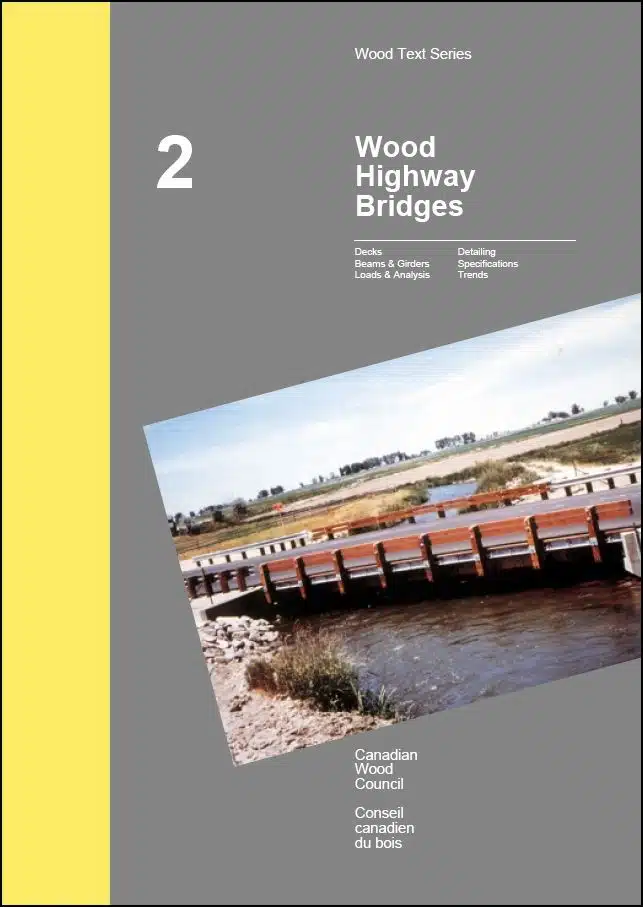
Wood Highway Bridges demonstrates how wood bridges can be designed to be assembled rapidly, resist deterioration caused by de-icing chemicals, and utilize stress-laminating in decks to provide long-term performance.
The Art Gallery of Ontario (AGO) was founded in 1900 as the Art Museum of Toronto. In 1919 it became the Art Gallery of Toronto and in 1966, took on its present name. The original gallery was a home (The Grange) built around 1817, located on the south side of the AGO facing Grange Park (Figure 1). In fall 2008, the Art Gallery of Ontario received wide acclaim when its recent renovation and addition, designed by Frank Gehry, was opened to the public. The work involved the renovation of existing spaces and the addition of 9,016 m2 (92,000 ft.2) of new floor space. The renovation and addition to the AGO is notable for several reasons. First, the design needed to unify and enhance previous constructions done in 1918, 1929, the 1970s and the 1980s. The design team made extraordinary use of structural and decorative wood elements to achieve this goal, as well as to lure, calm, entice and amaze visitors. In addition, the AGO needed to remain functional for prolonged periods during the construction process. Finally, the wood design, fabrication and erection was very complex. In the words of Bill Downing of Structurlam Products Ltd., the glulam supplier, in reference to the Galleria Italia portion of the AGO, “This is the most complex wood structure in North America.”
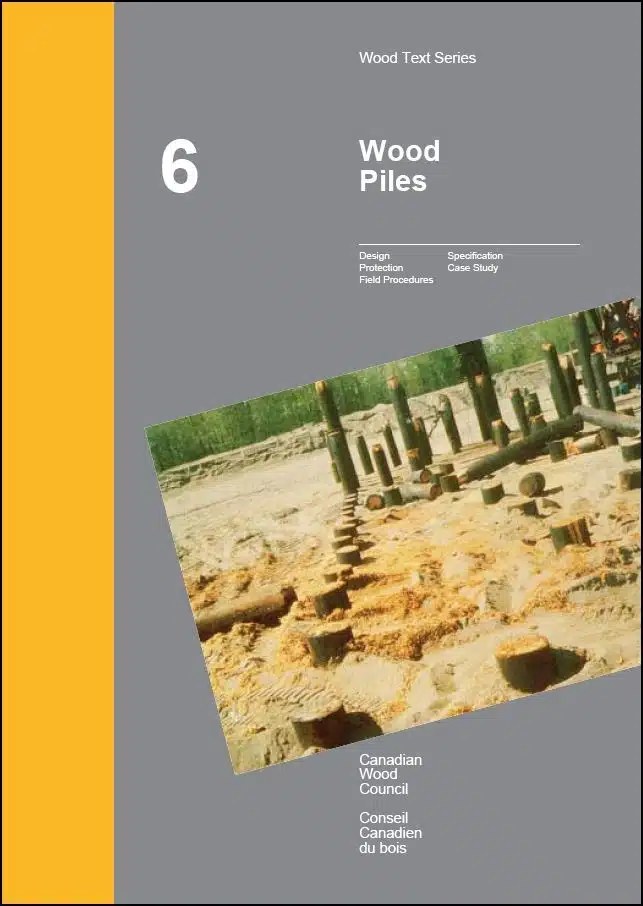
Wood Piles provides clear and concise coverage of a topic that is often considered obscure However, wood piling has been used around the world to support heavy loads for centuries – and it is still in use today
B.C. Restaurants (The Old Vines & The Hooded Merganser)
Eating and drinking are social activities best enjoyed in a warm, relaxing and comfortable atmosphere. These activities have had a long association with wood, which has traditionally been used for making tables, chairs and other furniture as well as for wine casks and beer barrels. Wood floors and exposed beams have been features of hostelries and restaurants across the world for centuries, and continue to lend a unique quality to contemporary dining establishments. The two examples included here are both located in the Okanagan Valley in the southern interior of British Columbia. Although they are very different in architectural character, they both use wood with great effectiveness to create the appropriate dining ambience.
Calgary’s aspirations to become a world-class city are supported by its recent investments in infrastructure and architecture, including the $192-million Shane Homes YMCA at Rocky Ridge, which was bolstered by the largest private donation ever contributed to the local YMCA. Shane Homes is a Calgary-based development company, established in 1979, that contributed $3.5 million for the project.
This is the first recreational facility for the northwest corner of the city, serving a community of more than 100,000 residents. Nestled in Calgary’s rolling foothills, the curvilinear design of the Shane Homes YMCA at Rocky Ridge is inspired by the surrounding landscape. The building is sited within a natural park featuring reconstructed wetlands. Multiple pathways and a timber pedestrian bridge curve throughout the site, linking to the regional pathway system.
Glulam timber is the primary structural component, allowing for a geometrically complex design at considerably less cost than other materials. The dramatic silhouette is dened by the largest freeform timber roof structure in North America. Construction began in 2014, and since opening to the public in January 2018, this new recreation centre has become a bustling hub of sport and activity. The Shane Homes YMCA has won numerous awards, including a 2019 Wood WORKS! Prairie Wood Design Award, a 2018 Canadian Wood Council Award and a 2017 CanBIM Best in BIM Award.
Efficient Tall Wall Framing using Engineered Wood Products
Course Overview
This webinar will explore the basic design principles and best practices for efficient tall wall design using engineered wood products. Discussion will include material selection, design for climate conditions, and a complete design example using freely available software tools.
Learning Objectives
Understand the design principles and inputs required to size tall wall framing members.
Recognize some of the pitfalls of inadequate tall wall design.
Learn about easy-to-use tools and software available to simplify this process.
Course Video
https://vimeo.com/1112024587?share=copy#t=0
Speaker Bio
Steve McManus Senior Engineer Weyerhaeuser
Steve McManus, a professional engineer based in Langley, BC, supports Weyerhaeuser’s Trus Joist® Engineered Lumber Products in residential and light commercial construction. He provides technical support, training, and field issue resolution for suppliers, architects, engineers, and building officials across Canada.
Steve’s 27 years of experience in the forest industry includes structural design and engineering, forest management, and wood products manufacturing.
Understanding Glulam: The structural and architectural capabilities of mass timber
Course Overview
In this course, you’ll gain insight into the design and manufacturing considerations involved in using glulam in buildings. As one of the oldest mass timber products used in Canada, glulam offers exceptional flexibility and can be incorporated into a wide range of building types—particularly where curvature and expressive geometry are key. Presenters will outline design and manufacturing strategies for creating efficient structures, showing how glulam can be used not just as columns and beams, but as the primary structure in today’s innovative buildings—whether architecturally driven or focused on value and efficiency. They will also cover the availability of glulam products across Canada and explain how to maximize the value of the timber used. Practical tips will be shared to help designers and specifiers take full advantage of glulam’s attributes in a cost-efficient way.
Learning Objectives
Participants will learn the design strategies employed when using curvature and geometry in buildings and gain an understanding of what is possible with expressive architecture.
Participants will understand the practical constraints of glulam manufacturing, including how to approach the design and specification of glulam members.
Participants will learn how different wood species and strength grades are applied in glulam design, and how to use them efficiently for optimal performance.
Participants will understand how geometry, fire ratings, and member layups influence the cost-efficiency and design potential of glulam systems.
Course Video
https://vimeo.com/1132255489
Speakers Bio
Andre Lema Manager of Business Development Western Archrib
Andre Lema, a seasoned professional in the wood industry, brings decades of experience and expertise. Starting as a carpenter and advancing through a degree in Construction Engineering at NAIT, Andre has been instrumental in driving the success of Western Archrib. His passion for wood and dedication to fostering client relationships have made him a key figure in the industry.
Alejandro Coronado, P.Eng. Technical Advisor WoodWorks BC
Alejandro Coronado is a Technical Advisor with a multidisciplinary background spanning contracting, supply, and consulting engineering. With both a Diploma and a Bachelor’s Degree in Structural Engineering from BCIT, Alejandro began his career in single-family residential design and steadily advanced to contribute to landmark projects such as the Centre Block Base Isolation at Parliament Hill, the UBC Museum of Anthropology Great Hall Renewal, the Royal BC Museum PARC Campus, and a mass timber campus in Silicon Valley. Initially drawn to mass timber for its expressive architectural potential, Alejandro quickly recognized its broader value in addressing today’s social and environmental challenges. Through many years of hands-on experience, Alejandro has become a champion for sustainable construction and simple yet effective structural solutions.
Sizer Course – US
Course Overview
The Sizer Course provides an in-depth introduction to the WoodWorks Sizer Program, a powerful tool for designing and analyzing structural elements such as beams, columns, wall studs and panels. The course covers key features, including load input, load patterns, bearing design, beam design, column design, lateral support considerations, and “concept mode” for preliminary structural modelling.
You will explore how the program optimizes designs by automatically generating load patterns, checking compliance with building codes, and refining structural elements for improved performance.
Course Learning Outcomes
By the end of this course, you will be able to:
Design and analyze structural elements using the WoodWorks Sizer Program, including beams, columns, and CLT panels, while considering material selection, loading conditions, and code compliance.
Evaluate load distribution and structural stability by applying Sizer’s automated features for pattern loading, lateral support analysis, and fire resistance adjustments.
Optimize structural designs through Concept Mode and detailed element analysis, ensuring efficient material use, proper load transfer, and adherence to engineering best practices.
Course Structure
This course consists of six (6) lessons. Each lesson is comprised of a lesson overview, learning outcomes, instructional videos, assessment questions and an assignment. Through these elements, you will gain practical experience in using the Sizer Woodworks Program for real-world applications.
Once you have completed all assessment questions and assignment submissions, a certificate of completion will be digitally awarded.
Time for Completion
This course is comprised of eight videos for a total run time of 53 minutes.
To complete the assessments in this course you can expect to spend ~ 85 minutes.
Program Download
In order to complete this course you will need to download a trial version of the SizerProgram.
Complete these steps to download the program:
Navigate to the program download page by clicking here.
Click on the “Download Now” button for the US SizerProgram.
Locate and click on the download either in your browser or on your computer.
Follow the prompts provided by your computer to complete installation.
*Note: the trial version of the program is only valid for 10 days upon installation.
Condensed Timber Engineering Module for Hybrid Course
Resource Description This module series is designed for use in 3rd- or 4th-year steel design courses, providing an efficient way to introduce key wood design concepts within a steel-focused curriculum....
Wood in Education
...buildings supports sustainability, promotes health and motivates learning. Learning Objectives How wood was used to create a healthy learning environment. How wood was used to create a sense of wellbeing...
...wood frame buildings that have provided strong and lasting housing for a multitude of people. Although wood can withstand much abuse, it needs to be stored and handled properly to...
BIM for Wood Buildings – An Introductory Guide
...Canadian Wood Council Usage and Citation Guidelines These teaching materials were developed by Scius Advisory and BIM One with funding support from the Canadian Wood Council. The content is provided...
Tallwood 1
...competitive option and we will share some with you in this presentation using the recently completed Tallwood 1 building in Langford, BC. Tallwood 1 is the first 12-story mass timber-steel...
Prefabrication of Wood Buildings
Resource Description This module provides an introduction to wood prefabrication, exploring its various levels and methods to give students a fundamental understanding of the advantages, disadvantages, and market factors that...
Shifting Gears: World’s First Passivehouse Auto Dealership
...and sustainable construction in the industrial sector. The project shows that manufactured wood products are not only capable but preferable when designing sustainable buildings. The use of wood not only...
Durability by Design
...exterior, especially when wood is exposed to the elements. Knowing what happens to the wood when exposed to moisture or the sun’s UV rays and applying that information, results in...
Low Carbon Buildings AND Energy Systems? Yes, We Wood.
Course Overview As Toronto grows, so does the need for housing and energy. The use of wood products presents a tremendous opportunity to meet these essential needs while reducing greenhouse...
Shearwall Connections and Lateral Systems for Wood Buildings
Course Overview This comprehensive course delves into the latest advancements in wood shearwall systems and connections, featuring critical updates from the 2020 National Building Code of Canada (NBCC). This course...
Bringing Mass Timber Mainstream: Unpacking Market Challenges and Opportunities
...two ASC Annual International Conferences (2009 and 2011). Annabelle Hamilton Executive Director WoodWorks BC Annabelle is the Executive Director of WoodWorks BC Team, overseeing active engagement, technical support and strategic...
Encapsulated Mass Timber: A New Construction Type for the 2020 NBC
...timber fire testing. Course Video https://vimeo.com/1046519298 Speaker Bio Marc Alam Manager, Codes and Standards in the fire division Canadian Wood Council Marc Alam is a member of the Canadian Wood...
Course Overview Canadian Nuclear Labs’ Chalk River Laboratories comprise the largest single complex in Canada’s science and technology community. The site contains more...
Sudbury, Ontario, located at the edge of a large geological structure known as the Sudbury Basin (a 1.85-billion-year-old meteorite impact crater), is home to Canada’s...
Modern six-storey light-frame wood construction in British Columbia (BC) incorporates highly-detailed, researched and safe solutions. the engineering technology being adapted...
Mountain Equipment Co-op (MEC) is one of Canada’s most progressive retailers, having embraced a philosophy of corporate, social and environmental responsibility since its...
The District of Thunder Bay Social Services Administration Board (the Board) delivers provincially mandated services to 13 communities in Northwestern Ontario. To help...
Aperçu du cours Le cours Shearwalls présente aux apprenants le programme WoodWorks Shearwalls, un outil conçu pour la modélisation et l'analyse des structures à ossature...
The National Energy Code of Canada for Buildings (NECB) aims to help save on energy bills, reduce peak energy demand, and improve the quality and comfort of the building's...
Recognizing the barriers to adoption, the Canadian Wood Council has proactively mobilized a response strategy. As a first step, we have commissioned several studies to...
Course Overview Join us for an introduction to a new, comprehensive Canadian technical reference guide to mass timber. Canada’s inherent building-with-wood culture lays a...
Course Overview From the housing supply deficit to affordability issues and labour challenges, several conditions have been supporting a renewed interest for innovation in...
Course Overview Discover the innovative approach to housing supply undertaken by Pathway Non-Profit Community Developments Inc. of Peel. The Arbor Mill expansion sets a...
Course Overview As global adoption of mass timber construction accelerates, a growing number of solutions are available in the marketplace that can contribute to the success...