en-ca

Searching for: Wood

Searching results for “Wood”
256 results found...
Sort By Dropdown Icon

Algonquin College Perth Campus

Algonquin College is a major provider of post-secondary education in Eastern Ontario, with campuses in Ottawa, Perth and Pembroke. The Perth Campus is located in the Town of Perth, approximately 65 km west of Ottawa. In keeping with Perth’s historic involvement with the Rideau Canal World Heritage Site, the Perth Campus’ area of excellence is heritage preservation training, which draws students from the local community and from around the world.

In 2009, planning began for a new building capable of accommodating more students. During construction of the new building, comprised of the Academic Hall and the Construction Wing (Figure 1), classes continued in an old building that was subsequently demolished. A new outdoor construction pad is located over the footprint of the old building. The new building was ready for classes in September 2011, one year after the start of construction.

The town of Perth has a rich history, reflected in the nineteenth-century mills and factory buildings along the Tay River, Victorian storefronts and grand, century-old, timber-frame buildings. The Algonquin College Perth Campus building sought to blend with this fabric through the use of traditional forms, locally sourced materials, and woodframe construction.

Community Resource Centre

The Greenfield Community Resource Centre and Elementary School is located in a small, isolated forestry community in Nova Scotia where 16.1 % of employment is provided by the forestry sector. This forestry based community is proud of its local heritage. Indeed, in 1987 it was dubbed the “Forestry Capital of Canada” and to this day has a “Build First with Wood” policy in place for new construction. The Resource Centre, valued at $1.3 million Canadian dollars, was built by a non-profit community group to replace an insufficient and outdated building that was over 60 years old.

Richmond Olympic Oval

The Richmond Olympic Oval is the largest structure to be built for the Vancouver 2010 Olympic Winter Games. Designed to accommodate the long track speed-skating events before an audience of more than 8000 spectators, the building features a 6 acre (2.5 hectare) free spanning roof that is a precedent setting example of British Columbia’s and Canada’s advanced wood engineering and prefabrication capabilities. The building is located a short distance from Vancouver’s International Airport in the City of Richmond, where after the Games, it will be transformed into a multi-sports training and recreation facility at the centre of a new residential and commercial neighbourhood. Construction of the project began in 2005, and the building was opened on time and under budget in December 2008.

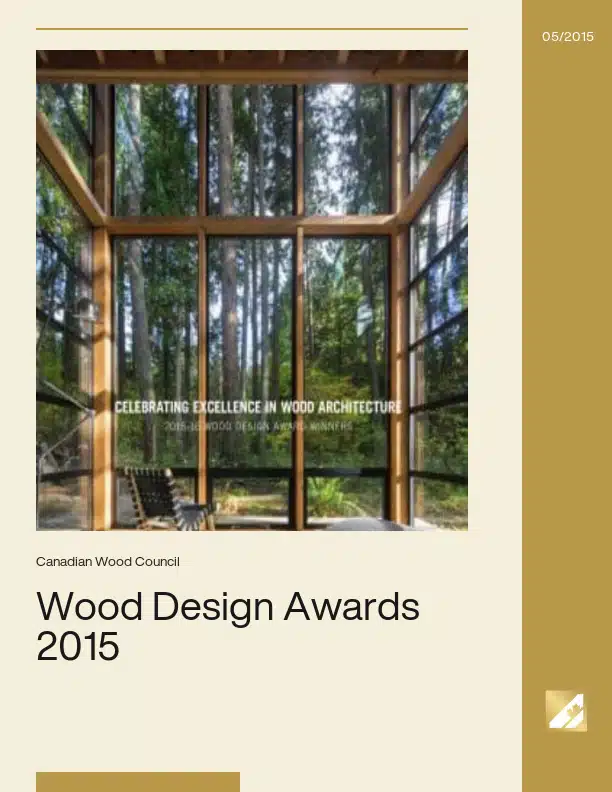
Wood Design Awards 2014

Engineering Guide for Wood Frame Construction 2014

The Engineering Guide for Wood Frame Construction has been produced by CWC to provide guidance to engineers, building designers, building officials, builders, and students of these disciplines on the structural design of wood elements and connections for wood frame buildings that fall within the scope of Part 9 of the NBC. The Guide was revised, in this 2014 Edition, in order to conform to changes in the 2015 edition of the NBC.

Fire Safety Challenges of Tall Wood Buildings

Acknowledging the growing importance of designing sustainable buildings and addressing overpopulation concerns, the development of engineered wood products has introduced the possibility of constructing high-rise timber structures that can improve both these conditions. However, as a combustible material, one of the biggest barriers to construction of tall timber buildings is the potential fire risk resulting from the combustible structure. In November 2012, the Fire Protection Research Foundation commissioned the Fire Safety Challenges of Tall Wood Buildings study to address this concern. Phase I of this two-phase study seeks to collect the available knowledge of fire safety in timber structures and identify gaps in knowledge that would further the understanding of fire performance of tall timber buildings. Results of the study, including a summary of timber construction and fire dynamics, is presented herein.

Wood Design Awards 2013

Wood Design Awards 2012

The Case for Tall Wood Buildings

Wood is the most significant building material we use today that is grown by the sun. When harvested responsibly, wood is arguably one of the best tools architects and engineers have for reducing greenhouse gas emissions and storing carbon in our buildings. The Case for Tall Wood Buildings expands the discussion of where we will see wood and specifically Mass Timber in the future of the world’s skylines. As we pursue the solar and green energy solutions that Thomas Edison spoke of over 80 years ago, we must consider that we are surrounded by a building material that is manufactured by nature, a material that is renewable, durable and strong.

This report introduces a major opportunity for systemic change in the building industry. For the last century there has been no reason to challenge steel and concrete as the essential structural materials of large buildings. Climate change now demands that we do. The work of thousands of scientists with the United Nations Intergovernmental Panel on Climate Change (IPCC) has defined one of the most significant challenges of our time. How we address climate change in buildings is a cornerstone in how the world will tackle the need to reduce emissions of green house gases and indeed find ways to store those same gases that are significantly impacting the health of our planet. Just as the automobile industry, energy sector and most other industries will see innovations that challenge the conventions of the way we will live in this century, the building industry must seek innovation in the fundamental materials that we choose to build with. In a rapidly urbanizing world with an enormous demand to house and shelter billions of people in the upcoming decades we must find solutions for our urban environments that have a lighter climate impact than today’s incumbent major structural materials. This report is a major step in that direction. Indeed it introduces the first significant challenge to steel and concrete in tall buildings since their adoption more than a century ago.

Wood Design Awards 2011

Wood Design Awards 2010

Wood Reference Handbook

The Wood Reference Handbook is much more than a guide to the architectural use of wood in building construction – it is a beautifully assembled homage to fine wood craftsmanship throughout the world.

Wood in Commercial Buildings
...two storeys. As a result, wood building types now include office, residential, mercantile, assembly, low hazard or storage/ garage uses. This case study examines two wood buildings, both with primary...
Laurentian University McEwen School of Architecture – Sudbury, ON
...culture, wood construction, local ecologies and resources, and design for the impact of climate change. The school is a didactic instrument with structural and HVAC design elements purposefully exposed in...
IBS4 – Sustainability and Life Cycle Analysis for Residential Buildings
...construction is never fully benign for the environment, designers and builders can make choices to minimize the impact. Wood plays an important part in sustainable design, as shown by scientific...
Vertical Movement in Wood Platform Structures: Basics
...is primarily related to shrinkage or swelling caused by moisture loss or gain when the moisture content is below 28% (wood fiber saturation point). Other movement in wood structures may...
Vertical Movement in Wood Platform Structures: Design and Detailing Solutions
...in the design drawings. Simply specifying wood materials with lower MC at time of delivery does not guarantee that the wood will not get wet on construction sites and will...
Vertical Movement in Wood Platform Structures: Movement Prediction
...this series of fact sheets. Different from solid sawn wood products, Engineered Wood Products (EWP) are usually manufactured with MC levels close to or even lower than the equilibrium moisture...
WPC Specification Guide for Non Residential Pressure Treated Wood Products Web
...properly protected, its service life can be extended for many years. The most effective way of protecting exposed wood is the use of wood preservatives. Preserved wood products can have...
Mass Timber Insurance Action Plan Phase 1 Report – Test
...unfamiliarity rather than demonstrated risk. Led by the Climate Smart Buildings Alliance and the Canadian Wood Council, and supported by Natural Resources Canada, this report summarizes the findings from Phase...
Alternative Solutions Guide
...techniques, enabled by a range of engineered wood products, associated connection technologies, and fabrication methods, has resulted in a wide range of possible building solutions that may not have been...
Timber Bridge Inspection, Maintenance, Restoration and Design Detailing Guide
This 3-volume guide on timber bridge inspection, maintenance, restoration, and detailing covers everything you need to know about detailing durable wood bridges, starting with a thorough description of wood’s unique...
Promoting Health and Wellness with Wood Architecture
...timber buildings also benefit workers throughout the construction process by reducing construction time, and prefabricated elements contribute to cleaner, safer building sites. The team at the Canadian Wood Council/Wood WORKS!...
In 2009, the British Columbia Building Code (BCBC) was amended to permit residential buildings of up to six storeys to be constructed in wood. Since then, through a five-year...
Located in Sudbury, Ontario, Laurentian University’s McEwen School of Architecture is the first new school of architecture to be built in Canada in 40 years. Its mandate is...
Environmental awareness in building design, construction and operation is stronger than ever. But how can we meet the world’s rapidly growing need for buildings and still...
Movement in structures due to environmental condition changes and loads must be considered in design. Temperature changes will cause movement in concrete, steel and masonry...
Most buildings are designed to accommodate a certain range of movement. In design, it is important for designers to identify locations where potential differential movement...
It is not possible or practical to precisely predict the vertical movement of wood structures due to the many factors involved in construction. It is, however, possible to...
Wood is the only renewable building material within the three major building material types. In exterior applications, wood is subject to deterioration from natural elements...
Mass Timber Insurance Action Plan – Phase 1 Report examines one of the most significant barriers to scaling mass timber construction in Canada: access to affordable and...
While alternative solutions have been an important feature of the National Building Code of Canada since 2005, there remains a lack of understanding among building...
This 3-volume guide on timber bridge inspection, maintenance, restoration, and detailing covers everything you need to know about detailing durable wood bridges, starting...
The year 2020 will forever be synonymous with COVID-19. After experiencing the pandemic and its ripple effects, few would question the importance of health and wellness. What...
1
2
3

Get Access to Our Resources

Stay in the loop and don’t miss a thing!

What’s Your Occupation?

Help us personalize the content for you.

What Interests You the Most?

Help us personalize the content for you.

Filters

Expertise Icon
Field of Expertise
Province Icon
Province
Member Type Icon
WoodWork National Partners

Filters

Post Type Icon
Post Type
Persona Icon
Persona
Language Icon
Language
Tags Icon
Tags
Mass Timber Plus Icon Environment Plus Icon Safety Plus Icon Durability Plus Icon Design Systems Plus Icon Budget Plus Icon Construction Management Plus Icon Fire Resistance Plus Icon Tall Buildings Plus Icon Short Buildings Plus Icon
Date Icon
Date
Line Separator