Searching for: Wood

Searching results for “Wood”
328 results found...
Sort By Dropdown Icon

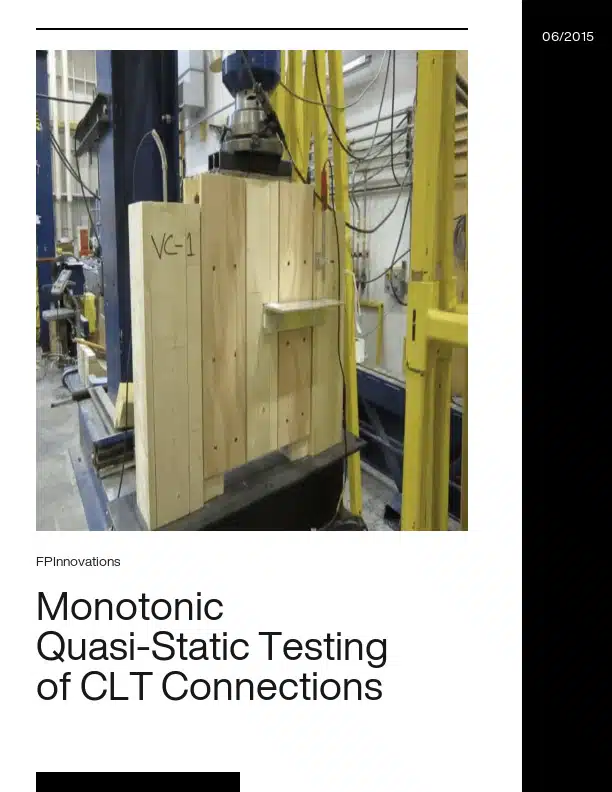
Monotonic Quasi-Static Testing of CLT Connections

This testing program was carried out by the Advanced Building Systems (ABS) Department of FPInnovations in response to a request from Mrs. Julie Frappier from Nordic Engineered Wood for the evaluation of the mechanical properties of three (3) different assemblies for attaching Cross Laminated Timber (CLT) panels. Each of the assemblies consisted of six (6) specimens for a total of eighteen (18) tests. All specimens were manufactured by Nordic Engineered Wood and delivered to FPInnovations’ laboratory in Québec City.

The key objective was to evaluate the mechanical properties pertinent for the design of CLT panel connections exposed to in-plane loading such as diaphragms or shear walls. The evaluation of the ultimate loading capacity (𝐏𝐮𝐥𝐭) and the stiffness (K) of the connections are thus the main focus of this study.
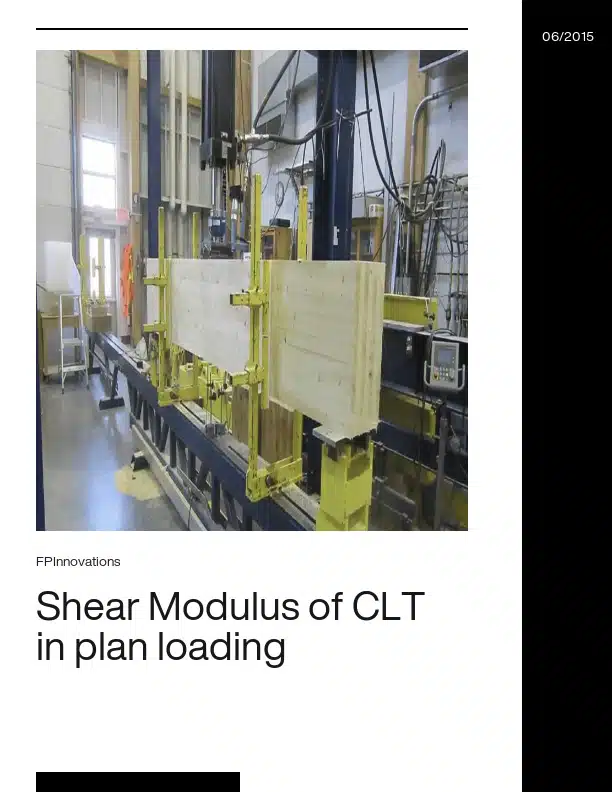
Shear Modulus of CLT in plan loading

A testing program was carried out by the Advanced Building Systems (ABS) Department of FPInnovations in response to a request made by Mrs. Julie Frappier of Nordic Engineered Wood Products for the evaluation of the effective shear modulus of eight (8) different Cross-laminated Timber (CLT) configurations or series. The test matrix consisted of a total seventy (70) specimens and each specimen was submitted to four (4) bending tests, resulting in a total two hundred and eighty (280) tests. All specimens were manufactured by Nordic Engineered Wood Products and delivered to FPInnovations’ testing facilities in Québec City.

IBS4 – Sustainability and Life Cycle Analysis for Residential Buildings

Environmental awareness in building design, construction and operation is stronger than ever. But how can we meet the world’s rapidly growing need for buildings and still be environmentally responsible? Although construction is never fully benign for the environment, designers and builders can make choices to minimize the impact. Wood plays an important part in sustainable design, as shown by scientific analysis.

The Historical Development of the Building Size Limits in the National Building Code of Canada

The use of wood is limited in larger and taller buildings by the National Building Code of Canada (NBCC) based on concern of increased fire risk. The current requirements were developed long ago, under much different conditions than today. Since then the industry’s knowledge of fire science has evolved considerably, fire service equipment and capabilities have improved, detection and suppression systems have advanced, construction materials and techniques have changed significantly, and public awareness and education regarding fire safety has increased.

Having an understanding of the knowledge, capability, materials and methods used to develop the height and area limits and the risks they were intended to mitigate, sets the basis for re-examination of those limits in a current context. This can be achieved through a historical examination of the development of the limits and their bearing on the use of combustible construction in buildings.

Combustible construction
...Code of Canada (NBC) categorizes wood buildings as ‘combustible construction’. Despite being termed combustible, common construction techniques can give wood frame construction fire-resistance ratings up to two hours. When designed...
i -Joists
Prefabricated wood I-joists are proprietary structural wood members that consist of fingerjoined solid sawn lumber or laminated veneer lumber (LVL) flanges attached to a plywood or oriented strand board (OSB)...
Wood design in the National Building Code of Canada
...expected to foster a spirit of innovation and create new opportunities for Canadian manufacturers. Requirements related to the specification of structural wood products and wood building systems that relates to...
Laminate Veneer Lumber
...use LVL in applications where appearance is important, common wood finishing techniques can be used to accent grain and to protect the wood surface. In finished appearance, LVL resembles plywood...
Grades
...knots ability to hold nails and screws There are more than a hundred softwood species in North America. To simplify the supply and use of structural softwood lumber, species having...
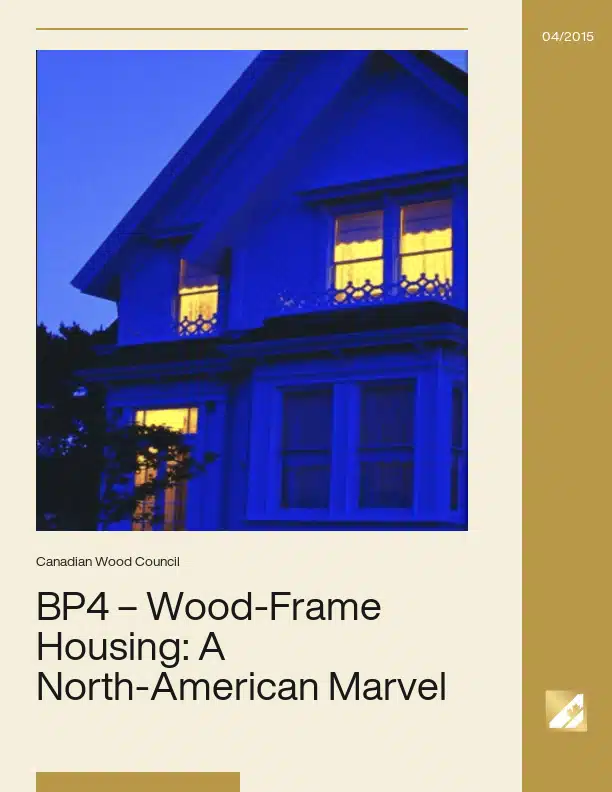
BP4 – Wood-Frame Housing: A North-American Marvel
...wood for exposed applications like cabinetry, flooring, furniture and moldings. Not only is wood builder-friendly, it is also environmentally friendly. Wood products take less energy to manufacture, affect the environment...
FRAMEWORK for Success: Prefabricated Wood Systems and Design Innovation
...evolved from a truss-fabricator-focused group into Ontario’s leading voice for structural wood component manufacturing. Today, the province is home to 70 certified truss plants and 40 wood-panel manufacturers, with engineered...
CSA S-6 Canadian Highway Bridge Design Code
...wood piles, wood cribs and wood trestles. The standard does not apply to falsework or formwork. CSA S-6 considers design of wood members under flexure, shear, compression and bearing. In...
The Role of the Wood Industry in Climate Change Mitigation
...of Wood in Sustainable Construction: Objective: To understand the environmental benefits of using wood in construction, including its properties as a low-carbon material. Relevance: Grasping why wood is considered a...
Design and Construction of Permanent Wood Foundations – The Buildings Show 2025
...from the Department of Wood Science at the University of British Columbia. He is the past Chair of the CSA Subcommittee on Permanent Wood Foundations and acted as a primary...
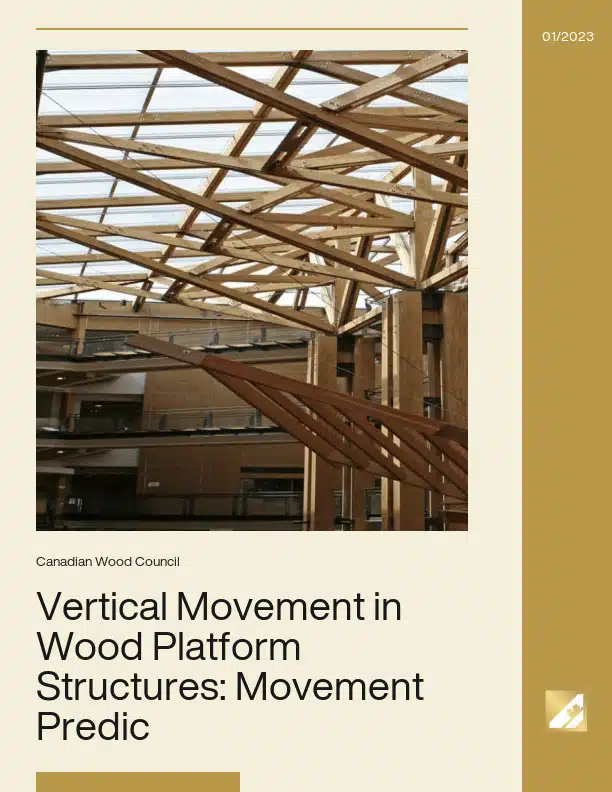
Vertical Movement in Wood Platform Structures: Movement Prediction
...this series of fact sheets. Different from solid sawn wood products, Engineered Wood Products (EWP) are usually manufactured with MC levels close to or even lower than the equilibrium moisture...
Environmental product declarations (EPDs)
...Canadian Oriented Strand Board View Resource An Industry Average EPD for Canadian Softwood Plywood View Resource A Regionalized Industry Average EPD for Canadian Wood Trusses View Resource Stakeholders within the...
CSA S406 Specification of permanent wood foundations for housing and small buildings CSA S406 is the design and construction standard for permanent wood foundations (PWF)...
By using roundwood that is often not be suitable for lumber production, wood-based panels make efficient use of the forest resource by providing engineered wood products with...
Laminated Strand Lumber (LSL) is one of the more recent structural composite lumber (SCL) products to come into widespread use. LSL provides attributes such as high strength...
Oriented Strand Lumber (OSL) Oriented Strand Lumber (OSL) provides attributes such as high strength, high stiffness and dimensional stability. The manufacturing process of...
Resource Description A structured undergraduate timber engineering course designed to introduce students to the fundamental material properties of wood and the principles of...
Course Overview This session will feature thought leaders in a podcast-style conversation exploring the evolving role of wood in Canadian construction. Through a series of...
Wood is resistant to some of the chemicals destructive to steel and concrete. For example, wood is often the material of choice when exposed to: organic compounds, hot or...
Course Overview Concrete, steel, and aluminum are responsible for 23% of the world’s total CO2 emissions. While a portion of those emissions come from other industries, the...
Course Overview This session brings together a panel of experts to discuss lessons learned and visions for wood-based manufactured housing solutions. The panel will address...
Course Overview WoodWorks and the BC Office of Mass Timber Implementation present a brief, but detailed technical webinar focusing on the recently adopted provincial code...
FPInnovations has been field testing the performance of treated wood products for years. Click one of these categories for performance data from our field tests....
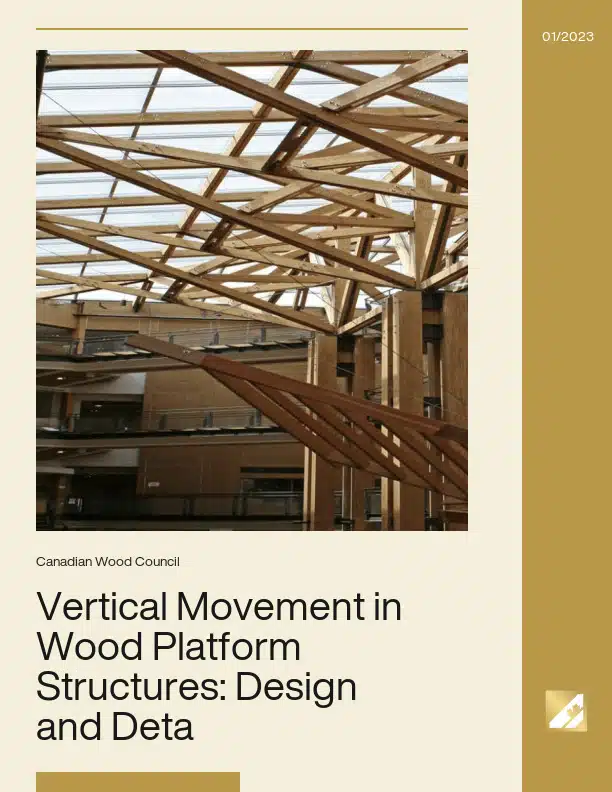
Most buildings are designed to accommodate a certain range of movement. In design, it is important for designers to identify locations where potential differential movement...
1
2
3

Get Access to Our Resources

Stay in the loop and don’t miss a thing!

What’s Your Occupation?

Help us personalize the content for you.

What Interests You the Most?

Help us personalize the content for you.

Filters

Expertise Icon
Field of Expertise
Province Icon
Province
Member Type Icon
WoodWork National Partners

Filters

Post Type Icon
Post Type
Persona Icon
Persona
Language Icon
Language
Tags Icon
Tags
Mass Timber Plus Icon Environment Plus Icon Safety Plus Icon Durability Plus Icon Design Systems Plus Icon Budget Plus Icon Construction Management Plus Icon Fire Resistance Plus Icon Tall Buildings Plus Icon Short Buildings Plus Icon
Date Icon
Date
Line Separator