Searching for: Wood

Searching results for “Wood”
520 results found...
Sort By Dropdown Icon

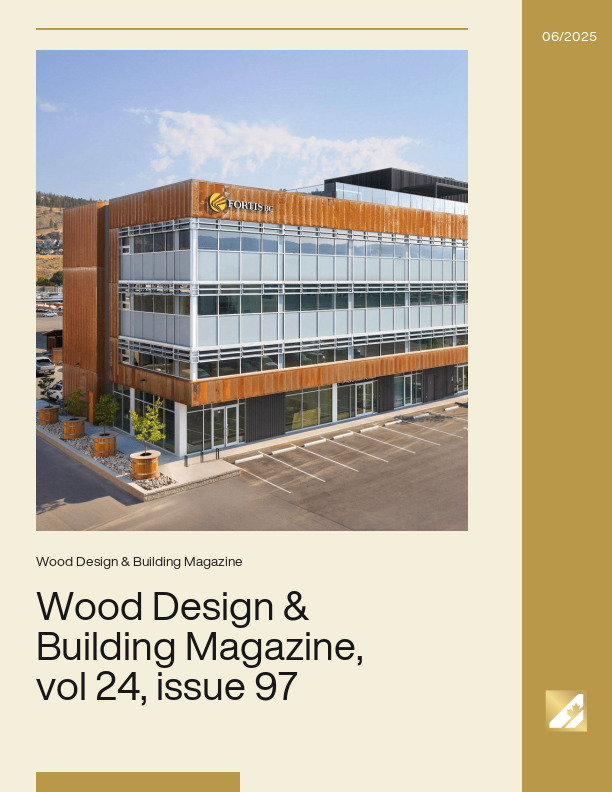
Wood Design & Building Magazine, vol 24, issue 97

In wood construction, success is rarely improvised. It’s the earned result of early design coordination, clearly communicated expectations, and a shared commitment to getting the details right—from design concept through to completion. Whether a project’s priority is accelerated construction timelines, lasting architectural impact, future disassembly and reuse, or all these things and more, the through line is thoughtful, deliberate planning.

As a structural system, timber calls for a high degree of coordination—especially as its applications continue to evolve and expand. It rewards teams who design with intent: those who understand that every exposed surface carries architectural weight, that detecting clashes early in the design phase avoids costly rework during construction, and that planning for a building’s end-of-life is just as essential as designing its first impression.

Society’s growing demand for low-carbon construction brings new urgency—and opportunity—to these conversations. As we continue to advance prefabricated, high-performance, and demountable wood building systems, the need for early alignment—between architect and engineer, builder and client—is not just integral to the success of individual projects, but to the advancement of the industry as a whole.

This issue of Wood Design & Building leans into that reality. As construction methods evolve, we examine how clear communication and coordination don’t just mitigate risk—they drive better outcomes for the built environment. In a construction landscape that values speed, efficiency, and low-carbon outcomes, it’s advanced planning and clear communication that turn ambition into meaningful results.

We’re not just building with wood. We’re building with purpose, intention, and care. And that process starts long before the first beam or panel is lifted into place.

2025 Wood Design & Building Awards Call for Submissions Now Open

OTTAWA, ON, 23 APR 2025 – The Canadian Wood Council is accepting submissions for the 2025 Wood Design & Building Awards. Now in its 41st year, this annual program invites architects, designers, and project teams from across North America and around the world to submit their most inspiring wood projects for consideration.

“At its core, this program is a celebration of architectural excellence,” says Martin Richard, VP Market Development & Communications at the Canadian Wood Council. “Each year, we’re inspired by the many ways designers harness wood’s versatile beauty—from bold, expressive forms to quietly transformative spaces.”

Over the decades, we’ve seen the creativity and talent of hundreds of project teams bring important changes to the built environment—elevating wood from a niche material to a sustainable, mainstream design ambition. While the awards program has always shone a light on architectural excellence in wood, winning projects in recent years also frequently demonstrate innovation, technical achievement, and a strong commitment to sustainability.

Submissions will be reviewed by a distinguished jury of Canadian and American architects. Projects will be evaluated based on creativity, design excellence, and the innovative and appropriate use of wood to achieve project objectives.

Award categories for 2025 include:

  • Non-residential
  • Residential
  • Adaptive Reuse, Additions, and Renovations
  • International Building
  • Other (e.g. exterior structures, bridges)


The program also includes several specialty awards:

  • Sustainable Forestry Initiative (SFI) Award
  • Sansin Award
  • Real Cedar Award
  • Wood Preservation Canada (WPC) Award
  • Regional WoodWorks Awards for Ontario, British Columbia, and the Prairies


Winners will receive a custom wood trophy and be recognized through a media announcement, social media, a feature profile on the Wood Innovation Network, and editorial coverage in Wood Design & Building Magazine (digital edition).

Key Dates
Early Bird Deadline: May 31, 2025
Final Submission Deadline: June 27, 2025

For more information and to submit your project, please visit: https://cwc.ca/wood-design-and-building-awards/


Wood Design and Building Awards

We are pleased to open our Call for Entries and invite North American and International submissions to the 2026 Wood Design and Building Awards program celebrating excellence in wood architecture and construction. 

Entries should showcase the use of wood products in any, or several, of their many forms and applications, demonstrating an understanding of the special properties of wood including strength, durability, beauty, and cost-effectiveness. To be eligible, projects must have been completed within the past three years and must be fully constructed, with finished photography available, by July 1, 2026. 

Awards will be presented at the discretion of the jury in the following categories: Honor, Merit, and Citation. Winners will receive a custom wood trophy recognizing their achievement and will also:

  • Be announced in a media release and on social media
  • Receive a feature profile on the Wood Innovation Network
  • Be featured in Wood Design & Building Magazine (digital)
  • Receive and invitation to an exclusive Awards Reception, where winners are celebrated among industry leadersoffering valuable exposure, networking opportunities, and a memorable evening in recognition of your success. 


Projects can be submitted in the following categories:

  • Non-residential
  • Residential
  • Adaptive Reuse, Additions, and Renovations
  • International Building
  • Other (Exterior Structures, Bridges etc.)


Plus, don’t miss our specialty awards:

Sponsored by WoodWorks
Sustainable Forestry Initiative (SFI)
Real Cedar
Wood Preservation Canada (WPC)

Ontario region
British Columbia region
Prairie region

Note: The WoodWorks Awards (ON, BC & Prairie) recognize institutional, commercial and industrial projects, including tall, multi-unit residential, mixed use and mid-rise buildings. 

Entry Fees

Early Bird Entry Fees
(applicable until May 31, 2026)
Regular Entry Fees
First Entry – $150.00 USD
Subsequent Entries – $140.00 USD
First Entry – $175.00 USD
Subsequent Entries – $165.00 USD


Submissions have now closed. Results will be posted in November 2026!

Wood Decay and Repair

LEAKY BUILDINGS AND DECAYING WOOD – WHAT’S HAPPENING?

The news across North America seems to frequently contain stories about serious moisture failures in wood-frame buildings. Whether it’s Vancouver’s “leaky condo crisis” or the “EIFS disaster” in North Carolina, homeowners are struggling with wood decay wherever the other components of the building’s walls and roof aren’t properly protecting the wood structure from excessive moisture. Interestingly, leaks are also getting attention in steel and concrete high-rises, causing rust in steel studs and fasteners and degradation of gypsum wallboard.

Why are we suddenly finding so many failures in buildings, including in our tried-and-true wood construction? This is a frustrating problem for everyone in the building industry, because there are no easy answers. It’s convenient to blame unskilled or unethical practitioners in the building industry. Other occasional targets for blame include municipalities for developing zoning ordinances that conflict with performance issues; energy efficiency codes for making our building envelopes tighter; new and complicated materials in our building envelopes; the building occupants for not practising proper maintenance; or the wood, which some seem to feel has declined in quality. The bottom line: many people have opinions, but so far there is little firm technical data to answer these questions. Please see our Links page for some of the research institutions working in this area.

Buildings have probably always leaked, although it is only recently that moisture seems to be a problem. Some believe that the difference is that today’s buildings are less tolerant of those leaks; that perhaps the older buildings were able to dry out. Another theory is that today’s leaky buildings leak more than in the past, due to design errors, sloppy construction, lack of overhangs, etc.

Thankfully, many people working in the building industry have turned their attention towards better design and construction practice for moisture control. A number of “best practice guides” are listed in our Links section.

HOW CAN I TELL IF WOOD IS DECAYED?

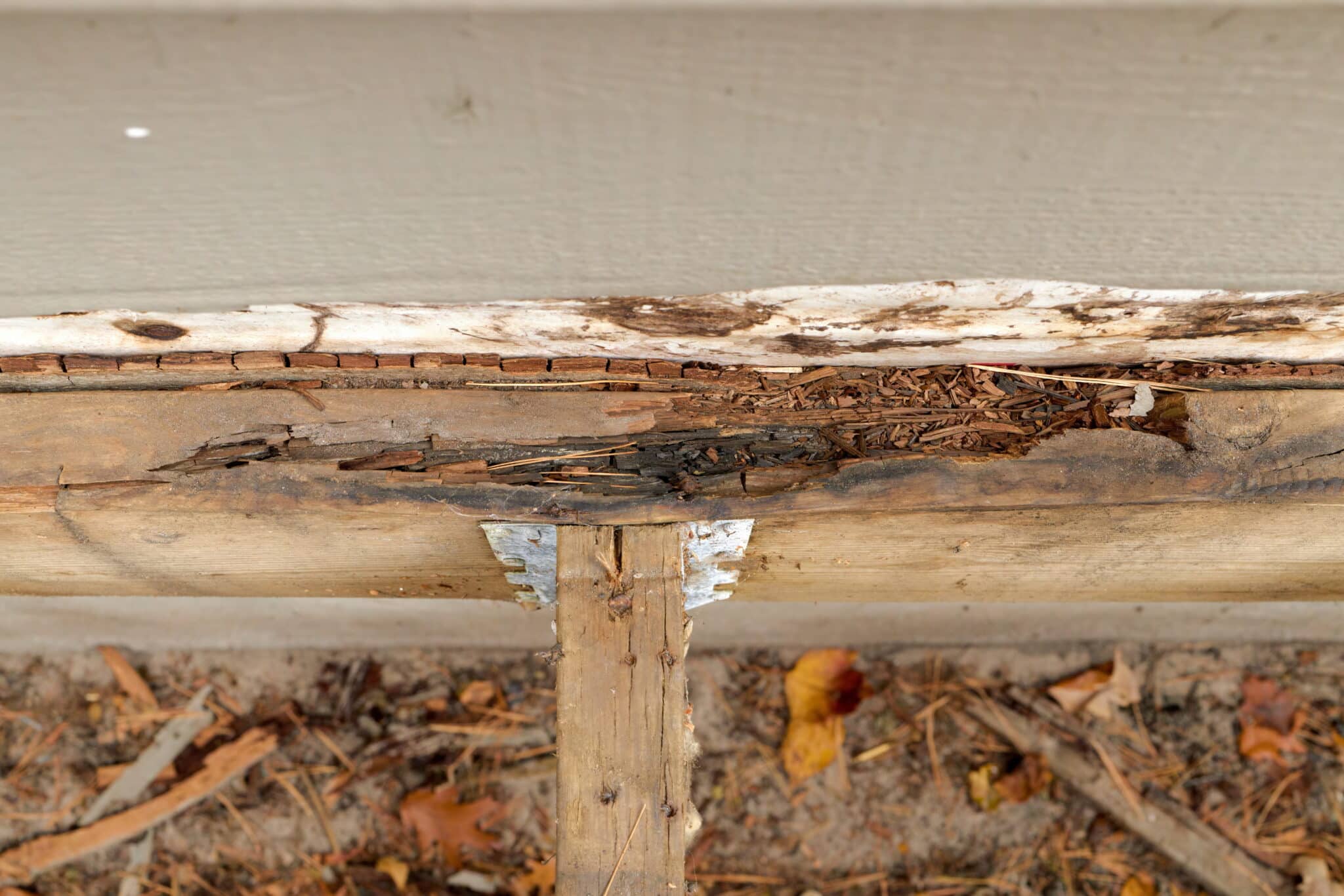
If wood is badly decayed, this will be quite obvious. The wood will be soft and perhaps even be breakable by hand. Decayed wood breaks with a carrot-like snap versus the splintering of sound wood. Use the pick test to be sure.

MY WOOD IS STAINED – IS IT DECAY?

Probably not, if this is new lumber. There are many harmless sources of wood stains, including dirt, iron filings, or staining fungi that merely colour the wood without damaging it. Please see the fact sheet “Discolourations on wood products: Causes and Implications” for a thorough explanation including photos. If the discoloured wood is found in a leaky building under repair and may have been wet, perform the pick test to see if it is rotted – see our page on Assessing decay.

I HAVE DECAYED WOOD – WHAT SHOULD I DO?

Remove all decayed wood and additionally remove another two feet of sound wood all around the decayed section. Any sound wood that is left in place when decayed wood around it has been removed should be field treated with a penetrating preservative. Also field treat any wood that may continue to get wet after repairs. We recommend preservatives containing a diffusible low-toxicity fungicide such as sodium borate, and low-toxicity formulating agents which assist in penetrating dry wood, such as propylene glycol. By the time the cladding has been removed, the structure has been inspected and the decayed wood has been removed, the wood left in place will likely have dried too much for effective use of formulations without a penetration aid. Under conditions of high relative humidity, the propylene glycol may cause a short term increase in the moisture content at the wood surface. For more information, please see our page on Assessing decay.

IS KILN-DRIED LUMBER MORE RESISTANT TO DECAY THAN GREEN OR AIR-DRIED LUMBER?

One advantage of kiln-dried lumber is that any live fungi present in the green lumber will have been killed by the heat of the kiln; in other words, KD lumber is sterile after leaving the kiln. However, if it gets sufficiently wet afterwards, then it is at the same risk of decay as any other wood.

ARE COMPOSITE WOOD PRODUCTS MORE RESISTANT TO DECAY THAN SOLID LUMBER?

No. Composite products (glulam, OSB, laminated veneer lumber, etc.) have the same resistance to decay as the wood from which they were made. The adhesives used in composites do not affect decay resistance.

DO WE HAVE TERMITES IN CANADA?

Yes, in a few limited areas across the country and to a greater extent around Toronto, termite species causing damage to buildings are present. Although termites are a significant problem in parts of southern Ontario, overall they are only a mild concern in this country. They prefer warmer conditions and are a far greater problem in parts of the United States. In Canada we do not have the voracious Formosan subterranean termite causing so much damage in the southeastern US.

WHAT IS DRY ROT?

Contrary to popular usage, dry rot does not mean rot that can happen in dry wood, or wood that has rotted and dried out. Dry rot is a specific kind of fungus, although the term is very commonly misused to describe all wood rot. This is unfortunate, because it disassociates rot from moisture. Wood rot always requires moisture, and the key to wood durability is the control of moisture. Wood that rotted long ago and is now dry was moist at the time of the rot. The true dry rot fungus has the ability to tap into a water source and conduct water to what would otherwise be dry wood. However, it has to wet the wood before it can attack the wood. The true dry rot fungus is more likely to be found in buildings that contain brick or stone than in all-wood buildings.

HOW FAST DOES WOOD DECAY?

It’s impossible to say; there are so many variables that influence the process. In a laboratory, under ideal conditions for decay fungi, wood can rot quite quickly. However, in real life applications, the entire process is slower and unpredictable.

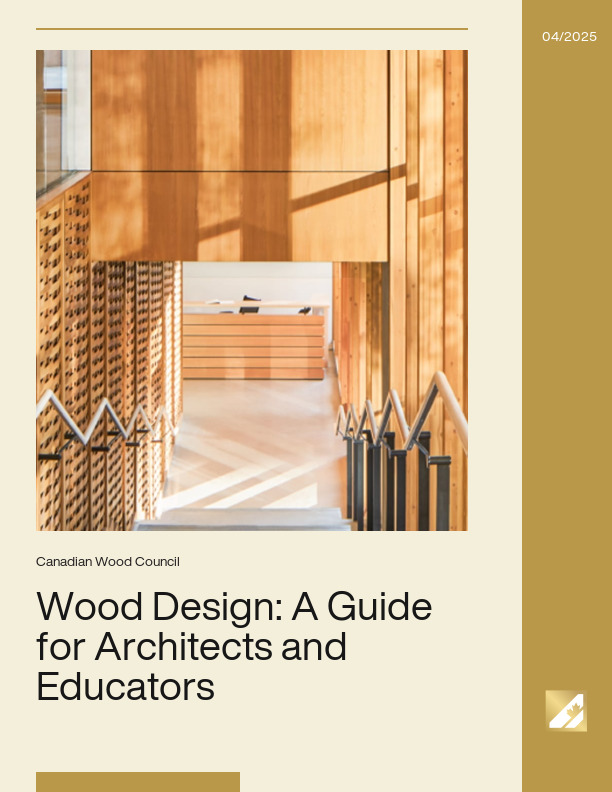
Wood Design: A Guide for Architects and Educators

This Guide is designed to help educators increase wood content in their already crowded curricula, exposing students to the unique challenges and opportunities of designing with advanced wood systems, within the context of the program and student performance criteria established, maintained, and evaluated by the Canadian Architectural Certification Board.

Canadian Wood Council releases new Environmental Product Declarations for 5 Canadian manufactured wood products

OTTAWA, ON, 1 APR 2025 – The Canadian Wood Council (CWC) is pleased to announce the release of five new Environmental Product Declarations (EPDs) for Canadian softwood lumber, oriented strand board (OSB), plywood, trusses, and prefabricated wood I-joists. These EPDs provide comprehensive, transparent environmental data on the potential impacts associated with the cradle-to-gate life cycle stages of these essential wood products.

Developed as regionalized, industry-wide business-to-business (B2B) Type III declarations, the EPDs comply with the highest international standards, including ISO 21930, ISO 14025, ISO 14040, ISO 14044, the governing product category rules, and ASTM General Program Instructions for Type III EPDs. This ensures credible, third-party verified environmental impact data, supporting designers, builders, and policymakers in making informed, sustainable material choices.

“The release of these new EPDs reinforces our commitment to transparency and sustainability in the wood products sector,” said Peter Moonen, National Sustainability Manager at the Canadian Wood Council. “By providing robust, science-based environmental information, we’re equipping the industry with the tools needed to demonstrate the environmental benefits of wood and support low-carbon construction.”

The EPDs are available for download from the Canadian Wood Council’s digital resource hub: www.cwc.ca

EPDLink
An Industry Average EPD for Canadian Pre-fabricated Wood I-JoistsView Resource
A Regionalized Industry Average EPD for Canadian Softwood LumberView Resource
A Regionalized Industry Average EPD for Canadian Oriented Strand BoardView Resource
An Industry Average EPD for Canadian Softwood PlywoodView Resource
A Regionalized Industry Average EPD for Canadian Wood TrussesView Resource

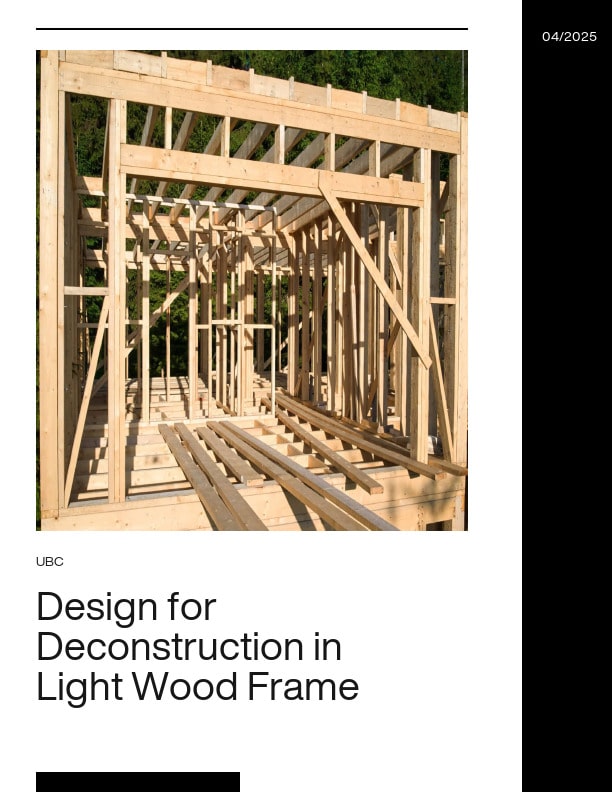
Design for Deconstruction in Light Wood Frame

The Guidebook of Design for deconstruction in Light Wood Frame presents a methodology for altering typical light wood frame assemblies so that they can be easily disassembled and the materials of the building can be reused. The province of BC and, more broadly, Canada, has relatively little infrastructure for recycling wood waste. In Vancouver alone, the construction, renovation, and demolition (CRD) sector produces about 1.7 million tonnes of waste per year.1 Of this, an estimated 30-60% is wood waste which is largely discarded in landfills. What little wood that is recycled is generally incinerated for waste-to-energy conversion or shredded for biomass. Deconstructing wood buildings and reusing the salvaged wood for new construction would extend the lifespan of the wood, add value and longevity to a valuable material, reduce GHG emissions and reduce the amount of new resources required for new construction projects. Despite the benefit of re-using wood, there are some barriers to deconstructing typical light wood frame buildings, including the use of irreversible fasteners, adhesives, spray foams, and liquid applied sealants. The presence of toxic materials such as asbestos and lead are also of concern when deconstructing a building. While use of toxic materials is now prohibited in new constructions the use of nails (particularly when applied with nail guns) and adhesives makes deconstruction very difficult if not impossible in some cases.2 This guidebook proposes a design for deconstruction system that addresses these remaining issues with simple modifications of typical light wood frame construction practices, allowing for both simple construction, solid performance, and easy deconstruction.

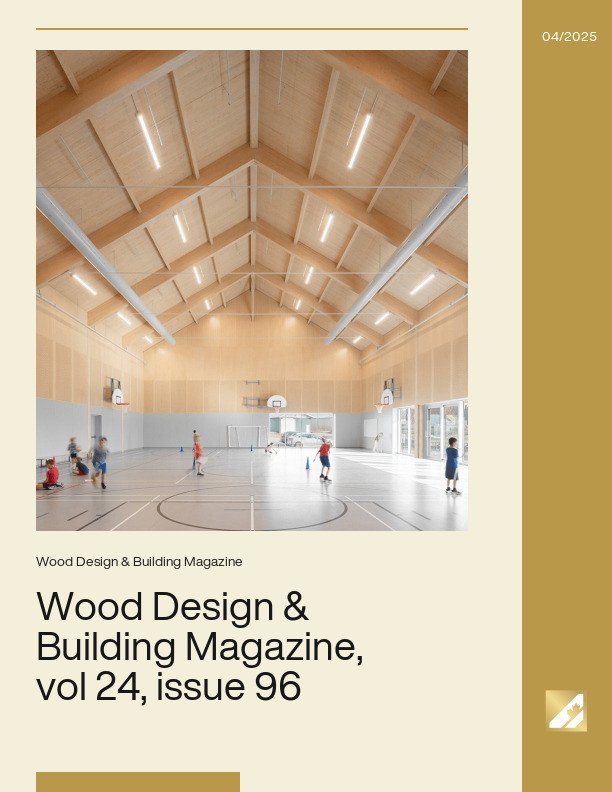
Wood Design & Building Magazine, vol 24, issue 96

Buildings that stand the test of time aren’t just durable—they are cherished. When we invest in quality materials and good design, we can create buildings that people connect with. As you’ll discover in this issue, many heavy timber warehouses and factories constructed in the early 1900s remain a vital part of our cities today—not because they still serve their original purpose, but because people valued them enough to adapt, restore, and reuse them, giving them a new purpose.

Fast forward a hundred years and resilient structures include many new forms. Modular construction, for example, has seen significant growth in recent years as this form of construction has transformed from a building method once considered inferior, into a method relied upon to deliver high-performance durable buildings.

Alongside our features on historic timber buildings and modular construction, this issue also highlights notable projects and emerging trends shaping today’s built environment. From innovative mass timber structures to forward-thinking design solutions, we explore how thoughtful craftsmanship and smart engineering continue to define the spaces we build—and the ones we keep.

Canadian Wood Council Applauds Strategic Federal Investments in B.C.’s Forest Industry

OTTAWA, March 25, 2025 – The Canadian Wood Council welcomes the Government of Canada’s announcement of over $20 million in funding for 67 projects that support the growth and resilience of British Columbia’s forest sector.

While the announcement includes several strategic large-scale investments in advanced wood manufacturing, a significant strength of this initiative lies in the breadth of smaller-scale, high-impact projects that are collectively transforming communities across the province. From feasibility studies for Indigenous-led forest product businesses to the development of next-generation building technologies, these projects are advancing wood innovation, supporting workforce development, and expanding the role of wood in low-carbon construction.

Administered through Natural Resources Canada, this Green Construction through Wood (GCWood) funding supports a wide range of initiatives—from fire-testing mass timber connections and refining modelling guides for timber structures, to developing bioenergy solutions and value-added wood processing in Indigenous communities.

This announcement underscores the importance of decentralized innovation, where targeted investments in communities and research institutions alike contribute to a stronger, more sustainable forest sector. The Canadian Wood Council applauds this commitment and looks forward to continuing its work with design professionals, governments, and industry partners to support the expanded use of wood in the province through its market-leading WoodWorks program.

View the announcement from Natural Resources Canada here:
https://www.canada.ca/en/natural-resources-canada/news/2025/03/canada-announces-support-for-british-columbias-forest-sector.html https://www.canada.ca/en/natural-resources-canada/news/2025/03/canada-announces-support-for-british-columbias-forest-sector.html

Canadian Wood Council Applauds Federal-Provincial Investment in Advanced Wood Construction in Quebec

OTTAWA, March 24, 2025 – The Canadian Wood Council (CWC) applauds the joint investment of over $8.5 million by Natural Resources Canada and Quebec’s Ministry of Natural Resources and Forests in four innovative wood construction-related projects across Quebec. These strategic initiatives will help strengthen the manufacturing sector and accelerate the adoption of low-carbon, Canadian-made wood products and technologies in residential construction and other critical community infrastructure.

By supporting advanced wood construction methods—including modular mass timber housing, artificial intelligence to modernize engineered wood manufacturing, and the design of tall wood residential buildings—this investment reinforces the essential role of wood in delivering high-performance, low-carbon construction solutions. From a 20-unit modular development and a 21-storey design study to the cultural leadership of the Cree First Nation of Waswanipi in forest-to-form construction, these projects demonstrate how innovative wood technologies can meet urgent housing needs in a sustainable way, through scalable and repeatable, locally driven approaches.

The Canadian Wood Council commends both levels of government for recognizing the critical role of Canada’s forest sector in delivering smart, climate-friendly building systems. These investments demonstrate how advanced wood technologies can contribute to addressing urgent housing needs while helping to lower the carbon footprint of the built environment.

Design and construction professionals in Quebec can access free technical support related to wood design and construction through the market-leading resource program, Cecobois. The CWC is pleased to provide support further expand the use of wood in residential, commercial, and institutional buildings throughout the rest of Canada through its WoodWorks program.

View the announcement from Natural Resources Canada here:
https://www.canada.ca/en/natural-resources-canada/news/2025/03/canada-and-quebec-invest-in-sustainable-wood-construction.html

Canadian Wood Council Applauds Federal Investment in Nova Scotia’s Mass Timber Industry

OTTAWA, ON, 21 MAR 2025 – The Canadian Wood Council (CWC) applauds the Government of Canada’s strategic investment in Nova Scotia’s mass timber sector, recognizing its role in advancing low-carbon construction, economic growth, and job creation.

This funding will accelerate the fabrication of high-value mass timber components from undervalued eastern spruce, unlocking new opportunities for Canada’s forest sector and expanding the use of advanced wood materials in construction. By supporting the production of Cross-Laminated Timber (CLT) and Glulam in Nova Scotia, this investment strengthens supply chains, creates skilled jobs in the region, and enhances the competitiveness of low-carbon building solutions across Canada.

Mass timber is increasingly recognized as a proven strategy for the rapid construction of much-needed housing and other critical infrastructure. Its benefits extend across multi-residential and commercial buildings, offering a scalable, efficient, and sustainable approach to modern construction.

Canada’s forest sector is well-positioned to meet the growing domestic demand for sustainable construction materials. This investment will drive innovation in mass timber manufacturing, creating economic opportunities in Nova Scotia while enhancing Canada’s capacity to produce and supply mass timber products nationwide. Expanding domestic production advances low-carbon building solutions and strengthens Canada’s wood manufacturing sector.

The CWC applauds this commitment to fostering a resilient and competitive mass timber industry in Atlantic Canada. Through our WoodWorks technical program, we look forward to supporting construction professionals with the knowledge and resources they need to integrate mass timber into more projects across the country.

View the announcement from Natural Resources Canada here: https://www.canada.ca/en/natural-resources-canada/news/2025/03/canada-invests-in-nova-scotias-local-mass-timber-industry.html

Treatment during engineered wood product manufacture

Some engineered wood panel products, such as plywood and laminated veneer lumber (LVL) are able to be treated after manufacture with preservative solutions, whereas thin strand based products (OSB, OSL) and small particulate and fibre-based panels (particleboard, MDF) are not. The preservatives must be added to the wood elements before they are bonded together, either as a spray on, mist or powder.

Products such as OSB are manufactured from small, thin strands of wood. Powdered preservatives can be mixed in with the strands and resins during the blending process just prior to mat forming and pressing. Zinc borate is commonly used in this application. By adding preservatives to the manufacturing process it’s possible to obtain uniform treatment throughout the thickness of the product.

In North America, plywood is normally protected against decay and termites by pressure treatment processes. However, in other parts of the world insecticides are often formulated with adhesives to protect plywood against termites. 

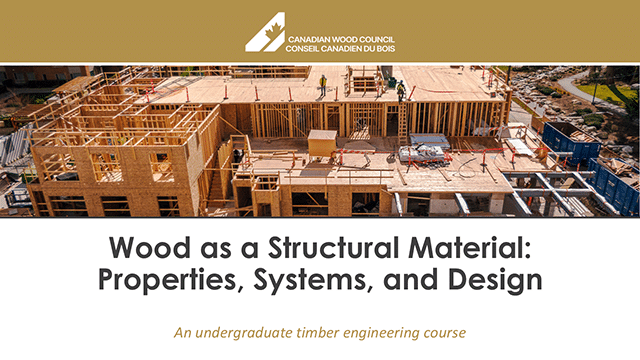
Wood as a Structural Material: Properties, Systems, and Design
Module 2 – Structural Wood Products & Systems
Module 1 – Physical and Mechanical Properties of Wood
wood_structural_material
Wood as a Structural Material: Properties, Systems, and Design
Light Wood Frame
Wood Education and Workforce Integration Concurrent Workshop @ Woodrise 2025
Mid rise Engineering Considerations for Engineered Wood Products
Wood in Education
Seismic Solutions for Resilient Wooden Structures
Regional Design With Wood For Educational Facilities
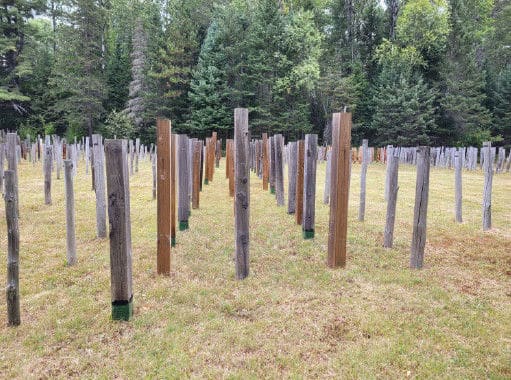
Preservation of Structural Wood
Plant a Seed Designing with Wood and Bio based Materials
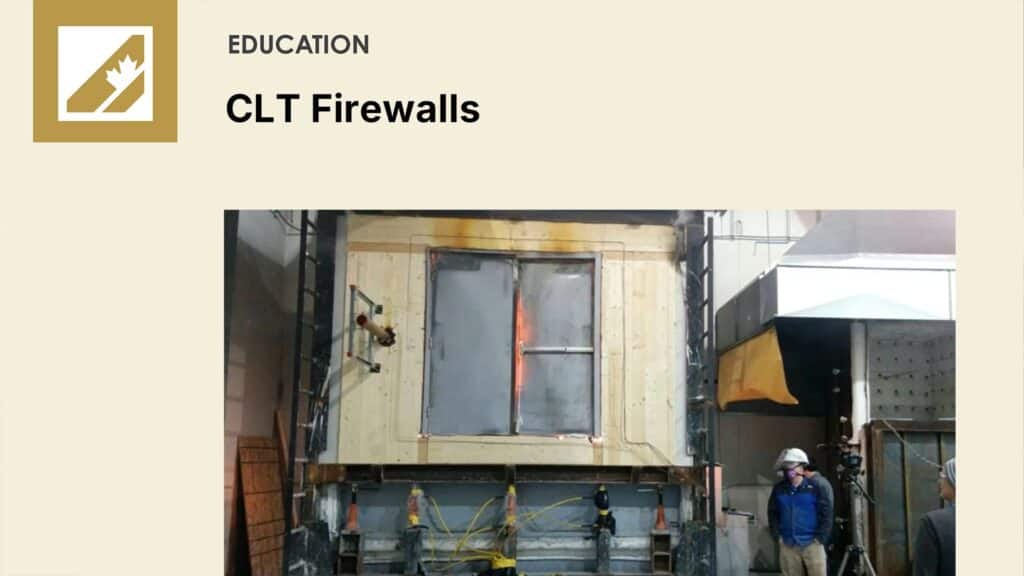
Course Overview Fire performances of CLT fire separations with closure (door) or service (pipe) penetrations will be discussed. Learning Objectives Beyond the introduction of...
Course Overview Melissa will discuss the role of the specialty structural engineer in glulam connection design for your project. Tips will be provided to help streamline the...
Course Overview Building a wood frame Car Dealership is a unique proposition to begin with. Making it a Certified Passivehouse building in cold windy Red Deer is an added...
Course Overview This 2-hour technical webinar will begin with an overview of ongoing fire research at the National Research Council of Canada into various performance aspects...
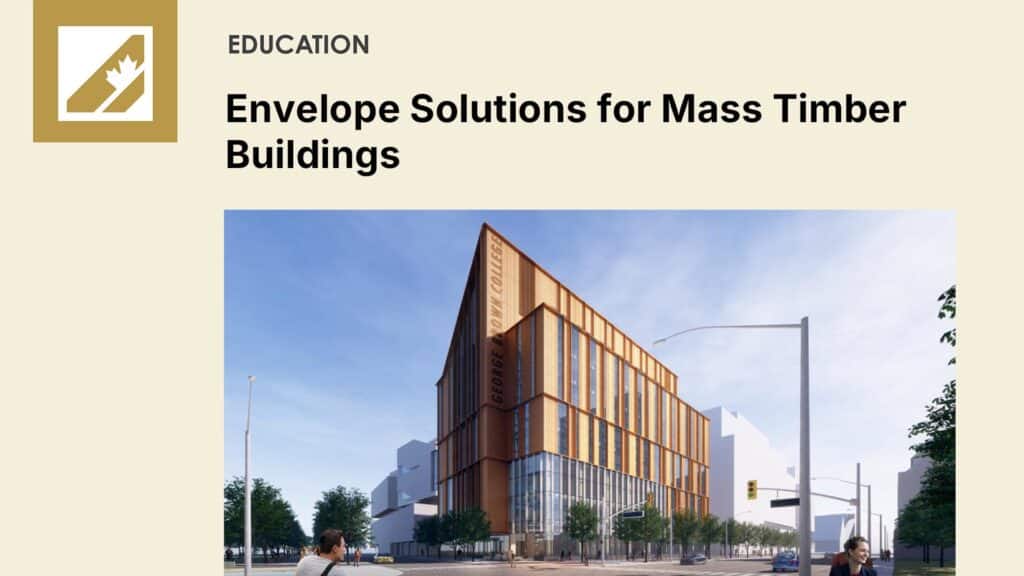
Course Overview As society strives toward lower-carbon construction and increased operational efficiency of the built environment, we know that a building’s envelope...
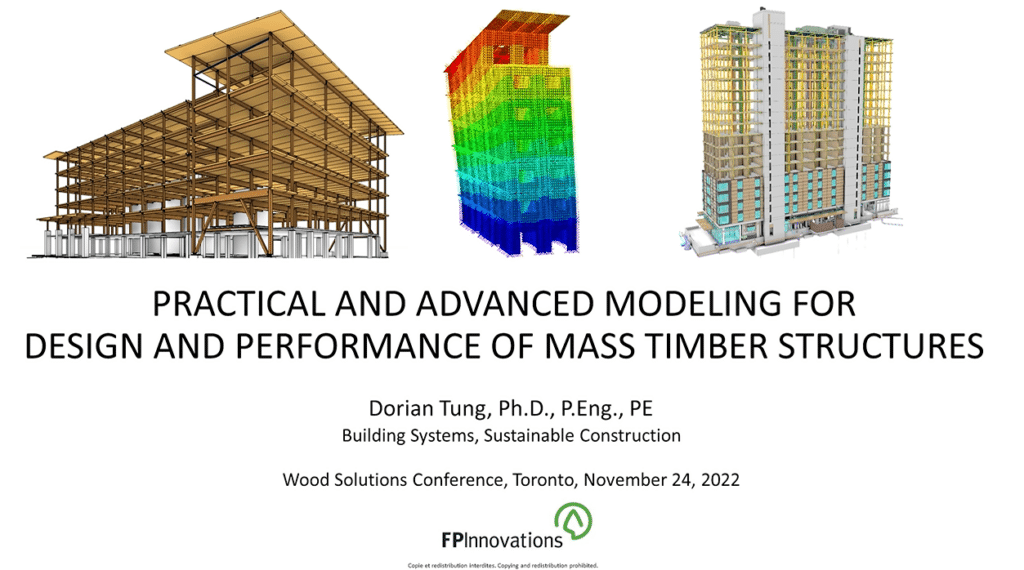
Course Overview FPInnovations’s Modeling Guide for Timber Structures is the result of global collaboration from over 100 experts. This definitive guide for timber structure...
Course Overview The presentation will provide an overview of the Mass Timber Demonstration Fire Tests which were conducted during the summer and fall of 2022. Past research...
Course Overview This 2-hour technical webinar will begin with an overview of ongoing fire research at the National Research Council of Canada into various performance aspects...
Course Overview Delivering superior acoustic comfort to building occupants doesn’t have to be complicated. In this panel discussion, presented by an industry-leading...
Course Overview In this session using specific project case studies, discover the latest ground-breaking advancements in sound technology that are transforming acoustic...
Course Overview Since Engineered Lumber Products are proprietary, there is a range of opinions about how much information to show on a set of Structural drawings. Should the...
Course Overview Coming Soon Learning Objectives The presentation will be focused on providing a summary of the Mass Timber Demonstration Fire Test Program’s results and...

Get Access to Our Resources

Stay in the loop and don’t miss a thing!

1
2
3

Get Access to Our Resources

Stay in the loop and don’t miss a thing!

What’s Your Occupation?

Help us personalize the content for you.

What Interests You the Most?

Help us personalize the content for you.

Filters

Expertise Icon
Field of Expertise
Province Icon
Province
Member Type Icon
WoodWork National Partners

Filters

Post Type Icon
Post Type
Persona Icon
Persona
Language Icon
Language
Tags Icon
Tags
Mass Timber Plus Icon Environment Plus Icon Safety Plus Icon Durability Plus Icon Design Systems Plus Icon Budget Plus Icon Construction Management Plus Icon Fire Resistance Plus Icon Tall Buildings Plus Icon Short Buildings Plus Icon
Date Icon
Date
Line Separator