

Oakville Fire Station 8

The Town of Oakville selected an Integrated Project Delivery (IPD) method for the design and construction of a new 11,450 ft2 (1064 m2) fire station. Design objectives for Oakville Fire Station 8 (OFS) specified that the building should promote staff retention, optimize efficiencies and layout flexibility, and incorporate appropriate and durable construction materials and building systems. The new facility was required to consider life cycle costs and be easy to operate and maintain. Solutions provided by the design team were innovative and cost efficient, providing value to the town. The project pursued sustainable construction methodologies to mitigate climate risk and achieve the LEED silver certification target. The layout and design of the fire station, utilizes space efficiently, accommodating two full fire crews, two captains, two fire trucks and storage space for spare fire apparatus.
Metis Crossing Case Study

The Métis Crossing grounds sit on a 512-acre site – river lot titles from the original Métis settlers to the region in the late 1800s – along the North Saskatchewan River, just outside Smoky Lake, Alberta (about 120 km northeast of Edmonton). As the first major Métis cultural interpretive centre in the province, it is a premier destination for Métis cultural education and public gatherings. The Cultural Gathering Centre site is bordered by Victoria Trail (north), an access road to the existing barn (west), the riverbank (south) and a zipline along an existing ravine (east). Camping, guided tours and other activities are hosted on the property; the facility is open year-round. A boutique lodge is under construction and will accommodate 40 families by the fall of 2021. The new Cultural Gathering Centre provides over 10,000 sq.ft. of gathering spaces, meeting rooms, classrooms and interpretive spaces. Designed to seat over 350 people indoors, it is an ideal venue for weddings and large gatherings, such as corporate retreats. The expansive 2,600-sq.ft. deck and canopy on the south side provides stunning views of the river valley. Timber was a natural choice for the primary structural material, given its long history of use in traditional Métis construction practices. In keeping with the structure’s connection to its heritage, the building was designed by Métis architect Tiffany Shaw-Collinge, from Manasc Isaac Architects, now Reimagine Architects.
Arbora – An Exposed Wood Structure in A Major Residential Project

Montreal’s Griffintown district is home to a world record-breaking building: Arbora is the world’s largest residential complex made of solid engineered wood. It boasts three 8-storey buildings, each 25 m high, for a total of 55,515 m2 and 434 housing units. Records can be broken, but the unmatched aesthetic quality of Arbora’s exposed wood beams and columns will endure. Sotramont has assembled a team of skilled professionals to complete this project, the first of its kind in Canada.
Industrial Buildings – A case study
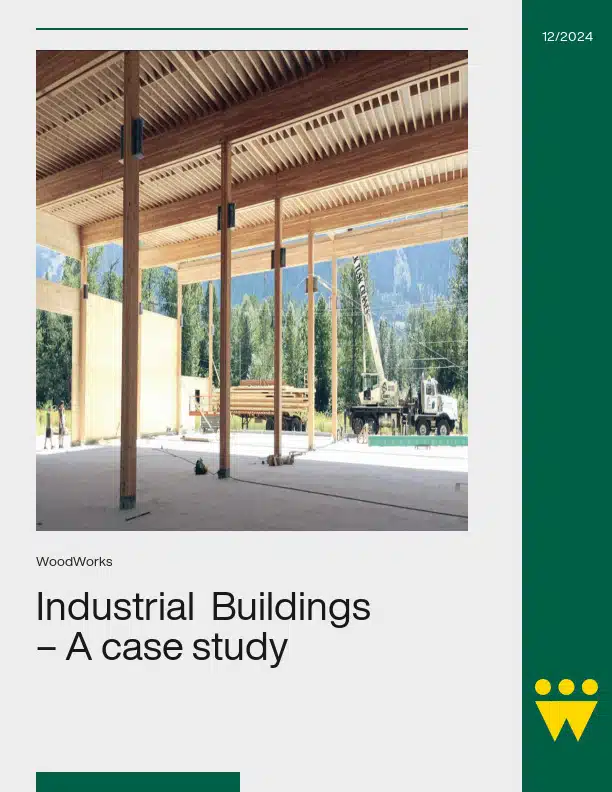
Over the past two decades, new engineered mass timber products and construction techniques have changed the way we think about wood as a building material. Historic perceptions about strength, durability and fire performance have been overturned by scientific evidence and full-scale testing of prototype structures. As a result, mass timber has begun to make its mark in the residential and commercial sectors, particularly on Canada’s West Coast. However, the market for industrial buildings continues to be dominated by tilt-up concrete and steel-frame construction, both of which have a significant environmental footprint. Tiltup concrete in particular has inherent disadvantages; concrete cannot be poured in the freezing conditions typical of Canadian winters, nor can it be easily insulated to reduce the operating energy requirements of the building. However, the National Building Code of Canada states that a roof assembly in a building of up to two storeys is permitted to be of heavy timber construction regardless of the building area or the type of construction required, provided the building is sprinklered. In addition, the structural members in the storey immediately below the roof assembly are also permitted to be of heavy timber construction. These requirements apply equally to industrial buildings, meaning that heavy timber is a viable alternative to the materials traditionally used, and single storey industrial buildings may be constructed entirely of heavy timber. This case study examines three recently completed industrial buildings in southern British Columbia, each of which uses engineered mass timber products and systems in a distinct and different way. Together, they offer insights into how industrial construction might evolve to offer greater environmental performance, speed and flexibility of construction, at little additional cost over traditional methods.
Design Example of Designing for Openings In Wood Diaphragm
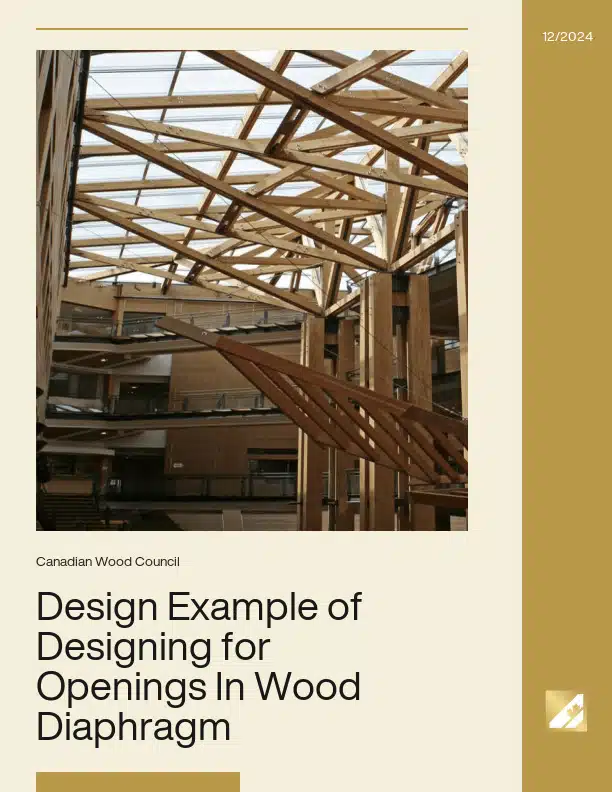
The effects of a single opening size and location on diaphragm shear, chord forces and framing member forces were investigated for a typical wood diaphragm. In conclusion, the maximum shear in the diaphragm with opening is greater than that in the diaphragm without opening. Increasing the distance between the edges of opening and diaphragm can reduce this increase in maximum shear significantly. When the dimension of the opening is no greater than 15% of the corresponding dimension of the diaphragm in both directions, and the distance of opening edge from diaphragm edge is no less than 3 times the larger dimension of the opening and that the portion of diaphragm alongside the opening satisfies the maximum aspect ratio requirement, the increase in maximum shear is less than 10%.
IBS1 – Moisture and Wood-Frame Buildings
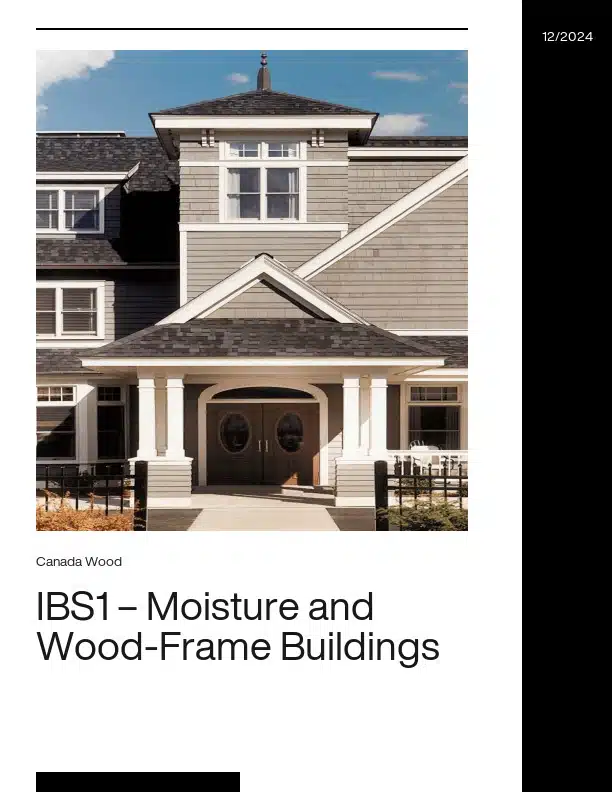
Throughout history, wherever wood has been available as a resource, it has found favor as a building material for its strength, economy, workability and beauty, and its ability to last has been demonstrated again and again. From the ancient temples of Japan and China and the great stave churches of Norway to the countless North American and European buildings built in the 1800s, wood construction has proven it can stand the test of time. The art and technology of wood building, however, has been changing through time. It’s a common misconception that water is wood’s enemy. That’s not necessarily true, since many wood buildings exist in rainy and humid places. It’s a matter of knowing how to manage water in buildings. Protection of buildings from water is the important design criterion, as important as protection from fire or structural collapse. Designers, builders and owners are gaining a deeper appreciation for the function of the building envelope (exterior walls and roof). This includes the performance of windows, doors, siding, sheathing membranes, air and vapour barriers, sheathing, and framing. The capabilities and characteristics of wood and other construction materials must be understood, and then articulated in the design of buildings, if proper and durable construction is to be assured. Wood and water are typically very compatible. Wood can absorb and release large quantities of moisture without problems, and it’s only when wood gets too wet for too long that there may be problems. If buildings are properly constructed to shed water, wood performs well as a building material in all types of climates. As an example, 90% of North American homes are built with wood. The primary focus of this publication is to address the control of rainwater penetration in exterior walls, which is the major source of moisture issues for all building materials, particularly in climates subject to high rainfall.
ONTARIO WOOD BRIDGE REFERENCE GUIDE
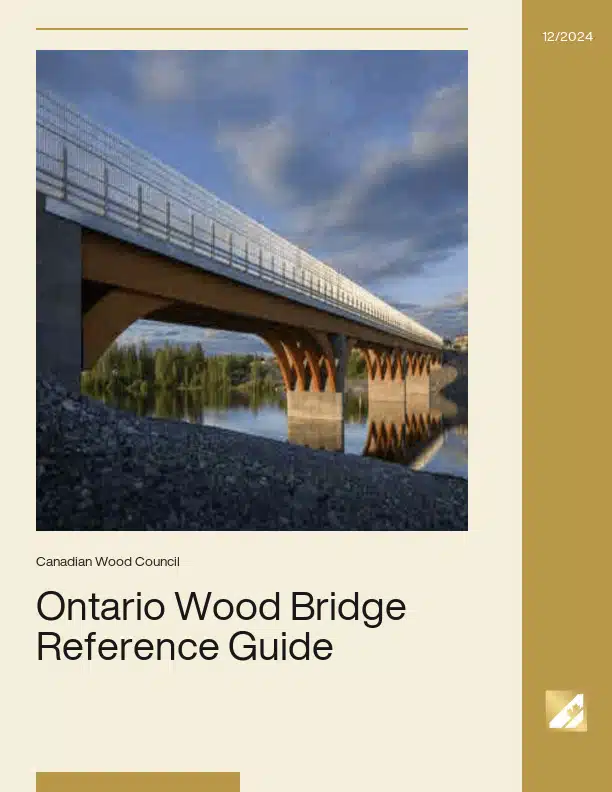
Timber bridges have a long history of construction and use throughout North America, including Ontario, for roadways, railways and logging roads. The Canadian Highway Bridge Design Code (CHBDC), together with the Canadian Wood Council publication Wood Highway Bridges from 1992 are typically referenced by designers of timber bridges in Ontario. This new reference is intended to provide updated background information for designers as they embark on proposing and designing timber highway bridges for primary and secondary roads. This reference is divided into three parts: Part 1 – Wood Bridges – Design and Use Part 2 – Opportunities & Current Limitations Part 3 – Design Examples Part 1 provides background information on topics including wood materials, bridge systems, prefabrication, durability and species availability. Details of costs, construction cycle and sustainability are also provided. Part 1 concludes with examples of a variety of completed highway bridges from North America and Europe. Part 2 of this reference is intended to provide designers and authorities with highlights of the current edition of the CHBDC on subjects related to the wood highway bridges, including areas that will require future development in the code. Additional references to other resources for advancing practitioner knowledge of and advancing the state of the art in wood bridge design are provided. Part 3 has two fully worked design examples of a two-lane 18-m span wood highway bridge designed in accordance with the latest provisions of the CHBDC and the best available information from current literature. Each example is based on a single-span, simply-supported glued-laminated girder bridge. One bridge has a glued-laminated deck and the other has a stress-laminated deck. These examples are intended to help designers understand the key issues as they undertake wood highway bridge design. Durability through detailing and choice of materials is discussed.
BP6 – Managing Moisture and Wood

Wood, a long-lasting, economical, and renewable resource, is the building material of choice in North American housing. This is largely due to the proven performance of properly designed and built wood frame buildings that have provided strong and lasting housing for a multitude of people. Although wood can withstand much abuse, it needs to be stored and handled properly to perform according to expectations. Managing moisture in structural wood products is essential in order to control swelling and shrinkage and prevent problems associated with mold or decay.
Surrey Memorial Hospital Critical Care Tower – Surrey, BC
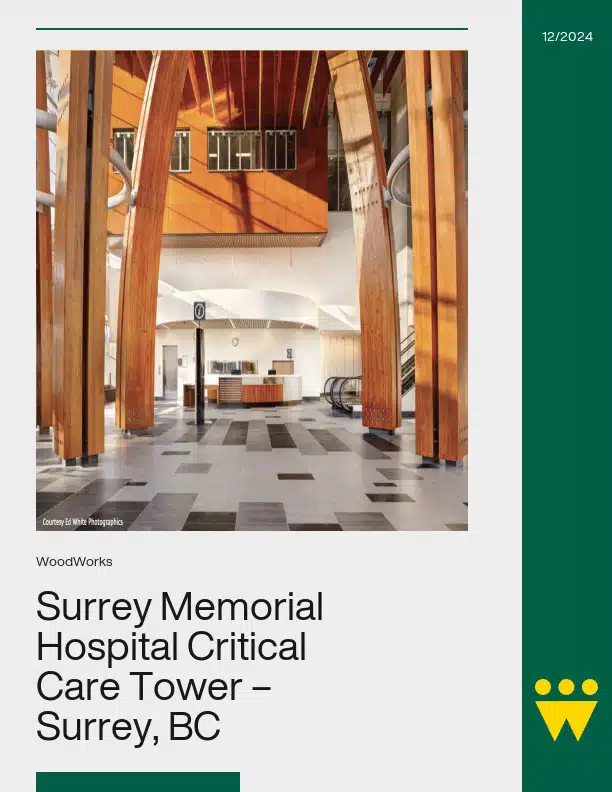
Just as our definition of green building has expanded with time so has our understanding of human health expanded to include not only our physical condition but also our psychological well-being. We have known intuitively for a long time that humans have an affinity for nature, and being in a natural environment—a forest, a park or simply our own garden—can make us feel more relaxed. The term ‘biophilia’ has been coined to refer to this phenomenon. Scientists have now confirmed that this sensation of relaxation in the presence of nature is the result of a physiological change, a reduction in the level of stress-related hormones produced by our body’s sympathetic nervous system (SNS). Using an approach known as ‘evidence-based design’ (in which detailed analyses of occupant responses to a building’s physical characteristics are used to inform the design of future projects), healthcare architects have begun to explore the physiological benefits of biophilia in the design of indoor environments. This has led to the greater use of natural daylight, access to views of nature, and the introduction of wood and other natural materials into healthcare facilities. Wood in particular is visually warm and contributes to a socially positive experience for building occupants. People respond emotionally to wood and are attracted to its visual variety and natural expressiveness. A study carried out by the University of British Columbia and FPInnovations1 confirms the value of these attributes. The joint research project found that the visual presence of wood in a room lowers SNS activation in occupants, further establishing the positive link between wood and human health.
Timmins Library & Judy A. Shank Integrated Services Building
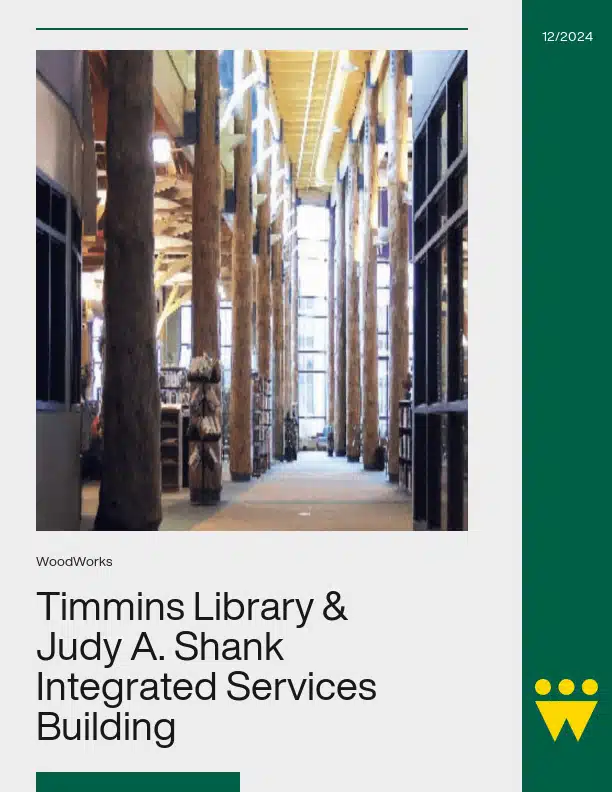
The City of Timmins has a population of 45,000 but due to its location in northeastern Ontario, is a regional service centre for 100,000 people. It had become obvious that two major community services were in drastic need of improvement. The existing library, built in 1921, had served long and well but needed more space to provide a stimulating learning environment and more room for new technology so vital for engaging young people. The Canadian Mental Health Coalition, providing a range of social services for the community, needed more space to adequately provide assistance in the region. The forest products sector is a vital part of the heritage, culture and economy of Timmins. For this reason, the City of Timmins wished, wherever economically justifiable, to incorporate wood products into the structure and appearance of the Library. In addition, there were obvious benefits to combining the library with the needs of the Coalition Centre offices of the Canadian Mental Health Coalition, funded by the Province of Ontario, and agreement was reached on combining these two buildings. The Coalition Centre has been named the Judy A. Shanks Integrated Services Building. The resulting landmark facility (Figure 1) is centrally located in Timmins, and with ample parking and barrier-free access, welcomes all the city’s and region’s residents.
UBCO Fitness and Wellness Centre – University of British Columbia Okanagan Campus
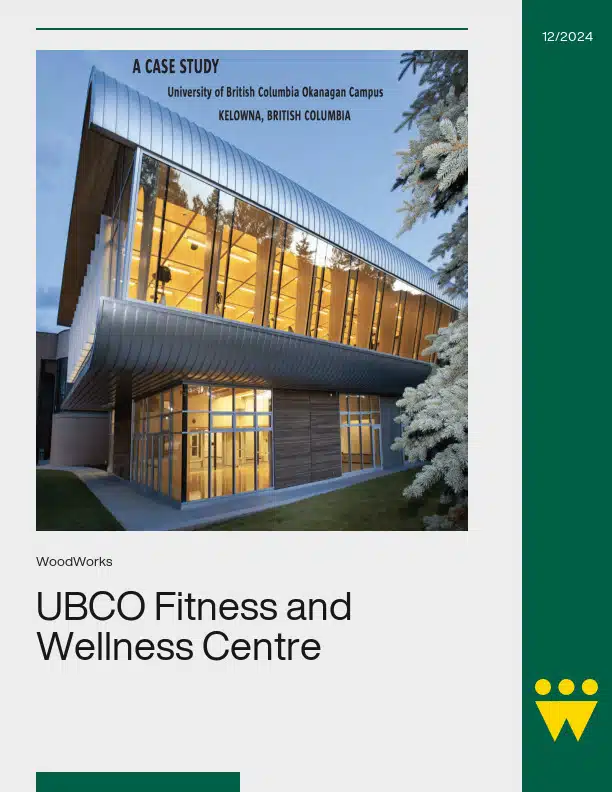
The University of British Columbia – Okanagan (UBCO) is located in the south-central community of Kelowna in BC’s interior. UBCO’s student community numbers just over 8,300 undergraduate and graduate students, 20 per cent of whom currently live on campus. UBCO strives to provide a vibrant campus life for its students. This is particularly important for resident students as the campus is located at a significant distance from activities in downtown Kelowna. UBCO’s Athletics and Recreation Department manages recreational needs on campus. It has been operating out of facilities initially built in 1994 to accommodate less than half of the current student population. The athletic competition venues on campus still meet a very high standard, but fitness and recreation facilities were lacking. A storage area in the existing gymnasium complex was converted into a weight room and cardio workout area in an effort to provide added services but a permanent solution was needed for the ever increasing number of memberships to the facility. Following the receipt of a substantial private donation for the express purpose of building a new fitness centre on the UBCO campus, UBC Properties Trust held a design-build competition for the new building. The donor stipulated two conditions for the facility: it needed to have an aviation theme, and it had to demonstrate innovative wood construction.
Social Services Administration Board – The District of Thunder Bay

The District of Thunder Bay Social Services Administration Board (the Board) delivers provincially mandated services to 13 communities in Northwestern Ontario. To help clients achieve self-sufficiency, the Board provides assistance to seniors, children, and people with addictions and administers social housing programs. In March 2012, the Board’s ability to help people was greatly enhanced by the opening of a new building in the Thunder Bay central business district. Before the new building came into service, services were delivered from three sub-standard locations, an arrangement that often required clients to travel from one location to another to get help. A feasibility study that examined the possibility of amalgamating the three offices considered three different locations for the new building. The site selected is in the centre of Thunder Bay, adjacent to the city hall and library (Figure 1). Initial resistance by the local community to bringing social services clients into the business district has been dispelled. Instead, it appears that the public and social services clients view a bright, progressive building as a positive influence. In addition, staff absenteeism has decreased. The building is wood post and beam construction with woodframe floors and infill walls. Glulam columns were left exposed. This aesthetically pleasing expression of the structure, combined with wood millwork and doors, provide a bright, positive atmosphere for staff and clients.


