
Design and Construction of Permanent Wood Foundations – The Buildings Show 2025
Course Overview This session will provide requirements and guidance on the design and construction of permanent wood foundations (PWF) based on the Canadian standard; CSA S406-16 – ‘Specification of permanent wood foundations for housing and small buildings’. Further information on site selection, backfilling, PWF floor systems, air and vapour barriers, insulation techniques, crawl spaces and design requirements for high wind and seismic zones will be discussed. This session will provide attendees with an overview of the design requirements and construction methods for PWF, with a focus on the structural system and building science considerations. Learning Objectives Apply the design requirements of CSA S406-16 for permanent wood foundations in housing and small buildings. Identify key building-science considerations for PWF systems, including drainage, air and vapour control, insulation, and crawl space design. Evaluate site and structural requirements for permanent wood foundations in high wind and seismic regions. Course Video Speakers Bio Adam Robertson Co-founder and Principal Sustainatree Adam completed his Bachelor of Applied Science in Civil Engineering at the University of Toronto and also holds a Master of Applied Science degree from the Department of Wood Science at the University of British Columbia. He is the past Chair of the CSA Subcommittee on Permanent Wood Foundations and acted as a primary author and editor during the update and revisions to the Canadian Wood Council’s Permanent Wood Foundations publication. He is the co-founder and principal of Sustainatree Consulting, a small firm specializing in sustainability and engineering design of wood building systems. Prior to opening his own practice, Adam was previously employed by the Canadian Wood Council and has also worked as a consulting structural engineer and within the building development and construction management fields.
Building Success: The Nshwaasnangong Child Care and Family Centre Story
Course Overview This session will explore the transformative journey of the Nshwaasnangong Child Care & Family Centre, a project that began as a response to the Truth and Reconciliation Commission’s Calls to Action. Led by Two Row Architect and supported by various community partners, the project highlights the innovative use of mass timber to create culturally meaningful and sustainable spaces. Attendees will learn about the collaborative design process, the integration of traditional materials with modern building practices, and the impact of the centre on the local community. The session will also provide insights into accessing technical resources and project support for wood construction through WoodWorks Ontario. Learning Objectives Explore the use of mass timber to create culturally meaningful and sustainable spaces, demonstrated through the Nshwaasnangong Child Care & Family Centre. Understand the collaborative design and prefabrication process, integrating community input, modern construction practices, and workflow planning with mass‑timber manufacturers for complex geometries. Course Video Speakers Bio Matthew Hickey Architect Two Row Architect Matthew Hickey is Mohawk from the Six Nations First Nation and is a licensed architect with 12 years of experience working in an on-reserve architecture firm. He received his Masters of Architecture from the University of Calgary and his Bachelor of Design from Ontario College of Art and Design, winning both the Alberta Association of Architects Presidents Medal and the Medal for Best Thesis, respectively. Mr. Hickey’s focus is on regenerative design – encompassing ecological, cultural, and economic principles. His research includes Indigenous history and the adaptation of traditional sustainable technologies to the modern North American climate. He currently instructs at OCAD U, for the OAA and the Canada Green Building Council.
Offsite Construction Handbook
Course Overview Offsite construction is transforming the building industry by shifting key processes from traditional sites to controlled factory environments. This approach enhances productivity, quality, and sustainability, addressing challenges like labor shortages and environmental impact. The delivery process emphasizes early collaboration, integrated design, and robust project management to optimize efficiency and risk management. Durability and energy efficiency are achieved through advanced material selection, moisture management, and airtight, highly insulated assemblies. Construction logistics, quality control, and commissioning are tailored for offsite methods, ensuring rapid, reliable project delivery. Life cycle analysis shows offsite construction can reduce embodied carbon and waste, supporting climate goals. Canada’s evolving policies and market trends position offsite construction as a key solution for affordable, sustainable housing. Learning Objectives Understand how offsite construction improves the durability, moisture control, and energy performance of wood building systems. Identify the structural and sustainability benefits of early design integration in offsite wood construction projects. Evaluate the role of life-cycle analysis and embodied carbon in positioning offsite wood construction as a solution for sustainable and affordable housing in Canada. Course Video Speakers Bio Dorian Tung Manager, Technology Assessment FPInnovations Dorian Tung is currently the Manager of Technology Assessment at FPInnovations. Prior to this, he worked as a structural consultant in Canada and the US. As a manager, he has been working with scientists on projects related to structure, seismic, durability, energy, fire, acoustic, and vibration. With the evolving ecosystem, Dorian is active in many working groups to facilitate discussions, remove duplicates, accelerate processes, with the goal to maximize impacts for the forest industry NOW using research data. He is also the editor of the Offsite Wood Construction Handbook published by FPInnovations. Helen Goodland Principal. Head of Research and Innovation SCIUS Advisory Helen Goodland is an architect registered in the UK and has an MBA from the University of BC. Helen is firmly committed to achieving truly sustainable buildings within the next decade. She is also passionate about advancing leadership opportunities for women in construction technology. To this end, she participates on numerous boards and committees. Currently she serves on the Board of Directors of Building Transformations (formerly CanBIM), the BC Digital Advisory Council, the BCIT Mass Timber Education Advisory Board and the University of Victoria’s Green Civil Engineering Advisory Council. She is also past chair of the UN Sustainable Buildings Initiative’s Materials Technical Committee. Adam Robertson Co-founder and Principal Sustainatree Adam completed his Bachelor of Applied Science in Civil Engineering at the University of Toronto and also holds a Master of Applied Science degree from the Department of Wood Science at the University of British Columbia. He is the past Chair of the CSA Subcommittee on Permanent Wood Foundations and acted as a primary author and editor during the update and revisions to the Canadian Wood Council’s Permanent Wood Foundations publication. He is the co-founder and principal of Sustainatree Consulting, a small firm specializing in sustainability and engineering design of wood building systems. Prior to opening his own practice, Adam was previously employed by the Canadian Wood Council and has also worked as a consulting structural engineer and within the building development and construction management fields.
Offsite Construction in Ontario: A Practical and Diligent Path Forward
Course Overview From the housing supply deficit to affordability issues and labour challenges, several conditions have been supporting a renewed interest for innovation in construction practices. Offsite construction is often identified as a promising approach to improve the way we build. This session explores the current market characteristics which are conducive to offsite practices, including the consistent shift towards multifamily construction in Ontario. It also identifies the numerous potential benefits of shifting the construction process from site to factory. The speakers will discuss underlying assumptions and conditions and questions such as: Are the promised benefits tangible and quantifiable? Do savings actually reach a project’s bottom line? Do all of the benefits apply to specific applications? Learning Objectives Identify market, labour, and housing conditions in Ontario that are driving interest in offsite and wood-based construction systems. Evaluate the practical benefits and limitations of offsite construction using mass timber and panelized wood systems. Assess when offsite construction provides measurable value at the project level, including cost, schedule, quality, and risk considerations. Course Video Speakers Bio Mike Schmidt President Auto Construct Incorporated A Tool & Die Maker with a Masters’ Degree in Business Administration, Mike understands manufacturing from the ground up. He spent his formative years as an executive in the automotive industry; working for world-class, multinational corporations such as Magna International and ArcelorMittal. In 2017, Mike established Auto Construct Incorporated (ACI), a management consulting firm, to accelerate the industrialization of residential construction. Specializing in the conversion from stick-built to offsite construction, Mike has led and facilitated the growth of several companies to become dominant players in their respective fields. ACI provides education, guidance, and implementation support in the areas of business development, manufacturing systems, technology selection, and factory start-ups. ACI serves a broad range of land developers, construction firms, homebuilders, and manufacturing companies throughout Canada and the United States.
Construction Moisture Management of Mass Timber Buildings
Course Overview Mass timber buildings are transforming the way we build—but with new materials come new challenges. This session will explore how moisture risks in mass timber construction and how to take a proactive approach to moisture management. Participants will gain practical insights into effective protection strategies during the construction phase and learn how to develop a tailored moisture management plan to safeguard both the mass timber structure and project timelines. Learning Objectives Identify key moisture risks specific to mass timber construction and understand how they differ from traditional structural systems. Apply practical construction-phase moisture protection strategies that align with project sequencing, site conditions, and contractor workflows. Develop or evaluate a project-specific moisture management plan to protect mass timber elements, reduce delays, and ensure long-term durability. Course Video Speakers Bio David Stanton Associate, Senior Engineer – Building Enclosure RDH Building Science Inc. David is an Associate and Senior Building Science Engineer in RDH Building Science’s Toronto office. David’s exposure to mass timber projects started with the Brock Commons project in BC as a coop student and then with the Catalyst building in Spokane, WA—a 4-storey mass timber building for Eastern Washington University—when he started working full-time in the Building Science field. Since moving back to Toronto, David has continued to work on large scale mass timber projects, including the Lawson Center for Sustainability and the Academic Wood Tower projects at UofT. Sean Carroll Senior Superintendent Graham Construction Sean Carroll is a Senior Superintendent with Graham Construction, bringing over 32 years of experience across Canada, Europe, and the UK. A civil engineer and journeyman carpenter, Sean has led complex projects in the commercial, residential, pharmaceutical, and educational sectors—including several involving advanced Mass Timber construction. Over his 11 years with Graham, split between Alberta and Ontario, Sean has been at the forefront of integrating sustainable building methods, particularly in the use of engineered timber systems. He brings a deep understanding of Mass Timber coordination, sequencing, and tolerances, along with a strong commitment to safety, quality, and team leadership. Known for his hands-on approach and global perspective, Sean combines technical precision with a collaborative leadership style—driving successful project outcomes from concept through completion. Natasha Jeremic Manager, Codes and Standards – Sustainability Canadian Wood Council Natasha Jeremic is a Professional Engineer in the building industry, with a background in design, building performance, and project management. She is currently the Sustainability Manager for Codes and Standards at the Canadian Wood Council, where she leads strategic initiatives focused on low-carbon construction, energy efficiency, durability, and circularity. Natasha leverages her expertise in structural design, building envelope consulting, and whole life carbon accounting to showcase how wood products contribute to a sustainable, low-carbon built environment. She is passionate about raising awareness of wood’s role as a viable solution in advancing climate-conscious construction.
Halsa 230 Royal York: Ontario’s Tallest Mass Timber Residential Building
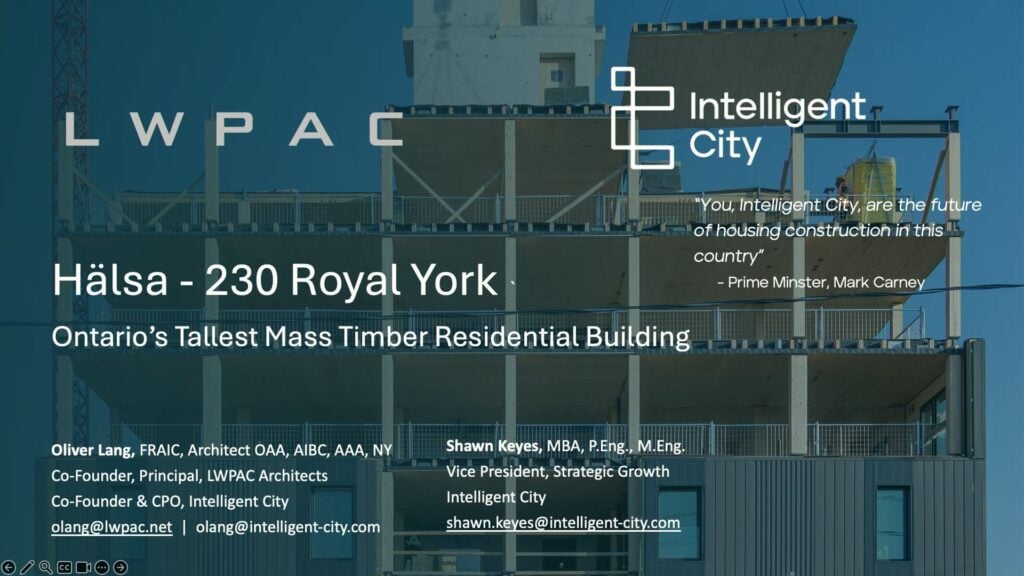
Course Overview Halsa 230 Royal York is setting new standards as Toronto’s pioneering 9-storey prefabricated mass timber rental building, demonstrating the viability of carbon-neutral communities within Toronto’s Right of Way zoning. Through a case study of the building, this session will present the advantages of integrated design and prefabricated mass timber building systems components. Learning Objectives Explain the integrated design and prefabrication strategies used in mass timber residential construction: Learners will be able to describe how collaborative design, advanced manufacturing, and prefabricated building systems contribute to project efficiency, quality, and scalability. Analyze the technical features and performance benefits of mass timber floor cassettes and curtain wall systems: Learners will understand the structural, acoustic, fire resistance, and thermal properties of the building’s mass timber components, and how these features address common challenges in high-rise construction. Evaluate the sustainability, regulatory, and operational considerations in developing carbon-neutral mass timber buildings: Learners will assess how material sourcing, certification, lifecycle carbon analysis, and code compliance shape the viability and impact of mass timber projects in urban environments. Course Video Speakers Bio Oliver Lang Co-Founder, Chief Product Officer, Intelligent City Co-Founder, Principal, LWPAC Oliver Lang is a German-Canadian architect and urban entrepreneur with 25+ years of experience and a recognized leader in design innovation and integration of complex urban projects, mixed-use housing, advanced prefabrication, and green building strategies. He is a graduate of Columbia University’s Graduate School of Architecture Planning and Preservation, with a Master of Science in Advanced Architectural Design, and he holds a professional degree (Diplom-Ingenieur Architektur) from the University of Technology Berlin with two-year studies at the ETSA Barcelona UPC. Prior to founding LWPAC in 1998, Oliver researched and practiced in digitally assisted design and fabrication with Smith-Miller & Hawkinson in New York, while teaching digital design at Princeton University, Columbia University, and University of Pennsylvania. He subsequently has taught advanced design and digital technology at SCI_ARC, the Berlage Institute, TU Berlin, UTF Santa Maria, and University of British Columbia (UBC). Shawn Keyes VP – Strategic Growth and Business Development Intelligent City Shawn is a structural engineer and commercial executive with more than a decade of experience leading innovation in mass timber and industrialized construction. As Vice President of Strategic Growth at Intelligent City, he leads commercialization, market strategy, and partnerships to scale the company’s prefabricated housing systems. Previously, Shawn served as Executive Director of WoodWorks BC, where he led a strategic transformation that strengthened partnerships, technical leadership, and influence across the development, AEC, and policy sectors. Before that, he spent over six years at Fast + Epp as a Senior Structural Engineer, developing deep technical expertise. Over his career, Shawn has supported more than 150 mass timber and hybrid projects across Canada, and has served on advisory councils for BC Housing, BCIT, the BC Office of Mass Timber Implementation, Forestry Innovation Investment, and Natural Resources Canada. He holds an MBA from UBC Sauder, a Master of Engineering from Carleton University, and is a licensed Professional Engineer in BC and Ontario.
The Future of Tall: The Future of Cities
Course Overview Over the past two decades, tall buildings have enjoyed a major uptake in almost all major cities globally. But is the push for greater urban density and taller buildings creating habitats and patterns of life that are truly sustainability, in terms of social, cultural and economic sustainability, as well as the carbon equation? Through examples from around the world, this session outlines areas where the typology, and cities, need to develop. Learning Objectives Understand the sustainability challenges and opportunities in tall building design: Explore how social, cultural, economic, and environmental factors influence the development of high-rise structures and urban density. Identify innovative strategies for integrating mass timber and other sustainable materials in tall buildings: Learn how material choices impact carbon reduction, energy efficiency, and structural performance in high-rise construction. Analyze global case studies to evaluate future trends in urban development and tall building typologies: Gain insights into design approaches that promote livable, resilient, and sustainable cities. Course Video Speakers Bio Dr. Antony Wood CEO Antony Wood Consulting Dr. Antony Wood is the former President of the Council on Tall Buildings and Urban Habitat (CTBUH), responsible for leading the Council’s thought leadership, research, and academic initiatives. Prior to this, he was CTBUH chief executive officer (CEO) from 2006-2022. During his sixteen-year tenure as CEO, CTBUH significantly increased its outputs and initiatives across all areas globally. Wood’s PhD dissertation explored the multi-disciplinary aspects of skybridge connections between tall buildings. He is associate editor of the CTBUH Journal and serves on the editorial board of several other journals. He is the author of numerous books and papers in the fields of tall buildings, sustainability, and related fields. Wood has been conference chair and chair of the scientific committee at all CTBUH conferences since 2006. He has also presented at numerous conferences, and lectures regularly around the world.
Mass Timber Economics: Why One Line Item Doesn’t Tell the Whole Story
Course Overview Mass timber buildings are often perceived as premium projects, but assumptions based on a single cost line can be misleading. This session explores the complexities of costing mass timber construction and highlights why a holistic, team-based approach is essential from the earliest stages of design. Attendees will gain insights into common pitfalls for cost consultants and learn how early architectural decisions such as grid spacing and aesthetic goals can significantly influence both cost and structural efficiency. The speakers will emphasize the importance of clear project objectives when setting the initial budget and outline best practices for cost predictability, including robust scope management, design reviews, and obtaining competitive bids from multiple timber suppliers. The session will also examine the role of architects in informing cost decisions, strategies for improved procurement and scheduling, and how to leverage mass timber’s expedited on-site phase. Learning Objectives Understand the complexities of mass timber costing: Participants will be able to explain why relying on a single cost line item is misleading and identify key factors—such as grid spacing and aesthetic goals—that influence overall project cost and structural efficiency. Apply best practices for cost predictability in mass timber projects: Learners will be able to outline strategies for achieving accurate budgets, including robust scope management, design reviews, and obtaining competitive bids from multiple timber suppliers. Recognize the role of collaboration in successful mass timber delivery: Attendees will be able to describe how architects, developers, and contractors can work together from early design stages to improve procurement, scheduling, and leverage mass timber’s expedited on-site phase. Course Video Speakers Bio Marlon Bray Executive Vice President Clark Construction Management Inc. Mass timber buildings are often perceived as premium projects, but assumptions based on a single cost line can be misleading. This session explores the complexities of costing mass timber construction and highlights why a holistic, team-based approach is essential from the earliest stages of design. Attendees will gain insights into common pitfalls for cost consultants and learn how early architectural decisions such as grid spacing and aesthetic goals can significantly influence both cost and structural efficiency. The speakers will emphasize the importance of clear project objectives when setting the initial budget and outline best practices for cost predictability, including robust scope management, design reviews, and obtaining competitive bids from multiple timber suppliers. The session will also examine the role of architects in informing cost decisions, strategies for improved procurement and scheduling, and how to leverage mass timber’s expedited on-site phase. Mathieu Fleury Partner Leader Lane Developments Mathieu combines a merchant developer mentality with institutional discipline to drive Leader Lane Developments’ ambitious urban projects. He holds a Masters in Real Estate Finance from The University of Cambridge and has over 15 years of experience with industry leaders, including Loblaw Properties Limited, Great Gulf, and Dream Unlimited. Over the course of his career, Mathieu has shaped over 15,000 residential units and 7 million square feet of development across Canada. With his entrepreneurial spirit and analytical mindset, he steers Leader Lane’s growth in Toronto’s dynamic mid-rise sector. Mathieu’s strategic leadership ensures each project balances innovation with strong financial performance, delivering communities that enhance the urban experience while maximizing investor value. Jonathan King Principal BNKC Architects Inc. An architect and design leader with nearly 30 years of experience, Jonathan has worked across the full spectrum of residential, institutional, and cultural projects across Canada—from university buildings and theatres to large-scale multi-residential developments. He’s led teams at firms such as Diamond and Schmitt, HOK, and Core Architects, and is now a Principal at BNKC, where he helps steer complex projects from early concept through to completion. Jonathan’s recent work has included multiple mid- and high-rise residential and commercial buildings that integrate new construction technologies—including hybrid and mass timber structures—within tight urban contexts. His background brings a deep understanding of how codes, construction logistics, and market realities shape design decisions. He’s particularly interested in how architects can help unlock the potential of mass timber by working more collaboratively with clients, engineers, and municipalities to address the barriers standing.
Architectural Assemblies Simplified: Understanding Structural Grids: Acoustics and Envelopes in Wood Buildings
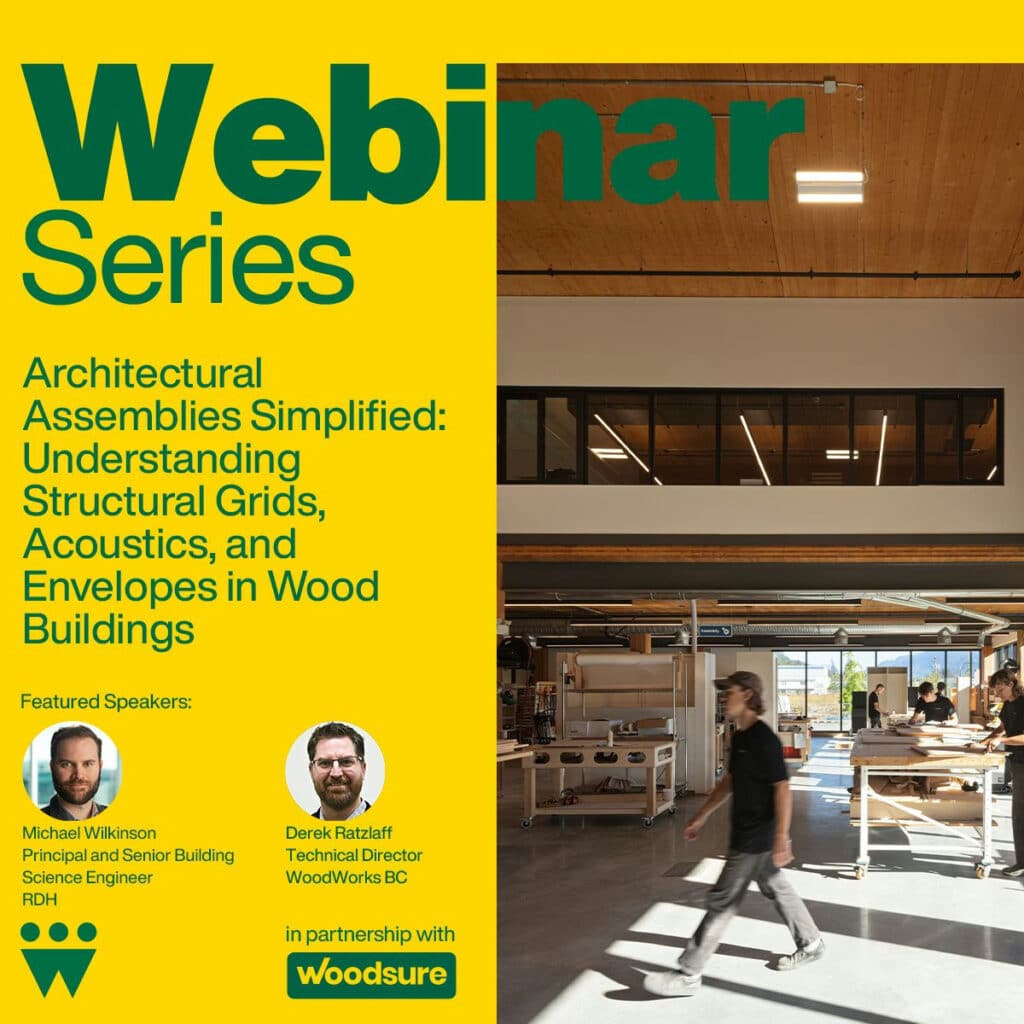
Course Overview This session will help you to formulate effective floor and wall assemblies when designing wood structures, both light wood frame and mass timber. Discussion will cover typical fire ratings and strategies, acoustic performance of different assemblies and effective strategies for weather-tight exterior envelopes. Background on typical structural assemblies for different grid sizes will help you understand how to effectively develop complete assemblies when designing timber buildings. Learning Objectives Participants will understand how to formulate effective floor and wall assemblies for wood structures, including both light wood frame and mass timber, to optimize performance and design efficiency. Participants will understand typical fire ratings and the acoustic performance of various assemblies and gain strategies to enhance the safety and comfort of wood buildings. Participants will learn how to design weather-tight, high-performance exterior envelopes for wood buildings. Participants will discover typical structural assemblies for different grid sizes and learn how to effectively develop complete assemblies when designing timber buildings. Course Video Speaker Bio Michael Wilkinson Principal and Senior Building Science Engineer RDH Michael Wilkinson is a Principal and Senior Building Science Engineer at RDH. He has provided consulting services across a range of building typologies with a focus on high performance and innovative building projects including those that are Passive House, mass timber, and volumetric modular. Michael has also been involved in numerous research projects including product development and performance monitoring and is the lead author of several guideline documents for government agencies and building enclosure product manufacturers. Additionally, Michael is a part-time instructor at the BC Institute of Technology where he teaches building science and construction technology classes. Derek Ratzlaff, P.Eng., Struct.Eng., PE Technical Director, WoodWorks BC Canadian Wood Council Derek began his career in the wood industry in high school working on single and multi-family light wood construction, after university and almost 20 years of structural consulting experience, Derek has worked in all types of wood construction and played key roles in the delivery of iconic BC wood structures, the Richmond Olympic Oval and Grandview Heights Aquatic Centre. He brings his experience in design and construction to support the industry as the Woodworks BC Technical Director.