
FRAMEWORK for Success: Prefabricated Wood Systems and Design Innovation
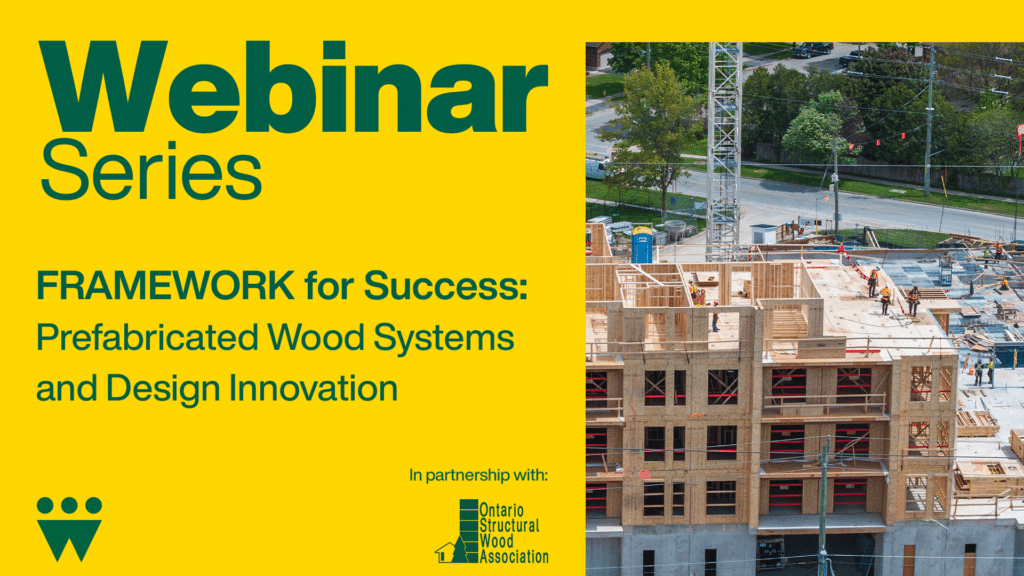
Course Overview This presentation explores the transformative impact of prefabricated light wood frame construction systems in multi-residential development, focusing on VanMar’s FRAMEWORK methodology and its application in the new 150 Wissler Road project in Waterloo. FRAMEWORK is a highly efficient, panelized light wood frame system designed for buildings up to six storeys, delivering rapid, sustainable, and cost-effective construction that meets and exceeds energy and greenhouse gas reduction targets. The session will highlight VanMar’s extensive experience in affordable housing, the advantages of offsite prefabrication, and the collaborative process that accelerates project delivery. Learning Objectives Participants will understand the benefits of prefabricated wood frame construction for multi-residential buildings. Participants will understand the FRAMEWORK system’s approach to speed, cost-effectiveness, and sustainability. Participants will be shown how collaborative offsite construction methods accelerated the 150 Wissler Road project. Participants will learn strategies for overcoming design challenges and achieving efficiencies in fire walls, shafts, and acoustics. Course Video Speakers Bio Jordan Zekveld Director of Preconstruction VanMar Constrcutors ON Jordan is a construction and development professional with deep experience in estimating, preconstruction, and cost strategy for multi-unit residential projects. At VanMar Constructors, he helps developers, REITs, and non-profits bring condominium, rental, and affordable housing projects from concept to construction. Drawing on VanMar’s integrated design-build expertise, Jordan leads collaborative preconstruction processes that align design intent, feasibility, and cost efficiency. His experience spans concrete high-rise and innovative mid-rise wood-frame developments, including the Framework system — VanMar’s sustainable, fast, and cost-effective building solution. With a focus on clarity, constructability, and long-term value, Jordan works at the intersection of planning, design, and execution to help deliver housing that’s efficient, affordable, and built to last. Mike Philips Executive Director Ontario Structural Wood Association (OSWA) Mike Phillips has served as Executive Director of OSWA since 2008. Under his leadership, the association has evolved from a truss-fabricator-focused group into Ontario’s leading voice for structural wood component manufacturing. Today, the province is home to 70 certified truss plants and 40 wood-panel manufacturers, with engineered wood products now the preferred choice for floor systems. At the same time, Ontario’s building code has never been more prepared to accommodate advanced wood-construction methods. Mike is a strong advocate for the industrialization of construction and the expanding role of off-site building systems—critical drivers of wood construction’s future growth. Paul Marchesani Operations Manager Panelized Building Solutions Inc. Paul Marchesani is the Vice President of Panelized Building Solutions Inc., a family run business where he plays a key leadership role in driving operational excellence, strategic growth, and project execution across the company. Known for his strong work ethic, hands-on approach, and deep industry knowledge, Paul oversees day-to-day operations while supporting long-term planning that aligns with the company’s vision. Before joining Panelized Building Solutions, Paul held key roles in project management and operations within manufacturing and construction environments, where he oversaw production teams, implemented process improvements, and helped streamline workflow efficiencies. His ability to manage both people and complex technical projects made him a natural fit for leadership. Respected by colleagues, clients, and trade partners alike, Paul combines technical expertise with strong leadership, making him an essential pillar of the company’s continued success.
Halsa 230 Royal York: Ontario’s Tallest Mass Timber Residential Building
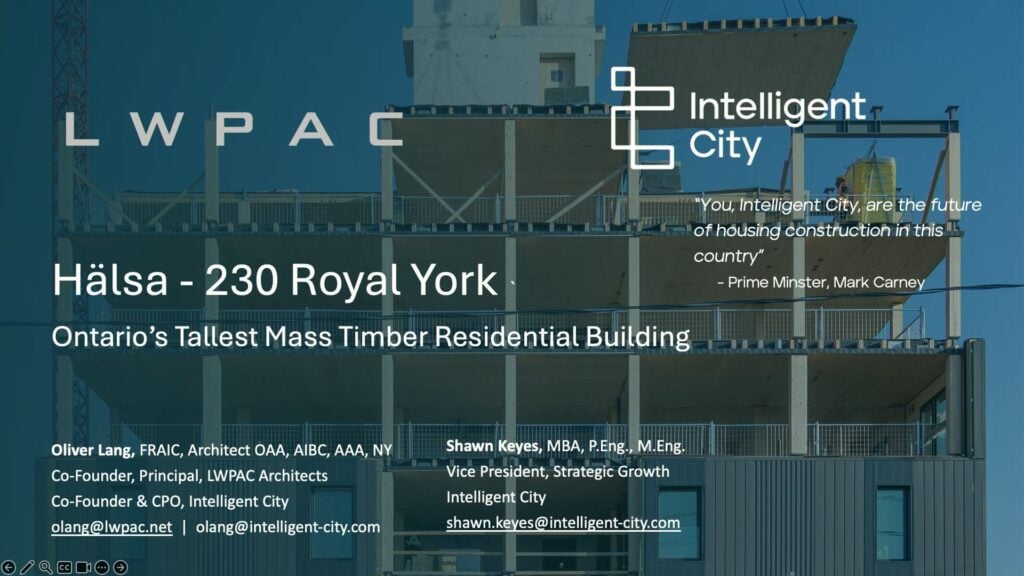
Course Overview Halsa 230 Royal York is setting new standards as Toronto’s pioneering 9-storey prefabricated mass timber rental building, demonstrating the viability of carbon-neutral communities within Toronto’s Right of Way zoning. Through a case study of the building, this session will present the advantages of integrated design and prefabricated mass timber building systems components. Learning Objectives Explain the integrated design and prefabrication strategies used in mass timber residential construction: Learners will be able to describe how collaborative design, advanced manufacturing, and prefabricated building systems contribute to project efficiency, quality, and scalability. Analyze the technical features and performance benefits of mass timber floor cassettes and curtain wall systems: Learners will understand the structural, acoustic, fire resistance, and thermal properties of the building’s mass timber components, and how these features address common challenges in high-rise construction. Evaluate the sustainability, regulatory, and operational considerations in developing carbon-neutral mass timber buildings: Learners will assess how material sourcing, certification, lifecycle carbon analysis, and code compliance shape the viability and impact of mass timber projects in urban environments. Course Video Speakers Bio Oliver Lang Co-Founder, Chief Product Officer, Intelligent City Co-Founder, Principal, LWPAC Oliver Lang is a German-Canadian architect and urban entrepreneur with 25+ years of experience and a recognized leader in design innovation and integration of complex urban projects, mixed-use housing, advanced prefabrication, and green building strategies. He is a graduate of Columbia University’s Graduate School of Architecture Planning and Preservation, with a Master of Science in Advanced Architectural Design, and he holds a professional degree (Diplom-Ingenieur Architektur) from the University of Technology Berlin with two-year studies at the ETSA Barcelona UPC. Prior to founding LWPAC in 1998, Oliver researched and practiced in digitally assisted design and fabrication with Smith-Miller & Hawkinson in New York, while teaching digital design at Princeton University, Columbia University, and University of Pennsylvania. He subsequently has taught advanced design and digital technology at SCI_ARC, the Berlage Institute, TU Berlin, UTF Santa Maria, and University of British Columbia (UBC). Shawn Keyes VP – Strategic Growth and Business Development Intelligent City Shawn is a structural engineer and commercial executive with more than a decade of experience leading innovation in mass timber and industrialized construction. As Vice President of Strategic Growth at Intelligent City, he leads commercialization, market strategy, and partnerships to scale the company’s prefabricated housing systems. Previously, Shawn served as Executive Director of WoodWorks BC, where he led a strategic transformation that strengthened partnerships, technical leadership, and influence across the development, AEC, and policy sectors. Before that, he spent over six years at Fast + Epp as a Senior Structural Engineer, developing deep technical expertise. Over his career, Shawn has supported more than 150 mass timber and hybrid projects across Canada, and has served on advisory councils for BC Housing, BCIT, the BC Office of Mass Timber Implementation, Forestry Innovation Investment, and Natural Resources Canada. He holds an MBA from UBC Sauder, a Master of Engineering from Carleton University, and is a licensed Professional Engineer in BC and Ontario.
Quiet by Design
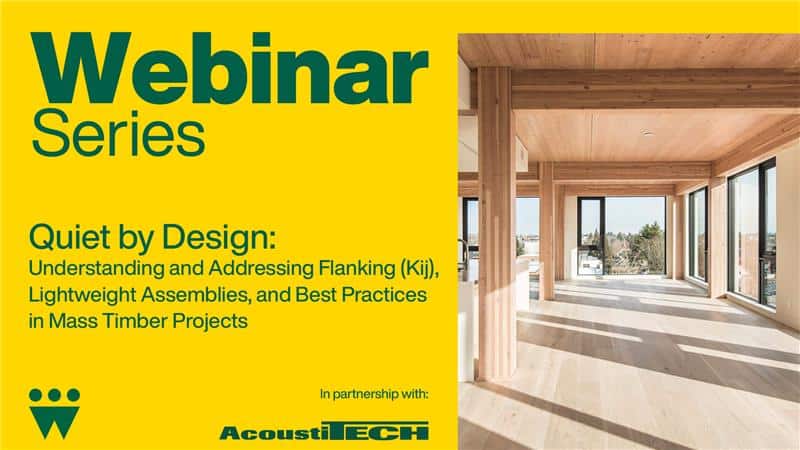
Course Overview Join us for Quiet by Design, an in-depth course exploring how to achieve consistent, high-performing acoustics in mass timber projects. In partnership with AcoustiTECH, a panel of leading acoustic experts will unpack the complexities of flanking (Kij), share best-practice detailing strategies—including bulkheads and wall interfaces—to help you avoid costly construction errors, and present the latest research on lightweight floor and ceiling assemblies for mass timber systems, including GLT. Expect practical design strategies, real-world insights, and clear, actionable guidance to help you choose the right acoustic solutions for your next project. Learning Objectives Understanding and Addressing Flanking (Kij): Gain a clear understanding of how sound transmits through indirect paths and learn proven methods to identify, measure, and control flanking effectively. Best Practices in Acoustic Design: Discover key detailing approaches—such as optimized bulkhead integration and wall interfaces—that enhance acoustic performance, improve Kij values, and minimize costly construction errors. Lightweight Assemblies for Mass Timber Structures: Explore innovative, lightweight floor and ceiling assemblies purpose-designed for mass timber systems, including the latest findings and design guidance for GLT applications. Course Video Speakers Bio Cristian Wallace AcoustiTECH Cristian Wallace has extensive experience in collaborating with architects, builders, acoustic consultants, and other stakeholders. He focuses on delivering tailored acoustical solutions to meet the specific needs of each project. With a hands-on approach, Cristian evaluates every detail to provide efficient, personalized solutions that help clients achieve their vision. His expertise, combined with AcoustiTECH’s proven methods, ensures reliable and effective outcomes in every collaboration. Ben White Senior Acoustical Engineer Aercoustics Engineering Ltd. David Dompierre Senior Noise Consultant SIBE Acoustics Simon Edwards Senior Acoustical Engineer HGC Noise Vibration Acoustics
Sound and Vibration in Mass Timber Buildings: A Practical Guide
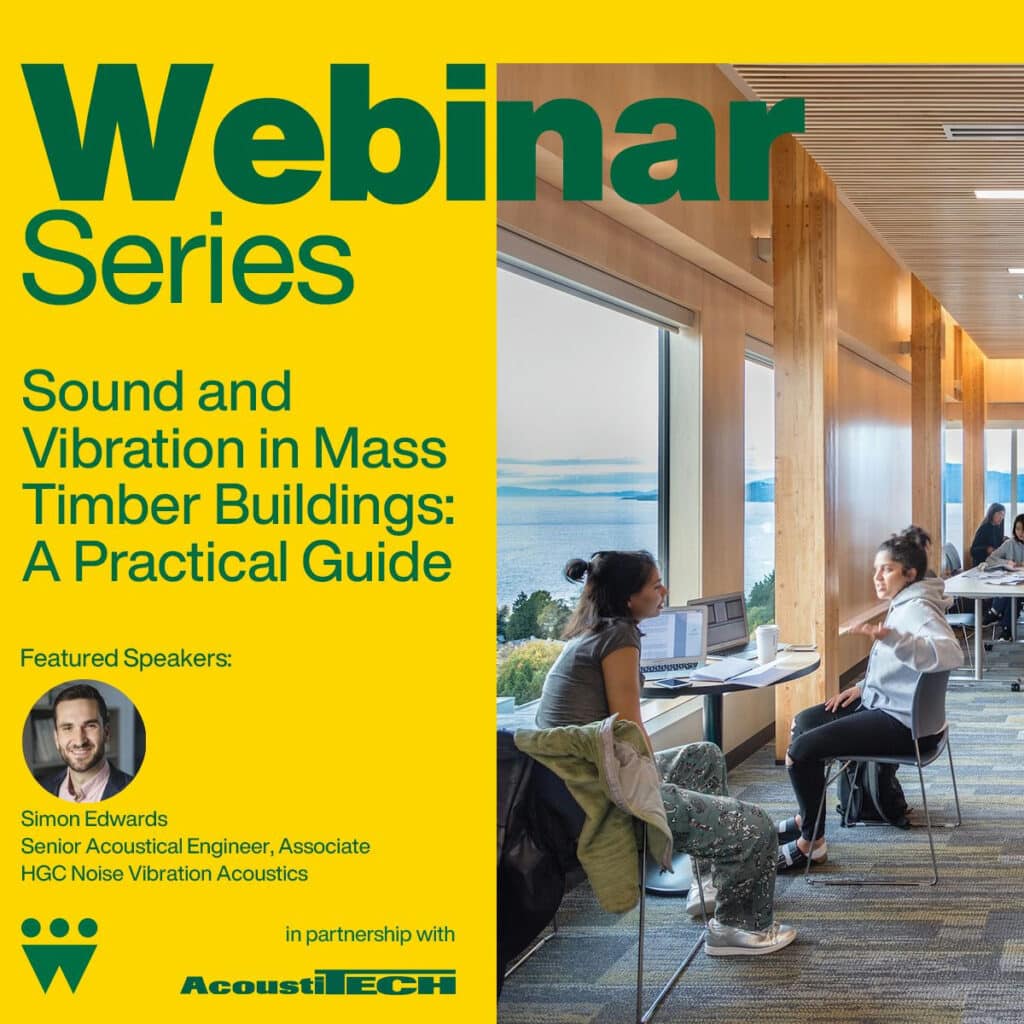
Course Overview Following an introductory overview of building acoustics, the presenter will explore both airborne and impact sound transmission in mass timber buildings. While direct sound transmission (i.e., through floor/ceiling assemblies) has been thoroughly tested, indirect sound transmission (i.e., around wall or floor/ceiling assemblies) remains more of a challenge. To address this, the presenter will share findings from recent R&D initiatives aimed at helping maximize exposed mass timber while still adhering to code requirements. This webinar will also examine the sound absorptive properties of mass timber, which play a critical role in environments such as schools, offices, and event spaces. Finally, we’ll conclude with specific design strategies to help prevent late-stage acoustical issues, especially when projects have progressed to a point where certain solutions are no longer feasible. Learning Objectives Gain familiarity with basic acoustic terminology and principles. Understand how sound and vibration can transmit directly and indirectly through the mass timber structure. Discover approaches to addressing sound and vibration transmission through continuous mass timber (CLT) panels. Gain an appreciation of various design considerations affecting the control of noise in mass timber buildings. Course Video Speaker Bio Simon Edwards, M.Eng., P.Eng., ing. Senior Acoustical Engineer, Associate HGC NOISE VIBRATION ACOUSTICS Simon is a member of HGC’s built environment division, with extensive experience in acoustical work across the permitting, design, construction, and post-occupancy phases of residential and commercial buildings. He has worked with poured concrete, hollow-core, wood-frame, and steel-deck structures and has particular expertise in mass timber projects, including Ontario’s first mass timber building, R-Town Vertical 6, and the acclaimed YW Supportive Housing project in Kitchener. Simon’s growing experience in designing and testing various CLT configurations has positioned him as a leader in mass timber acoustics. Simon is also an expert on sound transmission, with a background in both theoretical calculations and experimental sound transmission testing (“Kij Testing”) to evaluate flanking transmission in line with ISO 12354 and ISO 10848. He is a member of both the ISO and ASTM Technical Committees on Building Acoustics and contributes to the development of standards for measurement and calculation methodologies across the industry.
Architectural Assemblies Simplified: Understanding Structural Grids: Acoustics and Envelopes in Wood Buildings
Course Overview This session will help you to formulate effective floor and wall assemblies when designing wood structures, both light wood frame and mass timber. Discussion will cover typical fire ratings and strategies, acoustic performance of different assemblies and effective strategies for weather-tight exterior envelopes. Background on typical structural assemblies for different grid sizes will help you understand how to effectively develop complete assemblies when designing timber buildings. Learning Objectives Participants will understand how to formulate effective floor and wall assemblies for wood structures, including both light wood frame and mass timber, to optimize performance and design efficiency. Participants will understand typical fire ratings and the acoustic performance of various assemblies and gain strategies to enhance the safety and comfort of wood buildings. Participants will learn how to design weather-tight, high-performance exterior envelopes for wood buildings. Participants will discover typical structural assemblies for different grid sizes and learn how to effectively develop complete assemblies when designing timber buildings. Course Video Speaker Bio Michael Wilkinson Principal and Senior Building Science Engineer RDH Michael Wilkinson is a Principal and Senior Building Science Engineer at RDH. He has provided consulting services across a range of building typologies with a focus on high performance and innovative building projects including those that are Passive House, mass timber, and volumetric modular. Michael has also been involved in numerous research projects including product development and performance monitoring and is the lead author of several guideline documents for government agencies and building enclosure product manufacturers. Additionally, Michael is a part-time instructor at the BC Institute of Technology where he teaches building science and construction technology classes. Derek Ratzlaff, P.Eng., Struct.Eng., PE Technical Director, WoodWorks BC Canadian Wood Council Derek began his career in the wood industry in high school working on single and multi-family light wood construction, after university and almost 20 years of structural consulting experience, Derek has worked in all types of wood construction and played key roles in the delivery of iconic BC wood structures, the Richmond Olympic Oval and Grandview Heights Aquatic Centre. He brings his experience in design and construction to support the industry as the Woodworks BC Technical Director.
Application of CLT in high‐end custom homes and mixed‐use residential buildings
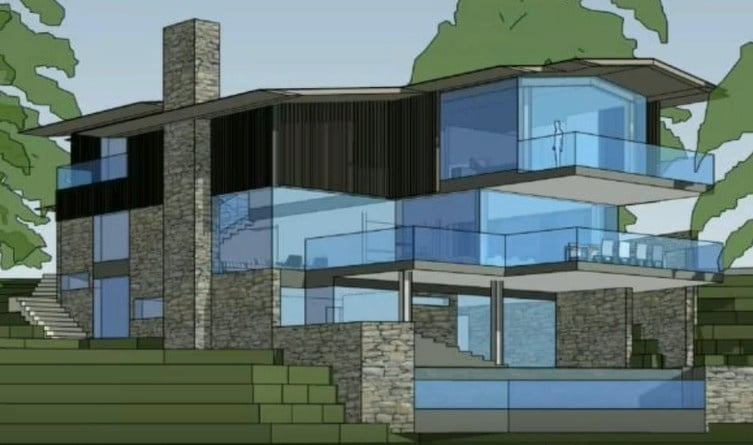
Course Overview Follow our journey of introducing CLT into high end‐custom homes and mixed‐use residential projects in the Greater Vancouver Area. We’ll explore the differences between light wood‐frame and CLT construction from the design and detailing phase right through to the end of construction. You’ll learn how the coordination, supply, and installation processes differ from conventional light wood‐frame projects and how our two examples were received by the design and construction teams. Learning Objectives Design and detailing considerations. Coordination process with design team. Supply consideration. Response of the industry. Course Video Speaker Bio Mehrdad Jahangiri, P.Eng., Dipl. Ing. (Germany) Founding Principal ASPECT Structural Engineers Mehrdad has over 25 years of international experience on notable, architecturally‐oriented projects. His experience enables him to integrate European codes and practices with the North American market, creating new ways for architects and owners to reach their project aspirations. Mehrdad understands the challenge to create carefully detailed, yet efficient structural designs and provides exceptional service to achieve them. Allison DenToom, P.Eng., P.E, LEED Green Associate ASPECT Structural Engineers Allison’s expertise is with the design of high‐end single‐family residences and multifamily residential buildings. From cozy cabins to 30,000+ sf estates, she is well‐versed in projects of all shapes, sizes, and materials. She is passionate about architecturally expressive structures and prides herself on providing the high level of attention that is required to create the finished project.
Simplified and Sustainable Acoustic Solutions for High-Performance Mass Timber Buildings
Course Overview Delivering superior acoustic comfort to building occupants doesn’t have to be complicated. In this panel discussion, presented by an industry-leading manufacturer of acoustic treatments, an acoustic expert, and a LEED GA certified engineer, discover the latest ground-breaking advancements in sound technology that are transforming acoustic design in wood construction. There are many critical factors to consider when looking at acoustic systems: weight reduction, fire performance, structural height, and environmental sustainability must all be taken into account. The panelists will share system recommendations to help designers achieve better sound performance in mass timber buildings. Learning Objectives Identify the latest systems solutions in the marketplace. Understand how to mitigate flanking paths. Explore impact sound solutions for exposed mass timber ceilings. Discuss the benefits of dry vs. wet floor toppings based on a building’s design. Course Video Speaker Bio David Dompierre, P.Eng. Acoustic Engineer SIBE Acoustics Having been involved in over a hundred successful projects in North America, David was able to develop expertise in the acoustics of numerous construction systems (steel, concrete, light wood frame, mass timber, hybrids, etc.). His position as R&D director at an acoustics laboratory allowed him to gain knowledge of acoustic materials and flooring types. For several years, he has had the opportunity to share that knowledge with firms, colleges, and universities. David’s role as a senior noise consultant at SIBE Acoustics is to help developers and professionals with the selection and implementation of acoustic solutions in their projects. David Gonzalez, LEED® Green Associate™ Solutions Ambassador DCC Solutions With over 20 years of experience in the building materials industry, David assists construction professionals achieve optimal acoustical performance for the soundproofing of buildings using a dry topping flooring system. He is a keen green building enthusiast and enjoys acquiring knowledge on environmentally friendly, low carbon and healthy building materials that can contribute to making a positive impact on people’s health, the environment, and the construction industry. André Rioux Co-Owner- Business Development AcoustiTECH André has been working alongside building professionals for 20 years and is recognized for his passion for the field of acoustics and his expert knowledge. Promoting wood construction across Canada and the US has been a great focus of his, he has participated in various organizations, presented at conferences and been part of innovative projects. André’s experience with wood construction combined with over 20 years of research and development from AcoustiTECH has resulted in a group that is able to bring invaluable expertise and know-how to the industry.
Elevate Innovate Acoustically Integrate
Course Overview In this session using specific project case studies, discover the latest ground-breaking advancements in sound technology that are transforming acoustic design in wood construction. There are many critical factors to consider when looking at acoustic systems: weight reduction, fire performance, structural height, on-site sequencing and environmental sustainability must all be taken into account. This session will shed light on the advantages of dry toppings over wet toppings, presenting innovative solutions that not only comply with building codes but also keep the construction process moving forward. Learning Objectives Define Basic Acoustic Principles. Propagation of noise in Wood Construction. Dry Topping VS Wet Topping. Case Studies. Course Video Speaker Bio Cristian Wallace AcoustiTECH Cristian Wallace brings a wealth of technical knowledge and a genuine passion for collaborating with Developers, Architects, and Acoustical Engineers. His primary objective is to empower clients by educating them on effective strategies to prevent noise-related problems and encourage sustainable construction methods. AcoustiTECH has evolved into a market leader with over 20 years of extensive research and development. Along with Cristian’s expertise they culminated into a team capable of delivering invaluable insights.