
Lessons from “The Timber City”
Course Overview The presentation explores the innovative approach undertaken by the municipality of Växjö, Sweden, which aligns sustainable construction practices with the development of smart cities. By leveraging wood as a primary building material, this strategy reduces environmental impact, promotes resource efficiency, and supports the circular economy. The presentation details the integration of prefabricated wooden elements and advanced technologies such as IoT, AI, and digitalization to optimize urban infrastructure and enhance the quality of life for residents. The strategic framework includes collaboration with industry stakeholders, the transition to open innovation, and the establishment of standards and regulations to support long-term sustainable development. The presentation also addresses the municipality’s role in fostering innovation and market opportunities, aiming to transform Växjö into a leading example of a smart, sustainable city. This study contributes to the broader discourse on urban sustainability, providing actionable insights for policymakers, architects, and urban planners committed to developing resilient and environmentally responsible urban environments. Learning Objectives Understanding Sustainable Construction Practices: Attendees will gain insights into the benefits of using wood as a sustainable building material, including its impact on reducing environmental footprints and promoting long-term urban sustainability. Integration of Technology in Urban Development: Participants will learn how modern technologies such as IoT, AI, and digitalization are transforming construction processes and contributing to the development of smart cities. Strategic Planning for Smart Cities: The presentation will provide knowledge on the critical components of a smart city, including energy efficiency, resource management, and the use of advanced technologies to improve the quality of life for residents. Collaboration and Innovation in Urban Development: Attendees will understand the importance of open innovation, collaboration among stakeholders, and the role of municipalities in facilitating sustainable development and market possibilities in the context of sustainable construction and smart cities. Course Video Speakers Bio Fredrik Lindblad Professor Linneaus University Fredrik Lindblad is an accomplished leader with a distinguished career in international business management, strategic development, and logistics. Throughout his career, Fredrik has held key leadership positions globally, including roles at Danzas, DHL, and as the Global Head of Supply Chain at Aramex. Most recently, he served as CEO of Växjö Linnæus Science Park, where he played a crucial role in forging strategic partnerships, driving business growth, and fostering innovation. In addition to his executive roles, Fredrik has held several board-level positions and has been actively engaged as an international consultant, working on projects for governments, NGOs, and non-profit organizations. Fredrik holds a Doctorate in Industrial Engineering and a Licentiate in Economics from Linnaeus University, where he also serves as an Associate Professor. He is a prolific author, with numerous publications in journals such as the Scandinavian Journal of Public Administration, Forest Products Journal, Management and Technology, Wood Material Science and Engineering, and Construction Management and Economics. His research has made contributions to the fields of logistics, supply chain management, and wood construction technology.
Green Construction through Wood
Course Overview Green Construction through WoodThe Green Construction through Wood (GCWood) program encourages the use of innovative wood-based building technologies in construction projects. The renewed program expanded its focus to fund innovative building solutions and schematic designs under key areas of interest including, but not limited to, prefabrication, modular buildings, retrofits, and design for disassembly/adaptability. Accelerating Mass Timber Adoption in Canada Regional experts from WoodWorks, representing jurisdictions from across Canada, offer insights into regional opportunities and lingering obstacles to mass timber adoption, and discuss the strategies developed and presented in the Mass Timber Roadmap recently published by FPAC, CWC, Energy Futures Lab and The Transition Accelerator. Learning Objectives Understand the purpose and impact of the Green Construction through Wood (GCWood) program, including its role in reducing embodied carbon, enabling innovation, and supporting Canada’s mass timber ecosystem. Identify key barriers and enablers affecting mass timber adoption in Canada, such as technical challenges, regulatory evolution, supply chain capacity, and regional policy differences. Identify regional opportunities and market pathways for expanding mass timber construction, incorporating insights from WoodWorks experts across Canada and the strategic directions presented in the Mass Timber Roadmap. Course Video Speakers Bio Jean-Francois Levasseur Director, Industry Relations & Innovation Programs Natural Resources Canada Graduating from the University of Ottawa’s Chemical Engineering program, Jean-Francois started his career in a variety of increasing roles in Kraft pulp mills, including mill process and environmental engineer positions. He then joined Environment and Climate Change Canada where he led on numerous aspects of environmental regulatory regimes applicable to Canada’s forest sector. At Natural Resources Canada since 2009, he has led in the design and implementation of various funding programs supporting strategic R&D, innovation and capital investments that accelerate the transformation of the Canadian forest sector towards the Bioeconomy: the Pulp & Paper Green Transformation (PPGTP); the Forest Innovation Program (FIP); the Investments in Forest Industry Transformation program (IFIT), and; the Green Construction through Wood program (GCWood). Together, these programs provided more than $1B to support energy efficiency improvements, green energy production, and the commercialization of innovative products, transformative technologies and new wood based green building and mass timber demonstrations. Scott Jackson Director of Conservation Biology Forest Products Association of Canada Steven Street Executive Director WoodWorks Ontario Shawn Keyes Executive Director WoodWorks BC Rory Koska Executive Director WoodWorks Alberta Simon Bellavance Technical Advisor Cecobois David Porter Program Coordinator WoodWorks Atlantic Tim Buhler Director – Programs and Operations Canadian Wood Council
An Overview of Sustainable Forestry in Canada for Architecture and Engineering Students 2022
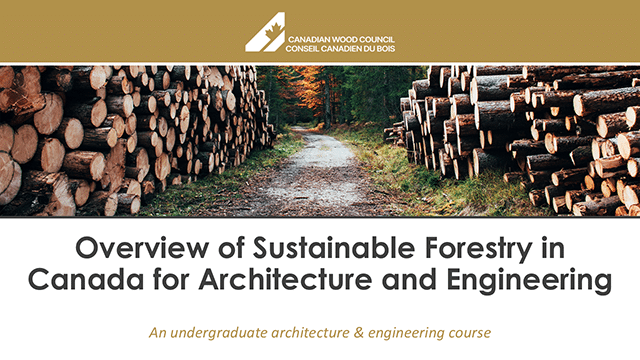
Resource Description Canada: A Forest Country With 362 million hectares of forest, Canada is the third-most forested country in the world. Acknowledgments Prepared by: The Mass Timber Institute at the University of Toronto’s John H. Daniels Faculty of Architecture, Landscape, and Design for the Canadian Wood Council. Lead Authors Monique Dosanjh Shan Shukla Sanjana Patel Dr. Anne Koven Usage and Citation Guidelines Coming soon
Global Lessons from Local Forests
Course Overview Through the example of the Biomass Power Plant at Hotchkiss School this presentation highlights distinctive and sustainable infrastructure. This Biomass Power Plant was designed to do double duty as a living classroom. It exposes ecologically friendly technologies and sustainable construction materials to students and community groups through public tours. Attendees will see how an industrial building can also be beautiful and how sustainable and local materials can be incorporated into local infrastructure in ways that include and invite the community into the building and the operations of a Biomass facility. Learning Objectives How wood structure can complement sustainable design. Appropriate uses for Glulam in the design of industrial and institutional construction. Conservation features under LEED that include: a renewable, laminated wood structural system; water-conserving plumbing fixtures; use of local materials with a high recycled content; an abundance of daylight inside; and highly efficient mechanical systems, lighting, and exterior skin. Infrastructure that connects and informs the local community and visitors, how the facility has become an integral part of the school’s commitment to becoming a carbon neutral campus by 2020. Course Video Speaker Bio Alan D Paradis, RA, Leed AP Associate Centerbrook Architects and Planners, LLP. – Connecticut, USA