
Building Canada’s Future With Wood

Course Overview This session will feature thought leaders in a podcast-style conversation exploring the evolving role of wood in Canadian construction. Through a series of rotating interviews, the discussion will highlight key themes including the rise of mass timber and tallwood buildings, the shift toward offsite construction, and wood’s potential to address the housing affordability crisis. The session offers a forward-looking yet grounded perspective on the opportunities and complexities shaping the industry. Learning Objectives Understand how mass timber and tall wood construction are transitioning from niche applications to mainstream use in Canadian mid- and high-rise buildings. Understand how prefabrication, modularization, and early team integration influence cost, schedule, and risk outcomes in wood construction projects. Explain how mass timber can support institutional, residential, and mixed-use project goals related to sustainability, constructability, and housing delivery. Course Video Speakers Bio Russell Hixson Editor SiteNews Russell Hixson is an award-winning investigative journalist who began his career covering crime and courts in the United States before transitioning into Canada’s construction sector. He spent eight years at the Journal of Commerce, where he developed deep expertise in the industry and its key issues. He has also reported on the federal budget from Ottawa and documented the early impacts of the COVID-19 pandemic while working remotely. Hixson has developed a strong interest in the construction industry and is passionate about sharing its stories through SiteNews, with the goal of engaging and informing a broader audience. Jana Foit Principal, Higher Education Practice Lead Perkins&Will, Vancouver Jana Foit is a Principal and Higher Education Practice Lead at Perkins&Will’s Vancouver studio. With over two decades of experience, she has led numerous mass timber projects, including the Earth Science Building and Gateway Building at the University of British Columbia, as well as the BCIT Tall Timber Student Housing project. She is a frequent speaker and panelist on mass timber design and contributes to several industry publications, including the Nail Laminated Timber Design and Construction Guide, the Survey of International Tall Wood Buildings, and the Technical Guide for the Design and Construction of Tall Wood Buildings in Canada. Robert Malczyk Principal Timber Engineering Inc. Robert Malczyk is one of a small number of university-trained specialized timber engineers. After completing his master’s degree at Warsaw University of Technology, he moved to Canada to study under the renowned Professor Borg Madsen at the University of British Columbia. In 1997, he co-founded Equilibrium Consulting Inc., contributing to award-winning projects such as the Art Gallery of Ontario’s Galleria Italia designed by Frank Gehry. In 2021, he co-founded Timber Engineering Inc. He currently works on projects across Canada, the United States, and Asia. His expertise focuses on a systems-based approach to mass timber design, with an emphasis on structural efficiency and energy performance. Andrew Stiffman Vice President, Construction Services Kalesnikoff Andrew Stiffman brings diverse project experience across single-family homes, large-scale passive house developments, and low- to mid-rise mass timber construction. At Kalesnikoff Mass Timber, he oversees the full project lifecycle of prefabricated and mass timber projects, from early-stage discussions through to completion. His background in building science, development management, and hands-on high-performance construction enables him to combine technical expertise with practical delivery, leading multidisciplinary teams to successful project outcomes.
Branching Traditions: Innovative Mass Timber in Indigenous Inspired Architecture
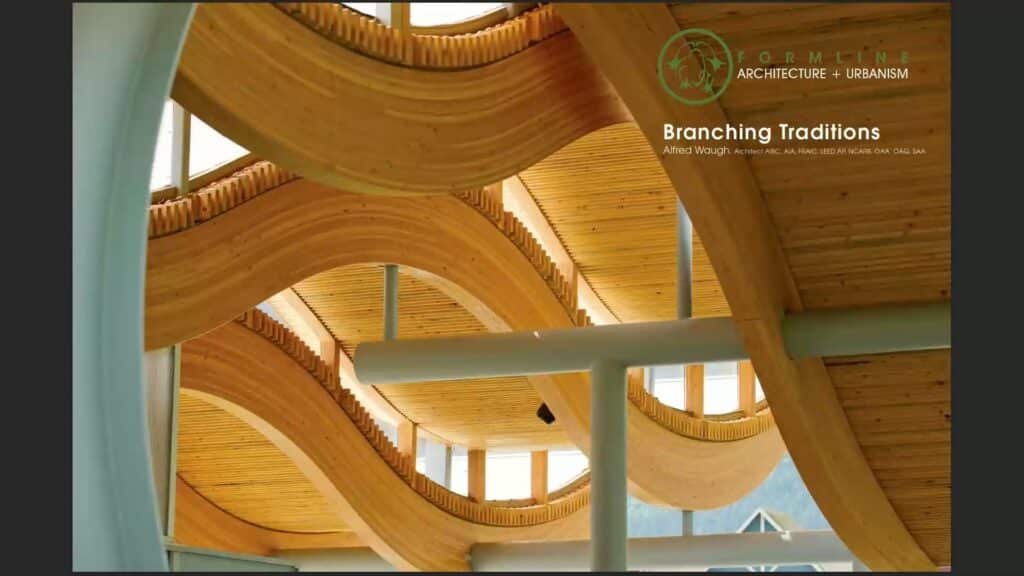
Course Overview Discover the transformative vision of Saskatoon’s New Central Library, a 150,000-square-foot, four-story beacon anchoring downtown’s northern edge. Inspired by Métis and Indigenous cultures, this community living room echoes the South Saskatchewan River’s rhythms, blending organic forms to connect urban vitality with the prairie landscape. As a place of healing and inclusiveness, it sparks renewal with a south-facing plaza featuring river-inspired flora for community events and a northern Indigenous landscape. This project honours the land’s stewards, fostering a welcoming hub that celebrates Saskatoon’s diverse heritage and unites all in shared cultural expression. Dive into the mass timber innovations of Saskatoon’s New Central Library in the lecture “Branching Traditions,” evoking leaf-like five-ply CLT floor plates radiating outward, distributing services via a central spine supported by a concrete core for rigidity. Explore value engineering evolution, overcoming manufacturing constraints, shipping logistics, and broad CLT floor plates without shear walls for concise structure. Celebrate adapting timber to cultural geometries, inspiring architects and engineers with sustainable, expressive insights honoring Indigenous and Métis heritage. Learning Objectives Integration of cultural expression within the rigid limitations of mass timber. Designing mass timber structures under manufacturing and shipping logistics restraints. Developing design strategies for a CLT and glulam column-and-beam system in organic architecture. Course Video Speakers Bio Alfred Waugh, Architect AIBC, AAA, OAA, SAA, FRAIC, AIA Owner, Principal Formline Architecture + Urbanism Waugh’s diverse and innovative designs have prompted national acclaim as one of the most inventive Canadian architects of his generation. As project designer for Busby Perkins Will, his Nicola Valley Institute of Technology project won a Governor-General’s Medal for architecture in 2004. Both the 2009 Squamish Lil’Wat Cultural Centre in Whistler and the 2010 First Peoples House on the University of Victoria campus have inspired locals and visitors from all backgrounds with their strong form-making and gracious interiors. Alfred Waugh is one of the few Indigenous Architects in Canada. His firm Formline Architecture + Urbanism is leading the way in defining contemporary Indigenous Architecture. His stature within Indigenous and academic communities was proven receiving a Governor-General’s Medal for the 2017 Indian Residential School History and Dialogue Centre (IRSHDC) at the heart of the University of British Columbia campus. This leading directly to his current work on the Indigenous House for the Scarborough campus of the University of Toronto and the New Central Library for Saskatoon. IRSHDC has been lauded for its integration of building and landscape, the symbolic uses of materials such as copper, and its rising to the challenge of a contemporary Indigenous design, without making specific architectural reference to any one of Canada’s many and diverse First Nations. Waugh’s creativity and independence are born of his background and education. Born in Yellowknife, Waugh enjoyed summers fishing and hunting on the East Arm of Great Slave Lake. His father, who is of English heritage, is a retired prospector, while his mother, who’s family originated in northern Saskatchewan, is a registered member of the Fond Du lac Denesuline First Nation. Waugh has an undergraduate degree in Urban and Regional Planning from the University of Lethbridge. Graduating with honours, he is the first Full Status person to graduate from UBC’s School of Architecture.
Emerging Solutions for Mass Timber in Healthcare
Resource Description Healthcare buildings are among the most complex and resource-intensive structures we design and, increasingly, they are being asked to do more. Modern hospitals not only need to support healing for patients and staff, but also to contribute to planetary health by reducing carbon emissions and addressing social and environmental determinants of wellbeing. To meet these goals, hospital design must evolve beyond the “squeezed and standardized” approach that has long defined it. Mass timber is emerging as a credible alternative to conventional systems for larger-scale, high-rise institutional buildings. Recent advancements in material science, manufacturing, engineering, and fire safety have made it possible to consider timber as a structural solution for complex facilities — including hospitals. Recognizing that innovation in healthcare design must be evidence-based, this collaborative study explores the feasibility of using mass timber for a 200+ bed acute care hospital. The multidisciplinary team — including KPMB Architects, PHSA (Provincial Health Services Authority of BC), Fast + Epp, Smith + Andersen, Resource Planning Group, CHM Fire, Hanscomb, AMB Planning, and EllisDon — developed and evaluated a detailed test design for a mass timber inpatient tower suited to the Canadian context. The study examined structure, cost, schedule, lifecycle carbon, code compliance, infection control, and biophilic design as part of a holistic approach to sustainable healthcare infrastructure. Learning Objectives Identify the key drivers that influence structural system selection in healthcare building design. Describe the opportunities, limitations, and specific considerations associated with using mass timber in hospital environments. Summarize findings from an in-progress feasibility study for a mass timber inpatient tower in a Canadian acute care setting. Evaluate the comparative schedule, cost, and lifecycle carbon outcomes identified in the study, and discuss implications for future healthcare projects. Course Video Speakers Bio Chris McQuillan, OAA, AIBC, FRAIC LEED AP Principal KPMB Architects Chris McQuillan, a registered architect and a distinguished Fellow of the RAIC, brings three decades of experience in planning, design and construction for healthcare and biomedical research. He has completed work across Canada, southeast Asia and in the Caribbean. In the healthcare sphere, his experience includes acute, rehabilitation and mental health treatment. Recently, Chris has designed major additions to Burnaby Hospital and Michael Garron Hospital in Toronto, a major expansion of the Halifax Infirmary, a new regional hospital in Corner Brook Newfoundland, a provincial specialty hospital for addictions and mental health in St John’s and strategic planning for the phased renovation of Royal Columbian Hospital here in Vancouver. A resident of Toronto, but active across Canada and beyond, Chris joined KPMB Architects in 2024 to propel the growth of the firm’s work in the healthcare sector. Chris’ focus in the design of healthcare facilities is to create healing architecture – for people, for our cities and for the planet. Mass timber must come to be viewed as an indispensable tool to help us achieve that goal. Juan J. Cruz Martinez, M.Arch, M.Des, EDAC, LEED GA Senior Director, Major Capital Projects Provincial Health Services Authority Lisa Miller-Way, C.E.T., LET Director CHM Fire
Aspen Art Museum: Creating an Innovative Wood Structure
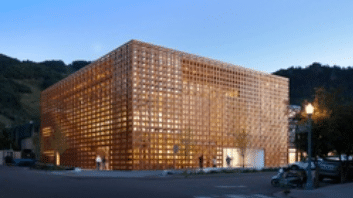
Course Overview The Aspen Art Museum, designed by architect Shigeru Ban, includes a long-span three-dimensional wood space-frame roof. Ban’s charge was to create a wood space frame with spans of more than 50 feet and cantilevers of 14 feet, in a structural depth of 3 feet. The space frame was to have two planes of intersecting diagonal webs of curved members that undulated up and down to touch the planes of the top and bottom chords with no visible connectors. This case study presentation will describe the design and construction of the wood structure, including paths explored but not chosen for the final design. Learning Objectives Articulate the particular demands associated with creating a 3-dimensional space frame entirely in wood. Recognize the advantages and disadvantages of several wood connection strategies in space-frame structures. Be aware of manufacturing capabilities and limitations that influenced the design of the Aspen Art Museum roof structure. Understand the importance of early engagement of manufacturing and engineering partners in the design process for innovative wood structures. Course Video Speaker Bio Gregory R. Kingsley, PhD, PE President and CEO KL&A Inc. Gregory is the president and CEO of KL&A Inc., Structural Engineers and Builders in Golden, Colorado, a firm of 65 that includes structural engineers, steel detailers, and construction managers. He enjoys working with design architects on innovative structures, especially wood and steel.