
Building Confidence in Low Carbon Construction De-risking Mass Timber
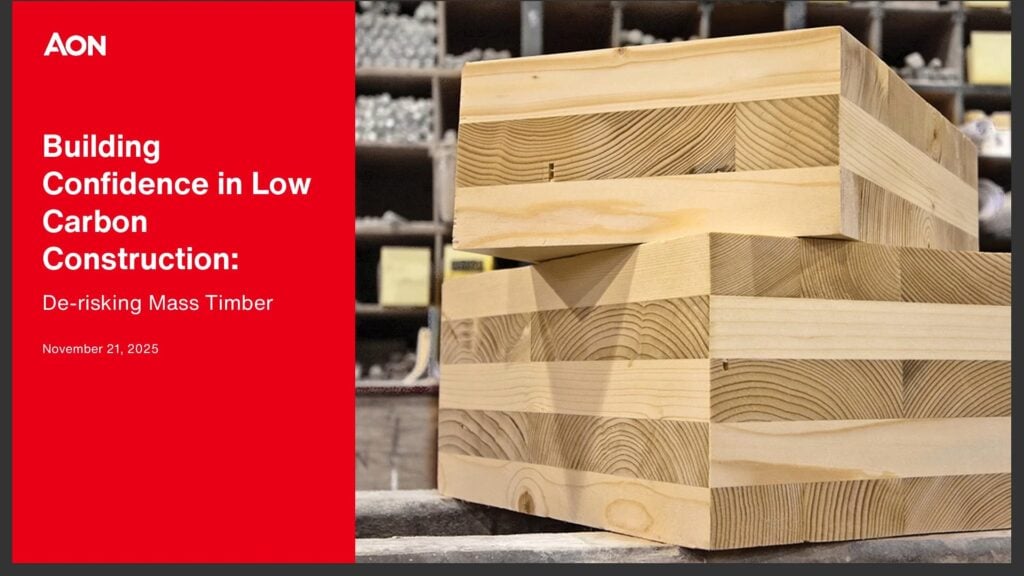
Course Overview This presentation explores how insurance can unlock opportunity by aligning risk strategies with sustainability goals. It will provide an analysis of the Canadian and Global insurance market and explain why mass timber has become such a hot topic for insurers. Critical risk mitigation strategies will be discussed as well as various options on how to address many of the more common moisture management problems encountered in construction. Learning Objectives Why is Mass Timber a focus area of the insurance industry? How do I design and position my project to achieve cost effective risk transfer? What are some of the most common types of insured loss and how do I avoid them? Course Video Speakers Bio Alicia Clendenan SVP – National Director of Sustainable Construction Aon Alicia is a socially conscious business professional with a passion for complex construction and infrastructure projects. She leads Aon’s Sustainable and Alternative Construction practice across Canada and has more than 15 years of risk and insurance advisory experience. She also serves as Aon’s global mass timber working group chair and is involved in a number of industry initiatives aimed at reducing barriers to insurance for mass timber construction as well as enhancing both the breadth of coverage offered by insurers and improving the industry adopted best practices for risk mitigation in construction.
Design Best Practices for Mid-Rise Light Wood Frame Structures
Course Overview Light wood frame (LWF) construction is an accessible, cost-effective, low-carbon solution for mid-rise multi-family buildings. This session will clarify fundamental differences in approach between traditional low-rise LWF construction and modern mid-rise construction methods. LWF is an attractive option for mid-rise development and participants will gain practical insights into design efficiencies, from meeting seismic demands and other key structural considerations to how engineered wood products and specialty hardware can be used to optimize design. The session will also explore prefabrication strategies, highlighting the challenges and opportunities offsite construction presents for streamlined, higher-quality construction. Whether attendees are new to mid-rise wood design or looking to optimize their next project, this session will share valuable information they can apply to their next mid-rise building. Learning Objectives Distinguish key differences between traditional low-rise and modern mid-rise light wood frame construction, including changes in design loads, seismic requirements, and code updates. Apply practical design strategies to optimize mid-rise wood structures—such as efficient stacked framing, engineered wood products, specialty hardware, and solutions for wood shrinkage and differential movement. Evaluate prefabrication and offsite construction methods for mid-rise projects, identifying both challenges and opportunities to improve construction quality, speed, and coordination. Course Video Speakers Bio Sean Henry Director – Mid-Rise, Principal Tacoma Engineers Sean is the Director of Mid-Rise and a Principal at Tacoma Engineers, bringing 20 years of structural engineering experience to the role. Since joining the firm in 2005, Sean has led the design of a wide range of building types, with a particular focus on mid-rise developments including multi-family, seniors and affordable housing projects. He is especially recognized for his expertise in light wood frame construction with multiple projects designed and built since the adoption of 6 storey wood framed buildings in Ontario. He also has extensive experience with cold-formed steel, structural steel, reinforced concrete, precast, and concrete block building systems. Sean focuses on delivering practical, efficient structural solutions that support design intent while meeting the demands of constructability and cost-effectiveness.