
Vertical Additions: An innovative pathway to delivering more homes
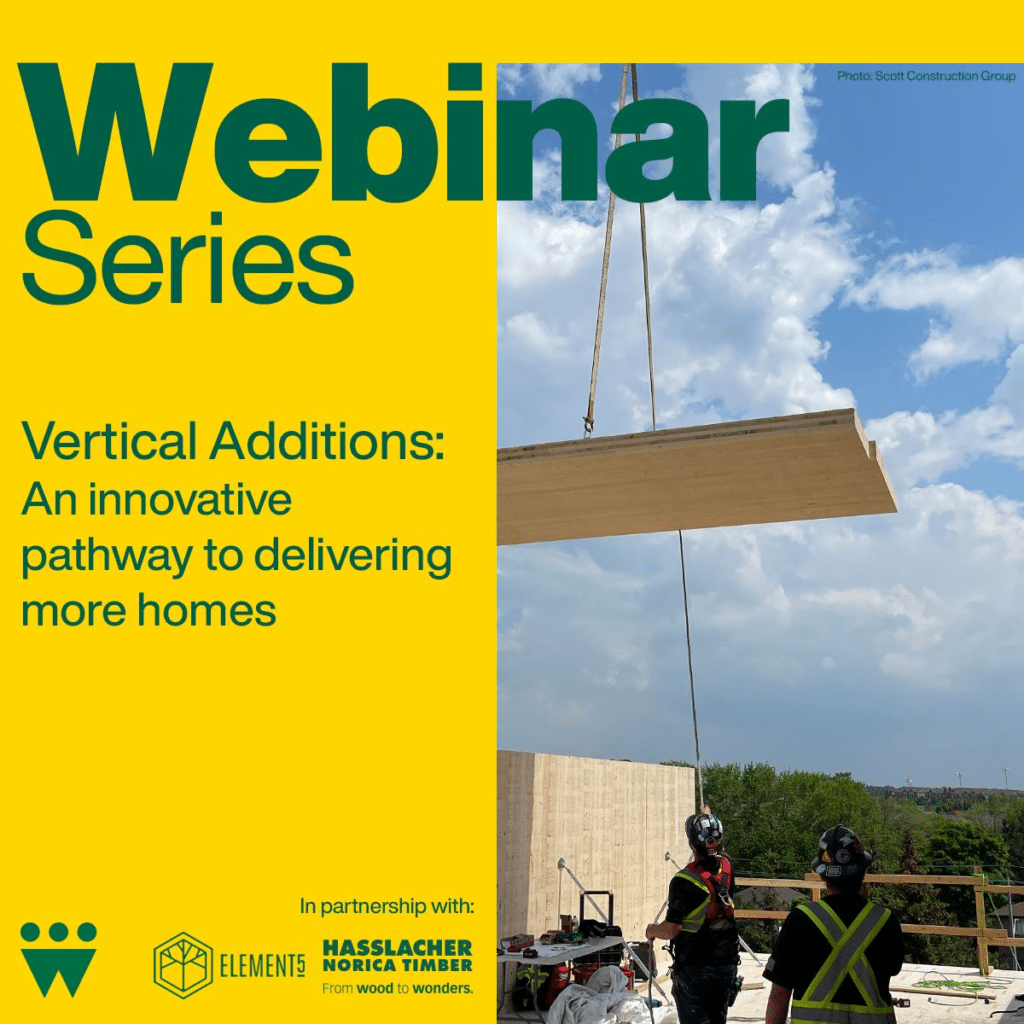
Course Overview Discover the innovative approach to housing supply undertaken by Pathway Non-Profit Community Developments Inc. of Peel. The Arbor Mill expansion sets a remarkable precedent for other non-profit affordable housing providers who want to build more housing and can do it by adding additional units on top of their existing buildings. Globally, it is estimated that approximately 20-25% of existing buildings can support a vertical addition in wood, which is a comparatively light weight building material. This novel approach removes the need to find new land to develop and has the added benefit of immediately integrating new residents into an existing supportive community. This project added 6 barrier-free, affordable apartments on top of a 35-year old, occupied residential building using prefabricated mass timber, delivering more affordable housing through the “gentle densification” of existing infrastructure. In this webinar, the project team will discuss the architectural, structural, and design challenges of the project, including blending prefabricated mass timber construction methods with an older structure built with conventional materials. Key sustainability and construction considerations will also be highlighted. Don’t miss this opportunity to gain valuable insights from one of the first project teams in North America to pursue this innovative approach to housing delivery. Learning Objectives Participants will learn how Pathway, a non-profit community developer in Peel Region, created a plan to expand its housing portfolio while addressing tenant needs and priorities. Participants will gain insights into the design and approval challenges of the project, including navigating site plan approvals, integrating mass timber, and meeting acoustic and fire safety requirements. Participants will understand the structural considerations for vertical expansions, which include performing load assessments and evaluating structural options. Participants will understand the mass timber fabricator’s process and the key considerations for successfully integrating prefabricated mass timber components into a project, including early involvement, securing production spots, and managing construction timelines. Course Video Speaker Bio Roman Spektor General Manager Pathway Non-Profit Community Developments Inc. of Peel Mechanical engineer by profession, Roman has been the General Manager of Pathway for over 25 years and has managed social housing projects for 35 years. Pathway Non-Profit Community Developments Inc. of Peel (Pathway) is an interfaith non-profit corporation that was incorporated in 1988. The Pathway organization is run by a volunteer board made up of members of the three founding congregations. Pathway owns and operates two apartment building in Mississauga constructed in the early 90s. Pathway’s two buildings, Forest Ridge and Arbour Mill, house 230 families and are funded by rental income and a government subsidy. Pathway has also created a separate management company and manages other non-profit housing communities. Roman has coordinated with the volunteer board on all aspects of management of the buildings including budgeting, capital work and project management. Through the creation of programs for the residents, Pathway has created inclusive communities where all residents feel welcome. Cathy Tafler, OAA Partner Tafler Rylett Architects Cathy has been a partner in the firm Tafler Rylett Architects since 1996 and is involved in all aspects of the firm’s work including client consultation, design, permit application, specifications and contract administration. Cathy is committed to producing thoughtful and environmentally responsible projects that are integrated with the surrounding landscape. The firm designs with a collaborative process, listening to their client’s requirements and budget and input from the surrounding community. Cathy was chair of the OAA’s Committee on the Environment and is a member of the Toronto Alliance to End Homelessness (TAEH). The firm’s work includes supportive and affordable housing, offices, institutional and private residential projects. Major projects include supportive housing for Houselink Community Homes, offices for Doctors Without Borders, offices for the U of T Faculty Association, Tiny Treasure Montessori School and affordable housing for Pathway. Craig Nicoletti, P.Eng. Partner, Structural Engineer Engineering Link Inc. Craig is a Professional Engineer and Partner for the Structural Division at Engineering Link. He has been with Engineering Link since 2011 and brings more than 20 years of structural engineering expertise to his projects. During his tenure, Craig acquired a diverse portfolio of experience with wood projects that spans all sectors including commercial, recreational, industrial, hospitality, civic, and sporting facilities, in addition to heritage designated sites. Stephen Balamut, B.Eng. Project Manager Element5 Stephen is a Civil Engineering Graduate of McMaster University. He began with Element5 as a designer and estimator, then moved into his current project manager position where he has overseen over 50 completed mass timber projects, from low- and mid-rise residential, to mixed-use and commercial. As a project manager, Stephen oversees the planning, coordination, and execution of Element5’s mass timber projects. He collaborates closely with architects, engineers, and contractors to ensure the structural integrity and sustainability of the mass timber components. Stephen is driven by a passion for contributing to sustainable projects that have a meaningful and lasting impact on people’s lives.
Preservation of Structural Wood
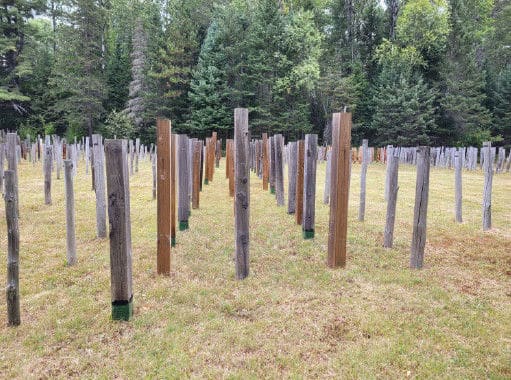
Course Overview This webinar will focus on the importance of proper structural applications for preserved wood products, with demonstrated examples of best practices as well as what to avoid. Learning Objectives Application of preserved wood products for barns, fences and decks. Overview of available preserved wood products for structural applications. CSA 080 requirements for various structural products. Best practices for installation and maintenance. Course Video Speaker Bio Ian Whittington, P.Eng. IWS Wood Products Inc.
Plant a Seed Designing with Wood and Bio based Materials
Course Overview Concrete, steel, and aluminum are responsible for 23% of the world’s total CO2 emissions. While a portion of those emissions come from other industries, the biggest sinner is without comparison construction. In this presentation, based on Henning Larsen’s recent publication, ‘Plant a Seed’, Fabia will present an alternative, sharing Henning Larsen cases studies and insights on designing with wood and biobased materials for significantly reduced carbon. Learning Objectives Coming soon Course Video Speaker Bio Fabia Baumann Structural Design Engineer / Timber Expert Henning Larsen – Denmark Fabia is a Structural Design Engineer and Timber Expert at Henning Larsen with both theoretical knowledge about timber from her engineering degree and practical experience from her work as a carpenter. She has a passion for timber construction and understands the potential of wood in developing unique, sustainable projects. Given her experiences, Fabia has extensive knowledge about incorporating wood in construction processes. She supports design teams by integrating wood into many projects like Henning Larsen’s World of Volvo experience center in Gothenburg, Sweden; Marmormolen, one of Denmark’s largest wooden structures; and Fælledby, Copenhagen’s first wooden district, and winner of Fast Company’s 2021 World Changing Ideas Awards. Having co-authored Henning Larsen’s Plant a Seed publication, innovative solutions are always in focus for Fabia, by which she strives to promote wood and biomass as essential materials for building a climate-neutral future.
Inspired Design
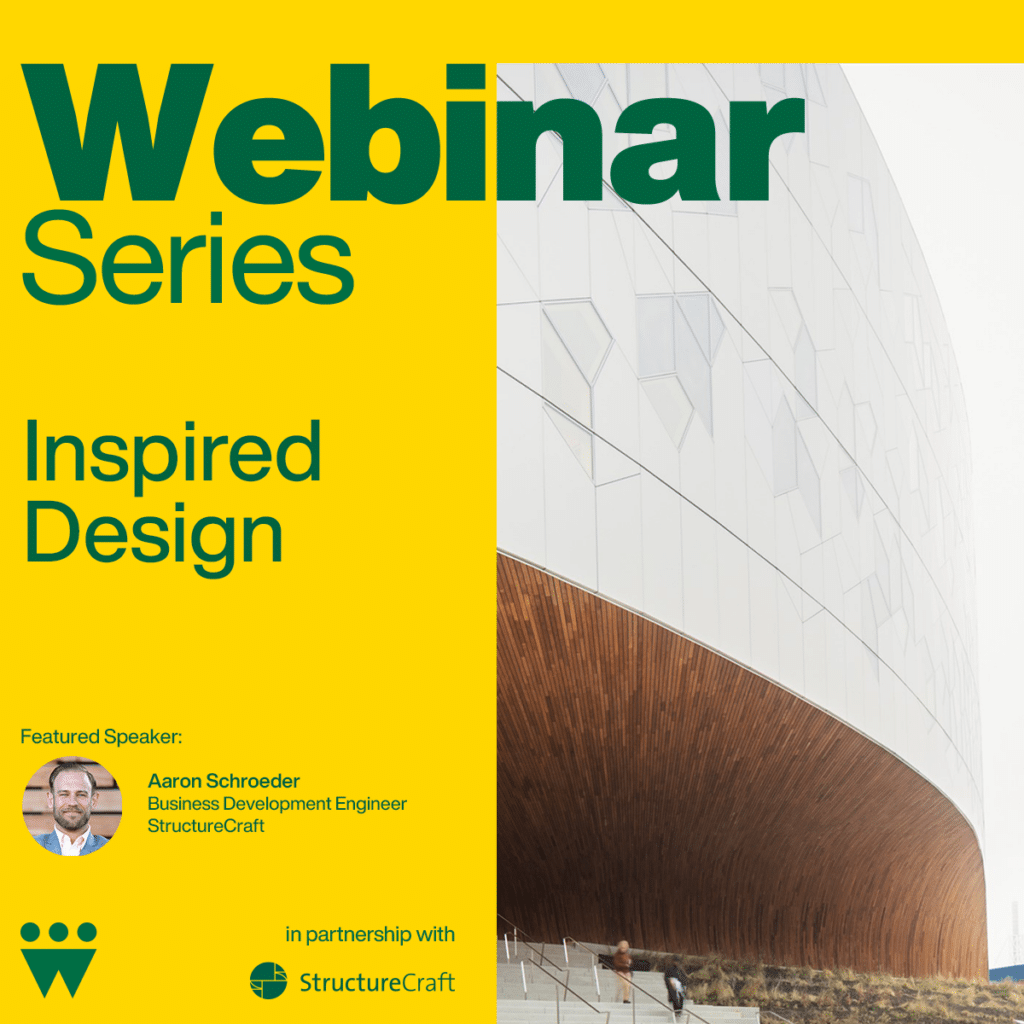
Course Overview This presentation explores the art and science of inspired structural design, emphasizing how engineering can harmonize beauty, efficiency, and sustainability. By allowing the structure itself to help inform the concept, it is possible to craft designs that are not only innovative but also deeply connected to their environment. This session will delve into strategies for designing sustainably, focusing on the most structurally efficient use of materials to reduce waste and environmental impact. Through case studies and examples, the presentation highlights how thoughtful engineering creates beautiful structures that people love to own and use. Attendees will leave with actionable insights into achieving designs that inspire and perform. Learning Objectives Inspired design does not need to cost more, it is often more economical. Design-Build is the perfect delivery method for true Inspired Design. Inspired design requires a cohesive design team from the start. Collaboration of project constraints is key to Inspired Design. Course Video Speaker Bio Aaron Schroeder Business Development Engineer StructureCraft Aaron graduated from the University of British Columbia with a bachelor’s degree in civil engineering and began his career as a structural engineer in the residential construction industry, earning his P.Eng. designation in 2018. His project portfolio spans heavy civil concrete structures, high-end single-family homes, and multi-family residential complexes. Since Joining the StructureCraft Team in 2021, Aaron served as the project engineer for the 7-story T3 office building in Nashville, Tennessee, before transitioning to the Business Development team. With a strong foundation as a structural engineering consultant, construction contracting experience, and a personable/outgoing demeanor, Aaron is passionate about fostering meaningful connections within the AEC industry. As one of the primary points of contact for new project inquiries, he plays a key role in introducing clients to StructureCraft’s innovative approach.
Gestimat Toward Low Carbon Construction
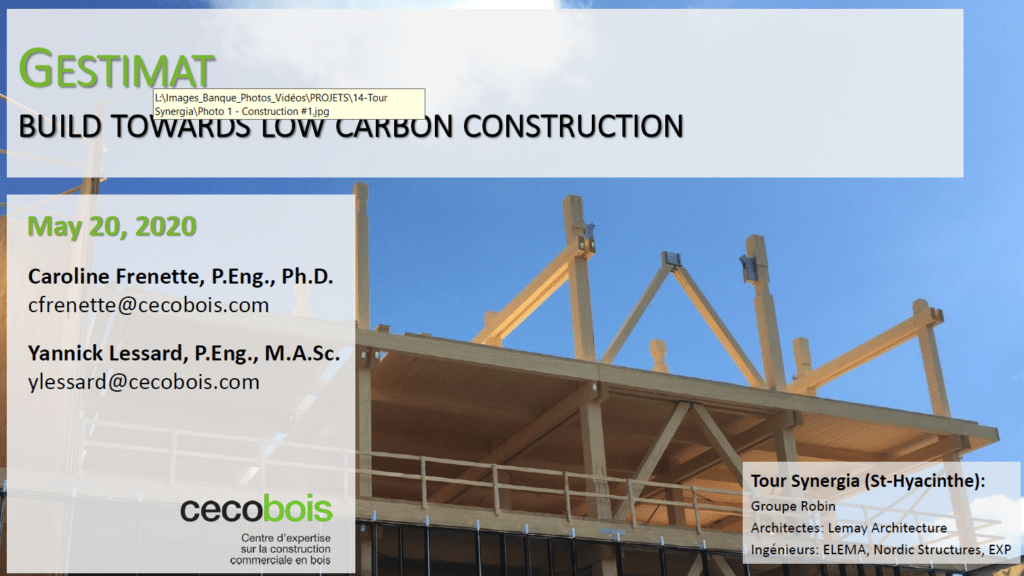
Course Overview Gestimat facilitates the assessment of the carbon footprint of buildings. Developed in Quebec for the Wood Charter and financed by the Fonds vert, Gestimat is also available in English since April 2020. This new web-based tool estimates the greenhouse gas (GHG) emissions related to structural materials used in different building scenarios. Scenario modelling can be done during preliminary design using estimation from typical buildings or, further in the design, by entering quantities of materials specific to a given project. Learning Objectives Learn about the possibilities of the GESTIMAT tool. Understand principles behind the calculations in GESTIMAT. Evaluate the applicability of GESTIMAT for your projects. Learn how to create a GESTIMAT analysis for a preliminary project. Learn how to modify a GESTIMAT analysis to adapt the quantities of materials to a specific project. Course Video Speaker Bio Caroline Frenette, Eng., Ph. D. Technical Advisor Cecobois Over the past 30 years, Caroline Frenette has developed expertise in timber structures and sustainable construction. After her bachelor’s degree in civil engineering at the Université de Sherbrooke, her interest in wood construction led her to undertake a master’s degree on the seismic behaviour of timber structures at the University of British Columbia. She worked for several years in France and Austria designing timber and hybrid structures in a specialized engineering firm. She was also involved in the construction of an experimental bioclimatic house, a personal project using biobased materials and innovative building technologies. She pursued her interest for sustainable construction during her doctoral thesis on multicriteria analysis of wood-framed walls, studying several aspects of building performance, including environmental impact based on Life Cycle Assessment. Technical advisor with Cecobois since 2009, Caroline is also adjunct professor in the Department of Wood and Forest Sciences and teaching at the Centre de formation en développement durable (CFDD) at Université Laval, and a member of the Centre de recherche sur les matériaux renouvelables (CRMR).
Harnessing Prefabrication: How to Navigate the Design and Construction Process
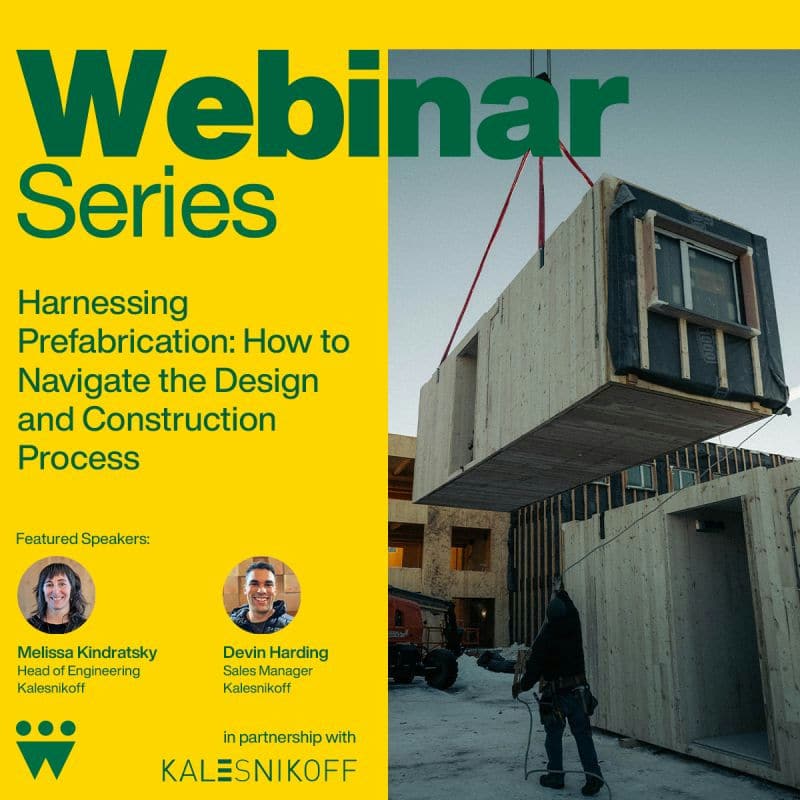
Course Overview This course offers an in-depth discussion on the evolving landscape of modular and prefabricated construction. The course will explore how to evaluate and integrate different levels of prefabrication based on project goals, site conditions, and logistical constraints. Key topics include site planning, design coordination, transportation logistics, and navigating regulatory requirements. We’ll also delve into technical considerations—comparing mass timber and drywall fire ratings, evaluating STC performance, and planning for MEP sub-module integration. The session will conclude with strategies for structural design of modular systems and insights on avoiding common post-construction pitfalls. Grounded in lessons learned from a completed multi-family volumetric modular CLT project, this presentation offers practical tools for design professionals, engineers, and developers looking to optimize prefabrication in their projects. Learning Objectives Understand key decision-making criteria for selecting appropriate prefabrication strategies. Apply a framework for integrating prefabrication into project planning and delivery. Recognize technical challenges and solutions in modular design, including fire ratings, acoustics, and MEP coordination. Identify best practices for optimizing structural integration and avoiding post-construction issues. Course Video Speaker Bio Melissa Kindratsky Head of Engineering Kalesnikoff Devin Harding Sales Manager Kalesnikoff
Diversify Your Structural Portfolio: Wood in Low-Rise Commercial Construction
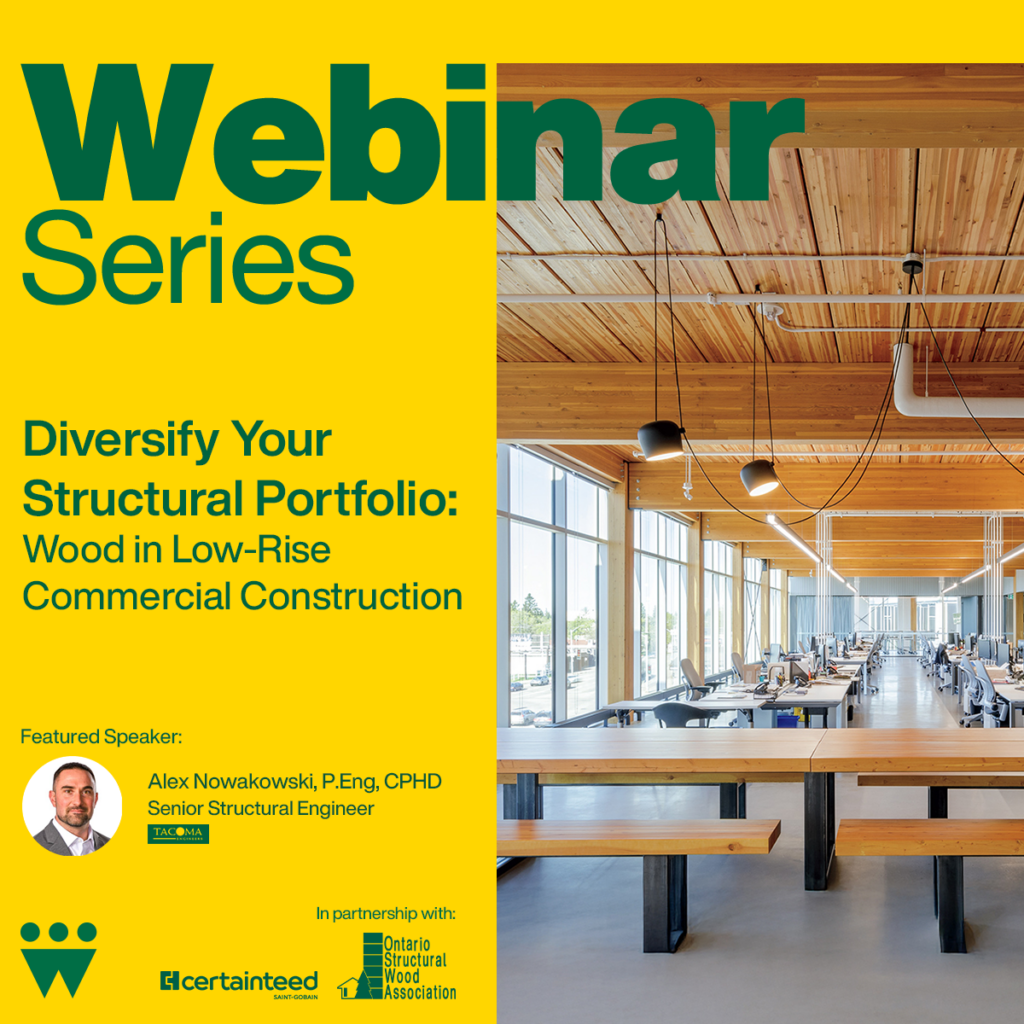
Course Overview This course will explore the use cases for incorporating more wood into a sector that is typically dominated by structural steel construction. We will look at Light Wood Framing (LWF), Structural Composite Lumber (SCL), Mass Timber (MT), and Hybrid Systems that may incorporate any or all of these materials, as well as structural steel. What is important is using the right material in the right application. Several examples from the CWC Publication “Low-Rise Commercial Construction in Wood: A guide for Architects and Engineers”, as well as real project examples from the presenter. Learning Objectives Identify strengths and weaknesses of various wood products. Learn to select the right wood material/system for the most efficient and cost effective structure. Highlight critical details and identify potential red flags to ensure a successful project. Provide useful examples, resources and tools for the practitioner to add to their “tool belt”. Course Video Speaker Bio Alex Nowakowksi Engineer, Senior Associate, and Barrie Team Lead Tacoma Engineers Alex is a Professional Engineer, Senior Associate, and Barrie Team Lead for Tacoma Engineers. Alex has been with Tacoma Engineers since 2012. As a Senior Structural Engineer and Project Manager, Alex has been the Primary Structural Engineer and Specialty Structural Engineer on a wide variety of wood projects in the Commercial, Institutional, Multi-Family, Agricultural and Residential Sectors.
Architectural Assemblies Simplified: Understanding Structural Grids: Acoustics and Envelopes in Wood Buildings
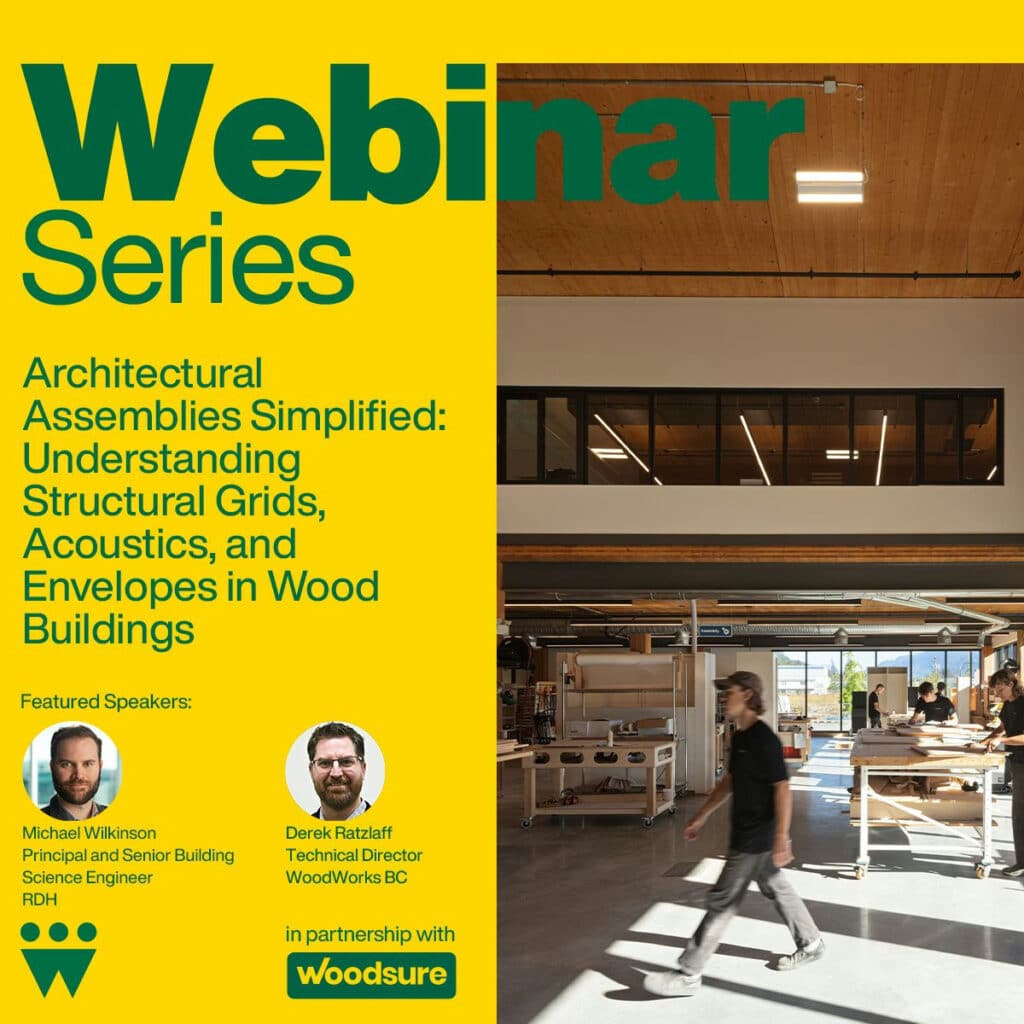
Course Overview This session will help you to formulate effective floor and wall assemblies when designing wood structures, both light wood frame and mass timber. Discussion will cover typical fire ratings and strategies, acoustic performance of different assemblies and effective strategies for weather-tight exterior envelopes. Background on typical structural assemblies for different grid sizes will help you understand how to effectively develop complete assemblies when designing timber buildings. Learning Objectives Participants will understand how to formulate effective floor and wall assemblies for wood structures, including both light wood frame and mass timber, to optimize performance and design efficiency. Participants will understand typical fire ratings and the acoustic performance of various assemblies and gain strategies to enhance the safety and comfort of wood buildings. Participants will learn how to design weather-tight, high-performance exterior envelopes for wood buildings. Participants will discover typical structural assemblies for different grid sizes and learn how to effectively develop complete assemblies when designing timber buildings. Course Video Speaker Bio Michael Wilkinson Principal and Senior Building Science Engineer RDH Michael Wilkinson is a Principal and Senior Building Science Engineer at RDH. He has provided consulting services across a range of building typologies with a focus on high performance and innovative building projects including those that are Passive House, mass timber, and volumetric modular. Michael has also been involved in numerous research projects including product development and performance monitoring and is the lead author of several guideline documents for government agencies and building enclosure product manufacturers. Additionally, Michael is a part-time instructor at the BC Institute of Technology where he teaches building science and construction technology classes. Derek Ratzlaff, P.Eng., Struct.Eng., PE Technical Director, WoodWorks BC Canadian Wood Council Derek began his career in the wood industry in high school working on single and multi-family light wood construction, after university and almost 20 years of structural consulting experience, Derek has worked in all types of wood construction and played key roles in the delivery of iconic BC wood structures, the Richmond Olympic Oval and Grandview Heights Aquatic Centre. He brings his experience in design and construction to support the industry as the Woodworks BC Technical Director.
A Zero Carbon Hybrid Wood Supertall Future

Course Overview With buildings generating 40% of global carbon emissions, we need to achieve net-zero by 2050 to meet the Paris Agreement target and limit global warming to 2°C. Timber sequesters an average of 1.9 metric tons of carbon-dioxide equivalent emissions per cubic meter (Sathre & O’Connor, 2010). While a purely mass timber tall building may not be the most cost-efficient solution, a hybrid structure can maximize the overall use of wood by volume in the most cost-efficient manner. Floor systems in buildings contribute as much as 73% of the environmental impact of a high-rise building’s structure (Lankhorst et al., 2019), making them an excellent target for reducing embodied carbon. DIALOG’s patent- pending Hybrid Timber Floor System (HTFS) takes advantage of the benefits of cross-laminated timber (CLT) combined with pre-stressed concrete to achieve a 12-metre column-free span. The HTFS is proposed as part of our Hybrid Timber Tower, a 105-storey mixed-use prototype that is being evaluated and tested by DIALOG and EllisDon. The prototype structure consists of the hybrid timber floor, combined with a concrete core and an external steel frame. Fire safety is achieved in the floor panels as the exposed wood chars to form a protective layer, while the non-combustible concrete and steel band continues to support the panel. The exposed CLT panels also provide a biophilic appeal, which has shown to support cognitive function as well as physical and psychological well-being (Vidovich, 2020). DIALOG, EllisDon, FPInnovations and other partners have completed the first phase of small-scale testing on over 40 panels. We are scheduled for fire testing of the panels in Ottawa with NRCan this fall with full scale testing of the 12-meter panels starting in late 2022. Learning Objectives Describe how hybrid mass timber systems—such as the Hybrid Timber Floor System (HTFS)—reduce embodied carbon and support zero‑carbon goals in high-rise, mixed-use developments. Explain the structural, fire safety, and performance characteristics of hybrid CLT–concrete floor assemblies, including how charring, concrete bands, and steel elements contribute to long-span capability and code compliance. Evaluate the role of multidisciplinary research, prototyping, and large-scale testing in validating hybrid timber technologies for supertall applications, including their impacts on sustainability, biophilia, and cost efficiency. Course Video Speaker Bio Craig Applegath, BSc, BArch, MArchUD, PPOAA, AIBC, NSAA, AIA, FRAIC, LEED® APBD+C Founding Partner & Architect DIALOG Craig Applegath is the founding principal of DIALOG’s Toronto Studio, and a passionate designer who believes in the power of built form to meaningfully improve the wellbeing of communities and the environment they are part of. Since graduating from the Graduate School of Design at Harvard University with a Master of Architecture in Urban Design Craig has focused his energies on leading innovative planning and design projects that address the complex challenges facing our communities, as well as on his advocacy of sustainable building design and urban regeneration and symbiosis. Craig’s area of practice includes the master planning and design of institutional projects, including post secondary education, healthcare facilities, as well as the design of innovative mixed-use- facilities. Craig was a founding Board Member of Sustainable Buildings Canada, a Past President of the Ontario Association of Architects, and the current moderator of SymbioticCities.net. Craig has lectured or taught at Harvard, the University of Toronto, the University of Waterloo, as well as at many professional and sector related conferences around the world. In 2001 Craig was made a Fellow of the Royal Architectural Institute of Canada for his contributions to the profession of architecture. In 2017 he was presented with the OALA Honourary Membership Award for his contributions to the cause of landscape architecture in Ontario. Neel Bavishi, PEng, CEM Building Performance Analysis, Associate DIALOG Neel is passionate about applying the art and science of building performance simulation and data-driven design to produce positive outcomes for the built environment. He embraces holistic solutions that minimize the environmental impact of building assets while providing enhanced value to building owners, developers, policymakers, and designers through improved well-being and reduced total cost of ownership. Neel believes that an integrated and collaborative approach that incorporates diverse perspectives is essential for delivering high-performance buildings. A mechanical engineer by training, Neel is well-versed in whole-building energy modelling for both new and existing buildings and lifecycle cost analysis, design optimization, and data visualization. His experience includes developing energy models for green building certification programs, carbon-neutral retrofit studies and district energy strategies, and the development of net-zero energy and emissions policies and standards for municipal, provincial, and federal government bodies. His projects span various asset classes, including recreational facilities, commercial high-rise towers, multi-unit residential buildings, hospitals, data centres, and transit facilities. He is a licensed Professional Engineer in the province of Ontario and is a Certified Energy Manager. Cameron Ritchie, PEng, PE, PhD, BSE Structural Engineer, Associate DIALOG Cameron is an Associate on the Structural Engineering team in DIALOG’s Toronto studio. Since graduating with a PhD from the University of Toronto, Cameron has acted as a structural design engineer and project manager across a variety of sectors and project types, including healthcare, institutional, government, and retail. He has experience in all stages of a project delivery, from feasibility studies through construction administration and management. Cameron is DIALOG’s project manager for the hybrid timber floor system (HTFS) research program, working closely with industry partners EllisDon. He is passionate about exploring mass timber wherever possible as a sustainable solution to our building needs.
Aspen Art Museum: Creating an Innovative Wood Structure
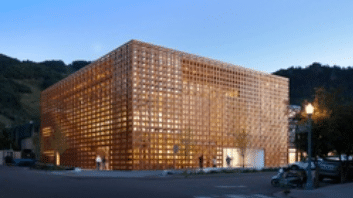
Course Overview The Aspen Art Museum, designed by architect Shigeru Ban, includes a long-span three-dimensional wood space-frame roof. Ban’s charge was to create a wood space frame with spans of more than 50 feet and cantilevers of 14 feet, in a structural depth of 3 feet. The space frame was to have two planes of intersecting diagonal webs of curved members that undulated up and down to touch the planes of the top and bottom chords with no visible connectors. This case study presentation will describe the design and construction of the wood structure, including paths explored but not chosen for the final design. Learning Objectives Articulate the particular demands associated with creating a 3-dimensional space frame entirely in wood. Recognize the advantages and disadvantages of several wood connection strategies in space-frame structures. Be aware of manufacturing capabilities and limitations that influenced the design of the Aspen Art Museum roof structure. Understand the importance of early engagement of manufacturing and engineering partners in the design process for innovative wood structures. Course Video Speaker Bio Gregory R. Kingsley, PhD, PE President and CEO KL&A Inc. Gregory is the president and CEO of KL&A Inc., Structural Engineers and Builders in Golden, Colorado, a firm of 65 that includes structural engineers, steel detailers, and construction managers. He enjoys working with design architects on innovative structures, especially wood and steel.