
Wood Design & Building Magazine, vol 24, issue 95

The Exchange

ARCHITECT: Faction Architecture Inc. STRUCTURAL ENGINEER: RJC Engineers DEVELOPER: Faction Projects Inc. CONSTRUCTION MANAGER: Faction Construction BUILDING CODE CONSULTANT: GHL Consultants Ltd. PHOTOS: Courtesy of naturally:wood In Kelowna, British Columbia’s evolving industrial north end, The Exchange stands as a forward-thinking demonstration of what’s possible when architectural ambition meets technical precision. Designed and developed by Faction Architecture and Faction Projects, the building blends mass timber with conventional materials in a hybrid system that highlights both structural performance and environmental responsibility. At the heart of the structural system is nail-laminated timber (NLT), used for both floor and roof assemblies. NLT is a mass timber product formed by mechanically fastening dimensional lumber together to create solid panels—an approach well-suited to exposed timber applications that value durability, texture, and straightforward fabrication. For this project, the team fabricated the panels in-house using locally sourced materials and trades. While this gave them greater control over cost and scheduling, it also introduced design and compliance challenges. The team opted for a fluted NLT profile to enhance visual appeal and improve acoustic performance. Because the panel design differed from prescriptive norms, it required approval as an alternative solution under the BC Building Code. Extensive analysis was conducted to demonstrate compliance with fire-resistance, vibration, and load-bearing requirements. Informed by existing NLT fire test data, the design team minimized voids between laminations to enhance charring behaviour and performed physical load testing at Okanagan College to confirm strength and stiffness performance. Complementing the NLT panels is a glulam post-and-beam system that forms the substructure, supported by concrete elevator and stair cores. Together, these elements support a program that includes retail and light industrial space at grade, with two to three storeys of open-plan office space above. A rooftop patio offers sweeping views, reinforcing the project’s appeal to creative businesses and environmentally conscious tenants. The Exchange also showcases a thoughtful approach to the building envelope, a key factor in achieving Step 3 of the BC Energy Step Code—the highest step currently applicable to non-residential buildings in the region. The high-performance envelope includes a combination of weathering steel and corrugated metal cladding, high-performance glass windows, semi-rigid exterior insulation, breathable weather barrier, plywood sheathing, lumber studs, batt insulation, gypsum board and a polyethylene vapour barrier. The light-frame wood walls contribute to envelope performance in two important ways: 1) wood has lower thermal conductivity than other materials, so thermal bridging is dramatically reduced, and 2) the stud wall configuration allowed for thicker insulation in the cavities between studs. This integrated approach—combining exposed timber construction, envelope efficiency, and locally supported fabrication—enabled the project team to deliver a space that performs as well technically as it does aesthetically. And with over 90% of the leasable area spoken for at completion, it’s clear that tenants are responding to both the look and the logic of the building. The Exchange sets a precedent for accessible mass timber construction in smaller markets, particularly in contexts where a streamlined fabrication process and strong design-control loop can help close the gap between sustainable ambition and budgetary constraints. As Faction Projects continues work on the remaining phases of the development, The Exchange stands as both a technical prototype and a commercial success—proof that high-performance, low-carbon construction can be as practical as it is inspiring.
The 2025 Ottawa Wood Solutions Conference will be presented on February 5, 2025 at the National Arts Centre

December 19, 2024 (Ottawa) – The 2025 Ottawa Wood Solutions Conference will be presented on Wednesday, February 5, 2025, from 8:00 am to 5:00 pm, at the National Arts Centre, located at 1 Elgin St. in Ottawa. First launched over 20 years ago to serve design and construction professionals interested in building with wood, this event has evolved from a niche gathering into a cornerstone of professional education, driven by the growing demand for sustainable wood construction. The program offers a range of presentations—from technical deep dives to inspiring case studies—catering to participants at every stage of their professional journey, from newcomers to seasoned experts. Attendees can also take advantage of valuable opportunities to connect, collaborate, and expand their professional networks within the wood community. Conference organizers are delighted to welcome Christophe Ouhayoun of KOZ Architects (France) to share insights into the innovative, collaborative development of the Paris Olympics Athletes’ Village. His presentation will also explore the current effort underway to convert these structures into much-needed permanent housing, highlighting this progressive mass timber development as a model of adaptability and sustainability. Another program highlight pays tribute to the venue itself. Donald Schmitt, CM, of Diamond Schmitt Architects will present on the revitalization of the National Arts Centre, offering a behind-the-scenes look at the timber structure and prefabrication process that transformed this iconic building into a modern landmark. Other technical presentations include managing sound and vibration in mass timber buildings and growing Canadian capacity for industrialized wood construction, advancing wood products in our changing climate, and a discussion of the value of conventional wood frame construction in small communities where it provides job opportunities, with a specific focus on Indigenous housing projects. Early Bird registration of just $99+HST is available until the end of December. In the new year, registration for the conference will be $149 +HST. Delegates can find the Ottawa Wood Solutions Conference on Eventbrite or jump directly to online registration with this link: https://www.eventbrite.ca/e/2025-ottawa-wood-solutions-conference-tickets-1080654991169 A limited number of discounted passes are available for post-secondary educators and students in AEC+D programs of study. Please contact Kelsey Dayler for more information [email protected].
Wood Design & Building Magazine, vol 23, issue 94

2024 Catherine Lalonde Memorial Scholarships Celebrate Students Driving Innovation in the Wood Industry

Ottawa, ON, December 12, 2024 – The Canadian Wood Council (CWC) announced the recipients of the 2024 Catherine Lalonde Memorial Scholarships: Laura Walters (McMaster University) and Jiawen Shen (University of British Columbia). Both students were recognized for their academic excellence and impactful research projects in the structural wood products industry. Established nineteen years ago, the memorial scholarships are awarded each year to graduate students whose wood research exemplifies the same level of passion for wood and the wood products industry that Catherine Lalonde tirelessly demonstrated as a professional engineer and president of the CWC. Laura Walters Laura is a 3rd-year graduate student pursuing a Master of Applied Science in Civil Engineering under a joint collaboration between McMaster University and the University of Northern British Columbia (UNBC). Her research project explores the use of pre-engineered beam hangers in mass timber post-and-beam systems, with a focus on the implications of design and modelling assumptions on the evaluation of structural load paths. Her work provides valuable insights into the design considerations and assumptions required for more accurate and reliable design of mass timber columns when pre-engineered beam hangers are used. Jiawen Shen Jiawen is a 1st year graduate student pursuing a Master in Wood Science at the University of British Columbia. Her research project focuses on the development of binderless composite bark-board cladding and insulation panels that are durable, ignition resistant, carbon neutral, and manufactured from an underutilized by-product that would otherwise be burned, landfilled, or used for low-value purposes. Collaborating with a Vancouver-based architecture firm on this project, her work is key to advancing the commercial application of these innovative cladding products. “This year marks a historic milestone for the Catherine Lalonde Memorial Scholarship program as, for the first time, it is awarded to two exceptional women,” said Martin Richard, VP of Market Development and Communications at the CWC. “Their achievements highlight the outstanding talent driving innovation in wood research and construction. We are inspired by their contributions and the growing diversity shaping the future of wood-based solutions.”
Canadian Wood Council and Woodsure launch new partnership between the WoodWorks and Woodsure programs

Ottawa, Ontario – September 17, 2024 — The Canadian Wood Council (CWC) and Woodsure (A division of Axis Insurance Managers Inc.) are pleased to announce a new partnership between their WoodWorks and Woodsure programs respectively. This strategic collaboration is expected to help support the increased adoption of wood construction in Canada. The positive influences of design innovation, advanced materials, new building codes, and the evolving priorities of society are driving change in the construction sector; in particular, these influences are driving the expanded use of advanced wood construction. However, as with the adoption of any new technology, perceived unknowns can create barriers that need to be to overcome. One such barrier is access to insurance for this new class of technologically advanced wood buildings. This partnership aims to empower architects, builders, and developers to choose wood with confidence, knowing they have access to robust insurance solutions that understand the complexities of wood construction. Together, we can significantly enhance the acceptance, safety, and growth of mass timber construction, recognizing it as a strategically preferred material for sustainable building practices. Statements from Key Stakeholders Rick Jeffery, President & CEO, Canadian Wood Council: “We are thrilled to welcome Woodsure as a partner of our WoodWorks program. This collaboration is a natural extension of our mutual commitment to supporting wood construction, fostering growth of the wood construction sector, and encouraging increased adoption of sustainable building practices. By combining our efforts, we are confident that this partnership will have a positive impact on the industry.” Roland Waldmeier, National Senior Vice President, Construction, Contracting, and Real Estate, Axis Insurance Managers Inc. “We believe that insurance should not only keep pace with, but also actively support, the mass timber and wood frame industries. These sectors are vital to both social and economic objectives in Canada. Therefore, it is important for us to continually develop innovative insurance solutions that foster growth in the Canadian wood industry. By providing the necessary capacity, we make it easier for projects to secure the coverage they need.” Connie Rowley, Senior Vice President, Woodsure: “Supporting the mass timber industry with specialized insurance products is crucial for accelerating the adoption of wood construction. By offering tailored insurance solutions, insurers can provide the necessary capacity and confidence for developers to invest in mass timber projects. This support not only mitigates financial risks, but also fosters innovation and sustainability in construction. Enhanced insurance products can address concerns related to fire safety, structural integrity, and long term reliability, thereby reassuring stakeholders and encouraging broader acceptance of this eco-friendly building material. Consequently, this leads to a more sustainable construction industry and helps in reducing the carbon footprint.”
Art Gallery of Ontario (Renovation and Addition)

The Art Gallery of Ontario (AGO) was founded in 1900 as the Art Museum of Toronto. In 1919 it became the Art Gallery of Toronto and in 1966, took on its present name. The original gallery was a home (The Grange) built around 1817, located on the south side of the AGO facing Grange Park (Figure 1). In fall 2008, the Art Gallery of Ontario received wide acclaim when its recent renovation and addition, designed by Frank Gehry, was opened to the public. The work involved the renovation of existing spaces and the addition of 9,016 m2 (92,000 ft.2) of new floor space. The renovation and addition to the AGO is notable for several reasons. First, the design needed to unify and enhance previous constructions done in 1918, 1929, the 1970s and the 1980s. The design team made extraordinary use of structural and decorative wood elements to achieve this goal, as well as to lure, calm, entice and amaze visitors. In addition, the AGO needed to remain functional for prolonged periods during the construction process. Finally, the wood design, fabrication and erection was very complex. In the words of Bill Downing of Structurlam Products Ltd., the glulam supplier, in reference to the Galleria Italia portion of the AGO, “This is the most complex wood structure in North America.”
Canada’s Blueprint for Mass Timber Success Unveiled at Parliament Hill

June 13, 2024 (Ottawa)– Earlier today, The Transition Accelerator unveiled The Mass Timber Roadmap at the Press Conference Room in the West Block on Parliament Hill. The comprehensive report outlines an ambitious and strategic vision for the future of mass timber in Canada and its potential to transform green construction and drive economic growth across the country. Developed in partnership with Canadian Wood Council (CWC), Forest Products Association of Canada (FPAC), and Energy Futures Lab (EFL), The Mass Timber Roadmap comes after more than a decade of collaborative efforts to unlock and demonstrate potential of mass timber and lays out a visionary plan to increase the mass timber market – both domestic and exports – to $1.2 billion by 2030 and to $2.4 billion by 2035. This ambitious growth aligns with increasing market demand in North America and around the world. By leveraging the power of mass timber solutions, Canada has a unique opportunity to enable the construction of residential and commercial structures at greater speeds, with lower costs, and with a lighter carbon footprint; all while capturing a share of the rapidly growing global market. Achieving targets laid out in The Mass Timber Roadmap requires coordinated efforts across three critical action areas and the report provides actionable next steps, including: Today’s event on Parliament Hill featured the following speakers who highlighted the roadmap’s goals and the promising future for mass timber in Canada, followed by an engaging Q&A session with journalists: Key Quotes: “The mass timber sector provides a perfect example of how Canada can add value to its primary resources through innovative technologies and advanced skills. If we act strategically and quickly, we have the opportunity to build an industry that reduces emissions, addresses urgent needs, and positions Canada to win in emerging global value chains.” – Derek Eaton, The Transition Accelerator “To build a world-class mass timber sector, Canada must adopt a strategic approach to ensure we can compete and win globally. This is about smart policy here at home and bringing more Canadian wood to our cities and to the world. By enabling faster, cost-effective, and environmentally-friendly construction with mass timber we can grow jobs, help address the affordable housing crunch, and reduce emissions.” – Kate Lindsay, Forest Products Association of Canada (FPAC) “The potential for Canadian wood products to reduce the carbon footprint of the built environment and drive the growth of a sustainable and prosperous wood industry is immense; however, global competition to capitalize on the significant economic opportunities mass timber presents in the transition to a lower-carbon world will require us to act swiftly to stay competitive and meet rapidly emerging domestic demand.” – Rick Jeffery, Canadian Wood Council (CWC)
UBC Gateway
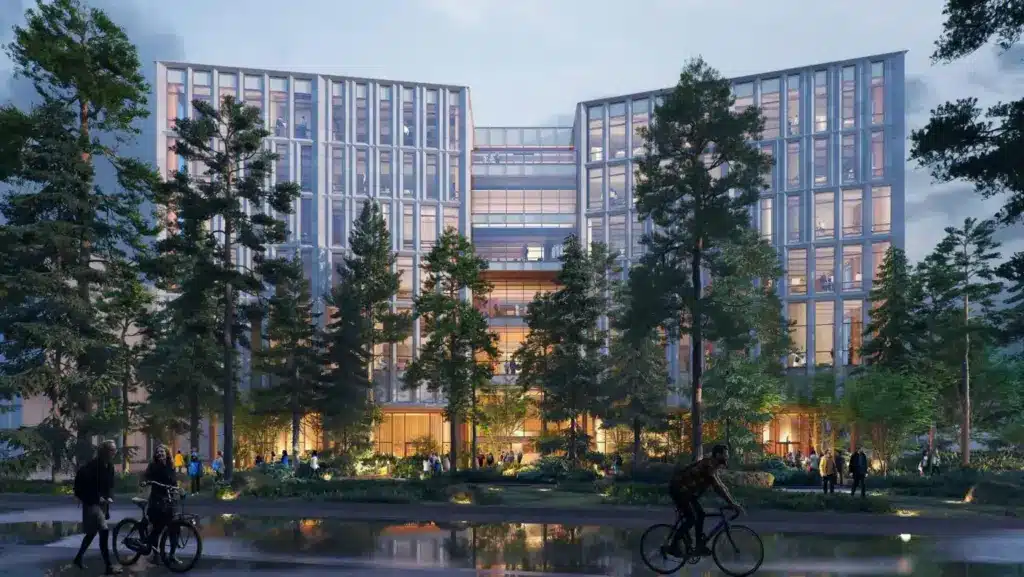
Province: British ColumbiaCity: VancouverProject Category: InstitutionalMajor Classification: A2 – Lecture hallsHeight: 5 storeysBuilding Area: 266,041 ft2 Description: The UBC Gateway project (official name to be determined) will co-locate the School of Nursing, School of Kinesiology, Integrated Student Health Services, and components of UBC Health together in a building that will facilitate inter-program interaction and contribute to students’ health and wellbeing. The building makes extensive use of local CLT and GLT in its hybrid structural system and architectural features reflecting the project’s Pacific Northwest setting and the immediate campus context. Prefabricated components are expediting construction and creating open, flexible space that can accommodate future programming changes. Long-span composite timber floor panels were pre-assembled off site and craned in, and the building envelope is fully prefabricated as three-metre-wide panels that tie into the timber structural module at the building perimeter. The building will be complete and occupied in 2024.
The Goldring Centre – University of Toronto Academic Tower
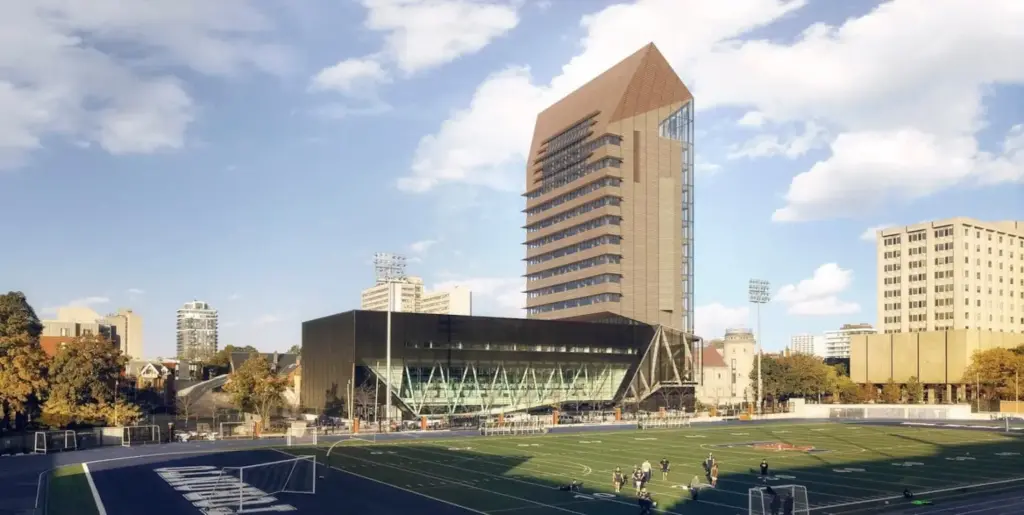
Province: OntarioCity: TorontoProject Category: InstitutionalMajor Classification: D – OfficesHeight: 14 StoreysBuilding Area: 176,549 ft2 Description: The University of Toronto’s new academic tower is a14 storey mass timber building, currently under construction, built with GLT components. Realizing an innovative building of this size and complexity that goes beyond prescriptive height limit of the Ontario Building Code required extensive support and a capable, timber experienced project team. Technical project interactions with WoodWorks staff date back to 2016 and we have tracked 21 direct interactions related to this project. A deeper look at our project data reveals that the project team had an additional 23 indirect interactions with the WoodWorks team (attending events, requesting technical documents, etc.). The project team has 28 projects in their combined experience portfolio, indicating an experienced, supported design team was able to push forward an alternative solutions success storey and one of North America’s tallest wood buildings.
BUILDEX and Canadian Wood Council Bring Cutting Edge Wood-Based Design and Construction to All Professionals of the Built Environment

Vancouver, BC, September 19, 2024 – Informa Connect and the Canadian Wood Council announce their collaboration, WoodWorks at BUILDEX, integrating WoodWorks’ technical expertise and wood products industry representation into BUILDEX Vancouver, February 26 – 27, 2025. This initiative builds on a shared commitment to advancing Canada’s built environment and expands BUILDEX’s focus on innovative materials, design, and construction practices. WoodWorks at BUILDEX offers an exceptional opportunity for all professionals of the built environment to immerse themselves in the latest innovations in wood-based design and construction through: Rick Jeffery, President and CEO, Canadian Wood Council, emphasized the importance of this collaboration: “Working with Informa Connect to bring WoodWorks to BUILDEX Vancouver in 2025 allows us to concentrate on one of our core strengths—delivering industry-leading educational content, technical support, and access to leading wood product providers—at Canada’s most progressive design, construction and real estate event.” Sherida Sessa, SVP for North America at Informa Connect, added “British Columbia is recognized as a global leader in wood-based design and construction, and this partnership solidifies BUILDEX as a key destination for technical expertise, innovation and leadership in the wood products industry.” WoodWorks at BUILDEX amplifies BUILDEX Vancouver’s core offering to Canadian and North America’s design and construction leaders: timely market insights, respected technical knowledge, transformative networking, and exposure to the materials and technologies at the forefront of Canada’s built environment. BUILDEX Vancouver will take place February 26 – 27, 2025, at the Vancouver Convention Centre West, attracting over 8,500 developers, architects, engineers, builders, designers, suppliers, and real estate professionals. Register now at www.BUILDEXVancouver.com to secure your place and witness the latest in progressive design and construction trends.
Mass Timber Insurance Action Plan Phase 1 Report – Test
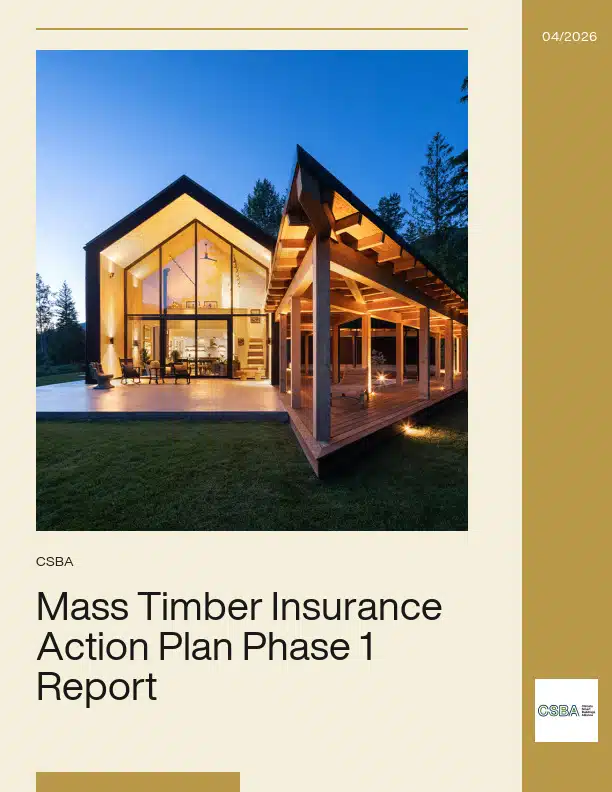
Mass Timber Insurance Action Plan – Phase 1 Report examines one of the most significant barriers to scaling mass timber construction in Canada: access to affordable and reliable insurance. While mass timber offers clear advantages in sustainability, performance, and long-term value, course-of-construction insurance rates remain disproportionately high—often several times those of concrete and steel—driven largely by limited data and insurer unfamiliarity rather than demonstrated risk. Led by the Climate Smart Buildings Alliance and the Canadian Wood Council, and supported by Natural Resources Canada, this report summarizes the findings from Phase 1 of a national action plan developed in collaboration with insurance and building industry stakeholders. It evaluates the feasibility of four targeted solutions focused on data sharing, insurer-relevant research, contractor verification, and expanding insurance capacity. Bringing together technical insight and industry perspectives, the report outlines practical pathways to reduce risk perception, improve market confidence, and unlock greater adoption of mass timber construction across Canada.


