

Wood Design & Building Award Winning Projects Announced

Vancouver, BC – September 23, 2025 – The Canadian Wood Council is pleased to announce the winning projects of the 41st annual Wood Design & Building Awards program. This prestigious awards program recognizes and celebrates the outstanding work of architectural professionals from Canada and around the world for excellence in wood design and construction. “The diversity and creativity in this year’s winning projects demonstrate how wood can connect people with nature,” says Martin Richard, Vice President of Communications and Market Development at the Canadian Wood Council (CWC). “These designs not only showcase wood’s versatility, but also create spaces that enrich daily life and support community well-being. They are high-performance solutions that respond to today’s urgent need for housing, schools, and community spaces.” “It’s a delight each year to see the latest and greatest wood buildings nominated to our awards program and it’s a privilege to recognize the best projects from the impressive submissions we receive,” added Ioana Lazea, Senior Project Manager at CWC responsible for delivering the awards program. “This year’s competition drew a remarkable 140 entries. We are deeply grateful to our esteemed jurors for the significant effort they invested in reviewing each one and for their careful deliberations in selecting the winners.” 18 projects earned recognition from the Wood Design & Building Awards jury. The jurors for the Wood Design & Building Awards were: Omar Ghandi, Principal at Omar Ghandi Architects Jane Abbott, Partner at Abbott Brown Architects Alec Holser, Founding Principal at Opsis Architecture 14 additional projects were selected for recognition under the WoodWorks category of the Wood Design Awards programs which have regional competitions in BC, Ontario, and the Prairie provinces for projects located in those jurisdictions. The jurors for the WoodWorks Awards category were: Eric Karsh, Founding Partner of Equilibrium Brenda Izen, Founding Principal at Izen Architecture Carol Belanger, City Architect, Edmonton In total, 38 projects from Canada and around the world were honoured at the Wood Design and Building Awards celebration hosted Tuesday, September 23, 2025, at the Woodrise Conference in Vancouver, BC. COMPLETE LIST OF AWARD-WINNING PROJECTS FOLLOWS: Honor The Spirit Garden (Toronto, ON) | Gow Hastings Architects in collaboration with Two Row Architects Fraser Mills Presentation Centre (Coquitlam, BC) | Patkau Architects Pacific Northwest Residence (Washington State) | Cutler Anderson Architects Google Borregas (Sunnyvale, CA, USA) | Project Designer: MGA | Michael Green Architecture, Architect of Record: SERA Architects TRUMPF Education Center (Ditzingen, Germany) | Barkow Leibinger Dwelling on the Mountainside: Jiuceng Art Gallery (Lishui, Zhejiang Province, China) | Atelier Lu+Architects Merit Vesterheim Commons (Decorah, IA, USA) | Snøhetta DogTrot Magnetawan (Magnetawan, ON) | Williamson Williamson Aiken Audubon Research Outpost (Chico Basin Ranch, CO, USA) | ColoradoBuildingWorkshop at CU Denver Citation Walking Dunes (Amagansett, NY, USA) | Bates Masi + Architects Timbrelyn (Bethel, NY 12720, USA) | Adel Research Group (ARG) sʔitwənx Child Care (Kelowna, BC) | Public Architecture + Design Canadian Canoe Museum (Peterborough, ON) | Unity Design Studio Greenhill School, Rosa O. Valdes STEM + Innovation Center (Addison, TX, USA) | Bohlin Cywinski Jackson Upper Canada College – Lindsay Boathouse (Toronto, ON) | VJAA Inc. (Lead Design Architect) | RDHA (Architect of Record) Winthrop Library (Winthrop, WA, USA) | Johnston Architects (Architect of Record) and Prentiss Balance Wickline Architects (Associate Architect) Toronto and Region Conservation Authority Headquarters (Toronto, ON) | Bucholz McEvoy Architects + ZAS Architects and Interiors MUMO (Museum of Motorcycle) (Puerto Octay, North Patagonia, Chile) | DRAA Sansin Sponsored Award Google Borregas (Sunnyvale, CA, USA) | Project Designer: MGA | Michael Green Architecture, Architect of Record: SERA Architects Sustainable Forestry Initiative Sponsored Awards Wahta’ elementary school (Wendake, QC) | DG3A Architecture Kreher Preserve & Nature Center Environmental Education Building (Auburn, AL, USA) | Leers Weinzapfel Associates Architects, Inc. Western Red Cedar Sponsored Awards San Juan Islands Residence (Eastsound, WA) | Vandervort Architects The Granary at Southlands (Delta (Tsawwassen) – BC) | MOTIV Architects Wood Preservation Sponsored Award Catchacoma Cottage (The Kawarthas, Municipality of Trent Lakes, ON) | Dubbeldam Architecture + Design WoodWorks Ontario Wood Design Awards DogTrot Magnetawan (Magnetawan, ON) | Williamson Williamson Ontario Secondary School Teachers’ Federation (OSSTF) Headquarters and Multi-Tenant Complex (Toronto, ON) | Moriyama Teshima Architects Toronto and Region Conservation Authority Headquarters (Toronto, ON) | Bucholz McEvoy Architects + ZAS Architects and Interiors Upper Canada College – Lindsay Boathouse (Toronto, ON) | VJAA Inc. (Lead Design Architect) | RDHA (Architect of Record) 1120 Ossington (Toronto, ON) | mcCallumSather WoodWorks BC Wood Design Awards Fraser Mills Presentation Centre (Coquitlam, BC) | Patkau Architects Adams Lake Health + Wellness Centre (Chase, BC) | Unison Architecture Ltd. Kin Park Pavilion and Ice Rink (Fort St. John, BC) | Public Architecture + Design sʔitwənx Child Care (Kelowna, BC) | Public Architecture + Design Point Grey House (Vancouver, BC) | Patkau Architects WoodWorks Prairie Wood Design Awards F Residence (RM of Stanley, MB) | 1×1 architecture inc. Riel Construction Office, (Dugald, MB) | Republic Architecture Inc. Sam Centre (Calgary, AB) | Diamond Schmitt Architects G7 Summit – Interior Renovations (Kananaskis, AB) | 1×1 architecture VIEW A VIDEO COMPILATION OF THIS YEAR’S WINNERS HERE: https://cwc.ca/WoodDesignandBuildingAwards2025/ FOR MORE INFORMATION, PLEASE CONTACT: Sarah Hicks Communications Manager, Canadian Wood Council 1-705-796-3381 | [email protected]
Canadian Wood and Forestry Resources

National Provincial Canadian Wood Council WoodWorks Forest Products Association of Canada Certification Canada Mass timber road map Natural Sciences and Engineering Research Council of Canada Forest sector funding programs The Canadian Forest Service Canada Action – Forestry Industry in Canada FPInnovations Forest Enhancement Society of BC Province of British Columbia – Ministry of Forests British Columbia, Forestry Innovation Investment Mass Timber Demonstration Program in British Columbia Alberta Forest Products Association Ontario Forest Industries Association Ontario Wood Cecobois Conseil de l’industrie forestière du Québec Maritime Lumber Bureau Government Resources Invest in Canada – Services The State of Canada’s Forests Annual Report Canadian Forests – Federal Government Mass Timber Action Plan Trade Commissioner Service Forestry and wood products Funding and financing for international business Opportunities for Wood (PDF) Two Sides – Canadian forests are a renewable natural resource Canadian Council of Forest Ministers – Healthy forests. Healthy communities. naturally:wood – Mass Timber Demonstration Program The State of Canada’s Forests Annual Report 2023 (.pdf) The Conference Board of Canada – Use of Forest Resources COFI – Forest Facts
Canada’s Wood Industry Welcomes New Build Canada Homes Agency to Drive Rapidly Deployable Housing

September 15, 2025, Ottawa, ON: The Canadian Wood Council (CWC) welcomes the federal government’s launch of the Build Canada Homes (BCH) agency, announced yesterday by Prime Minister Mark Carney. Backed by a robust $13 billion investment and a plan to allocate federally owned lands for development, BCH will fast-track the delivery of affordable, sustainable housing nationwide. “This commitment to factory-built housing and prefabricated building components, including both mass timber and light wood frame systems, directly supports the architects, engineers, and builders we work with every day. It enables them to rapidly deploy quality homes at scale, while meeting Canada’s sustainability and affordability goals,” said Rick Jeffery, President and CEO of CWC. “We’re especially encouraged by BCH’s plan to adopt a ‘Buy Canadian’ policy and streamline permitting for bulk projects.” BCH’s first projects will be launched in Dartmouth, Longueuil, Ottawa, Toronto, Winnipeg, and Edmonton, with construction expected to begin next year. The agency will also work with the Nunavut Housing Corporation to deliver 700 homes, 30% of which will be built off-site and transported to Nunavut. In advance of this announcement, the Canadian Wood Council (CWC) with Forest Products Association of Canada (FPAC) submitted recommendations to the BCH Market Sounding Guide highlighting how wood-based modern methods of construction (MMC)—including mass timber, light wood frame, and modular systems—can reduce build times by up to 50%, cut carbon emissions by 30–60%, and lower long-term operating costs. The CWC and FPAC urges BCH to implement key recommendations from its submission, including: Loan guarantees and concessional financing for factory expansion. A national “one-window” approval system for factory-built housing. A Design for Manufacturing & Assembly (DfMA) pattern library. Indigenous equity and workforce development tied to housing pipelines. The CWC stands ready to champion this effort and ensure design and construction professionals have the information and support they need to rapidly deploy the sustainable, affordable homes Canadians need. –30– The Canadian Wood Council (CWC) is a leading force in advancing building codes and standards for wood construction, ensuring market access for Canadian wood products, and accelerating the adoption of sustainable, wood-based construction solutions in the marketplace. As a national federation of associations, the CWC serves as the unifying voice for our members, who represent hundreds of manufacturers across the country.
Canadian Wood Council’s WoodWorks Program Welcomes BarrierTEK as National Partner

Ottawa, Ontario – September 9, 2025 — The Canadian Wood Council (CWC) is pleased to welcome BarrierTEK as a new national partner of its WoodWorks program. This collaboration aligns two organizations committed to supporting safe, innovative, and low-carbon construction practices across Canada through education, technical excellence, and strategic market development. As the construction sector responds to climate imperatives, shifting societal expectations, and progressive building codes, the role of wood in the built environment continues to expand. By combining traditional wood systems with value-added solutions like fire-retardant treatments, project teams can expand the application of wood in diverse building types without compromising performance or design flexibility. This partnership will help raise awareness of the full range of tools and technologies available to support safe, code-compliant wood construction while reinforcing wood’s reputation as a versatile, safe, high-performance building material. “WoodWorks is proud to collaborate with BarrierTEK to help build industry knowledge and confidence in the proven fire performance of wood construction,” says Martin Richard, Vice President of Market Development and Communications at the Canadian Wood Council. “This partnership supports our broader goal of advancing wood use in all forms by equipping professionals with practical, performance-based solutions.” “At BarrierTEK, our mission has always been to make fire safety more accessible without compromising the sustainability or affordability of wood construction,” says Ewan Davie, VP Sales at BarrierTEK. “Working alongside WoodWorks allows us to contribute to the national conversation on wood construction and demonstrate how innovation in fireperformance can enhance—not limit—wood’s role in shaping modern construction practices.” Through shared outreach, resource development, and technical education across the country, this national partnership aims to equip architects, builders, and developers with the knowledge they need to confidently design and build with wood. About the Canadian Wood Council The Canadian Wood Council (CWC) is Canada’s unifying voice for the wood products industry. As a national federation of associations, our members represent hundreds of manufacturers across the country. Our mission is to support our members by accelerating market demand for wood products and championing responsible leadership through excellence in codes, standards, and regulations. We also deliver technical support and knowledge transfer for the construction sector through our market leading WoodWorks program. About the National WoodWorks Program The Canadian Wood Council’s WoodWorks Program a national outreach initiative dedicated to advancing the use of wood in construction by providing educational opportunities and direct technical support. The program helps architects, engineers, developers and other industry professionals expand their capacity for wood design and construction, contributing to a more sustainable built environment. About BarrierTEK BarrierTEK is a Canadian company based near Edmonton, Alberta, at the forefront of enhanced fire performance of wood construction since 2010. Their team of chemists, engineers, and researchers collaborates with builders, code officials, and fire prevention authorities to develop cost-effective, non-toxic, factory-applied fire-retardant treatments for dimensional lumber, I-joists, OSB/plywood panels, attic trusses, and sheathing. These solutions meet or exceed Canadian and NFPA fire safety standards—while being LEED‑compliant and compatible with conventional construction processes—and are designed to reduce the risk and severity of high‑intensity fires in both single‑family and multi‑family wood buildings, delivering measurable benefits like lower insurance premiums and enhanced community safety.
Mass Timber Demonstration Fire Tests Program

The Canadian Wood Council partnered with federal and provincial governments and organizations, as well as key experts, to conduct a series of five fire research burns on a full-scale mass timber structure in Ottawa. The five tests occurred in June 2022. The project supports market acceptance of tall and large mass timber buildings in Canada and encourages the construction of buildings that include mass timber. With the most certified sustainable forests in the world, Canada is a champion of sustainable forest management and in a position to solidify our global leadership in the bioeconomy and forest sector by advancing mass timber adoption. Mass timber is revolutionizing the building industry as a renewable, nature-based construction material. Recognizing mass timber’s vital role in achieving a low carbon, built environment, the Canadian Wood Council and its partners are dedicated to advancing its adoption. Click here for the final report Purpose The project was designed to support market acceptance of tall and large mass timber buildings in Canada and encourage the construction of buildings that include mass timber. By designing and executing a series of demonstration fire research tests on a full-scale mass timber structure, and collecting data from tests, the project: Demonstrated mass timber fire performance to key stakeholders including building officials, fire service and insurance industry Encouraged building code advancements that will allow for taller and larger wood buildings Support the adoption of the 2020 National Building Code introducing new provisions to allow 12 storey mass timber buildings Supported future code change proposals and the development of alternative solutions Encouraged the development of / provide data and information to support the transition toward performance-based codes, long-term strategy Promoted the adoption of mass timber by developing educational materials for targeted audiences Supported the maximum use of exposed mass timber elements (visual aesthetic), leading to cost competitive projects and health and wellness benefits Demonstrated the ability of different mass timber assemblies to maintain structural integrity under, during and post-construction fire scenarios in a way that is comparable to (or superior to) conventional materials. Supported the transition to Performance-based codes Summary of the Mass Timber Demonstration Fire Test #5 Objectives While there is evidence, research, and case studies that demonstrate the comparable, safety and performance of mass timber construction compared to construction using conventional materials like steel and concrete, misconceptions still circulate. By designing and executing a series of demonstration fire research burns on a full-scale mass timber structure, and collecting data from these burns, our objective was to: Showcase, through fire demonstration tests, that mass timber construction is a safe and viable alternative to other more conventional construction systems (steel & concrete) for constructing large or tall buildings; Support the implementation and adoption of the 2020 edition of the National Building Code of Canada; Support future code change proposals to extend the use of mass timber to other building types, heights, and sizes; Support the transition to Performance-based codes; Use the results and finds from the demonstration tests to develop viable solutions to mitigate construction fire risk. Targeted Audiences Various key stakeholders within the construction sector need to be educated through science-based tests that mass timber building systems can be designed to provide a safe building environment when subjected to fire. The key groups targeted by the project include, but are not limited to: Building Code Officials & Regulators Fire Services Professionals Insurance Professionals Building & Construction Industry Sustainability Specialists Building Occupants & Owners Funders & Stakeholders Natural Resources Canada BC Forestry Innovation Investment Government of British Columbia – Office of Mass Timber Implementation (OMTI) Ontario – Ministry of Northern Development, Mines, Natural Resources and Forestry Alberta – Agriculture, Forestry & Rural Economic Development Québec – Ministère des Forêts, de la Faune et des Parcs Canadian Wood Council FPInnovations Full Scale Fire Testing and Research The National Research Council of Canada (NRC) provided support for the technical work and science-based fire tests, as part of its research to inform the advancement of safe and innovative solutions across Canada’s construction industry. Key Consultants & Contractors GHL Consultants Ltd. CHM Fire Consultants Ltd. ISL Engineering Timmerman Timberworks Inc. Key Suppliers & Manufacturers Five mass timber product manufacturers supplied the mass timber materials: Western Archrib: ◦ Glulam beams and columns ◦ Westdek panels for the roof Element5 Modern Timber Buildings ◦ Glulam beams and columns ◦ CLT floor Structurlam Mass Timber Corporation ◦ Glulam beams and columns ◦ CLT floor and walls StructureCraft: Timber engineering & Construction: ◦ DLT floor and roof Nordic Structures ◦ Glulam beams and columns ◦ CLT roof and walls Several key material suppliers also supported the program: MTC ◦ Connectors and fasteners Rockwool ◦ Fire Proof Insulation Hilti ◦ Fireproof material The structure for the Ottawa Fire Test was built by Timmerman Timberworks Inc.
Canadian Wood Council and Canadian Institute of Steel Construction Partner to Advance Steel-Timber Hybrid Construction

Ottawa, ON — September 4, 2025 — The Canadian Wood Council (CWC) and the Canadian Institute of Steel Construction (CISC) are pleased to announce a strategic partnership to accelerate the adoption of steel-timber hybrid structural solutions in Canada. Steel-timber hybrid construction is emerging as a sustainable and efficient approach to modern building design. By combining the strength and durability of steel with the renewable, low-carbon benefits of wood, hybrid systems—such as steel-timber composite floors—can deliver superior structural performance, improved cost efficiency, and faster construction timelines. These benefits are particularly valuable for larger and taller buildings where structural demands are greatest. To advance this opportunity, CWC and CISC have established a joint Technical Steering Committee. This committee will oversee the strategic use of funds contributed by both organizations to maximize industry impact. Its primary mandate is to support designers, engineers, and builders by developing technical guidance, best practices, and publications that will enable practical, code-compliant solutions for hybrid systems. “By working together, we aim to provide the industry with the resources it needs to deliver innovative, cost-effective, and sustainable building solutions,” said Robert Jonkman, Vice-President, Engineering, Canadian Wood Council. “This partnership reflects our shared commitment to advancing construction practices that meet today’s affordability and performance challenges,” added Logan Callele, Director of Engineering, Canadian Institute of Steel Construction. Further details on upcoming resources, publications, and industry engagement opportunities will be shared in the coming months. For more information, visit: www.cwc.ca For media inquiries, please contact: Martin Richard, VP, Communications and Market Development Canadian Wood Council [email protected] | 1-613-725-4339 About the Canadian Wood Council (CWC) The Canadian Wood Council is the national association representing manufacturers of Canadian wood products used in construction. Through technical expertise, market development, and education, CWC promotes the responsible use of wood, advancing building practices that are innovative, sustainable, and aligned with Canada’s climate goals. About the Canadian Institute of Steel Construction (CISC) The Canadian Institute of Steel Construction is the national industry organization representing the structural steel, open web steel joist, and steel plate fabrication industries. CISC works to advance the use of steel in construction through advocacy, education, research, and the development of design and construction resources.
Wood Education and Workforce Integration Concurrent Workshop @ Woodrise 2025

Woodrise 2025 Registration | Official Program | Offsite Tours Workshop on Wood Education and Workforce Integration Date: September 24th, 2025 Time: 2 p.m. – 6 p.m. Duration: 4 hours Speakers: Alexander Opazo Vega, Blériot Feujofack, Craig Applegath, Ghasan Doudak, Guido Wimmers, Michael David Burnard, Peter Moonen, Pierre Quenneville Description: This workshop will bring together international experts to explore advancements in wood design and construction education, highlighting the multifaceted challenges and, most importantly, showcasing and discussing innovative solutions. The workshop will feature perspectives on timber engineering education in New Zealand, the New European Bauhaus Pioneer Hub and its role in shaping Europe’s future workforce, seismic considerations in timber engineering education in Chile, strategies for integrating design, engineering, and construction in North American wood education, as well as workforce integration and the challenges of engaging young professionals in the field. These discussions will also address key strategies for developing and retaining talent within the sector. An interactive panel discussion will follow, bringing together all speakers to address the complex landscape of wood education and workforce integration. The panel will explore the evolution of curricula, the integration of emerging technologies, and effective strategies for engaging the next generation in wood design and construction. This will also provide the audience with a valuable opportunity to engage directly with the panelists through questions and discussion. The workshop will conclude with a one-hour roundtable dedicated to shaping an international platform for collaboration. This platform is envisioned to bring together leading experts from around the world, harmonize curricula across institutions, and share high-quality resources to elevate wood education globally. By participating in this roundtable, you will help establish the foundation for a lasting network that fosters innovation, strengthens training, and ensures the next generation of manufacturers, architects, engineers, and builders are well-prepared to design, construct, and maintain advanced wood structures. In preparation for the workshop, a global survey has been developed to gather insights from educators on wood design and construction. The survey aims to explore current practices, challenges, and technological innovations in wood education. Its findings will provide a data-driven foundation for the workshop discussions, focusing on key topics such as post-secondary education structures, curriculum integration, industry partnerships, and the adoption of new technologies in wood education programs. If you are an educator or professional and would like to share your experiences and perspectives, we invite you to complete the survey by clicking on the following link: Survey Link Here! This workshop promises to be a pivotal event for shaping the future of wood education, combining academic and industry perspectives to create a unified global approach to training the next generation of professionals in the wood sector. Agenda: 2:00 – 2:10 PM Introduction – Peter Moonen, Canadian Wood Council; Guido Wimmers, BCIT; Blériot Feujofack, Canadian Wood Council 2:10 – 3:45 PM Expert presentations Innovations in Timber Engineering Education: Insights from New Zealand – Dr. Pierre Quenneville, University of Auckland Workforce Integration in Wood Design and Construction: Challenges and Solutions for Engaging Young Professionals – Craig Applegath, DIALOG Empowering Graduates: The Role of the New European Bauhaus Pioneer Hub on Sustainable Built Environment with Renewable Materials – Dr. Michael Burnard, InnoRenew CoE Advancing Timber Engineering Education in Seismic Regions: Insights from Chile’s Academic and Research Initiatives – Dr. Alexander Opazo Vega, University of Bío-Bío Advancing Wood Education in Canada and North America: Integrating Design, Engineering, and Construction – Dr. Ghasan Doudak, University of Ottawa 4:15 – 5:00 PM Panel Discussion – Moderated by Blériot Feujofack, Canadian Wood Council 5:00 – 5:55 PM Round Table – Led by Peter Moonen, Canadian Wood Council; Guido Wimmers, BCIT; Blériot Feujofack, Canadian Wood Council 5:55 – 6:00 PM Summary of Activities and Wrap-Up Featuring: Blériot Feujofack Manager Wood Education Canadian Wood Council Peter Moonen National Sustainability Manager Canadian Wood Council
Canadian Wood Council Welcomes Federal Investment in Forestry Innovation and Housing Solutions

August 5, 2025 – (Ottawa, ON) The Canadian Wood Council (CWC) welcomes today’s announcement by Prime Minister Mark Carney in Kelowna, unveiling a $1.2 billion investment to support Canada’s forest sector and accelerate the use of Canadian wood in domestic construction. The measures – including $700 million in loan guarantees and $500 million to advance innovation, workforce development, and market diversification – send a strong signal of support for sustainable construction and domestic manufacturing. CWC is encouraged to see federal action aligned with the priorities it has long championed through its technical work in codes and standards and resource program delivery. “This announcement reinforces the critical role that wood-based solutions can play in meeting Canada’s housing and climate goals,” said Rick Jeffery, President and CEO of the Canadian Wood Council. “The focus on innovation, capacity expansion, and domestic use of wood aligns well with technical insights we’ve shared over many years through our work with government, industry, and the architects, engineers, construction professionals, and developers (AECD) community.” CWC has worked closely with federal departments and agencies, including Natural Resources Canada, on initiatives such as the Green Construction through Wood (GCWood) program, which has demonstrated the ability to de-risk early projects and help scale up Modern Methods of Construction (MMC). These approaches, such as mass timber and prefabrication, are essential to accelerating housing starts while reducing carbon emissions and supporting rural economies across Canada. “With the Build Canada Homes plan targeting 500,000 new units annually, today’s announcement provides important tools to help scale construction innovation,” Jeffery added. “Ensuring that Canadian wood products are part of the solution is a smart investment in housing, climate action, and economic resilience.” CWC will continue its work providing technical assistance, education, and data-driven insight to support the successful implementation of federal initiatives. The organization remains committed to working with all levels of government and industry partners to help increase the use of sustainable wood systems in construction.
Wood Design & Building Magazine, vol 24, issue 98
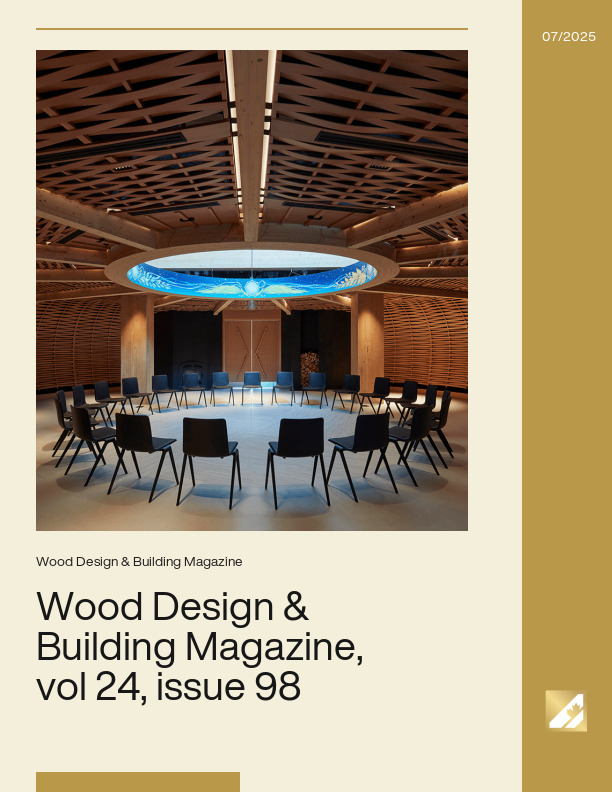
What does it take to deliver better buildings? In this issue, we explore that question from a couple of different angles—primarily through a look at standout wood projects that demonstrate wood design excellence, but also through a thoughtful feature on offsite prefabrication that invites the construction industry to think critically about how we build and what it will take to build better. Through enhanced collaboration and the expanded use of technology, prefabricated construction—an approach especially well-suited to wood—is transforming the way we design and deliver buildings. This fall, the Canadian Wood Council is proud to support Woodrise 2025, an international conference coming to Vancouver, British Columbia. As part of this event, the 5th International Congress on tall wood construction, we’ve curated nine immersive tours that offer attendees a unique opportunity to step inside some of the region’s most compelling wood projects for a firsthand look at the leadership and innovation happening here. If you believe one of the best ways to learn about a building is to walk through it—this is your chance. The full tour lineup is available now at www.woodrise2025.com/offsite-tours. Join us to explore everything from sustainable forest management and advanced manufacturing to some of the region’s most iconic mass timber buildings – experiences that bring together the people, materials, and design approaches shaping the future of low-carbon construction in B.C. and beyond. We hope this issue inspires you to keep exploring what’s possible with wood—whether in your own projects or out with us on tour.
Canadian Wood Council Applauds Nova Scotia’s Prioritization of Wood Products for Construction and Heating in Public Buildings

OTTAWA, ON, 18 July 2025 – The Canadian Wood Council (CWC) applauds the Province of Nova Scotia’s recent announcement regarding the prioritization of wood products for construction and heating in public buildings – a strategic move that supports economic growth, climate resilience, and innovation in the province’s forestry sector. By committing to mass timber and other solid wood products for construction, alongside the use of wood pellets, biomass, and other products made from forest residuals for heat and energy, Nova Scotia is taking a leadership approach to development that aligns environmental stewardship with economic opportunity. This initiative reinforces the principles of a circular economy built on sustainable forest management. This comprehensive approach to fibre utilization ensures the province is maximizing the value of harvested wood and reducing waste while simultaneously supporting jobs, stimulating rural economies, and strengthening local and regional supply chains across the forestry and construction sectors. “This commitment from the province of Nova Scotia not only supports local forestry and bioeconomy innovation, but also delivers practical solutions to reduce emissions, improve energy security, and build with a lighter carbon footprint,” says Rick Jeffery, President & CEO of the Canadian Wood Council. It’s a smart and timely commitment to sustainability that will strengthen local industries while advancing practical, low-carbon building solutions.” View the announcement from Nova Scotia Public Works and Nova Scotia Natural Resources here: https://news.novascotia.ca/en/2025/07/17/government-promotes-wood-construction-heating
Canadian Wood Council Supports Ontario’s Advanced Wood Construction Action Plan

KITCHENER, ON — The Canadian Wood Council (CWC) was proud to participate in a significant announcement by the Government of Ontario yesterday, where the Honourable Mike Harris, Minister of Natural Resources, and the Honourable Kevin Holland, Associate Minister of Forestry and Forest Products, launched Ontario’s Advanced Wood Construction Action Plan. The Action Plan outlines a strong, strategic commitment to advancing the use of mass timber and prefabricated wood systems—technologies that can deliver high-performance buildings while supporting job creation and investment across Ontario’s forestry, manufacturing, and construction sectors. As the national association representing manufacturers of Canadian wood products, CWC welcomes this important step forward. Through its technical resource program, WoodWorks, the Council is committed to supporting the growth of advanced wood construction by providing guidance, education, and project support to professionals across the building sector. “This is about solving today’s challenges while laying the groundwork for long-term economic growth—with industrialized wood construction driving that transformation forward,” said Steven Street, Executive Director of WoodWorks Ontario. The Action Plan includes investments in research, education, training, and manufacturing, positioning Ontario as a leader in low-carbon, efficient, and sustainable construction. CWC applauds the province’s leadership and looks forward to continuing its collaboration with public and private partners to advance the adoption of made-in-Ontario wood solutions. To read the full plan, visit: https://www.ontario.ca/page/advanced-wood-construction-action-plan
Canadian Wood Council’s 2024 Annual Report Now Available

The Canadian Wood Council is pleased to share it’s 2024 Annual Report, offering a clear view of the progress, resilience, and impact achieved over the past year. In his message, Chairman Kevin Pankratz reflects on the Council’s strategic leadership during a year marked by economic pressures and shifting market conditions. Emphasis is placed on the value of collaboration, strong governance, and industry alignment as essential to maintaining momentum and ensuring long-term competitiveness. The report reinforces the importance of maintaining a united voice across our membership and fostering clarity in our purpose as a national federation. From the President & CEO’s perspective, Rick Jeffery outlines how the organization navigated 2024 with focus and adaptability—delivering trusted technical guidance, growing influence in codes and standards, and expanding national education and outreach efforts. With renewed government investment and increased awareness of low-carbon construction, the Council is well-positioned to lead the next chapter of growth for Canada’s wood sector. View the full report: English | Francais


