There is much to learn from the resilient and adaptable warehouse buildings that line the streets of Canada’s historic manufacturing districts. ‘Historical Tall-Wood Toronto’ is an evidentiary database of late 19th and early 20th century vernacular brick and beam buildings that were built using the fire restrictive specifications and construction technology of Heavy Timber Mill-Construction (mill-construction) in Toronto.
Throughout history, wherever wood has been available as a resource, it has found favour as a building material for its durability, strength, cost-competitiveness, ease-of-use, sustainability, and beauty. Wood-frame and timber buildings have an established record of long-term durability. From the ancient temples of China and Japan built in the 1000s, and the great stave churches of Norway to the numerous North American buildings built in the 1800s, wood construction has proven it can stand the test of time.
Although wood building technology has been changing over time, wood’s natural durability properties will continue to make it the material of choice.
This website helps designers, construction professionals, and building owners understand what durability hazards exist for wood, and describes durability solutions that ensure wood, as a building material, will perform well for decades, and even centuries, to come.
Durability Guidelines
Wood structures, properly designed and properly treated, will last indefinitely. This section includes guidance on specific applications of structures that have constant exposure to the elements.
Mass timber exteriors
Modern Mass Timber Construction includes building systems otherwise known as post-and-beam, or heavy-timber, and cross laminated timber (CLT). Typical components include solid sawn timbers, glue-laminated timbers (glulam), parallel strand lumber (PSL) laminated veneer lumber (LVL) laminated strand (LSL), and CLT. Heavy-timber post and beam with infill walls of various materials is one of the oldest construction systems known to man. Historic examples still standing range from Europe through Asia to the long-houses of the Pacific Coastal first nations. Ancient temples in Japan and China dating back thousands of years are basically heavy timber construction with some components semi-exposed to the weather. Heavy-timber-frame warehouses with masonry walls dating back 100 years or more are still serviceable and sought-after as residences or office buildings in cities like Toronto, Montreal and Vancouver (Koo 2013). Besides their historic value, these old warehouses offer visually impressive wood structures, open plan floors and resultant flexibility of use and repurposing. Building on this legacy, modern mass timber construction is becoming increasingly popular in parts of Canada and the USA for non-residential construction, recreational properties and even multi-unit residential buildings. Owners and architects typically see a need to express these structural materials, particularly glulam, on the exterior of the building where they are at semi-exposed to the elements. In addition wood components are being increasingly used to soften the exterior look of non-wood buildings and make them more appealing. They are anticipated to remain structurally sound and visually appealing for the service life. However, putting wood outside creates a risk of deterioration that needs to be managed. Similar to wood used for landscaping, the major challenges to wood in these situations are decay, weathering and black-stain fungi. This document provides assistance to architects and specifiers in making the right decisions to maximize the durability and minimize maintenance requirements for glulam and other mass timber on the outside of residential and non-residential buildings. It focusses on general principles, rather than providing detailed recommendations. This is primarily focussed on a Canadian and secondarily on a North American audience.
Shelter needs after natural disasters come in three phases:
Immediate shelter: normally supplied by tarpaulins or light tents Transition shelter: may be heavy-duty tents or more robust medium-term shelters. Permanent buildings: Ultimately permanent shelters need to be constructed when the local economy recovers.
Immediate and transition shelters are typically supplied by aid agencies. Light wood frame is ideal for rapid provision of medium- to long-term shelter after natural disasters. However, there are challenges in certain climates for wood frame construction that must be addressed in order to sustainably and responsibly build them. For example, many of the regions which experience hurricanes, earthquakes and tsunamis also have severe decay and termite hazards including aggressive Coptotermes species and drywood termites. In extreme northern climates, high occupancy loads are common and when combined with the need for substantial thermal insulation to ensure comfortable indoor temperatures, can result in condensation and mould growth if wall and roof systems are not carefully designed.
The desire of aid organizations to maximize the number of shelters delivered tends to drive down the allowable cost dictating simplified designs with fewer moisture management features. It may also be difficult to control the quality of construction in some regions. Once built, “temporary” structures are commonly used for much longer than their design life. Occupier improvements over the longer term can potentially increase moisture and termite problems. All of these factors mean that the wood used needs to be durable.
One method of achieving more durable wood products is by treating the wood to prevent decay and insect/termite attack. However, commonly available preservative treated wood in Canada may not be suitable for use in other countries. Selection of the preservative and treatment process must take into account the regulations in both the exporting and receiving countries, including consideration of the potential for human contact with the preserved wood, where the product will be within the building design, the treatability of wood species, and the local decay and termite hazard. Simple design features, such as ensuring wood does not come into contact with the ground and is protected from rain, can reduce moisture and termite problems.
Building with concrete and steel does not eliminate termite problems. Termites will happily forage in a concrete or masonry block buildings looking for wood components, furniture, cupboards, and other cellulosic materials, such as the paper on drywall, cardboard boxes, books etc. Mud tubes running 10ft over concrete foundations to reach cellulosic building materials have been documented. Indeed, termites have caused major economic damage to cellulosic building materials even in concrete and steel high-rises in Florida and in southern China.
Timber bridges
Timber bridges are an excellent way to showcase the strength and durability of wood structures, even under harsh conditions, when material selection, design, construction and maintenance are done well. They could also be critical infrastructure elements that span fast rivers or deep gorges. Consequences of failure of these structures can be severe in loss of life and loss of access to communities. Durability is as critical as engineering to ensure safe use of timber bridges for the design life, typically 75 years in North America.
There are numerous examples of old wood bridges still in service in North America (Figure 1). The oldest are traditional covered bridges (Figure 2), three of which are around 190 years old. In Southeast China, Fujian and Zhejiang provinces have numerous covered bridges that are almost 1000 years old (Figure 3). The fact that these bridges are still standing is a testament to the craftsmen that selected the materials, designed the structures, built them, monitored their condition and kept them maintained and repaired. They would have selected the most durable wood species available, likely Chestnut or cedars in North America, china fir (china cedar) in southeast China. They would have adzed off the thin perishable sapwood exposing only the naturally durable heartwood. The fact the covered bridges around today all look similar is because those were the tried and tested designs that worked. They clearly designed those bridges to shed water with a wood shingle roof, vertical siding projecting below the deck and structural elements sheltered from all but the worst wind-driven rain. Any rain that did not drip off the bottom of the vertical siding and wicked up the end grain would also dry out reasonably rapidly. Slow decay that did occur at the bottom of these boards was inconsequential because it was remote from connections to structural elements. Construction must have been meticulously performed by experienced craftsmen. Those craftsmen may well have been locals that would continue to monitor the bridge over its life and make any repairs necessary. Of course, not every component in those ancient bridges is original, particularly shingle roofs that typically last 20-30 years depending on climate. These bridges have all been repaired due to decay and in some cases dismantled and re-built over the years for various reasons (e.g., due to changes in traffic loads, arson, flooding, fire, hurricanes, etc.). The Wan’an Bridge in Fujian is known to have been built in 1090, refaced in 1708 and rebuilt in 1845, 1932 and 1953. The apparently increasing frequency of rebuilding may suggest a loss of knowledge and skills, but all repairs and reconstruction prior to 1845 may not have been recorded.
Permanent Wood Foundations
A permanent wood foundation (PWF) is a strong, durable and proven construction method that has a number of unique advantages over other foundation systems for both the builder and the homeowner. The first Canadian examples were built as early as 1950 and are still being used today. PWFs can also be designed for projects such as crawl spaces, room additions and knee-wall foundations for garages and mobile homes. Concrete slab-on-grade, wood sleeper floors and suspended wood floors can all be used with PWFs.
A permanent wood foundation is an in-ground engineered construction system designed to turn a home’s foundation into useable living space. A below-grade stud wall constructed of preservative treated plywood and lumber supports the structure and encloses the living space. PWFs are suitable for all types of light-frame construction covered under Part 9 (Housing and Small Buildings) of the National Building Code of Canada, under clauses 9.15.2.4.(1) and 9.16.5.1.(1). This includes single-family detached houses, townhouses, low-rise apartments, and institutional and commercial buildings. In addition, the recently revised CSA S406 standard, Specification of permanent wood foundations for housing and small buildings, allows for three-storey construction supported by PWF.
Wood has been a valuable and effective structural material since the earliest days of human civilisation. With normal good practice, wood can deliver many years of reliable service. But, like other building materials, wood can suffer as a result of mistakes made in storage, design, construction, and maintenance practices.
How can you ensure long life of a wood building? The best approach is always to remember that wood meant for dry application must stay dry. Start out by buying dry wood, store it carefully to keep it dry, design the building to protect the wood elements, keep wood dry during construction, and practice good maintenance of the building. This approach is called durability by design.
If wood won’t stay dry, you have two choices in approach. Because wet wood is at risk of decay, you must select a product with decay resistance. One choice is to choose a naturally durable species like Western red cedar. This approach is called durability by nature.
Most of our construction lumber is not naturally durable, but we can make it decay resistant by treating it with a preservative. Preservative-treated lumber is more reliably resistant to decay than naturally durable lumber. This approach is called durability by treated wood.
The level of attention you give to durability issues during the course of design depends on your decay hazard. In other words, the more that your circumstances put wood at risk, the more care you must take in protecting against decay. In outdoor applications, for example, any wood in contact with the ground is at high risk of decay and should be pressure-treated with a preservative. For wood that is exposed to the weather but not in direct ground contact, the degree of hazard correlates with climate. The fungi that harm wood generally grow best in moist environments with warm temperatures. Researchers have developed hazard zones in North America using mean monthly temperature and number of rainy days. This map in particular shows the rainfall hazard and applies to exposed uses of wood such as decks, shingles and fence boards. A high degree of hazard would indicate a need to carefully choose a wood species or preservative treatment for maximum service life. In the future, building codes may provide more specific directives as a function of decay hazard. For wood not exposed to weather, such as framing lumber, this map is only moderately useful. This is because the environmental conditions in the wall may be substantially different than those outdoors.
Durability Hazards
Moisture, Decay, and Termites
Wood is a natural, biodegradable material. That means certain insects and fungi can break wood down to be recycled via earth into new plant material.
Decay, also called rot, is the decomposition of organic material by fungal activity. A few specialized species of fungi can do this to wood. This is an important process in the forest. But it is obviously a process to be avoided for wood products in service.
The key to controlling decay is controlling excessive moisture. Water by itself doesn’t cause harm to wood, but water enables these fungal organisms to grow. Wood is actually quite tolerant of water and forgiving of many moisture errors. But too much unintended moisture (for example, a major wall leak) can lead to a significant decay hazard. If a wood product is to be used in an application that will frequently be wet for extended periods, then measures need to be taken to protect the wood against decay.
Various types of insects can damage wood, but the predominant ones causing problems are termites. Termites live everywhere in the world where the climate is warm or temperate.
Durability – FAQ
Please refer to the pdf documents below for Frequently Asked Questions pertaining to durability:
The Durability site is a joint CWC/ FPInnovations – website whose intent is to provide current information on the durability of wood products in order to ensure long service life of wood structures. The site is maintained and updated regularly by both groups, which ensures that architects, engineers, builders, and homeowners get answers to their inquiries regarding wood durability.
As interest in mass timber construction continues to grow in a more carbon-friendly world, examples of innovative projects using these sustainable materials are popping up all over Canada. One prime example is Glenora West Block 300.
Located in Glenora, one of Edmonton’s oldest and most sought-after neighbourhoods, the three-storey, mixed-use building was constructed using glue-laminated timber (GLT).
Completed in 2019, Glenora West Block 300 was the first mass timber office building to be built in Alberta and features 60,000 square feet of office and retail space.
There’s no reason a wood structure can’t last virtually forever – or, at least hundreds of years, far longer than we may actually need the building. With a good understanding of how to protect wood from decay and fire, we can expect today’s wood buildings to be around for as long as we wish.
While wood does not have the historical longevity of stone, there nonetheless remain standing some very old wood buildings. In Europe, wood was long a dominant building material dating back to the beginning of civilisation. Most of these ancient buildings are long gone, lost to fire, decay, or deconstruction for another purpose. In the early days of wood construction, the primary structural components were placed directly in the ground, which eventually leads to decay. It was not until sometime in the 1100s that builders began to use stone footings – thus our still-standing examples of wood buildings generally date from no earlier than that time.
Perhaps the most famous ancient European wood buildings still in evidence today are the Norwegian stave churches, hundreds of which were built in the 12th and 13th centuries and of which 25-30 still remain today. Their exterior claddings have typically been replaced, but the structural wood is original.
The Urnes stave church (c. 1150) in Sogn og Fjordane County is Norway’s oldest. Photo source
In North America, the abundance of wood and the existing timber skills of early settlers led to widespread use of wood – wood has always been and still is the primary structural material for small buildings here. The oldest surviving wood homes in the US date to the early 1600s. Nearly 80 homes remain from this era in the New England states.
The Fairbanks House (c. 1636) in Dedham, Massachusetts, USA, is the oldest surviving timber frame house in North America. It was built for Jonathan and Grace Fairebanke and was occupied by them and seven succeeding generations of the family until the early twentieth century. The Fairbanks family still owns the property. The house is open as a museum. Photo source.
Many other North American wood buildings survive from the 18th century. Even in the demanding climate of Louisiana, where hot and humid conditions present a challenge for wood durability, one can still find some of the original French settlements dating to the first half of the 1700s. And of course, there are countless standing wood buildings from the 1800s and early 1900s, most of which are probably still occupied.
The Parlange Plantation (c. 1750) in Pointe Coupée Parish, Louisiana, USA, was built by the Marquis Vincent de Ternant and remains in the possession of his descendants, the Parlange family. This large plantation home was constructed of bousilliage (mud, moss and deer hair) and cypress wood set over a hand-made brick raised basement. Photo source.
Japan has a well-known history of wood use and is the home of the oldest surviving wood structure in the world, a Buddhist temple near the ancient capital city of Nara. The Horyu-ji temple is believed to have been built at the beginning of the eighth century (c. 711) and possibly even earlier, as one of the hinoki (Japanese cypress) posts appears to have been felled in the year 594. This temple’s longevity is largely helped by careful maintenance and repair. This entire region of Japan has many other ancient wood buildings still standing.
The Horyu-ji temple at Nara
For modern buildings, we don’t normally require such exceptional longevity. The life of a typical North American house is no more than 100 years (the average is lower), and our non-residential buildings are usually demolished in 50 years or less. Wood is perfectly suitable for these lifetime expectations. Click here for survey data showing that wood buildings last as long, or longer than buildings made of other materials.
Reference:
Architecture in Wood: A History of Wood Building and Its Techniques in Europe and North America. Hans Jrgen Hansen, Ed., Faber and Faber, London, 1971..
Case Studies
1865 House, Vancouver BC
Irving House is a large, one and one-half storey plus basement wood-frame residence, designed in the Gothic Revival style, located on its original site at the corner of Royal Avenue and Merivale Street in the New Westminster neighbourhood of Albert Crescent. Irving House is remarkable for the extent to which its original exterior and interior elements have been maintained. Operated as an historic house museum, it also includes a collection of many original furnishings from the Irving family.
Irving House
Location
302 Royal Avenue, New Westminster, B.C.
Completion of Construction
1865
Other Information
Original owner – Captain William and Elizabeth Jane Irving
Current Status
Heritage of New Westminster
Construction Method
Platform-Frame
Style
Gothic Revival style
Framing
2-inch Douglas Fir lumber
Cladding
Wide lapped Redwood weatherboard siding and wooden trim
Comdition
No signs of decay on any framing members
Major Repair
1880
By courtesy of New Westminster Museum and Archives, New Westminster, British Columbia
This classic turn-of-the-century home was slated for demolition in 1990. It was already stripped back to the bare framing when it was purchased by a new owner who wished to convert it into apartments. At the new owner’s request, the building was inspected by Dr. Paul Morris of Forintek in 1991 for signs of deterioration. After 80 years in service there were no signs of decay on any of the framing members nor the window frames, most of which were original.
1912 House
Location
Vancouver
Date of Construction
1912 (estimated)
Original Records
Water service 1909
On City File
1915
Other Information
Original owner – Henry B. Ford
Current Status
Vancouver Heritage Resource Inventory
Construction Method
Platform-Frame
Style
Heritage, with multiple pitched roofs & wide overhangs
Framing
Rough green full 2-inch Douglas Fir lumber
Sheathing
Rough green Douglas Fir boards
Building Paper
Asphalt-impregnated paper
Cladding
Western Red Cedar shakes
Western Red Cedar siding
Roofing
Western Red Cedar shakes (new in 1991)
Condition
No signs of decay on any framing members
Temple at Nara, Japan
The Horyuji Buddhist temple at Nara is probably the oldest wooden structure in the world. Nara became the first permanent capital of Japan in 710.
Horyuji Buddhist temple at Nara
Location
Nara, Japan
Date of Construction
670 – 714 (Estimated)
Original Records
Built on site of original temple from 607
Other Information
Original owner – Prince Shotoku
Current Status
World Cultural Heritage Building
Construction Method
Heavy Timber
Style
2-inch Douglas-fir lumber
Framing
Hinoki (Durable – Japanese cypress)
Roofing
Multi-tiered roof with Clay tile
Condition
No signs of decay on any framing members
Maintenance Schedule
Major repairs every 100 years, rebuilt every 300 years
Supplementary treatment may be added wherever on-site cutting or drilling of wood is unavoidable, or where it is suspected the original protection measures may be inadequate. This is most commonly done in applications such as wood foundations, agricultural buildings, or non-residential long-life applications such as utility poles and bridge timbers.
For wood foundations and agricultural buildings, it is normal to expect some end cutting and boring for bolts, pipes or electrical wiring. Typically copper naphthenate is brushed on the cut ends or holes in the treated wood to protect the exposed surfaces. Experience has shown that this is adequate for the limited exposure resulting from such cases.
For cases such as poles or bridge timbers, the original preservative protection can be lost over time due to degradation or depletion of the active ingredients. A need for supplementary treatment may be indicated by damage to similar structures in the same area. Or there may be evidence that the risk of damage has increased, for example, if new termites move into the area.
In cases like utility poles, where these are part of the physical infrastructure of an organization, inspection, maintenance and remediation are regularly practiced to ensure continued safety in use and to schedule replacement. Often the cost of supplementary treatment is relatively small compared to the cost of inspection, and is a very small fraction of the cost of premature failure. Supplementary treatment may also be prudent in terms of due diligence (reducing legal liability). During inspection of these structures, drills or increment borers may be used to determine the condition of the interior of the wood members. It is advised to treat these holes, to avoid infection from non-sterilized drills and borers. In addition, as holes are typically drilled where decay is suspected or anticipated, treating the holes is wise to supplement protection at that site.
Solids
Borate, copper/borate and fluoride rods have seen increasingly widespread use as supplementary treatments for internal decay due to their convenience in handling and very low toxicity. Copper moves more slowly in the wood than borate, providing protection to the zone around the rod if the borate is removed over time through mass flow of water. This is mainly of concern for utility poles in wet climates, where moisture moves into the pole from the soil, wicks up the pole and evaporates above ground, moving the borate up the pole with it – this leaves the borate in a part of the pole not especially at risk for decay. The rate of water flow may be relatively slow in Douglas fir (an impermeable wood species) treated with an oil-borne preservative having some water repellency. It may be more rapid in southern pine (a very permeable wood species) treated with a waterborne preservative.
Liquids, Pastes and Gels
Spray and foam application of liquids and gels are increasingly used for supplementary treatment of wood frame buildings against termites and wood boring beetles. Holes are drilled into each stud space and the liquids or gels are pumped in under pressure. Coverage cannot be expected to be as effective as that achieved by spray treatment during construction. Liquids can be poured or pumped into drilled holes to treat internal decay in utility poles or timbers. Typically the loading of preservative that can be achieved is limited in the first case by the size and location of the holes and the solubility of the chemical, and in the second case by the permeability of the wood. Another approach is to leave a pressurized device attached to the pole below ground, which pushes a larger amount of liquid into the pole over a longer time period. Care must be taken to ensure that drilled holes do not intersect voids or checks leading to the surface of the wood; otherwise, the liquids can flow out. Pastes can be packed into drilled holes to treat internal decay. Alternatively, they can be brushed or trowelled on or applied on bandages to treat external decay.
Fumigants
Fumigant treatments have been used successfully for decades on utility poles and timber structures. The gas moves rapidly through the wood, adsorbing to the lignocellulose and providing several years of residual protection.
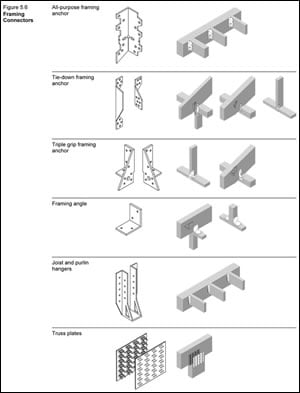
Framing connectors are proprietary products and include fastener types such as; framing anchors, framing angles, joist, purling and beam hangers, truss plates, post caps, post anchors, sill plate anchors, steel straps and nail-on steel plates. Framing connectors are often used for different reasons, such as; their ability to provide connections within prefabricated light-frame wood trusses, their ability to resist wind uplift and seismic loads, their ability to reduce the overall depth of a floor or roof assembly, or their ability to resist higher loads than traditional nailed connections. Examples of some common framing connectors are shown in Figure 5.6, below.
Framing connectors are made of sheet metal and are manufactured with pre-punched holes to accept nails. Standard framing connectors are commonly manufactured using 20- or 18-gauge zinc coated sheet steel. Medium and heavy-duty framing connectors can be made from heavier zinc-coated steel, usually 12-gauge and 7-gauge, respectively. The load transfer capacity of framing connectors is related to the thickness of the sheet metal as well as the number of nails used to fasten the framing connector to the wood member.
Framing connectors are suitable for most connection geometries that use dimensional lumber that is 38 mm (2″ nom.) and thicker lumber. In light-frame wood construction, framing connectors are commonly used in connections between joists and headers; rafters and plates or ridges; purlins and trusses; and studs and sill plates. Certain types of framing connectors, manufactured to fit larger wood members and carry higher loads, are also suitable for mass timber and post and beam construction.
Manufacturers of the framing connectors will specify the type and number of fasteners, along with the installation procedures that are required in order to achieve the tabulated resistance(s) of the connection. The Canadian Construction Materials Centre (CCMC), Institute for Research in Construction (IRC), produce evaluation reports that document resistance values of framing connectors, which are derived from testing results.
Figure 5.6 Framing Connectors
For more information, refer to the following resources:
Canadian Construction Material Centre, National Research Council of Canada
Truss Plate Institute of Canada
CSA S347 Method of Test for Evaluation of Truss Plates used in Lumber Joints
ASTM D1761 Standard Test Methods for Mechanical Fasteners in Wood
Canadian Wood Truss Association
Engineered Wood Products (EWP), Mass Timber, Wood Products
Advancements in wood product technology and systems are driving the momentum for innovative buildings in Canada. Products such as cross-laminated timber (CLT), nailed-laminated timber (NLT), glued-laminated timber (GLT), laminated strand lumber (LSL), laminated veneer lumber (LVL) and other large-dimensioned structural composite lumber (SCL) products are part of a bigger classification known as ‘mass timber’.
Although mass timber is an emerging term, traditional post-and-beam (timber frame) construction has been around for centuries. Today, mass timber products can be formed by mechanically fastening and/or bonding with adhesive smaller wood components such as dimension lumber or wood veneers, strands or fibres to form large pre-fabricated wood elements used as beams, columns, arches, walls, floors and roofs. Mass timber products have sufficient volume and cross-sectional dimensions to offer significant benefits in terms of fire, acoustics and structural performance, in addition to providing construction efficiency.
Glulam (glued-laminated timber) is an engineered structural wood product that consists of multiple individual layers of dimension lumber that are glued together under controlled conditions. All Canadian glulam is manufactured using waterproof adhesives for end jointing and for face bonding and is therefore suitable for both exterior and interior applications. Glulam has high structural capacity and is also an attractive architectural building material.
Glulam is commonly used in post and beam, heavy timber and mass timber structures, as well as wood bridges. Glulam is a structural engineered wood product used for headers, beams, girders, purlins, columns, and heavy trusses. Glulam is also manufactured as curved members, which are typically loaded in combined bending and compression. It can also be shaped to create pitched tapered beams and a variety of load bearing arch and trusses configurations. Glulam is often employed where the structural members are left exposed as an architectural feature.
Available sizes of glulam
Standard sizes have been developed for Canadian glued-laminated timber to allow optimum utilization of lumber which are multiples of the dimensions of the lamstock used for glulam manufacture. Suitable for most applications, standard sizes offer the designer economy and fast delivery. Other non-standard dimensions may be specially ordered at additional cost because of the extra trimming required to produce non-standard sizes. The standard widths and depths of glulam are shown in Table 6.7, below. The depth of glulam is a function of the number of laminations multiplied by the lamination thickness. For economy, 38 mm laminations are used wherever possible, and 19 mm laminations are used where greater degrees of curvature are required.
Standard widths of glulam
Standard finished widths of glulam members and common widths of the laminating stock they are made from are given in Table 4 below. Single widths of stock are used for the complete width dimension for members less than 275 mm (10-7/8″) wide. However, members wider than 175 mm (6-7/8″) may consist of two boards laid side by side. All members wider than 275 mm (10-7/8″) are made from two pieces of lumber placed side by side, with edge joints staggered within the depth of the member. Members wider than 365 mm (14-1/4″) are manufactured in 50 mm (2″) width increments, but will be more expensive than standard widths. Manufacturers should be consulted for advice.
Initial width of glulam stock
Finished width of glulam stock
mm.
in.
mm.
in.
89
3-1/2
80
3
140
5-1/2
130
5
184
7-1/4
175
6-7/8
235 (or 89 + 140)
9-1/4 (or 3-1/2 + 5-1/2)
225 (or 215)
8-7/8 (or 8-1/2)
286 (or 89 + 184)
11-1/4 (or 3-1/2 + 7-1/4)
275 (or 265)
10-7/8 (or 10-1/4)
140 + 184
5-1/2 + 7-1/4
315
12-1/4
140 + 235
5-1/2 + 9-1/4
365
14-1/4
Notes:
Members wider than 365 mm (14-1/4″) are available in 50 mm (2″) increments but require a special order.
Members wider than 175 mm (6-7/8″) may consist of two boards laid side by side with logitudinal joints staggered in adjacent laminations.
Standard depths of glulam
Standard depths for glulam members range from 114 mm (4-1/2″) to 2128 mm (7′) or more in increments of 38 mm (1-1/2″) and l9 mm (3/4″). A member made from 38 mm (1-1/2″) laminations costs significantly less than an equivalent member made from l9 mm (3/4″) laminations. However, the l9 mm (3/4″) laminations allow for a greater amount of curvature than do the 38 mm (1-1/2″) laminations.
Width
in.
Depth range
mm
in.
80
3
114 to 570
4-1/2 to 22-1/2
130
5
152 to 950
6 to 37-1/2
175
6-7/8
190 to 1254
7-1/2 to 49-1/2
215
8-1/2
266 to 1596
10-1/2 to 62-3/4
265
10-1/4
342 to 1976
13-1/2 to 77-3/4
315
12-1/4
380 to 2128
15 to 83-3/4
365
14-1/4
380 to 2128
15 to 83-3/4
Note:
1. Intermediate depths are multiples of the lamination thickness, which is 38 mm (1-1/2″ nom.) except for some curved members that require 19 mm (3/4″ nom.) laminations.
Laminating stock may be end jointed into lengths of up to 40 m (130′) but the practical limitation may depend on transportation clearance restrictions. Therefore, shipping restrictions for a given region should be determined before specifying length, width or shipping height.
Glulam appearance grades
In specifying Canadian glulam products, it is necessary to indicate both the stress grade and the appearance grade required. The appearance of glulam is determined by the degree of finish work done after laminating and not by the appearance of the individual lamination pieces.
Glulam is available in the following appearance grades:
Industrial
Commercial
Quality
The appearance grade defines the amount of patching and finishing work done to the exposed surfaces after laminating (Table 6.8) and has no strength implications. Quality grade provides the greatest degree of finishing and is intended for applications where appearance is important. Industrial grade has the least amount of finishing.
Grade
Description
Industrial Grade
Intended for use where appearance is not a primary concern such as in industrial buildings; laminating stock may contain natural characteristics allowed for specified stress grade; sides planed to specified dimensions but occasional misses and rough spots allowed; may have broken knots, knot holes, torn grain, checks, wane and other irregularities on surface.
Commercial Grade
Intended for painted or flat-gloss varnished surfaces; laminating stock may contain natural characteristics allowed for specified stress grade; sides planed to specified dimensions and all squeezed-out glue removed from surface; knot holes, loose knots, voids, wane or pitch pockets are not replaced by wood inserts or filler on exposed surface.
Quality Grade
Intended for high-gloss transparent or polished surfaces, displays natural beauty of wood for best aesthetic appeal; laminating stock may contain natural characteristics allowed for specified stress grade; sides planed to specified dimensions and all squeezed-out glue removed from surface; may have tight knots, firm heart stain and medium sap stain on sides; slightly broken or split knots, slivers, torn grain or checks on surface filled; loose knots, knot holes, wane and pitch pockets removed and replaced with non-shrinking filler or with wood inserts matching wood grain and colour; face laminations free of natural characteristics requiring replacement; faces and sides sanded smooth.
Glulam camber
For long straight members, glulam is usually manufactured with a built in camber to ensure positive drainage by negating deflection. This ability to provide positive camber is a major advantage of glulam. Recommended cambers are shown in Table 5 below.
Table 5: Camber Recommendations for Glulam Roof Beams
Type of Structure
Recommendation
Simple Glulam Roof Beams
Camber equal to deflection due to dead load plus half of live load or 30 mm per 10 m (1″ per 30′) of span; where ponding may occur, additional camber is usually provided for roof drainage.
Simple Glulam Floor Beams
Camber equal to dead load plus one quarter live load deflection or no camber.
Bowstring and Pitched Trusses
Only the bottom chord is cambered. For a continuous glulam bottom chord; camber in bottom chord equal to 20 mm per 10 m (3/4″ in 30′) of span.
Flat Roof Trusses (Howe and Pratt Roof Trusses)
Camber in top and bottom glulam chords equal to 30 mm per 10 m (1″ in 30′) of span.
Glulam manufacture
The dimension lumber pieces that make up glulam are end jointed and arranged in horizontal layers or laminations. The lumber used for the manufacture of glulam is a special grade (lamstock) that is purchased directly from lumber mills. The lamstock is dried to a maximum moisture content of 15 percent and planed to a closer tolerance than that required for visually graded lumber. Laminating multiple pieces together is an effective way of using high strength dimension lumber of limited length to manufacture glulam members in many cross sectional shapes and lengths. The special grade of lumber used for glulam, lamstock, is received and stored at the laminating plant under controlled conditions. The lamstock must be dried to a moisture content of between 7 and 15% before laminating to maximize adhesion and minimize shrinkage in service. The lumber laminations (lamstock) are visually and mechanically sorted for strength and stiffness into lamstock grades. The assessments of strength and stiffness are used to determine where a given piece will be situated in a beam or column. For example, high strength pieces are placed in the outermost laminations of a beam where the bending stresses are the greatest and for columns and tension members, the stronger laminations are more equally distributed. This blending of strength characteristics is known as grade combination and ensures consistent performance of the finished product. The laminations are glued under pressure using a waterproof adhesive. See Figure 3.7, below, for a schematic representation of glulam manufacture. Glulam beams may also be cambered, which means that they may be produced with a slight upward bow so that the amount of deflection under service loads is reduced. A typical camber is 2 to 4 mm per metre of length. Glulam is manufactured to meet the requirements outlined in CSA O122 Structural GluedLaminated Timber.
Quality Control
Glulam is an engineered wood product requiring exacting quality control at all stages of manufacture. Certified manufacturing plants adhere to quality control standards that govern lumber grading, finger joining, gluing and finishing. Canadian manufacturers of glulam are required to be qualified and certified under CSA O177 Qualification Code for Manufacturers of Structural Glued- Laminated Timber. This standard sets mandatory guidelines for equipment, manufacturing, testing and record keeping procedures. As a mandatory manufacturing procedure, tests must be routinely performed on several critical manufacturing steps, and recording of test results must be done. For example, representative samples are tested for adequacy of glue bond and all end joints are stress tested to ensure that each joint exceeds the design requirements. Each member fabricated has a quality assurance record indicating glue bond test results, lumber grading, end joint test and laminating conditions for each member fabricated, including glue spread rate, assembly time, curing conditions and curing time. In addition, mandatory quality audits are performed by independent certification agencies to ensure that in-plant procedures meet the requirements of the manufacturing standard. A certificate of conformance to manufacturing standards for a given glulam order is available upon request.
Glulam species
Glulam is primarily produced in Canada from two species groups; Douglas fir-Larch and SprucePine. Hem-Fir species are also used occasionally.
Canadian Glulam – Commercial Species
Commercial Species Group Designation
Species in Combination
Wood Characteristics
Douglas Fir-Larch (D.Fir-L)
Douglas fir, western larch
Woods similar in strength and weight. High degree of hardness and good resistance to decay. Good nail holding, gluing and painting qualities. Colour ranges from reddish-brown to yellowish-white.
Hem-Fir
Western hemlock, amabilis fir, Douglas fir
Lightwoods that work easily, take paint well and hold nails well. Good gluing characteristics. Colour range is yellow-brown to white.
Spruce-Pine
Spruce (all species except coast sitka spruce), lodgepole pine, jack pine
Woods of similar characteristics, they work easily, take paint easily and hold nails well. Generally white to pale yellow in colour.
Glulam strength grades
In specifying Canadian glulam products, it is necessary to indicate both the stress grade and the appearance grade required. The specification of the appropriate stress grade depends on whether the intended end use of a member is for a beam, a column, or a tension member as shown in Table 2.
Table 2: Canadian Glulam – Stress Grades
Stress Grade
Species
Description
Bending Grades
20f-E and 20f-EX
D.Fir-L or Spruce Pine
Used for members stressed principally in bending (beams) or in combined bending and axial load.
24f-E and 24f-EX
D.Fir-L or Hem-Fir
Specify EX when members are subject to positive and negative moments or when members are subject to combined bending and axial load such as arches and truss top chords.
Compression Grades
16c-E 12c-E
D.Fir-L Spruce Pine
Used for members stressed principally in axial compression, such as columns.
Tension Grades
18t-E 14t-E
D.Fir-L Spruce Pine
Used for members stressed principally in axial tension, such as bottom chords of trusses.
For the bending grades of 20f-E, 20f-EX, 24f-E and 24f-EX, the numbers 20 and 24 indicate allowable bending stress for bending in Imperial units (2000 and 2400 pounds per square inch). Similarly the descriptions for compression grades,16c-E and 12c-E, and tension grades,18t-E and 14t-E indicate the allowable compression and tension stresses. The “E” indicates that most laminations must be tested for stiffness by machine. The lower case letters indicate the use of the grade as follows: “f” is for flexural (bending) members, “c” is for compression members, and “t” is for tension members. Stress grades with EX designation (20f-EX and 24f-EX) are specifically designed for cases where bending members are subjected to stress reversals. In these members the lamination requirements in the tension side are the mirror image of those in the compression side. Unlike visually graded sawn timbers where there is a correlation between appearance and strength, there is no relationship between the stress grades and the appearance grades of glulam since the exposed surface can be altered or repaired without affecting the strength characteristics.
Moisture Control of Glulam
The checking of wood is due to differential shrinkage of the wood fibres in the inner and outer portions of a wood member. Glulam is manufactured from lamstock having a moisture content of 7 to 15 percent. Because this range approximates the moisture conditions for most end uses, checking is minimal in glulam members. Proper transit, storage and construction methods help to avoid rapid changes in the moisture content of laminated members. Severe moisture content changes can result from the sudden application of heat to buildings under construction in cold weather, or from exposure of unprotected members to alternate wet and dry conditions as might occur during transit and storage. Canadian glulam routinely receives a coat of protective sealer before shipping and is wrapped for protection during shipping and erection. The wrapping should be left in place as long as possible and ideally until permanent protection from the weather is in place. During on-site storage, glulam should be stored off the ground with spacer blocks placed between members. If construction delays occur, the wrapping should be cut on the underside to prevent the accumulation of condensation.
Treatment and sealant for glulam
Preservative treatment is not often required but should be specified for any application where ground contact is likely. Advice on suitable preservative treatment should be sought from the manufacturer. Untreated glulam can be used in humid environments such as swimming pools, curling rinks or in industrial buildings which use water in their manufacturing process. Where the ends of glulam members will be subject to wetting, protective overhangs or flashings should be provided. In applications where direct water contact is not a factor, a factory applied sealer will prevent large swings in moisture content. The alkyd sealer applied to glulam members in the factory provides adequate protection for most high-humidity applications. Since wood is corrosion-resistant, glulam is used in many corrosive environments such as salt storage domes and potash warehousing.
Plank decking may be used to span farther and carry greater loads than panel products such as plywood and oriented strand board (OSB). Plank decking is often used where the appearance of the decking is desired as an architectural feature or where the fire performance must meet the heavy timber construction requirements outlined in Part 3 of the National Building Code of Canada. Plank decking is usually used in mass timber or post and beam structures and is laid with the flat or wide face over supports to provide a structural deck for floors and roofs.
Plank decking can be used in either wet or dry service conditions and can be treated with preservatives, dependent on the wood species. Nails and deck spikes are used to fasten adjacent pieces of plank decking to one another and are also used to fasten the deck to its supports.
Decking is generally available in the following species:
Douglas fir (D.Fir-L species combination)
Pacific coast hemlock (Hem-Fir species combination)
Various species of spruce, pine and fir (S-P-F species combination)
Western red cedar (Northern species combination)
In order to product plank decking, sawn lumber is milled into a tongue and groove profile with special surface machining, such as a V-joint. Plank decking is normally produced in three thicknesses: 38 mm (1-1/2 in), 64 mm (2-1/2 in) and 89 mm (3-1/2 in). The 38 mm (1-1/2 in) decking has a single tongue and groove while the thicker sizes have a double tongue and groove. Thicknesses greater than 38 mm (1-1/2 in) also have 6 mm (1/4 in) diameter holes at 760 mm (2.5 ft) spacing so that each piece may be nailed to the adjacent one with deck spikes. The standard sizes and profiles are shown below.
Plank decking is most readily available in random lengths of 1.8 to 6.1 m (6 to 20 ft). Decking can be ordered in specific lengths, but limited availability and extra costs should be expected. A typical specification for random lengths could require that at least 90 percent of the plank decking be 3.0 m (10 ft) and longer, and at least 40 percent be 4.9 m (16 ft) and longer.
Plank decking is available in two grades:
Select grade (Sel)
Commercial grade (Com)
Select grade has a higher quality appearance and is also stronger and stiffer than commercial grade.
Plank decking is required to be manufactured in accordance with CSA O141 and graded under the NLGA Standard Grading Rules for Canadian Lumber. Since plank decking is not grade stamped like dimensional lumber, verification of the grade should be obtained in writing from the supplier or a qualified grading agency should be retained to check the supplied material.
To minimize shrinkage and warping, plank decking consists of sawn lumber members that are dried to a moisture content of 19 percent or less at the time of surfacing (S-Dry). The use of green decking can result in the loosening of the tongue and groove joint over time and a reduction in structural and serviceability performance.
Individual planks can span simply between supports, but are generally random lengths spanning several supports for economy and to take advantage of increased stiffness. There are three methods of installing plank decking: controlled random, simple span and two span continuous. A general design rule for controlled random plank decking is that spans should not be more than 600 mm (2 ft) longer than the length which 40 percent of the decking shipment exceeds. Both the latter methods of installation require planks of predetermined length and a consequently there could be an associated cost premium.
With advanced construction technologies and modern mass timber products such as glued-laminated timber, cross-laminated timber and structural composite lumber, building tall with wood is not only achievable but already underway – with completed contemporary buildings in Australia, Austria, Switzerland, Germany, Norway and the United Kingdom at 9 storeys and taller. Increasingly recognized by the construction sector as an important, new, and safe construction choice, the reduced carbon footprint and embodied / operational energy performance of these buildings is appealing to communities that are committed to sustainable development and climate change mitigation.
Tall wood buildings, built with renewable wood products from sustainably managed forests, have the potential to revolutionize a construction industry increasingly focused on being part of the solution when it comes to urban intensification and environmental impact reduction. The Canadian wood product industry is committed to building on its natural advantage, through the development and demonstration of continuously improving wood-based building products and building systems.
A tall wood building is a building over six-storeys in height (top floor is higher than 18 m above grade) that utilizes mass timber elements as a functional component of its structural support system. With advanced construction technologies and modern mass timber products such as glued-laminated timber (glulam), cross-laminated timber (CLT) and structural composite lumber (SCL), building tall with wood is not only achievable but already underway – with completed contemporary buildings in Canada, US, Australia, Austria, Switzerland, Germany, Norway, Sweden, Italy and the United Kingdom at seven-storeys and taller.
Tall wood buildings incorporate modern fire suppression and protection systems, along with new technologies for acoustic and thermal performance. Tall wood buildings are commonly employed for residential, commercial and institutional occupancies.
Mass timber offers advantages such as improved dimensional stability and better fire performance during construction and occupancy. These new products are also prefabricated and offer tremendous opportunities to improve the speed of erection and quality of construction.
Some significant advantages of tall wood buildings include:
the ability to build higher in areas of poor soils, as the super structure and foundations are lighter compared to other building materials;
quieter to build on site, which means neighbours are less likely to complain and workers are not exposed to high levels of noise;
worker safety during construction can be improved with the ability to work off large mass timber floor plates;
prefabricated components manufactured to tight tolerances can reduce the duration of construction;
tight tolerances in the building structure and building envelope coupled with energy modelling can produce buildings with high operational energy performance, increased air tightness, better indoor air quality and improved human comfort
Design criteria for tall wood buildings that should be considered include: an integrated design, approvals and construction strategy, differential shrinkage between dissimilar materials, acoustic performance, behaviour under wind and seismic loads, fire performance (e.g., encapsulating the mass timber elements using gypsum), durability, and construction sequencing to reduce the exposure of wood to the elements.
It is important to ensure early involvement by a mass timber supplier that can provide design assistance services that can further reduce manufacturing costs through the optimization of the entire building system and not just individual elements. Even small contributions, in connection designs for example, can make a difference to the speed of erection and overall cost. In addition, mechanical and electrical trades should be invited in a design-assist role at the outset of the project. This allows for a more complete virtual model, additional prefabrication opportunities and quicker installation.
Recent case studies of modern tall wood buildings in Canada and around the world showcase the fact that wood is a viable solution for attaining a safe, cost-effective and high-performance tall building.
For more information, refer to the following case studies and references:
Design of wood frame and podium structures using linear dynamic analysis, by Newfield, G., Ni, C., and Wang, J., Proceedings of the World Conference on Timber Engineering 2014, Quebec City, Canada (2014)
Concerns about climate change are encouraging decarbonization of the building sector, including the use of construction materials responsible for fewer greenhouse gas (GHG) emissions and improvements in operational performance over the life cycle of buildings. Accounting for over 10 percent of total GHG emissions in Canada, the building sector plays an important role in climate change mitigation and adaptation. Decreasing the climate change impacts of buildings offers high environmental returns for relatively low economic investment.
The Government of Canada, as a signatory to the Paris Agreement, has committed to reducing Canada’s GHG emissions by 30 percent below 2005 levels by 2030. In addition, the Pan-Canadian Framework on Clean Growth and Climate Change acknowledges that forest and wood products have the ability to contribute to the national emissions reductions strategy through:
enhancing carbon storage in forests;
increasing the use of wood for construction;
generating fuel from bioenergy and bioproducts; and
advancing innovation in bio-based product development and forest management practices.
The importance of the forestry and wood products sector as a critical component toward mitigating the effects of climate change is also echoed by the Intergovernmental Panel on Climate Change (IPCC); stating that a sustainable forest management strategy aimed at maintaining or increasing forest carbon stocks while producing timber, fibre, or energy, generates the largest sustained benefit to mitigate climate change. In addition, the IPCC proclaims that “mitigating options by the forest sector include extending carbon retention in HWP [harvested wood products], product substitution, and producing biomass for bioenergy.”
The Canadian forest industry is pledging to remove 30 megatons of carbon dioxide (CO2) a year by 2030, equivalent to 13 percent of Canada’s national commitments under the Paris Agreement. Several mechanisms will be employed to meet this challenge, including:
product displacement, using bio-based products in place of fossil fuel-derived products and energy sources;
forest management practices, including increased utilization, improved residue use and land use planning, and better growth and yields;
accounting for long-lived bio-based product carbon pools; and
higher efficiencies in wood product manufacturing processes
Canada is home to 9 percent of the world’s forests, which have the ability to act as enormous carbon sinks by absorbing and storing carbon. Annually, Canada harvests less than one-half of one percent of its forest land, allowing for the forest cover in Canada to remain constant for last century. Sustainable forest management and legal requirements for reforestation continue to maintain this vast carbon reservoir. A forest is a natural system that is considered carbon neutral as long as it is managed sustainably, which means it must be reforested after harvest and not converted to other land uses. Canada has some of the strictest forest management regulations in the world, requiring successful regeneration after public forests are harvested. When managed with stewardship, forests are a renewable resource that will be available for future generations.
Canada is also a world leader in voluntary third-party forest certification, adding further assurance of sustainable forest management. Sustainable forest management programs and certification schemes strive to preserve the quantity and quality of forests for future generations, respect the biological diversity of the forests and the ecology of the species living within it, and respect the communities affected by the forests. Canadian companies have achieved third-party certification on over 150 million hectares (370 million acres) of forests, the largest area of certified forests in the world.
The forest represents one carbon pool, storing biogenic carbon in soils and trees. The carbon remains stored until the trees die and decay or burn. When a tree is cut, 40 to 60 percent of the biogenic carbon remains in the forest; the rest is removed as logs and much of it is transferred to the wood products carbon pool within the built environment. Wood products continue to store this biogenic carbon, often for decades in the case of wood buildings, delaying or preventing the release of CO2 emissions.
Wood products and building systems have ability to store large amounts of carbon; 1 m3 of S-P-F lumber stores approximately 1 tonne of CO2 equivalent. The amount of carbon stored within a wood product is directly proportional the density of the wood. The average single-family home in Canada stores almost 30 tonnes of CO2 equivalent within the wood products used for its construction. Most bio-based construction products actually store more carbon in the wood fibre than is released during the harvesting, manufacturing and transportation stages of their life cycle.
In general, bio-based products like wood that are naturally grown with help from the sun have lower embodied emissions. The embodied emissions arise through the production processes of building materials, starting with resource extraction or harvesting through manufacturing, transportation, construction, and end-of-life. Bioenergy produced from bio-based residuals, such as tree bark and sawdust, is primarily used to generate energy for the manufacture of wood products in North America. Wood construction products have low embodied GHG emissions because they are grown using renewable solar energy, use little fossil fuel energy during manufacturing, and have many end-of-life options (reuse, recycle, energy recovery).
Wood products have the ability to substitute for other more carbon-intensive building materials and energy sources. GHG emissions are thereby avoided by using wood products instead of other more GHG-intensive building products. Displacement factors (kg CO2 avoided per kg wood used) have been estimated to calculate the amount of carbon avoided through the use of wood products in building construction.
For further information, refer to the following resources:
Addressing Climate Change in the Building Sector – Carbon Emissions Reductions (Canadian Wood Council)
Resilient and Adaptive Design Using Wood (Canadian Wood Council)
Courtesy of the Mass Timber Institute There is much to learn from the resilient and adaptable warehouse buildings that line the streets of Canada’s historic manufacturing districts. ‘Historical Tall-Wood Toronto’...
...section includes guidance on specific applications of structures that have constant exposure to the elements. Mass timber exteriors Modern Mass Timber Construction includes building systems otherwise known as post-and-beam, or...
As interest in mass timber construction continues to grow in a more carbon-friendly world, examples of innovative projects using these sustainable materials are popping up all over Canada. One prime...
...wood homes in the US date to the early 1600s. Nearly 80 homes remain from this era in the New England states. The Fairbanks House (c. 1636) in Dedham, Massachusetts,...
...and very low toxicity. Copper moves more slowly in the wood than borate, providing protection to the zone around the rod if the borate is removed over time through mass...
...and carry higher loads, are also suitable for mass timber and post and beam construction. Manufacturers of the framing connectors will specify the type and number of fasteners, along with...
...lumber (LSL), laminated veneer lumber (LVL) and other large-dimensioned structural composite lumber (SCL) products are part of a bigger classification known as ‘mass timber’. Although mass timber is an emerging...
...warehousing. Common glulam shapes For more information on individual glulam manufacturers in Canada, refer to the following links: Western Archrib Mercer Mass Timber Nordic Structures Goodfellow Kalesnikoff Mass timber Element5...
...Code of Canada. Plank decking is usually used in mass timber or post and beam structures and is laid with the flat or wide face over supports to provide a...
With advanced construction technologies and modern mass timber products such as glued-laminated timber, cross-laminated timber and structural composite lumber, building tall with wood is not only achievable but already underway...
...(2014) Testing Other Reports Final Report – Full-scale Mass Timber Shaft Demonstration Fire (including the National Research Council test report as an Appendix), by FPInnovations (April 2015) Full Scale Exterior...
...products], product substitution, and producing biomass for bioenergy.” The Canadian forest industry is pledging to remove 30 megatons of carbon dioxide (CO2) a year by 2030, equivalent to 13 percent...
Courtesy of the Mass Timber Institute There is much to learn from the resilient and adaptable warehouse buildings that line the streets of Canada’s historic manufacturing...
Throughout history, wherever wood has been available as a resource, it has found favour as a building material for its durability, strength, cost-competitiveness...
As interest in mass timber construction continues to grow in a more carbon-friendly world, examples of innovative projects using these sustainable materials are popping up...
There’s no reason a wood structure can’t last virtually forever – or, at least hundreds of years, far longer than we may actually need the building. With a good...
Supplementary treatment may be added wherever on-site cutting or drilling of wood is unavoidable, or where it is suspected the original protection measures may be inadequate....
Framing connectors are proprietary products and include fastener types such as; framing anchors, framing angles, joist, purling and beam hangers, truss plates, post caps...
Advancements in wood product technology and systems are driving the momentum for innovative buildings in Canada. Products such as cross-laminated timber (CLT)...
Glulam (glued-laminated timber) is an engineered structural wood product that consists of multiple individual layers of dimension lumber that are glued together under...
Plank decking may be used to span farther and carry greater loads than panel products such as plywood and oriented strand board (OSB). Plank decking is often used where the...
With advanced construction technologies and modern mass timber products such as glued-laminated timber, cross-laminated timber and structural composite lumber, building tall...
Studies General “The Historical Development of the Building Size Limits in the National Building Code of Canada“, by Sereca for CWC (2015) (17 Mb) Structural &...
Concerns about climate change are encouraging decarbonization of the building sector, including the use of construction materials responsible for fewer greenhouse gas (GHG)...