en-ca

Searching for: Mass%252525252525252525252525252525252525252525252525252525252520Timber

Searching results for “Mass%252525252525252525252525252525252525252525252525252525252520Timber”
62 results found...
Sort By Dropdown Icon

Measurement of Airborne Sound Insulation of Wall & Floor Assemblies

The following report contains the Transmission Loss (TL) results measured in accordance with ASTM E90-09 of 8 cross-laminated timber (CLT) wall assemblies and the TL results and normalized impact sound pressure level results measured in accordance with ASTM E492-09 of 26 CLT floor assemblies and 3 glulam floor assemblies.

Reference tables containing the specimen number, sketch, short description, rating(s) as well as the page number of all the assemblies tested are found starting on page 16.

The wall assemblies were built and tested between November and December 2014. The specimen descriptions and the reported mass per area of the 8 wall assemblies that were previously published under report numbers A1-006070.1 to A1-006070.8 have been revised in this report.

The floor assemblies were built and tested between December 2014 and June 2015. The specimen description and the reported mass per area of floor specimen A1-006070-11F that were previously published under report number A1-006070.9 have been revised in this report.

The following discussion section contains analyses and graphical comparisons of the tested wall and floor assemblies used to highlight key findings:

In-situ TL vs. Laboratory TL Results

2. TL Results of Current Bare Assemblies vs. Previous Assemblies

3. TL Results of Walls vs. Floors

4. TL Results of CLT Walls

5. TL Results of CLT Floors

6. TL Improvement of Toppings and Resilient Membranes

7. TL Difference of Poured vs. Precast Concrete Topping

8. TL Interpolation for Floor Toppings

9. TL Improvement of Floor Coverings

10. TL Improvement of Hung Ceilings

11. TL Results of Glulam Floors

The last three pages of this report contain additional test setup information for each facility. APPENDIX: ASTM E90-09 – Airborne Sound Transmission – Wall Facility APPENDIX: ASTM E90-09 – Airborne Sound Transmission – Floor Facility APPENDIX: ASTM E492-09 – Light Impact Sound Transmission – Floor Facility

The Case for Tall Wood Buildings

Wood is the most significant building material we use today that is grown by the sun. When harvested responsibly, wood is arguably one of the best tools architects and engineers have for reducing greenhouse gas emissions and storing carbon in our buildings. The Case for Tall Wood Buildings expands the discussion of where we will see wood and specifically Mass Timber in the future of the world’s skylines. As we pursue the solar and green energy solutions that Thomas Edison spoke of over 80 years ago, we must consider that we are surrounded by a building material that is manufactured by nature, a material that is renewable, durable and strong.

This report introduces a major opportunity for systemic change in the building industry. For the last century there has been no reason to challenge steel and concrete as the essential structural materials of large buildings. Climate change now demands that we do. The work of thousands of scientists with the United Nations Intergovernmental Panel on Climate Change (IPCC) has defined one of the most significant challenges of our time. How we address climate change in buildings is a cornerstone in how the world will tackle the need to reduce emissions of green house gases and indeed find ways to store those same gases that are significantly impacting the health of our planet. Just as the automobile industry, energy sector and most other industries will see innovations that challenge the conventions of the way we will live in this century, the building industry must seek innovation in the fundamental materials that we choose to build with. In a rapidly urbanizing world with an enormous demand to house and shelter billions of people in the upcoming decades we must find solutions for our urban environments that have a lighter climate impact than today’s incumbent major structural materials. This report is a major step in that direction. Indeed it introduces the first significant challenge to steel and concrete in tall buildings since their adoption more than a century ago.

Climate Change
...products], product substitution, and producing biomass for bioenergy.” The Canadian forest industry is pledging to remove 30 megatons of carbon dioxide (CO2) a year by 2030, equivalent to 13 percent...
Codes & Standards
...construction Encapsulated mass timber construction Energy Code National Fire Code National Model Codes in Canada Wood design in the National Building Code of Canada Wood in non-combustible buildings Wood Standards...
Acoustics
...of topping or a built-up floating floor system overlaid on light wood frame or mass timber structural elements is a common approach to address acoustic separation between floors of a...
Combustible construction
...stipulated in the NBC. Mass timber elements may also be used whenever combustible construction is permitted. In those instances, however, such mass timber elements need to be specifically designed to...
Encapsulated mass timber construction
...ULC S146 Standard Method of Test for the Evaluation of Encapsulation Materials and Assemblies of Materials for the Protection of Mass Timber Structural Members and Assemblies Fire performance of mass-timber...
Structural Design
...light-frame housing and small buildings that utilize repetitive small dimension members or within larger and heavier structural framing systems, such as mass timber construction, which is often utilized for commercial,...
Non-Pressure Treated Wood
...in the wood and diffuses throughout the moist region. Mass flow of moisture along the grain may speed up distribution of the borate. Secondary biocides such as copper can be...
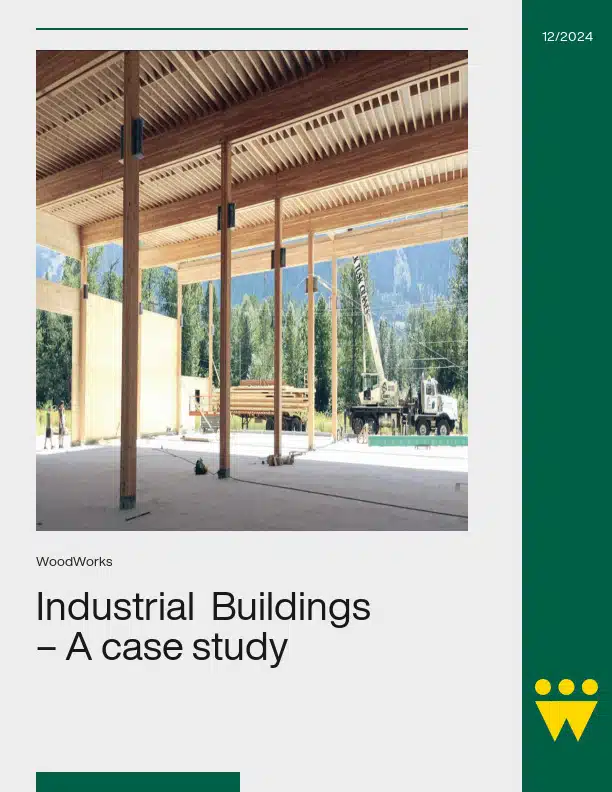
Industrial Buildings – A case study
Over the past two decades, new engineered mass timber products and construction techniques have changed the way we think about wood as a building material. Historic perceptions about strength, durability...
Brock Commons Tallwood House – University of British Columbia Vancouver Campus
...Tallwood House currently stands as the tallest contemporary hybrid mass timber building in the world. Over the years, with an ever-increasing demand for student housing, UBC developed a preferred typology...
Mid-Rise 2.0 – Innovative Approaches to Mid-Rise Wood Frame Construction
...to be built in noncombustible construction. This requirement will change when British Columbia adopts the 2015 National Building Code of Canada (NBC), which will allow light wood frame assemblies, mass...
Terminus
...from the operation of the buildings themselves. In addition, the City of Langford has taken a progressive position on reducing the embodied carbon of buildings, encouraging the use of mass...
R-Town Vertical 6 | Mass Timber Midrise
The R-Town V6 pilot project is the first 6-storey, mixed-use, multi-unit residential building developed in Ontario that fully employs mass timber as the main structural system. The energy-efficient wood building...
The following report contains the Transmission Loss (TL) results measured in accordance with ASTM E90-09 of 8 cross-laminated timber (CLT) wall assemblies and the TL results...
Wood is the most significant building material we use today that is grown by the sun. When harvested responsibly, wood is arguably one of the best tools architects and...
1
2
3

Get Access to Our Resources

Stay in the loop and don’t miss a thing!

What’s Your Occupation?

Help us personalize the content for you.

What Interests You the Most?

Help us personalize the content for you.

Filters

Expertise Icon
Field of Expertise
Province Icon
Province
Member Type Icon
WoodWork National Partners

Filters

Post Type Icon
Post Type
Persona Icon
Persona
Language Icon
Language
Tags Icon
Tags
Mass Timber Plus Icon Environment Plus Icon Safety Plus Icon Durability Plus Icon Design Systems Plus Icon Budget Plus Icon Construction Management Plus Icon Fire Resistance Plus Icon Tall Buildings Plus Icon Short Buildings Plus Icon
Date Icon
Date
Line Separator