en-ca

Searching for: Mass Timber

Searching results for “Mass Timber”
123 results found...
Sort By Dropdown Icon

Standard Connections, Issue 1: Gravity – Solutions Paper

Connection design variability is often considered to be a significant cost driver for mass timber projects, yet designers often lack clear guidance on what standard solutions could look like. The purpose of this document is to provide the construction industry with standardized detailing practices that cover a wide range of connections commonly found in mass timber buildings in Canada. These details can be adapted across multiple projects with various design teams and suppliers. The focus is on providing high-capacity, simple installation, and overall cost-effectiveness for timber connections.

Six details are presented based on typical beam, column, and wall connections. This document also outlines the design focus areas that were prioritized during detail development. Lastly, a checklist is provided for detailers to ensure that all priorities are considered. Companion 3D versions of these details can downloaded here.

2025 Catherine Lalonde Memorial Scholarships Recognize Students Advancing the Next Generation of Wood Solutions

Ottawa, ON, December 16, 2025 – The Canadian Wood Council (CWC) is pleased to announce three recipients of the 2025 Catherine Lalonde Memorial Scholarship: Houman Ganjali (University of Northern British Columbia), Kalkidan Tesfaye Shewandagn (McGill University), and Henri Monette (University of Toronto). These exceptional graduate students were selected for their academic excellence and their cutting-edge research advancing innovation in structural wood products and wood-based construction systems.

Established twenty years ago, the memorial scholarships honour the legacy of Catherine Lalonde, whose leadership as a professional engineer and president of the CWC helped shape the trajectory of wood design and construction in Canada. Each year, the awards recognize graduate students whose research reflects the same commitment to scientific excellence, industry impact, and passion for wood that Catherine championed throughout her career.

This year, the Canadian Wood Council received 51 submissions, a record for the program. The submissions reflected a high level of academic discipline and a strong orientation toward industry-relevant challenges, an indication of both the vitality of the research community and the growing importance of wood-based solutions in the built environment.

2025 Catherine Lalonde Memorial Scholarships Recognize Students Advancing the Next Generation of Wood Solutions

Houman Ganjali
Houman is a 5th year PhD candidate in Engineering at the University of Northern British Columbia. His research investigates the structural performance of point-supported cross-laminated timber (CLT) floors, focusing on the rolling-shear strength of CLT panels and the punching-shear capacity of point-supported systems. His work also examines improved connection strategies along the minor strength axis, reinforcement approaches for point supports, and the creep and vibration behaviour of point-supported floors. Houman’s research culminated in the development of a design proposal for the resistance of point-supported CLT floors, which will be presented to the CSA O86 Technical Committee for potential inclusion in future editions of the standard.


2025 Catherine Lalonde Memorial Scholarships Recognize Students Advancing the Next Generation of Wood Solutions

Kalkidan Tesfaye Shewandagn
Kalkidan is a 2nd year PhD student in Civil Engineering at McGill University. Her research focuses on the seismic design and performance assessment of wood-frame buildings constructed over podium structures. By integrating experimental testing, nonlinear modelling (OpenSeesPy), and performance-based assessment, her work quantifies the interaction between wood-frame systems and podiums. The resulting guidelines aim to support broader adoption of wood in multi-storey and hybrid buildings across Canada.


2025 Catherine Lalonde Memorial Scholarships Recognize Students Advancing the Next Generation of Wood Solutions

Henri Monette
Henri is a 4th year PhD candidate in Civil and Mineral Engineering at the University of Toronto. His research explores the development of a high-resistance connector for mass timber structures—an innovative system designed to optimize fibre use by mobilizing the full sectional resistance of connected timber members. By addressing the strength and resilience limitations of current connection technologies, Henri’s work supports mass timber’s ability to compete with and displace traditional materials such as steel and concrete.


“The large number of submissions we received this year signals the impressive depth of wood-focused research underway across Canada,” said Blériot Feujofack, Manager of Wood Education at the Canadian Wood Council. “This year’s scholarship recipients stand as strong examples of the academic excellence demonstrated throughout the applicant pool, distinguished by their clear methodological strength and practical relevance. Their findings hold meaningful value for practitioners, code developers, and industry partners, and will contribute to the continued advancement of wood construction in Canada.”

About the Canadian Wood Council

The Canadian Wood Council (CWC) is Canada’s unifying voice for the wood products industry. As a national federation of associations, its members represent hundreds of manufacturers across the country. CWC supports its members by accelerating market demand for wood products and championing responsible leadership through excellence in codes, standards, and regulations. CWC also delivers technical support and knowledge transfer for the construction sector through its market leading WoodWorks program.

Canadian Wood Council Advances Wood Innovation and Education

Toronto, ON – December 15, 2025 – The Canadian Wood Council (CWC) welcomes the announcement made today by the Honourable Tim Hodgson, Minister of Energy and Natural Resources, at the Toronto and Region Conservation Authority. The event celebrated funding for projects that strengthen Canada’s forestry sector and foster innovation in wood-based solutions.

CWC received $8.5 million since 2023 to expand the use of wood-based products, broaden education on wood construction and contribute to the advancement of the National Building Code.

The Canadian Wood Council deeply values the Government of Canada’s continued leadership in advancing innovative, low-carbon construction through the GCWood Program. This funding has allowed CWC and its WoodWorks program to support design and construction professionals with expert resources, tools, and guidance that help accelerate the adoption of wood construction nationwide. As we continue this work, we will help catalyze sustainable demand for construction solutions that are not only innovative but also replicable and rapidly deployed, approaches that will help address Canada’s housing and affordability challenges at scale.

CWC and WoodWorks provide:

  • project based technical assistance to architects, engineers, developers, and builders on wood design and construction;
  • education and training through specialized programs, conferences, webinars, and resources developed for post-secondary students, tradespeople, and construction professionals to support advanced wood construction technologies including mass timber and engineered wood products;
  • expert network development opportunities for industry professionals to connect and share best practices; and
  • sector engagement in national code development to facilitate greater understanding and adoption of advanced, performance-based wood construction.


“GCWood support enables us to provide critical technical advisory services, deliver wood-focused education and training to existing and future practitioners, and contribute to code developments that reflect the evolving strengths of modern wood products and systems. GCWood investments are important, strategic inputs that strengthen Canada’s forestry, manufacturing, and construction sectors. We look forward to building on our work to date as we engage with partners nationwide to accelerate the adoption of sustainable wood solutions and modern methods of construction.” – Rick Jeffrey, President and CEO, Canadian Wood Council.

The Canadian Wood Council looks forward to collaborating with partners and stakeholders as these projects move forward, supporting Canada’s leadership in sustainable construction and forestry.

Background

  • The Canadian Wood Council received $4,999,536 to increase the use of wood-based solutions, systems, and products in Canada by building proficiency in the use of wood as a construction material through direct technical support, training, awareness, and networking.
  • The Canadian Wood Council received $2,942,610 for a second project to increase the number of educational offerings and content related to wood construction education in order to increase the understanding and acceptance of wood as a building material by post-secondary students, trades and other construction industry professionals.
  • The Canadian Wood Council received $594,000 for a third project to enable the forest industry’s participation over the next three years for code change proposals allowing for the increased use of low-carbon building materials and mass timber in wood buildings for the 2025 and 2030 editions of the National Building Code and to accelerate the adoption of performance-based building codes.


About the Canadian Wood Council

The Canadian Wood Council (CWC) is Canada’s unifying voice for the wood products industry. As a national federation of associations, CWC members represent hundreds of manufacturers across the country. CWC’s mission is to support its members by accelerating market demand for wood products and championing responsible leadership through excellence in codes, standards, and regulations. CWC also delivers technical support and knowledge transfer for the construction sector through its market leading WoodWorks program.

About the National WoodWorks Program

The Canadian Wood Council’s WoodWorks Program a national outreach initiative dedicated to advancing the use of wood in construction by providing educational opportunities and direct technical support. The program helps architects, engineers, developers and other industry professionals expand their capacity for wood design and construction, contributing to a more sustainable built environment.

Exploring the Feasibility of Point-Supported Mass Timber for Tallwood Construction

Course Overview

This session examines the growing potential of point-supported mass timber systems in tall building construction, contrasting them with traditional timber framing and conventional steel and concrete approaches. It highlights regulator advancements, the role of mass timber in addressing mid-density housing needs, and the structural fundamentals of gravity and lateral systems. Through cost and schedule comparisons, design principles like bi-axial bending and punching shear, and insights from ongoing Canadian codification efforts, the presentation offers a comprehensive overview supported by real-world projects such as VAHA Burrard and BCIT Tall Timber. 

Learning Objectives

  1. Evaluate the opportunities and constraints for point-supported mass timber when compared to traditional timber framing schemes.
  2. Analyze the schedule and cost benefits of point-supported mass timber systems versus steel and concrete in tall construction projects.
  3. Explore state-of-the-art design methodologies and ongoing efforts towards codification in Canada.

Course Video

Speakers Bio

Carla Dickof, P.Eng., M.A.Sc.
Associate Principal | Director of Research & Development
Fast+Epp

Carla Dickof is the Associate Principal & Director of Research and Development at Fast + Epp, where she leads the Testing Team at Fast + Epp’s R&D hub, Concept Lab, and uses the data gleaned from research programs to regularly contribute to academic journals and conferences. Carla completed her Master’s degree studies at the University of British Columbia, where her thesis research focused on hybrid systems, specifically those combining steel and mass timber (CLT). Her experience as an engineer spans commercial, recreational, educational, and residential projects – and, since joining Fast + Epp in 2012, Carla has gained a robust fluency in all major building materials, including concrete, steel, light-framed wood, heavy timber, and mass timber. Her understanding of building physics and materials brings invaluable insights to her projects.

Alejandro Coronado, P.Eng.
Technical Advisor
WoodWorks BC

Alejandro Coronado is a Technical Advisor with a multidisciplinary background spanning contracting, supply, and consulting engineering. With both a Diploma and a Bachelor’s Degree in Structural Engineering from BCIT, Alejandro began his career in single-family residential design and steadily advanced to contribute to landmark projects such as the Centre Block Base Isolation at Parliament Hill, the UBC Museum of Anthropology Great Hall Renewal, the Royal BC Museum PARC Campus, and a mass timber campus in Silicon Valley. Initially drawn to mass timber for its expressive architectural potential, Alejandro quickly recognized its broader value in addressing today’s social and environmental challenges. Through many years of hands-on experience, Alejandro has become a champion for sustainable construction and simple yet effective structural solutions.

Understanding Glulam: The structural and architectural capabilities of mass timber

Course Overview

In this course, you’ll gain insight into the design and manufacturing considerations involved in using glulam in buildings. As one of the oldest mass timber products used in Canada, glulam offers exceptional flexibility and can be incorporated into a wide range of building types—particularly where curvature and expressive geometry are key. Presenters will outline design and manufacturing strategies for creating efficient structures, showing how glulam can be used not just as columns and beams, but as the primary structure in today’s innovative buildings—whether architecturally driven or focused on value and efficiency. They will also cover the availability of glulam products across Canada and explain how to maximize the value of the timber used. Practical tips will be shared to help designers and specifiers take full advantage of glulam’s attributes in a cost-efficient way.

Learning Objectives

  1. Participants will learn the design strategies employed when using curvature and geometry in buildings and gain an understanding of what is possible with expressive architecture.
  2. Participants will understand the practical constraints of glulam manufacturing, including how to approach the design and specification of glulam members.
  3. Participants will learn how different wood species and strength grades are applied in glulam design, and how to use them efficiently for optimal performance.
  4. Participants will understand how geometry, fire ratings, and member layups influence the cost-efficiency and design potential of glulam systems.

Course Video

Speakers Bio

Andre Lema
Manager of Business Development
Western Archrib

Andre Lema, a seasoned professional in the wood industry, brings decades of experience and expertise. Starting as a carpenter and advancing through a degree in Construction Engineering at NAIT, Andre has been instrumental in driving the success of Western Archrib. His passion for wood and dedication to fostering client relationships have made him a key figure in the industry.

Alejandro Coronado, P.Eng.
Technical Advisor
WoodWorks BC

Alejandro Coronado is a Technical Advisor with a multidisciplinary background spanning contracting, supply, and consulting engineering. With both a Diploma and a Bachelor’s Degree in Structural Engineering from BCIT, Alejandro began his career in single-family residential design and steadily advanced to contribute to landmark projects such as the Centre Block Base Isolation at Parliament Hill, the UBC Museum of Anthropology Great Hall Renewal, the Royal BC Museum PARC Campus, and a mass timber campus in Silicon Valley. Initially drawn to mass timber for its expressive architectural potential, Alejandro quickly recognized its broader value in addressing today’s social and environmental challenges. Through many years of hands-on experience, Alejandro has become a champion for sustainable construction and simple yet effective structural solutions.

Canadian Wood Council Joins Ontario’s Advanced Wood Construction Working Group

Toronto, ON – December 3, 2025 The Canadian Wood Council (CWC) welcomes the Ontario government’s launch of the Advanced Wood Construction Working Group, a strategic team that will guide the implementation of Ontario’s Advanced Wood Construction Action Plan. 

The Working Group brings together leaders from across the manufacturing and construction sectors to identify practical ways to expand the use of Ontario-made wood products in homes, businesses, and communities across the province. 

“Ontario continues to show leadership in advancing innovative, low-carbon building solutions,” said Rick Jeffery, President and CEO of the Canadian Wood Council. “CWC looks forward to contributing technical expertise and national insight to help deliver on the Action Plan’s goals and grow advanced wood construction in Ontario.” 

As part of the Working Group, CWC will collaborate with government and industry partners to accelerate adoption of mass timber and prefabricated wood systems, support code modernization and training, and promote greater use of Ontario’s sustainable wood products in construction.  

“Building with wood offers a highly efficient solution for addressing Ontario’s housing needs while supporting the growth of local value-added manufacturing. More industrialized wood construction means more opportunities for skilled workers and their communities. I am proud to support Ontario’s leading role in the evolving construction sector, contributing to a more resilient, efficient, and forward-looking building environment.” Steven Street, Executive Director, WoodWorks Ontario, Canadian Wood Council. 

This initiative marks an important step forward in implementing Ontario’s Action Plan and driving investment, innovation, and housing solutions through advanced wood construction. 

About the Canadian Wood Council 

The Canadian Wood Council (CWC) is Canada’s unifying voice for the wood products industry. As a national federation of associations, our members represent hundreds of manufacturers across the country. Our mission is to support our members by accelerating market demand for wood products and championing responsible leadership through excellence in codes, standards, and regulations. We also deliver technical support and knowledge transfer for the construction sector through our market leading WoodWorks program. 

Quiet by Design

Course Overview

Join us for Quiet by Design, an in-depth course exploring how to achieve consistent, high-performing acoustics in mass timber projects. In partnership with AcoustiTECH, a panel of leading acoustic experts will unpack the complexities of flanking (Kij), share best-practice detailing strategies—including bulkheads and wall interfaces—to help you avoid costly construction errors, and present the latest research on lightweight floor and ceiling assemblies for mass timber systems, including GLT. 

Expect practical design strategies, real-world insights, and clear, actionable guidance to help you choose the right acoustic solutions for your next project. 

Learning Objectives

  1. Understanding and Addressing Flanking (Kij): Gain a clear understanding of how sound transmits through indirect paths and learn proven methods to identify, measure, and control flanking effectively.
  2. Best Practices in Acoustic Design: Discover key detailing approaches—such as optimized bulkhead integration and wall interfaces—that enhance acoustic performance, improve Kij values, and minimize costly construction errors.
  3. Lightweight Assemblies for Mass Timber Structures: Explore innovative, lightweight floor and ceiling assemblies purpose-designed for mass timber systems, including the latest findings and design guidance for GLT applications.

Course Video

Speakers Bio

Cristian Wallace
AcoustiTECH

Cristian Wallace has extensive experience in collaborating with architects, builders, acoustic consultants, and other stakeholders. He focuses on delivering tailored acoustical solutions to meet the specific needs of each project. With a hands-on approach, Cristian evaluates every detail to provide efficient, personalized solutions that help clients achieve their vision. His expertise, combined with AcoustiTECH’s proven methods, ensures reliable and effective outcomes in every collaboration.

Ben White
Senior Acoustical Engineer
Aercoustics Engineering Ltd.

David Dompierre
Senior Noise Consultant
SIBE Acoustics

Simon Edwards
Senior Acoustical Engineer
HGC Noise Vibration Acoustics

Wood Design & Building Magazine, vol 24, issue 99

As the design and construction industry collectively strives towards a more sustainable built environment, one of the more interesting challenges in architecture today is how to work with what already exists. When existing structures are adapted and repurposed rather than demolished once they outlive their original use, resources are conserved, greenhouse gas emissions are lowered, heritage is preserved, and decarbonization goals are advanced.

Whether it’s adapting a historic structure to a new use or extending the life of a contemporary one with a creative renovation or addition, designers are exploring the possibilities and finding ways to integrate wood into projects that build on the foundations of the past, figuratively and literally, to meet the needs of the present.

In this issue, two feature stories explore different approaches to giving existing buildings new, expanded purpose. One project breathes new life into a traditional fieldstone barn through adaptive reuse, while another demonstrates how a lightweight mass timber vertical addition can expand an existing apartment building, adding new units to help meet growing housing needs. Both illustrate how wood enables design solutions that are respectful, efficient, and forward-looking.

Projects like these remind us that innovation is a form of evolution, and sometimes, the most sustainable, creative, and community-minded choice is to work with what you’ve already got.

Mass Timber Industrial Buildings and Warehouses

Course Overview

The emerging use of mass timber in industrial buildings presents promising opportunities that are shaping the future of construction in this sector. As a sustainable and economically competitive alternative, mass timber is redefining what is possible in industrial construction, a field traditionally dominated by prefabricated steel. An analysis of two cutting-edge projects in Sudbury, Ontario, highlights key advantages, including cost competitiveness, reduced embodied carbon, and superior aesthetic appeal. The insights from these two projects present stakeholders with helpful considerations and valuable strategies for integrating mass timber into future developments.

Learning Objectives

  1. Participants will learn how to create flexible, multi-tenant industrial layouts using mass timber systems that are able to accommodate evolving tenant needs.
  2. Participants will gain insight into how early-stage collaboration with mass timber suppliers streamlines design, engineering, and construction processes.
  3. Participants will gain insight into the role of mass timber in biophilic design, and how its visual warmth and natural materials contribute to wellness-centred spaces that appeal to tenants.
  4. Participants will understand how mass timber can be a cost-competitive alternative to steel, especially in volatile markets, and assess its impact on embodied carbon and sustainability goals.

Course Video

Speakers Bio

Darian Sweeney, B.Sc., B.B.A
Chief Operating Officer
Bloomington Developments

Born and raised in Greater Sudbury, Darian holds dual bachelor’s degrees from Laurentian University – in Biochemistry and Business Administration with a specialization in finance. In December of 2021, he joined Bloomington Developments, a real estate investor and developer in Greater Sudbury with a focus on commercial and industrial assets. While he has had the chance to apply his skills in capital budgeting, asset valuation, financial forecasting, and cost tracking in his time with Bloomington, his first major role with the company was unrelated to his educational background: overseeing the two concurrent mass timber building projects that are the subject of this seminar. Darian now manages all construction projects – whether new builds or renovations – and negotiates all leases across the company’s portfolio, in addition to his roles as primary liaison on legal, administrative, tenant relations, marketing, and business development matters.

Patrick Danielson, OAA + AIBC, MRAIC
Founder and Principal
Danielson Architecture Office Inc.

Patrick holds a degree in Biomedical Science and a graduate degree from the School of Architecture + Landscape Architecture at the University of British Columbia. Combining these disciplines, he developed a unique “genetic design” approach — an evolving architectural strategy informed by biological principles. Patrick has expanded this framework through academic research, patented innovations, private sector projects, biological studies, and his experience as a pilot.

Emerging Solutions for Mass Timber in Healthcare 

Resource Description

Healthcare buildings are among the most complex and resource-intensive structures we design and, increasingly, they are being asked to do more. Modern hospitals not only need to support healing for patients and staff, but also to contribute to planetary health by reducing carbon emissions and addressing social and environmental determinants of wellbeing. To meet these goals, hospital design must evolve beyond the “squeezed and standardized” approach that has long defined it. 

Mass timber is emerging as a credible alternative to conventional systems for larger-scale, high-rise institutional buildings. Recent advancements in material science, manufacturing, engineering, and fire safety have made it possible to consider timber as a structural solution for complex facilities — including hospitals. 

Recognizing that innovation in healthcare design must be evidence-based, this collaborative study explores the feasibility of using mass timber for a 200+ bed acute care hospital. The multidisciplinary team — including KPMB Architects, PHSA (Provincial Health Services Authority of BC), Fast + Epp, Smith + Andersen, Resource Planning Group, CHM Fire, Hanscomb, AMB Planning, and EllisDon — developed and evaluated a detailed test design for a mass timber inpatient tower suited to the Canadian context. The study examined structure, cost, schedule, lifecycle carbon, code compliance, infection control, and biophilic design as part of a holistic approach to sustainable healthcare infrastructure. 

Learning Objectives

  1. Identify the key drivers that influence structural system selection in healthcare building design.
  2. Describe the opportunities, limitations, and specific considerations associated with using mass timber in hospital environments.
  3. Summarize findings from an in-progress feasibility study for a mass timber inpatient tower in a Canadian acute care setting.
  4. Evaluate the comparative schedule, cost, and lifecycle carbon outcomes identified in the study, and discuss implications for future healthcare projects.

Course Video

Speakers Bio

Chris McQuillan, OAA, AIBC, FRAIC LEED AP
Principal
KPMB Architects

Chris McQuillan, a registered architect and a distinguished Fellow of the RAIC, brings three decades of experience in planning, design and construction for healthcare and biomedical research. He has completed work across Canada, southeast Asia and in the Caribbean. In the healthcare sphere, his experience includes acute, rehabilitation and mental health treatment. Recently, Chris has designed major additions to Burnaby Hospital and Michael Garron Hospital in Toronto, a major expansion of the Halifax Infirmary, a new regional hospital in Corner Brook Newfoundland, a provincial specialty hospital for addictions and mental health in St John’s and strategic planning for the phased renovation of Royal Columbian Hospital here in Vancouver.

A resident of Toronto, but active across Canada and beyond, Chris joined KPMB Architects in 2024 to propel the growth of the firm’s work in the healthcare sector. Chris’ focus in the design of healthcare facilities is to create healing architecture – for people, for our cities and for the planet. Mass timber must come to be viewed as an indispensable tool to help us achieve that goal.

Juan J. Cruz Martinez, M.Arch, M.Des, EDAC, LEED GA
Senior Director, Major Capital Projects
Provincial Health Services Authority


Lisa Miller-Way, C.E.T., LET
Director
CHM Fire

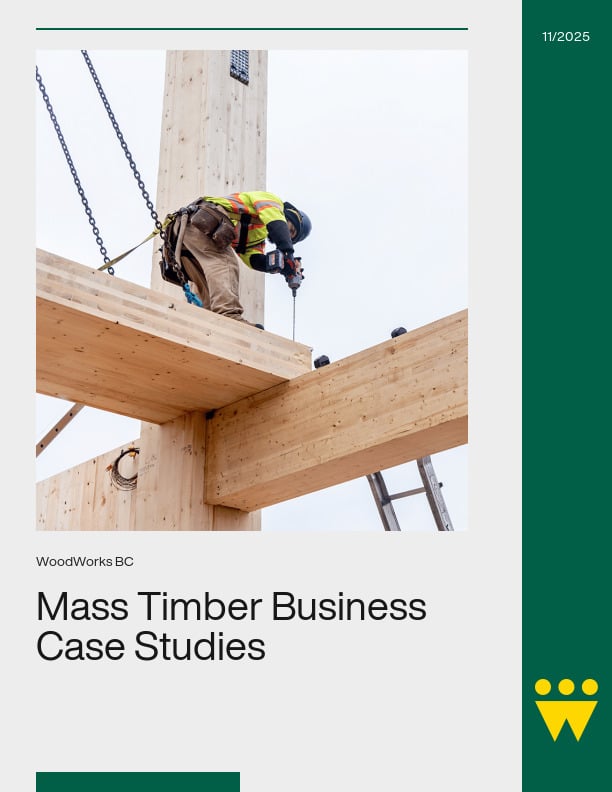
Mass Timber Business Case Studies

This document presents a series of business case studies that explore the financial performance of mass timber projects, providing quantitative data and qualitative insights to help developers and investors assess its economic viability.

Each case study measures investment success, challenges, and lessons learned from the developer’s and project team’s perspectives. Moreover, by analyzing strategy, risk, revenue, cost and schedule, these case studies enable direct comparisons between mass timber and traditional construction methods.

WoodWorks is seeking developers and owners with completed mass timber projects to share data for analysis, supporting education and training in the mass timber sector. The goal is to continuously expand case studies across various sectors and markets. To participate or learn more, please contact a WoodWorks staff member.

Webinar: Emerging Solutions for Mass Timber in Healthcare

Three women wearing safety vests and hard hats at a construction site, symbolizing collaboration and innovation in the wood industry.
2025 Catherine Lalonde Memorial Scholarships Recognize Students Advancing the Next Generation of Wood Solutions
Canadian Wood Council Advances Wood Innovation and Education
Exploring the Feasibility of Point-Supported Mass Timber for Tallwood Construction
Understanding Glulam: The structural and architectural capabilities of mass timber
Quiet by Design
Wood Design & Building Magazine, vol 24, issue 99
Mass Timber Industrial Buildings and Warehouses
Emerging Solutions for Mass Timber in Healthcare 
Mass Timber Business Case Studies
Webinar: Emerging Solutions for Mass Timber in Healthcare
Canadian Nuclear Laboratories: Case Study and Environmental Impact Analysis This report showcases how Canadian Nuclear Laboratories (CNL) delivered three landmark mass timber...
Across Canada, the low-rise non-residential sector—think offices, retail stores, warehouses, and restaurants—presents a major growth opportunity for structural wood...

Get Access to Our Resources

Stay in the loop and don’t miss a thing!

1
2
3

Get Access to Our Resources

Stay in the loop and don’t miss a thing!

What’s Your Occupation?

Help us personalize the content for you.

What Interests You the Most?

Help us personalize the content for you.

Filters

Expertise Icon
Field of Expertise
Province Icon
Province
Member Type Icon
WoodWork National Partners

Filters

Post Type Icon
Post Type
Persona Icon
Persona
Language Icon
Language
Tags Icon
Tags
Mass Timber Plus Icon Environment Plus Icon Safety Plus Icon Durability Plus Icon Design Systems Plus Icon Budget Plus Icon Construction Management Plus Icon Fire Resistance Plus Icon Tall Buildings Plus Icon Short Buildings Plus Icon
Date Icon
Date
Line Separator