en-ca

Searching for: Sustainability

Searching results for “Sustainability”
57 results found...
Sort By Dropdown Icon

International Perspectives on Sustainable Housing Development

Course Overview

Around the world there is a significant and growing housing shortage that is exacerbated by rapid urbanization and population growth. This challenge demands innovative solutions that prioritize sustainability, occupant comfort, and efficient land use. This panel discussion brings together three internationally renowned architects: Francine Houben (Mecanoo, the Netherlands), Christophe Ouhayoun (KOZ Architects, France), and Geoff Denton (White Arkitekter, Sweden) to explore their approaches to sustainable housing. Each panelist will share their unique perspective on how to address housing shortages and sustainable densification, offering insights into the latest design strategies, materials, and technologies that can contribute to more resilient and equitable urban environments. Join us for a dynamic conversation that will delve into the future of housing and the role of architecture in creating livable, sustainable cities. 

Learning Objectives

  1. Understand how international architects approach sustainable housing development, including wood‑based construction, urban densification, and low‑carbon strategies.
  2. Compare differing regulatory, cultural, and construction‑industry conditions that influence mass timber, modularity, prefabrication, and approval processes in Sweden, France, and Canada.
  3. Identify urban‑design principles used to create healthy, community‑oriented neighborhoods.

Course Video

Speakers Bio

Francine Houben
Founding Partner, Creative Director
Mecanoo, the Netherlands

Francine Houben is founding partner of Mecanoo (1984) and has led the firm to success in The Netherlands and abroad, amassing a portfolio of work that is wide-ranging, inspired by global challenges and with a sustainable view on society. Mecanoo combines the disciplines of architecture, urban planning, landscape architecture and interior design to produce unorthodox design solutions born from a strong sensitivity to context and a highly interdisciplinary design process. Each of her projects illustrates the four fundamental elements of her architectural vision: People, Place, Purpose, Poetry. Francine Houben was professor of mobility aesthetics at Delft University of Technology and taught at the universities of Harvard, Yale and Mendrisio. As curator of the First International Architecture Biennale Rotterdam (2003), she brought the theme of the aesthetics of mobility to the forefront of international design consciousness. Francine holds Honorary Fellowships of the Royal Institute of British Architects (RIBA), the American Institute of Architects (AIA), the Royal Architectural Institute of Canada (RAIC) and was granted lifelong membership to the Akademie der Künste in Berlin as well as receiving the International Honorary Fellow Award by the Architecture Institute of Taiwan. In 2014 Francine was named Woman Architect of the Year by the Architects’ Journal and in November 2015 Queen Máxima of The Netherlands presented her with the Prins Bernhard Cultuurfonds Prize for her wide-ranging career. Francine was awarded Honorary Doctorates from the Université de Mons, Belgium (2017) and the Utrecht University (2016). In 2018 she received the BNA Kubus Award for her oeuvre; the International Prize, Prix des Femmes Architectes (2019) and distinguished with the TU Delft Alumnus of the Year (2020). In 2024, King Willem-Alexander appointed Francine Houben as a Knight in the Order of the Netherlands Lion.

Christophe Ouhayoun
Founding Partner Architect
KOZ Architects, France

Christophe Ouhayoun is a graduate of the École Nationale Supérieure d’Architecture de Paris-Belleville. He currently serves as a State Architect Advisor in the Aveyron department. In 1999, he co-founded KOZ Architectes with Nicolas Ziesel. A pioneer in wood architecture since 2001, he recently delivered Lot E of the Paris 2024 Athletes’ Village as co-coordinator within the Nexity-Eiffage team. In addition to his architectural work, he co-founded: KOZTO, a workshop dedicated to the creation of up-cycled furniture. PLAN01, a collaborative “”second office”” active from 2003 to 2014, in partnership with Atelier du Pont, BP Architectures, and Philéas. PLAN02, an integrated environmental consulting firm. Alongside his private practice, Christophe Ouhayoun works as a visiting professor at the École Nationale Supérieure d’Arts et Métiers and at the École spéciale d’architecture de Paris.

Geoff Denton
Partner Architect
White Arkitekter, Sweden

Geoff Denton is an architect and urban designer who has led residential, educational and mixed-use urban design and architectural projects across the UK, Europe and North America. Educated at Sheffield University in the UK, his career in Sweden notably led him to the role of lead architect for the implementation of Greenwich Millennium Village for Ralph Erskine Architect. This project marked the beginning of his focus on socially and environmentally sustainable urban development and regeneration. He joined White Arkitekter in 2011 and is now a partner and member of the board of directors. During his time at White he has led award winning urban design projects and was responsible for starting White Arkitekter’s London Studio. The studio has been built on the goal to share knowledge and experience of sustainable development and offsite fabrication methods used throughout the Nordics. Key projects developed during the first years of the London studio include the Climate Innovation District in Leeds and the Gascoigne estate regeneration in London. Geoff is now based in Stockholm where he works with diverse complex international projects. His approach to architecture is collaborative and he strongly believes that good design solutions are very much about creating places where people feel secure and invigorated.

Design and Construction of Permanent Wood Foundations – The Buildings Show 2025

Course Overview

This session will provide requirements and guidance on the design and construction of permanent wood foundations (PWF) based on the Canadian standard; CSA S406-16 – ‘Specification of permanent wood foundations for housing and small buildings’. Further information on site selection, backfilling, PWF floor systems, air and vapour barriers, insulation techniques, crawl spaces and design requirements for high wind and seismic zones will be discussed. This session will provide attendees with an overview of the design requirements and construction methods for PWF, with a focus on the structural system and building science considerations. 

Learning Objectives

  1. Apply the design requirements of CSA S406-16 for permanent wood foundations in housing and small buildings.
  2. Identify key building-science considerations for PWF systems, including drainage, air and vapour control, insulation, and crawl space design.
  3. Evaluate site and structural requirements for permanent wood foundations in high wind and seismic regions.

Course Video

Speakers Bio

Adam Robertson
Co-founder and Principal
Sustainatree

Adam completed his Bachelor of Applied Science in Civil Engineering at the University of Toronto and also holds a Master of Applied Science degree from the Department of Wood Science at the University of British Columbia. He is the past Chair of the CSA Subcommittee on Permanent Wood Foundations and acted as a primary author and editor during the update and revisions to the Canadian Wood Council’s Permanent Wood Foundations publication. He is the co-founder and principal of Sustainatree Consulting, a small firm specializing in sustainability and engineering design of wood building systems. Prior to opening his own practice, Adam was previously employed by the Canadian Wood Council and has also worked as a consulting structural engineer and within the building development and construction management fields.

Offsite Construction Handbook

Course Overview

Offsite construction is transforming the building industry by shifting key processes from traditional sites to controlled factory environments. This approach enhances productivity, quality, and sustainability, addressing challenges like labor shortages and environmental impact. The delivery process emphasizes early collaboration, integrated design, and robust project management to optimize efficiency and risk management. Durability and energy efficiency are achieved through advanced material selection, moisture management, and airtight, highly insulated assemblies. Construction logistics, quality control, and commissioning are tailored for offsite methods, ensuring rapid, reliable project delivery. Life cycle analysis shows offsite construction can reduce embodied carbon and waste, supporting climate goals. Canada’s evolving policies and market trends position offsite construction as a key solution for affordable, sustainable housing. 

Learning Objectives

  1. Understand how offsite construction improves the durability, moisture control, and energy performance of wood building systems.
  2. Identify the structural and sustainability benefits of early design integration in offsite wood construction projects.
  3. Evaluate the role of life-cycle analysis and embodied carbon in positioning offsite wood construction as a solution for sustainable and affordable housing in Canada.

Course Video

Speakers Bio

Dorian Tung
Manager, Technology Assessment
FPInnovations

Dorian Tung is currently the Manager of Technology Assessment at FPInnovations. Prior to this, he worked as a structural consultant in Canada and the US. As a manager, he has been working with scientists on projects related to structure, seismic, durability, energy, fire, acoustic, and vibration. With the evolving ecosystem, Dorian is active in many working groups to facilitate discussions, remove duplicates, accelerate processes, with the goal to maximize impacts for the forest industry NOW using research data. He is also the editor of the Offsite Wood Construction Handbook published by FPInnovations.

Helen Goodland
Principal. Head of Research and Innovation
SCIUS Advisory

Helen Goodland is an architect registered in the UK and has an MBA from the University of BC. Helen is firmly committed to achieving truly sustainable buildings within the next decade. She is also passionate about advancing leadership opportunities for women in construction technology. To this end, she participates on numerous boards and committees. Currently she serves on the Board of Directors of Building Transformations (formerly CanBIM), the BC Digital Advisory Council, the BCIT Mass Timber Education Advisory Board and the University of Victoria’s Green Civil Engineering Advisory Council. She is also past chair of the UN Sustainable Buildings Initiative’s Materials Technical Committee.

Adam Robertson
Co-founder and Principal
Sustainatree

Adam completed his Bachelor of Applied Science in Civil Engineering at the University of Toronto and also holds a Master of Applied Science degree from the Department of Wood Science at the University of British Columbia. He is the past Chair of the CSA Subcommittee on Permanent Wood Foundations and acted as a primary author and editor during the update and revisions to the Canadian Wood Council’s Permanent Wood Foundations publication. He is the co-founder and principal of Sustainatree Consulting, a small firm specializing in sustainability and engineering design of wood building systems. Prior to opening his own practice, Adam was previously employed by the Canadian Wood Council and has also worked as a consulting structural engineer and within the building development and construction management fields.

Construction Moisture Management of Mass Timber Buildings

Course Overview

Mass timber buildings are transforming the way we build—but with new materials come new challenges. This session will explore how moisture risks in mass timber construction and how to take a proactive approach to moisture management. Participants will gain practical insights into effective protection strategies during the construction phase and learn how to develop a tailored moisture management plan to safeguard both the mass timber structure and project timelines. 

Learning Objectives

  1. Identify key moisture risks specific to mass timber construction and understand how they differ from traditional structural systems.
  2. Apply practical construction-phase moisture protection strategies that align with project sequencing, site conditions, and contractor workflows.
  3. Develop or evaluate a project-specific moisture management plan to protect mass timber elements, reduce delays, and ensure long-term durability.

Course Video

Speakers Bio

David Stanton
Associate, Senior Engineer – Building Enclosure
RDH Building Science Inc.

David is an Associate and Senior Building Science Engineer in RDH Building Science’s Toronto office. David’s exposure to mass timber projects started with the Brock Commons project in BC as a coop student and then with the Catalyst building in Spokane, WA—a 4-storey mass timber building for Eastern Washington University—when he started working full-time in the Building Science field. Since moving back to Toronto, David has continued to work on large scale mass timber projects, including the Lawson Center for Sustainability and the Academic Wood Tower projects at UofT.

Sean Carroll
Senior Superintendent
Graham Construction

Sean Carroll is a Senior Superintendent with Graham Construction, bringing over 32 years of experience across Canada, Europe, and the UK. A civil engineer and journeyman carpenter, Sean has led complex projects in the commercial, residential, pharmaceutical, and educational sectors—including several involving advanced Mass Timber construction. Over his 11 years with Graham, split between Alberta and Ontario, Sean has been at the forefront of integrating sustainable building methods, particularly in the use of engineered timber systems. He brings a deep understanding of Mass Timber coordination, sequencing, and tolerances, along with a strong commitment to safety, quality, and team leadership. Known for his hands-on approach and global perspective, Sean combines technical precision with a collaborative leadership style—driving successful project outcomes from concept through completion.

Natasha Jeremic
Manager, Codes and Standards – Sustainability
Canadian Wood Council

Natasha Jeremic is a Professional Engineer in the building industry, with a background in design, building performance, and project management. She is currently the Sustainability Manager for Codes and Standards at the Canadian Wood Council, where she leads strategic initiatives focused on low-carbon construction, energy efficiency, durability, and circularity. Natasha leverages her expertise in structural design, building envelope consulting, and whole life carbon accounting to showcase how wood products contribute to a sustainable, low-carbon built environment. She is passionate about raising awareness of wood’s role as a viable solution in advancing climate-conscious construction.

Halsa 230 Royal York: Ontario’s Tallest Mass Timber Residential Building

Course Overview

Halsa 230 Royal York is setting new standards as Toronto’s pioneering 9-storey prefabricated mass timber rental building, demonstrating the viability of carbon-neutral communities within Toronto’s Right of Way zoning. Through a case study of the building, this session will present the advantages of integrated design and prefabricated mass timber building systems components.

Learning Objectives

  1. Explain the integrated design and prefabrication strategies used in mass timber residential construction: Learners will be able to describe how collaborative design, advanced manufacturing, and prefabricated building systems contribute to project efficiency, quality, and scalability.
  2. Analyze the technical features and performance benefits of mass timber floor cassettes and curtain wall systems: Learners will understand the structural, acoustic, fire resistance, and thermal properties of the building’s mass timber components, and how these features address common challenges in high-rise construction.
  3. Evaluate the sustainability, regulatory, and operational considerations in developing carbon-neutral mass timber buildings: Learners will assess how material sourcing, certification, lifecycle carbon analysis, and code compliance shape the viability and impact of mass timber projects in urban environments.

Course Video

Speakers Bio

Oliver Lang
Co-Founder, Chief Product Officer, Intelligent City
Co-Founder, Principal, LWPAC

Oliver Lang is a German-Canadian architect and urban entrepreneur with 25+ years of experience and a recognized leader in design innovation and integration of complex urban projects, mixed-use housing, advanced prefabrication, and green building strategies. He is a graduate of Columbia University’s Graduate School of Architecture Planning and Preservation, with a Master of Science in Advanced Architectural Design, and he holds a professional degree (Diplom-Ingenieur Architektur) from the University of Technology Berlin with two-year studies at the ETSA Barcelona UPC. Prior to founding LWPAC in 1998, Oliver researched and practiced in digitally assisted design and fabrication with Smith-Miller & Hawkinson in New York, while teaching digital design at Princeton University, Columbia University, and University of Pennsylvania. He subsequently has taught advanced design and digital technology at SCI_ARC, the Berlage Institute, TU Berlin, UTF Santa Maria, and University of British Columbia (UBC).

Shawn Keyes
VP – Strategic Growth and Business Development
Intelligent City

Shawn is a structural engineer and commercial executive with more than a decade of experience leading innovation in mass timber and industrialized construction. As Vice President of Strategic Growth at Intelligent City, he leads commercialization, market strategy, and partnerships to scale the company’s prefabricated housing systems. Previously, Shawn served as Executive Director of WoodWorks BC, where he led a strategic transformation that strengthened partnerships, technical leadership, and influence across the development, AEC, and policy sectors. Before that, he spent over six years at Fast + Epp as a Senior Structural Engineer, developing deep technical expertise. Over his career, Shawn has supported more than 150 mass timber and hybrid projects across Canada, and has served on advisory councils for BC Housing, BCIT, the BC Office of Mass Timber Implementation, Forestry Innovation Investment, and Natural Resources Canada. He holds an MBA from UBC Sauder, a Master of Engineering from Carleton University, and is a licensed Professional Engineer in BC and Ontario.

The Future of Tall: The Future of Cities

Course Overview

Over the past two decades, tall buildings have enjoyed a major uptake in almost all major cities globally. But is the push for greater urban density and taller buildings creating habitats and patterns of life that are truly sustainability, in terms of social, cultural and economic sustainability, as well as the carbon equation? Through examples from around the world, this session outlines areas where the typology, and cities, need to develop.

Learning Objectives

  1. Understand the sustainability challenges and opportunities in tall building design: Explore how social, cultural, economic, and environmental factors influence the development of high-rise structures and urban density.
  2. Identify innovative strategies for integrating mass timber and other sustainable materials in tall buildings: Learn how material choices impact carbon reduction, energy efficiency, and structural performance in high-rise construction.
  3. Analyze global case studies to evaluate future trends in urban development and tall building typologies: Gain insights into design approaches that promote livable, resilient, and sustainable cities.

Course Video

Speakers Bio

Dr. Antony Wood
CEO
Antony Wood Consulting

Dr. Antony Wood is the former President of the Council on Tall Buildings and Urban Habitat (CTBUH), responsible for leading the Council’s thought leadership, research, and academic initiatives. Prior to this, he was CTBUH chief executive officer (CEO) from 2006-2022. During his sixteen-year tenure as CEO, CTBUH significantly increased its outputs and initiatives across all areas globally. Wood’s PhD dissertation explored the multi-disciplinary aspects of skybridge connections between tall buildings. He is associate editor of the CTBUH Journal and serves on the editorial board of several other journals. He is the author of numerous books and papers in the fields of tall buildings, sustainability, and related fields. Wood has been conference chair and chair of the scientific committee at all CTBUH conferences since 2006. He has also presented at numerous conferences, and lectures regularly around the world.

Wood Design & Building Magazine, vol 24, issue 100

Reaching one hundred issues is a milestone worthy of both celebration and reflection. Wood Design & Building, once upon a time called Wood le Bois, began as a modest trade magazine dedicated to showcasing excellence in wood architecture. Over the years we added special features and technical content that helped us grow a loyal readership and community of wood design advocates.

Recently, our cherished print magazine evolved into a digital, multi-media publication. While this transformation involved a small sense of loss for the printed ways of our past, we remain excited by the expanded potential the new format affords, with a reach far wider than we ever imagined at the outset of this journey. So, while the format may have changed, and content options expanded, our purpose has remained remarkably steady. Issue after issue, we have tried to capture not just great buildings, but the innovations, insights, and architectural aspirations that continue to expand wood’s role in contemporary design and construction.

As we look back, there is a sense of gratitude for all that has unfolded across these pages. Past editions captured early explorations in modern timber construction, the resurgence of adaptive reuse, and the steady shift toward high-performance, low-carbon buildings. Today, advances in mass timber systems, hybrid approaches, and industrialized processes are reshaping how buildings come together. Throughout this evolution, wood has been at the center of conversations about sustainability, long-term value, and design expression. The body of work published over the years reflects not only changing technologies but the steady influence of a material with deep cultural and environmental roots.

It is fitting that our 100th issue is also our special awards edition, honouring the winners of the 2025 Wood Design & Building Awards. These celebrated projects are the latest chapter in the architectural story we have been privileged to document for decades. What distinguishes them is not only their accomplishment today, but what they suggest about tomorrow: a more sustainable built environment defined by technical excellence, architectural warmth, and memorable experiences that transcend program or scale.

To everyone who has contributed, read, shared, and championed this publication—thank you. Reaching 100 issues is deeply meaningful, not because of the number alone, but because it represents a sustained conversation within a community that cares about design, innovation, and the future of building. We remain committed to documenting that evolution, and we look forward to continuing the conversation with you, discovering new stories, and celebrating the work yet to come.

Design and Construction of Permanent Wood Foundations

Course Overview

This course will provide guidance on the design and construction of permanent wood foundations (PWF) based on the Canadian standard CSA S406-16 – Specification of Permanent Wood Foundations for Housing and Small Buildings. Topics will include site selection, backfilling, PWF floor systems, air and vapour barriers, insulation techniques, crawl spaces, and design considerations for high wind and seismic zones. The course will give attendees a comprehensive overview of the structural and building science requirements for designing and constructing PWF systems.

Learning Objectives

  1. History of PWF construction.
  2. Wood preservatives and material requirements for PWF.
  3. Overview of pertinent design and construction aspects of PWF.
  4. Standardization of PWF as per CSA S406.

Course Video

Speakers Bio

Adam Robertson, M.A.Sc., P.Eng.
Co-founder and Principal
Sustainatree Consulting

Adam completed his Bachelor of Applied Science in Civil Engineering at the University of Toronto and also holds a Master of Applied Science degree from the Department of Wood Science at the University of British Columbia. He is the past Chair of the CSA Subcommittee on Permanent Wood Foundations and acted as a primary author and editor during the update and revisions to the Canadian Wood Council’s Permanent Wood Foundations publication. He is the co-founder and principal of Sustainatree Consulting, a small firm specializing in sustainability and engineering design of wood building systems. Prior to opening his own practice, Adam was previously employed by the Canadian Wood Council and has also worked as a consulting structural engineer and within the building development and construction management fields.

Mass Timber Industrial Buildings and Warehouses

Course Overview

The emerging use of mass timber in industrial buildings presents promising opportunities that are shaping the future of construction in this sector. As a sustainable and economically competitive alternative, mass timber is redefining what is possible in industrial construction, a field traditionally dominated by prefabricated steel. An analysis of two cutting-edge projects in Sudbury, Ontario, highlights key advantages, including cost competitiveness, reduced embodied carbon, and superior aesthetic appeal. The insights from these two projects present stakeholders with helpful considerations and valuable strategies for integrating mass timber into future developments.

Learning Objectives

  1. Participants will learn how to create flexible, multi-tenant industrial layouts using mass timber systems that are able to accommodate evolving tenant needs.
  2. Participants will gain insight into how early-stage collaboration with mass timber suppliers streamlines design, engineering, and construction processes.
  3. Participants will gain insight into the role of mass timber in biophilic design, and how its visual warmth and natural materials contribute to wellness-centred spaces that appeal to tenants.
  4. Participants will understand how mass timber can be a cost-competitive alternative to steel, especially in volatile markets, and assess its impact on embodied carbon and sustainability goals.

Course Video

Speakers Bio

Darian Sweeney, B.Sc., B.B.A
Chief Operating Officer
Bloomington Developments

Born and raised in Greater Sudbury, Darian holds dual bachelor’s degrees from Laurentian University – in Biochemistry and Business Administration with a specialization in finance. In December of 2021, he joined Bloomington Developments, a real estate investor and developer in Greater Sudbury with a focus on commercial and industrial assets. While he has had the chance to apply his skills in capital budgeting, asset valuation, financial forecasting, and cost tracking in his time with Bloomington, his first major role with the company was unrelated to his educational background: overseeing the two concurrent mass timber building projects that are the subject of this seminar. Darian now manages all construction projects – whether new builds or renovations – and negotiates all leases across the company’s portfolio, in addition to his roles as primary liaison on legal, administrative, tenant relations, marketing, and business development matters.

Patrick Danielson, OAA + AIBC, MRAIC
Founder and Principal
Danielson Architecture Office Inc.

Patrick holds a degree in Biomedical Science and a graduate degree from the School of Architecture + Landscape Architecture at the University of British Columbia. Combining these disciplines, he developed a unique “genetic design” approach — an evolving architectural strategy informed by biological principles. Patrick has expanded this framework through academic research, patented innovations, private sector projects, biological studies, and his experience as a pilot.

Canada’s Wood Industry Welcomes New Build Canada Homes Agency to Drive Rapidly Deployable Housing

September 15, 2025, Ottawa, ON: The Canadian Wood Council (CWC) welcomes the federal government’s launch of the Build Canada Homes (BCH) agency, announced yesterday by Prime Minister Mark Carney. Backed by a robust $13 billion investment and a plan to allocate federally owned lands for development, BCH will fast-track the delivery of affordable, sustainable housing nationwide.

“This commitment to factory-built housing and prefabricated building components, including both mass timber and light wood frame systems, directly supports the architects, engineers, and builders we work with every day. It enables them to rapidly deploy quality homes at scale, while meeting Canada’s sustainability and affordability goals,” said Rick Jeffery, President and CEO of CWC.

“We’re especially encouraged by BCH’s plan to adopt a ‘Buy Canadian’ policy and streamline permitting for bulk projects.”

BCH’s first projects will be launched in Dartmouth, Longueuil, Ottawa, Toronto, Winnipeg, and Edmonton, with construction expected to begin next year. The agency will also work with the Nunavut Housing Corporation to deliver 700 homes, 30% of which will be built off-site and transported to Nunavut.

In advance of this announcement, the Canadian Wood Council (CWC) with Forest Products Association of Canada (FPAC) submitted recommendations to the BCH Market Sounding Guide highlighting how wood-based modern methods of construction (MMC)—including mass timber, light wood frame, and modular systems—can reduce build times by up to 50%, cut carbon emissions by 30–60%, and lower long-term operating costs.

The CWC and FPAC urges BCH to implement key recommendations from its submission, including:

  • Loan guarantees and concessional financing for factory expansion.
  • A national “one-window” approval system for factory-built housing.
  • A Design for Manufacturing & Assembly (DfMA) pattern library.
  • Indigenous equity and workforce development tied to housing pipelines.


The CWC stands ready to champion this effort and ensure design and construction professionals have the information and support they need to rapidly deploy the sustainable, affordable homes Canadians need.

–30–

The Canadian Wood Council (CWC) is a leading force in advancing building codes and standards for wood construction, ensuring market access for Canadian wood products, and accelerating the adoption of sustainable, wood-based construction solutions in the marketplace. As a national federation of associations, the CWC serves as the unifying voice for our members, who represent hundreds of manufacturers across the country.

Limberlost Place: Video Case Study

Discover the world’s first 10-storey exposed mass timber academic tower at George Brown College. This landmark project proves that sustainable, innovative, and human-centred design can stand tall together.


Building What’s Possible

George Brown College’s Limberlost Place redefines what’s possible with mass timber construction. Rising 10 storeys above the college’s Toronto waterfront campus, this project is currently the largest exposed mass timber building of its occupancy type in the world.

Designed by Moriyama & Teshima Architects in joint venture with Acton Ostry Architects, built by PCL Construction, and realized in partnership with George Brown College, Limberlost Place demonstrates how innovation and collaboration can create a new model for sustainable development.


Sustainability at Scale

Mass timber is more than a building material — it’s a climate solution. This project shows that Canada’s design and construction industry is leading the way to a net-zero future.

By prioritizing wood construction, Limberlost:

  • Reduces carbon emissions significantly.
  • Creates healthy, biophilic spaces that support learning and well-being.
  • Proves that large-scale, low-carbon construction is achievable today.


Powered by Partnerships

Limberlost Place was made possible through strong collaboration. George Brown College worked alongside architects, engineers, and construction partners to deliver a bold vision: a living classroom where future designers, builders, and innovators can study inside the very spaces shaping tomorrow’s built environment.


A Blueprint for the Future

Limberlost Place is more than a single project. It’s a blueprint for how to build smarter and faster. By combining mass timber with hybrid engineering solutions, this project has set a new benchmark for low carbon construction in Canada and beyond.


Limberlost Place: Video Case Study

Limberlost Place: Video Case Study

Limberlost Place: Video Case Study

Limberlost Place: Video Case Study

Limberlost Place: Video Case Study

Limberlost Place: Video Case Study


This video case study was made possible through funding support from Natural Resources Canada and the Canadian Wood Council.

Canadian Wood Council’s WoodWorks Program Welcomes BarrierTEK as National Partner

Ottawa, Ontario – September 9, 2025 — The Canadian Wood Council (CWC) is pleased to welcome BarrierTEK as a new national partner of its WoodWorks program. This collaboration aligns two organizations committed to supporting safe, innovative, and low-carbon construction practices across Canada through education, technical excellence, and strategic market development.

As the construction sector responds to climate imperatives, shifting societal expectations, and progressive building codes, the role of wood in the built environment continues to expand. By combining traditional wood systems with value-added solutions like fire-retardant treatments, project teams can expand the application of wood in diverse building types without compromising performance or design flexibility. This partnership will help raise awareness of the full range of tools and technologies available to support safe, code-compliant wood construction while reinforcing wood’s reputation as a versatile, safe, high-performance building material.

“WoodWorks is proud to collaborate with BarrierTEK to help build industry knowledge and confidence in the proven fire performance of wood construction,” says Martin Richard, Vice President of Market Development and Communications at the Canadian Wood Council. “This partnership supports our broader goal of advancing wood use in all forms by equipping professionals with practical, performance-based solutions.”


Canadian Wood Council’s WoodWorks Program Welcomes BarrierTEK as National Partner


“At BarrierTEK, our mission has always been to make fire safety more accessible without compromising the sustainability or affordability of wood construction,” says Ewan Davie, VP Sales at BarrierTEK. “Working alongside WoodWorks allows us to contribute to the national conversation on wood construction and demonstrate how innovation in fireperformance can enhance—not limit—wood’s role in shaping modern construction practices.”

Through shared outreach, resource development, and technical education across the country, this national partnership aims to equip architects, builders, and developers with the knowledge they need to confidently design and build with wood.

About the Canadian Wood Council
The Canadian Wood Council (CWC) is Canada’s unifying voice for the wood products industry. As a national federation of associations, our members represent hundreds of manufacturers across the country. Our mission is to support our members by accelerating market demand for wood products and championing responsible leadership through excellence in codes, standards, and regulations. We also deliver technical support and knowledge transfer for the construction sector through our market leading WoodWorks program.

About the National WoodWorks Program
The Canadian Wood Council’s WoodWorks Program a national outreach initiative dedicated to advancing the use of wood in construction by providing educational opportunities and direct technical support. The program helps architects, engineers, developers and other industry professionals expand their capacity for wood design and construction, contributing to a more sustainable built environment.

About BarrierTEK
BarrierTEK is a Canadian company based near Edmonton, Alberta, at the forefront of enhanced fire performance of wood construction since 2010. Their team of chemists, engineers, and researchers collaborates with builders, code officials, and fire prevention authorities to develop cost-effective, non-toxic, factory-applied fire-retardant treatments for dimensional lumber, I-joists, OSB/plywood panels, attic trusses, and sheathing. These solutions meet or exceed Canadian and NFPA fire safety standards—while being LEED‑compliant and compatible with conventional construction processes—and are designed to reduce the risk and severity of high‑intensity fires in both single‑family and multi‑family wood buildings, delivering measurable benefits like lower insurance premiums and enhanced community safety.

International Perspectives on Sustainable Housing Development
Design and Construction of Permanent Wood Foundations – The Buildings Show 2025
Offsite Construction Handbook
Construction Moisture Management of Mass Timber Buildings
Halsa 230 Royal York: Ontario’s Tallest Mass Timber Residential Building
The Future of Tall: The Future of Cities
Wood Design & Building Magazine, vol 24, issue 100
Design and Construction of Permanent Wood Foundations
Mass Timber Industrial Buildings and Warehouses
Canada’s Wood Industry Welcomes New Build Canada Homes Agency to Drive Rapidly Deployable Housing
Limberlost Place: Video Case Study
Canadian Wood Council’s WoodWorks Program Welcomes BarrierTEK as National Partner
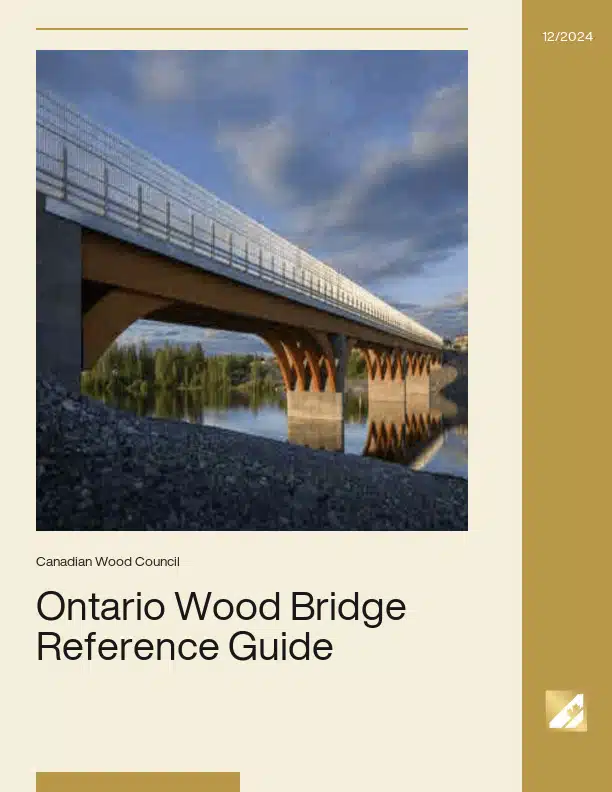
Timber bridges have a long history as vital components of the roadway, railway and logging road networks within Canada. Dependent on the availability of materials...
Construction products and the building sector as a whole have significant impacts on the environment. Policy instruments and market forces are increasingly pushing...
Ottawa, Ontario – September 17, 2024 — The Canadian Wood Council (CWC) and Woodsure (A division of Axis Insurance Managers Inc.) are pleased to announce a new partnership...
June 13, 2024 (Ottawa)– Earlier today, The Transition Accelerator unveiled The Mass Timber Roadmap at the Press Conference Room in the West Block on Parliament Hill. The...
Ottawa, Toronto | 27 March 2024] – The Canadian Wood Council (CWC) and George Brown College’s Brookfield Sustainability Institute (BSI) are thrilled to announce a...
Climate change is one of the largest threats facing the planet today. The construction industry accounts for 11% of global carbon emissions, playing a significant part in the...

Get Access to Our Resources

Stay in the loop and don’t miss a thing!

1
2
3

Get Access to Our Resources

Stay in the loop and don’t miss a thing!

What’s Your Occupation?

Help us personalize the content for you.

What Interests You the Most?

Help us personalize the content for you.

Filters

Expertise Icon
Field of Expertise
Province Icon
Province
Member Type Icon
WoodWork National Partners

Filters

Post Type Icon
Post Type
Persona Icon
Persona
Language Icon
Language
Tags Icon
Tags
Mass Timber Plus Icon Environment Plus Icon Safety Plus Icon Durability Plus Icon Design Systems Plus Icon Budget Plus Icon Construction Management Plus Icon Fire Resistance Plus Icon Tall Buildings Plus Icon Short Buildings Plus Icon
Date Icon
Date
Line Separator