
en-ca

Searching for: Wood

Searching results for “Wood”
408 results found...
Sort By Dropdown Icon

Innovative Envelope Solutions for Mass Timber

Course Overview

As society strives toward lower-carbon construction and increased operational efficiency of the built environment, we know that a building’s envelope significantly impacts a project’s overall environmental performance. This panel presentation offers attendees a glimpse into three different façade systems being employed in three important mass timber projects in Toronto.

Industrialized exterior wall system for the 1925 Victoria Park project in Toronto, Canada.

From local to global, global to local – the CREE building system is used locally in various markets and continents. 1925 Victoria Park is an example of how you can use this exterior wall system. Since 2010, the CREE building system is constantly evolving and adapting to different markets. Now it is reaching North America. This presentation will give you insights into the project developments, design processes, challenges, and details of the exterior wall of the 1925 Victoria Park project in Toronto, Canada.

Learning Objectives

  1. Understand the integration of wood products in building envelopes and their role in achieving high-performance in mass timber projects.
  2. Analyze the challenges and technological solutions involved in combining wood products with other building materials for envelope construction.
  3. Evaluate the impact of prefabricated wood product systems on construction efficiency and environmental sustainability – in terms of construction timelines, labor efficiency, and carbon footprint reduction.
  4. Discuss the future implications and potential innovations in wood product applications in building envelope systems.

Course Video

Speaker Bio

Chris Ertsenian, Dip. Arch. Tech.
Associate
Moriyama & Teshima Architects

Case study presentation on the façade at Limberlost Place, Georg Brown College’s 10-storey, mass timber, net zero carbon emissions academic building on Toronto’s waterfront.

Chris Ertsenian, a long-standing MTA Associate and Senior Job Captain, facilitates competitive contractor bids, expedites construction, and minimizes change orders by ensuring that the firm’s contract documents optimize constructability and are clear, complete, and well-coordinated. He brings a breadth of experience on a wide range of project types and has been an integral member of the production and quality control team on many highly complex and exacting projects.

Chris is currently serving as Job Captain for Ontario’s first institutional mass timber building, Limberlost Place (formerly “The Arbour”) at George Brown College; managing the consultant team and monitoring construction progress. He is also the Senior Technologist on the University of Waterloo Faculty of Mathematics Academic Building.

Previously, Chris has worked with all of MTA’s partners to realize many major college and university buildings, including the Brian Mulroney Institute of Government at St. Francis Xavier University, Nova Scotia Community College’s Sydney Waterfront Campus, Toronto Metropolitan University’s Centre for Urban Innovation, and many more to name a few. He has also worked on several public and cultural projects, such as Place des Arts in the City of Greater Sudbury, the Government of Canada’s Visitor Welcome Centre Phase 1 on Parliament Hill, the City of Surrey (British Columbia) Civic Centre, as well as the Ismaili Centre and Aga Khan Museum in Toronto. With strong organizational skills and the ability to manage multiple complex projects at once, Chris’ impact on MTA’s portfolio is wide-ranging and highly influential.

He authored Moriyama & Teshima Architects’ CADD standards and user manual, as well as more recently authoring MTA’s Drawing Standards and assisting in BIM Standards which exemplify his organizational abilities, attention to detail and comprehensive knowledge of building technologies.

Kelsey Saunders, M.B.Sc., CPHD, LEED® AP BD+C.
Project Manager and Building Scientist
RDH Building Science Inc.

Case study presentation on the façade at the University of Toronto’s new 4-storey, 346-unit, mass timber student residence at Trinity College.

Kelsey Saunders is a Project Manager and Building Scientist at RDH Building Science and has been in the building science field for nearly 10 years. She holds a Bachelor of Architectural Science and a Master of Building Science degree from Ryerson University. She is a Certified Passive House Designer and a LEED AP in Building Design and Construction.

Kelsey’s work is focused on early-stage building enclosure consulting on new construction projects across North America with a particular specialty in low carbon buildings both in terms of operational and embodied carbon. She takes an enclosure-first approach to low carbon design and has worked on many Passive House, Net Zero Carbon, mass timber, and prefabricated panelized enclosure projects.

Kelsey has also been involved in numerous public and private research projects, including a current study of the embodied carbon impact of building enclosure systems in whole life carbon emissions to support early-stage decision making for low carbon design.

Tim Steffinger
Structural Consultant specialized in Engineering and System Design
CREE Buildings

Case study presentation on the façade at 1925 Victoria Park, an 11-storey, 154-unit mixed-use rental apartment building with ground floor commercial.

Tim Steffinger is a civil engineer from Germany specializing in Engineering and System Design. He studied at the University of Stuttgart and received his master’s degree in civil engineering with a focus on structural design. At CREE Buildings, he is our expert in exterior wall systems and is constantly improving the CREE System with his expertise and ever-expanding know-how through practical experience and exchange with the international network. As Structural Consultant at CREE, he supports our license partners in the realization of timber hybrid structures and coordinates CREE projects worldwide.

From local to global, global to local – the CREE building system is used locally in various markets and continents. 1925 Victoria Park is an example of how you can use this exterior wall system. Since 2010, the CREE building system is constantly evolving and adapting to different markets. Now it is reaching North America. This presentation will give you insights into the project developments, design processes, challenges, and details of the exterior wall of the 1925 Victoria Park project in Toronto, Canada.
The Importance of Proper Specification: Agricultural, Commercial, and Industrial Applications for Pressure Treated Wood

Course Overview

One important aspect for all building products is proper specification. The Canadian Wood Council partnered with Wood Preservation Canada to publish a Specification Guide for non-residential pressure treated wood products, with a focus on agricultural, commercial, and industrial applications. Presentation attendees will learn more about the governing standard for wood preservation, how this standard is linked to the National Building Code, and key considerations that are essential for ensuring proper specification of pressure treated wood products.

Learning Objectives

Coming Soon

Course Video

Speaker Bio

Craig Wilson
Vice President
Technical Services with Timber Specialties Ltd.

Craig has nearly 40 years of experience in the wood preservation industry. He currently oversees the Technical Services Department at Timber Specialties which provides preservatives and technically related services to the wood preservation industry in Canada. He has been involved in many aspects of wood preservation and has served on several committees and associations including the Canadian Standards Association, the American Wood Preservation Association, Wood Preservation Canada, and was past President for the Canadian Wood Preservation Association.

Craig was an integral part of the development of the Use Category System and residential standards for treated wood in the CSA Standards. He has extensive knowledge on the treatability of Canadian Wood species with a variety of waterborne preservatives including CCA, ACQ, Borate, and Micronized copper.

Robert Jonkman, P.Eng.
VP Codes and Engineering
Canadian Wood Council

After completing a Bachelor of Civil Engineering and Management degree at McMaster University in 1994, Robert worked for one year at a structural engineering consulting firm and over nine years as the Design and Engineering Supervisor at a Canadian timber frame manufacturer. Robert joined the Canadian Wood Council in 2005, progressing to become the Director of Codes and Standards – Structural Engineering in 2014, and VP of Codes Engineering in 2021.

Robert has expertise in structural engineering, building science, and energy issues and active in the Codes and Standards development and with the Canadian Home Builders, including:
-Member – NBC SC Structural Design (Part 4).
-Member – NBC SC Housing and Small Buildings (Part 9).
-Secretary – TC responsible for CSA O86 “Engineering Design in Wood” Standard.
-Chair – ISO TC 165 mirror committee.

Practical and Advanced Modeling for Design and Performance of Mass Timber Structures

Course Overview

FPInnovations’s Modeling Guide for Timber Structures is the result of global collaboration from over 100 experts. This definitive guide for timber structure modelling is the first of its kind, bringing together the experience gained from recently built timber projects with the latest research development in the modelling of timber structures. Computer modelling is essential for analyzing and designing mid- and high-rise buildings and long-span structures. It is also a valuable tool for optimizing wood-based products, connections, and systems that improve structural performance. This useful guide supports the application and development of timber construction given that timber structures increasingly require demonstration of performance or equivalency through computer modelling, regardless of whether prescriptive or performance-based design procedures are used. This session offers an overview of the guide, which includes a wide range of practical and advanced modelling topics, such as key modelling principles, methods, and techniques specific to timber structures; modelling approaches and considerations for wood-based components, connections, and assemblies; and analytical approaches and considerations for timber structures during progressive collapse, wind, and earthquake events. It also presents the differences in the modelling approaches to timber, steel, and concrete structures.

Learning Objectives

Coming Soon

Course Video

Speaker Bio

Dorian Tung
Manager Building Systems of Sustainable Construction Innovation Centres of Excellence
FPInnovations

Dr. Dorian Tung is currently the Vancouver Manager for Building Systems of Sustainable Construction Innovation Centres of Excellence in FPInnovations. He has 20 years of experience in industry and academia. He has dealt with intellectual properties, knowledge transfer, and research dissemination. In addition to delivering research and development, he has been responsible for project management, sales, and marketing, as well as developing and maintaining business relationship. Dorian is a licensed professional engineer in Canada and USA, and also holds LEED certification, Building Design + Construction, from the U.S. Green Building Council (USGBC). He has designed a variety of structural systems and is experienced with various construction materials. Dorian has a strong portfolio in developing innovative structural solutions to achieve resilience. He has ongoing collaborations with researchers and scientists around the world to apply state-of-the-art technologies.

Overview of the Ottawa Mass Timber Fire Test

Course Overview

The presentation will provide an overview of the Mass Timber Demonstration Fire Tests which were conducted during the summer and fall of 2022. Past research on the fire performance of mass timber construction will be reviewed briefly to provide the background necessary to understand how the latest tests support the design of taller and larger mass timber buildings. A review of how each of the five tests performed will be reviewed along with what it means for future mass timber building design.

Learning Objectives

  1. Understand the rationale and execution of the demonstration fire tests – why and how the tests were conducted, their significance in obtaining approvals for mass timber projects.
  2. Analyze the fire performance of mass timber structures compared to traditional building materials under controlled test conditions – understand fire dynamics in mass timber projects versus traditional materials like concrete or steel.
  3. Understand the role and results of compartment fire tests in analyzing fire dynamics in mass timber projects.
  4. Explore the implications of mass timber fire test findings on future building code developments and construction practices – how could the results from these fire tests influence changes in building codes and impact mass timber design and construction practices.

Course Video

Speaker Bio

Steve Craft, PhD, P.Eng.
Principal
CHM Fire Consultants Ltd.

Dr. Steven Craft is a founding partner of CHM Fire Consultants Ltd located in Ottawa. He served as an Adjunct Professor in the Fire Safety Engineering Program at Carleton University from 2010- 2019 and was a Research Scientist with Canada’s National Forest Products Research Institute, FPInnovations, from 2006-2011. He has an undergraduate degree in Forest Engineering from the University of New Brunswick and a PhD in Fire Safety Engineering from Carleton University. He is active in codes and standards development. He is the Chair of the ULC S100a Fire Test Committee and is on the Technical Committee for the Canadian Wood Design Standard, CSA O86, where he Chairs the Task Group on Fire Resistance.

Light Wood Frame and Mass Timber Hybrid Mid-Rise Construction

Course Overview

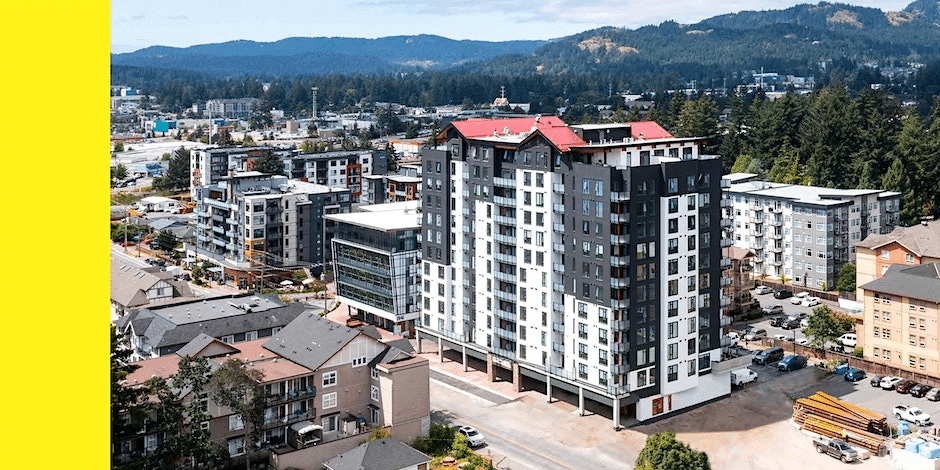
55 Franklin in Kitchener, Ontario, is a four-building complex of mid-rise residential buildings that the project team is using as an opportunity to explore new and different strategies for delivering quality affordable housing to our Region. Each of the four buildings will be designed as a prototype exploring different construction methodologies and solutions tested against their sustainability impacts. The first building constructed uses a combination of conventional wood framing and mass timber.

Learning Objectives

  1. Understand the impact of mass timber construction on project timelines and the operational efficiencies it can provide.
  2. Analyze the factors influencing the choice of construction methodologies in mid-rise building projects, with a focus on the efficiency and speed of different methods.
  3. Evaluate the challenges associated with municipal approvals when using new building materials like mass timber, including the need for alternative compliance solutions.
  4. Assess the practical benefits of using Cross-Laminated Timber (CLT) in construction, particularly in terms of labor and time savings during the flooring installation process.

Course Video

Speaker Bio

Mike Maxwell
President
Maxwell Building Consultants

Mike was drawn to Waterloo for his degree from Laurier University and has seen local real estate development potential ever since. A combination of zoning bylaw rules, site data chart statistics and construction knowledge produce unique results for projects that he is involved with. He loves the math and the problem solving. In an advisory position with local governments, not-for-profit organizations, and CMHC, Mike has created strong partnerships to move the cause of affordable housing forward.

Understanding the New EMTC Provisions in the Ontario Building Code

Course Overview

This 2-hour technical webinar will begin with an overview of ongoing fire research at the National Research Council of Canada into various performance aspects of mass timber construction and tall wood buildings. From there, code experts from Morrison Hershfield will discuss the new building code provisions related to Encapsulated Mass Timber Construction (EMTC), which is a new construction type in the code, that permit mass timber structures up to twelve storeys in building height. Participants will receive a complimentary electronic copy of the CWC’s recently published “Guide to Encapsulated Mass Timber Construction in the Ontario Building Code” authored by Morrison Hershfield.

Learning Objectives

  1. An overview of the Ottawa Mass Timber Demonstration Fire Tests:
    The presentation will provide an overview of the Mass Timber Demonstration Fire Test Project which were conducted during the summer and fall of 2022. Past research on the fire performance of mass timber construction will be reviewed briefly to provide the background necessary to understand how the latest tests support the design of taller and larger mass timber buildings. Each of the five tests performed will be reviewed along with what it means for future mass timber building design.
  2. Guide to Encapsulated Mass Timber Construction in the Ontario Building Code:
    Encapsulated mass timber construction (EMTC) showcases recent advancements in fire safety engineering. These advancements are reflected in recent adoptions of EMTC as a new construction type across various jurisdictions and specifically in Ontario, through O.Reg. 451/22, which became applicable as of July 1, 2022. This presentation introduces designers and authorities to the “Guide to Encapsulated Mass Timber Construction in the Ontario Building Code.”
    The purpose of the guide, and this presentation, is to introduce users to the new provisions governing EMTC in Ontario, so that readers are aware of the content, intent, and application of the new provisions. The guide introduces the new provisions and highlights where new EMTC features align with similar well-known provisions of the OBC for noncombustible construction and where the new provisions differ or are unique. Through highlighting these differences, this guide seeks to broaden awareness of OBC application to the design of this new building type.

Course Video

Speaker Bio

Marc Alam
Senior Manager, Codes & Standards – Fire & Acoustics
Canadian Wood Council

As Senior Manager of Codes and Standards in fire and acoustics, Marc participates in CWC’s building code and standards fire and acoustics related initiatives and the development of CWC’s fire design tools, as well as code‐related fire and acoustics research projects. He is finalising a PhD in Fire Engineering from Carleton and has a Bachelor’s degree in Civil Engineering with a concentration in Management.

Dana Scherf, P.Eng.
Senior Code Consultant, Director of Code and Life Safety Group
Morrison Hershfield

Dana has been applying Building and Fire Codes across Canada since 1997 and has been with Morrison Hershfield since 2001. She has extensive experience in interpretation and application of the Codes to new and existing buildings, development and negotiation of Alternative Solutions, resolution of unusual fire protection construction issues, fire hazards analysis, and application of fire and smoke modelling to support design solutions. She started her career as a plans examiner with the City of Hamilton. Dana supports clients in applying the Building Code to achieve their project vision while providing the level of safety required by the Code.

Trisha Ashworth, P.Eng., M.Eng.
Senior Code Consultant, Department Manager of Code within the Code and Life Safety Group
Morrison Hershfield

Trisha has been working in the building consulting industry since 2007 and has been with Morrison Hershfield since 2017. Trisha actively applies her knowledge of Building and Fire Codes across various Canadian jurisdictions for both new building designs and existing building retrofits across a range of occupancy types. Trisha’s fundamental knowledge of fire dynamics and fire protection design, inherent in the formation of the Building Codes, allows her to apply judgment in the application of prescriptive requirements of the Codes and develop alternative solutions to meet the areas of performance required by the Codes.

A Business Case for Tall Wood

Course Overview

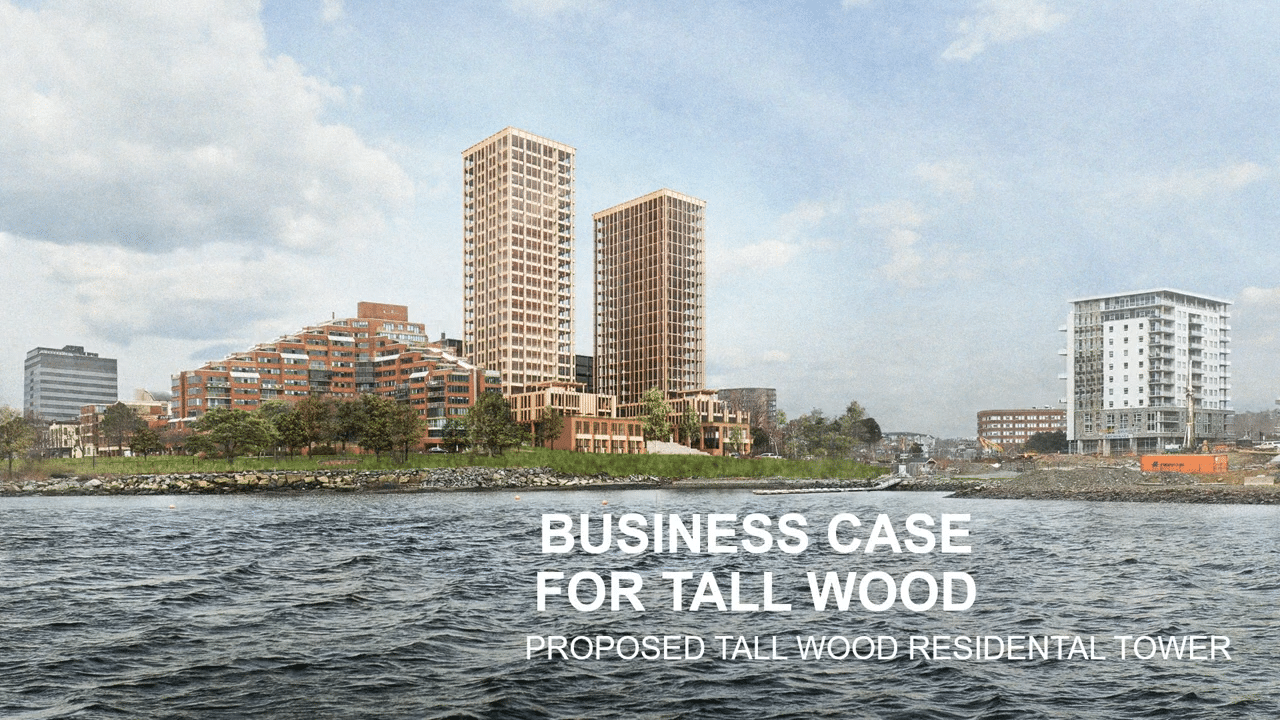
This session will present a vision and business case for innovation, sustainability, and affordability for the tallest residential wood tower in the world (proposed in Nova Scotia). Addressing rapid delivery to meet urgent residential needs supported by Bird Construction costing and scheduling.

Learning Objectives

  1. Understand the business case for developing tall residential mass timber buildings, including how sustainability, affordability, and rapid delivery needs are addressed through advanced structural design and innovative project phasing strategies.
  2. Identify the key costing, scheduling, and manufacturing considerations that influence the feasibility of tall wood construction, including lessons learned from previous mass timber projects and the role of integrated project teams in mitigating bottlenecks.
  3. Evaluate how mass timber products such as glulam and CLT can support high‑rise residential development, including insights into supply‑chain innovation, local manufacturing capacity, and the broader economic and environmental impacts of tall wood construction in Atlantic Canada.

Course Video

Speaker Bio

Patrick Crabbe
Director of Mass Timber
Bird Construction

Patrick Crabbe is the Director of Mass Timber at Bird Construction – Bird is a publicly traded, commercial and industrial conglomerate, recognized as a top 5 General Contractor (GC) in Canada.

Patrick is also the leader of a Mass Timber Manufacturing start-up, based in Halifax, Nova Scotia. MTC is a sawmill integrated, glulam focused entity, that is currently executing a $2.3M feasibility effort to code approve proprietary high performing mass timber products (made from undervalued-commodity maritime spruce, pine and fir) that will expand the needed capacity of North American mass timber products and positively impact sustainable forestry practises.

Patrick’s professional career has been dedicated to developing markets for high-value structural wood products and working with industry to facilitate the. Through this experience, Patrick has a comprehensive understanding of construction contract methods supply chain solutions to set-up large, complex, mass timber build programs for success.

Patrick is an active member of the Carbon Pricing Leadership Coalition (led by the World Bank) and a trusted advisor to Infrastructure British Columbia and the Canadian Wood Council.

Joe Nickerson
Vice President & Partner
Sidewalk Real Estate Development

Joe Nickerson is a leader with a proven history of success managing a variety of real estate portfolios for high-net-worth families in Toronto, Alberta, and British Columbia. Joe has worked at RBC Capital Markets and for both private and public real estate holding companies ranging from $100M to $11B in AUM. Joe holds an MBA with a specialization in Real Estate & Infrastructure from Schulich School of Business and studied Private Equity & Finance at SDA Bocconi University in Milan, Italy.

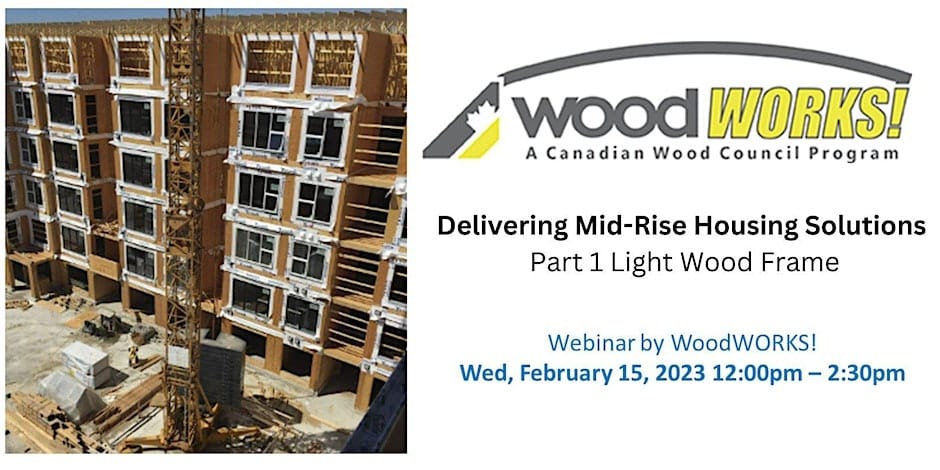
Delivering Mid-Rise Housing Solutions – Part 1 Light Wood Frame

Course Overview

We are excited to be joined by Ashley Hammerbacher and Seungyeon Hong from s2e Technologies Development Inc a team constructing the 4 storey Eve Park in London Ontario. Eve Park is an innovative net zero community with Phase 1 underway. With the unique building shape, it shows that there are no limits with what offsite prefabrication can’t do.

Learning Objectives

  1. Understand the innovative use of prefabricated light wood construction in creating sustainable residential developments – design choices, construction techniques, and sustainability goals.
  2. Analyze the design and logistical challenges in implementing prefabricated construction systems, including coordination between various stakeholders.
  3. Evaluate the benefits of modular construction in achieving sustainability goals, such as Net Zero Energy standards.
  4. Discuss the role of innovative parking solutions and community design in enhancing the sustainability and livability of residential developments.

Course Video

Speaker Bio

Ashley Hammerbacher
Managing Director
S2E Technologies

Ashley is a Managing Director for the US division of S2E Technologies and is the EVE Park Project Lead. She is currently living and breathing everything EVE Park. Ashley is coordinating and advising on EVE Park where we are reimagining neighbourhoods for green energy along with the future of aut-on-omous vehicles. Ashley holds a Bachelors in Bioengineering and a Masters in Civil and Environmental Engineering from Stanford University, and has accumulated a breadth of experience in green technology and intelligent mobility.

Seungyeon Hong
Modelling and Data Specialist
S2E Technologies

Seung is a Modelling and Data Specialist at S2E Technologies. His role includes providing technical analysis on all matters related to buildings. This includes developing physics-based computer simulations to study a building’s behaviour and estimate the associated energy use, which helps guide design decisions and achieve net-zero energy design. Seung had earned a Bachelor’s and Master’s degrees in Civil Engineering at Carleton University, apprenticed as a timber-framer in South Korea, worked as structural inspector, wrote a thesis on BIM-BEM interworking, and co-led a team of graduate students to win a national Hackathon.

Simplified and Sustainable Acoustic Solutions for High-Performance Mass Timber Buildings

Course Overview

Delivering superior acoustic comfort to building occupants doesn’t have to be complicated. In this panel discussion, presented by an industry-leading manufacturer of acoustic treatments, an acoustic expert, and a LEED GA certified engineer, discover the latest ground-breaking advancements in sound technology that are transforming acoustic design in wood construction.

There are many critical factors to consider when looking at acoustic systems: weight reduction, fire performance, structural height, and environmental sustainability must all be taken into account. The panelists will share system recommendations to help designers achieve better sound performance in mass timber buildings.

Learning Objectives

  1. Identify the latest systems solutions in the marketplace.
  2. Understand how to mitigate flanking paths.
  3. Explore impact sound solutions for exposed mass timber ceilings.
  4. Discuss the benefits of dry vs. wet floor toppings based on a building’s design.

Course Video

Speaker Bio

David Dompierre, P.Eng.
Acoustic Engineer
SIBE Acoustics

Having been involved in over a hundred successful projects in North America, David was able to develop expertise in the acoustics of numerous construction systems (steel, concrete, light wood frame, mass timber, hybrids, etc.). His position as R&D director at an acoustics laboratory allowed him to gain knowledge of acoustic materials and flooring types.

For several years, he has had the opportunity to share that knowledge with firms, colleges, and universities.

David’s role as a senior noise consultant at SIBE Acoustics is to help developers and professionals with the selection and implementation of acoustic solutions in their projects.

David Gonzalez, LEED® Green Associate™
Solutions Ambassador
DCC Solutions

With over 20 years of experience in the building materials industry, David assists construction professionals achieve optimal acoustical performance for the soundproofing of buildings using a dry topping flooring system.

He is a keen green building enthusiast and enjoys acquiring knowledge on environmentally friendly, low carbon and healthy building materials that can contribute to making a positive impact on people’s health, the environment, and the construction industry.

André Rioux
Co-Owner- Business Development
AcoustiTECH

André has been working alongside building professionals for 20 years and is recognized for his passion for the field of acoustics and his expert knowledge.

Promoting wood construction across Canada and the US has been a great focus of his, he has participated in various organizations, presented at conferences and been part of innovative projects.

André’s experience with wood construction combined with over 20 years of research and development from AcoustiTECH has resulted in a group that is able to bring invaluable expertise and know-how to the industry.

Elevate Innovate Acoustically Integrate

Course Overview

In this session using specific project case studies, discover the latest ground-breaking advancements in sound technology that are transforming acoustic design in wood construction. There are many critical factors to consider when looking at acoustic systems: weight reduction, fire performance, structural height, on-site sequencing and environmental sustainability must all be taken into account. This session will shed light on the advantages of dry toppings over wet toppings, presenting innovative solutions that not only comply with building codes but also keep the construction process moving forward.

Learning Objectives

  1. Define Basic Acoustic Principles.
  2. Propagation of noise in Wood Construction.
  3. Dry Topping VS Wet Topping.
  4. Case Studies.

Course Video

Speaker Bio

Cristian Wallace
AcoustiTECH

Cristian Wallace brings a wealth of technical knowledge and a genuine passion for collaborating with Developers, Architects, and Acoustical Engineers. His primary objective is to empower clients by educating them on effective strategies to prevent noise-related problems and encourage sustainable construction methods. AcoustiTECH has evolved into a market leader with over 20 years of extensive research and development. Along with Cristian’s expertise they culminated into a team capable of delivering invaluable insights.

By Engineer or By Supplier? How “Involved” to Be in Choosing Engineered Lumber

Course Overview

Since Engineered Lumber Products are proprietary, there is a range of opinions about how much information to show on a set of Structural drawings. Should the framing choices be left to a supplier (similar to roof trusses), or should specific sizes and grades be specified? 

This decision affects the time-sensitive process of putting together an estimate and can affect the quality of the construction itself. Through our experience working on over 100 mid-rise projects, we provide 5 examples where information provided on the Structural Plans can make a big difference.”

Learning Objectives

4 Learning Objectives:

  1. The role of the supplier: Should they be the main “specifier” of engineered lumber?
  2. Components that Structural Engineers should be very specific about on their plans.
  3. How to select a proprietary product without committing to one brand.
  4. Vertical Load transfer details on Structural Plans that help projects succeed. 

Course Video

Speaker Bio

Andy Teasell, P.Eng
Senior Engineer, Trus Joist
Weyerhaeuser

Andy is a professional engineer with over 30 years of experience in the construction industry including: project management, structural engineering, wood component design, and field problem resolution. Based in Surrey, B.C., Andy is the Senior Engineer in Canada for Weyerhaeuser’s “Trus Joist” line of wood products. Through his interactions with Builders, Engineers, Architects, and Inspectors, he has seen what works well (and not-so well!) in the construction industry.

Ernst Grell
Territory Manager, Eastern Canada, Trus Joist
Weyerhaeuser

Ernst is a Territory Manager for Weyerhaeuser / Trus Joist in the eastern Canada region. Ernst has over 30 years technical sales experience in the Engineered Wood Industry launching his career with Trus Joist Canada in Calgary, Alberta. Ernst works closely with specifiers, builders, code officials, building and component manufacturers, and lumber yards for the smooth implementation of Trus Joist EWP in multi-family, mid-rise and low-rise residential and ICI wood framed projects.

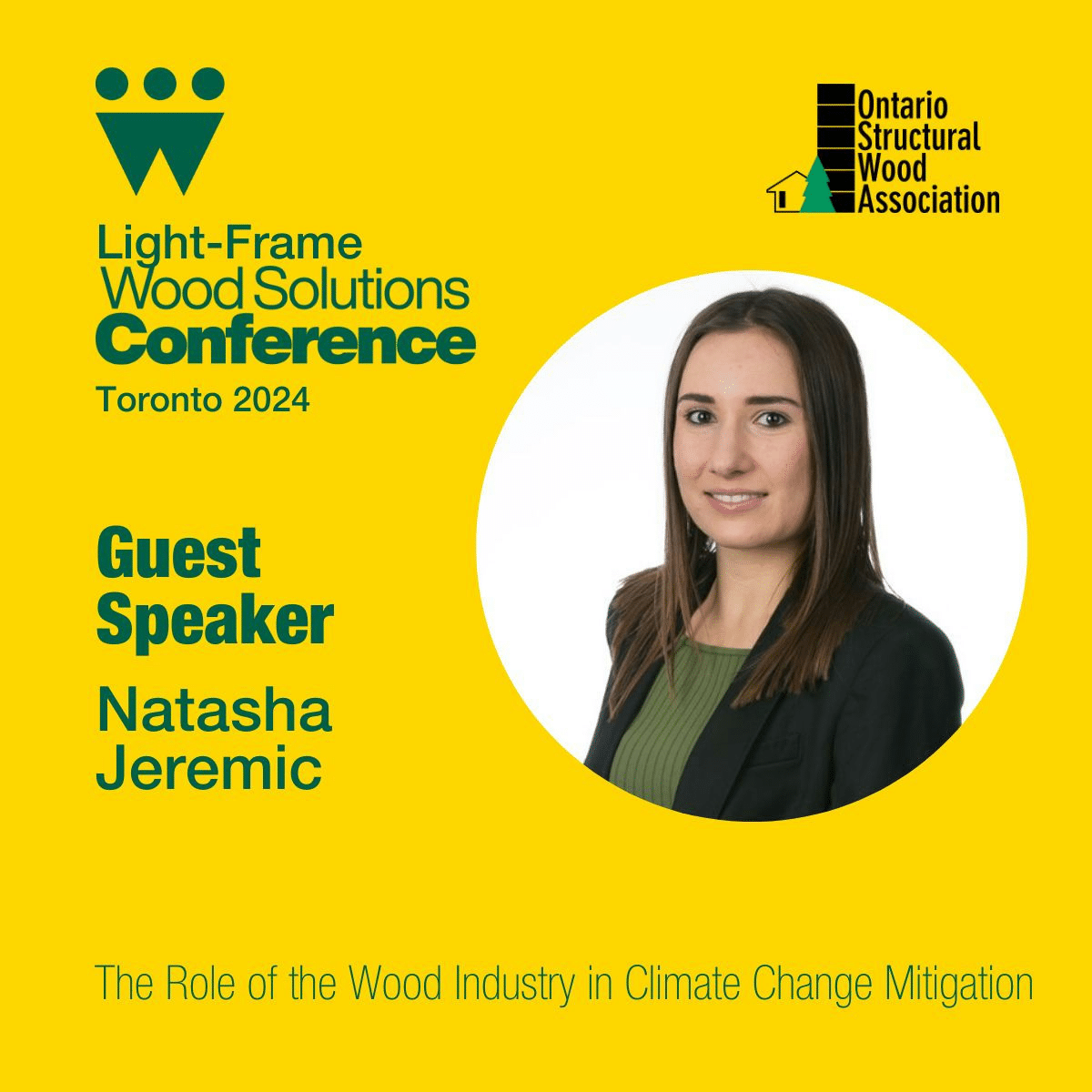
The Role of the Wood Industry in Climate Change Mitigation

Course Overview

This presentation will describe the role of the wood industry in mitigating the impacts the built environment has on climate change. Learn about the importance of embodied carbon in construction and how wood has the ability to influence positive change in the building sector’s decarbonization efforts.

This session will highlight current research programs such as National Research Council Canada’s initiative on Low-carbon assets through life cycle assessment (LCA2) and emerging initiatives such as embodied carbon provisions in municipal and national building standards and codes.

Learning Objectives

These objectives are aligned with key concepts in sustainability, building regulations, and lifecycle assessments within the building sector.

  1. Understanding Embodied Carbon:
    Objective: To learn what embodied carbon is, how it is relevant to building materials, and its implications for sustainability in construction.
    Relevance: Knowing the sources of embodied carbon helps in making informed decisions about material selection to reduce environmental impact.
  2. Role of Wood in Sustainable Construction:
    Objective: To understand the environmental benefits of using wood in construction, including its properties as a low-carbon material.
    Relevance: Grasping why wood is considered a sustainable choice can influence policies, building practices, and material selection, supporting climate change mitigation efforts.
  3. Biogenic Carbon Concept:
    Objective: To comprehend what biogenic carbon is, how it is stored in wood, and the significance of using wood to capture and store carbon.
    Relevance: Learning about biogenic carbon can lead to greater appreciation of sustainable forestry and its role in carbon sequestration, promoting the use of renewable resources.
  4. Regulatory Expectations and Future Trends in Building Materials:
    Objective: To gain insight into future regulatory changes regarding building materials, specifically the focus on reducing embodied carbon.
    Relevance: Understanding these regulatory trends prepares professionals to comply with upcoming standards and encourages the adoption of sustainable practices in construction.
These objectives help learners—from construction professionals to students and policy makers—understand critical aspects of sustainability in the building industry, encouraging the implementation of practices that reduce the environmental impact of construction activities.

Course Video

Speaker Bio

Natasha Jeremic, MASc, PEng, LEED GA
Manager Codes and Standards – Sustainability
Canadian Wood Council

Natasha Jeremic is Manager of Sustainability in the Codes and Standards group at the Canadian Wood Council. She is engaged in strategic building code and standards initiatives related to sustainability, circularity, and durability. Natasha leverages her experience in structural design, building performance, and whole life carbon accounting to demonstrate that wood products are a viable solution for a sustainable and low-carbon built environment.

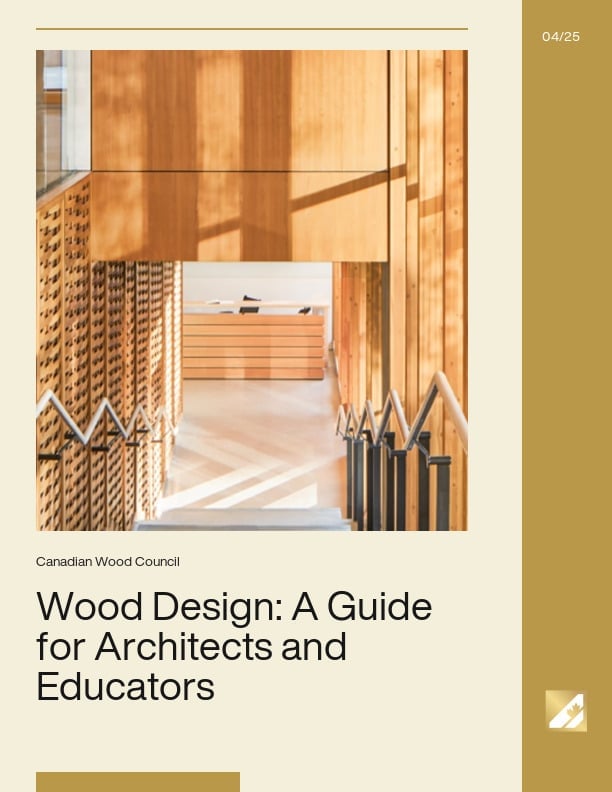
Wood Design: A Guide for Architects and Educators
Canadian Wood Council releases new Environmental Product Declarations for 5 Canadian manufactured wood products
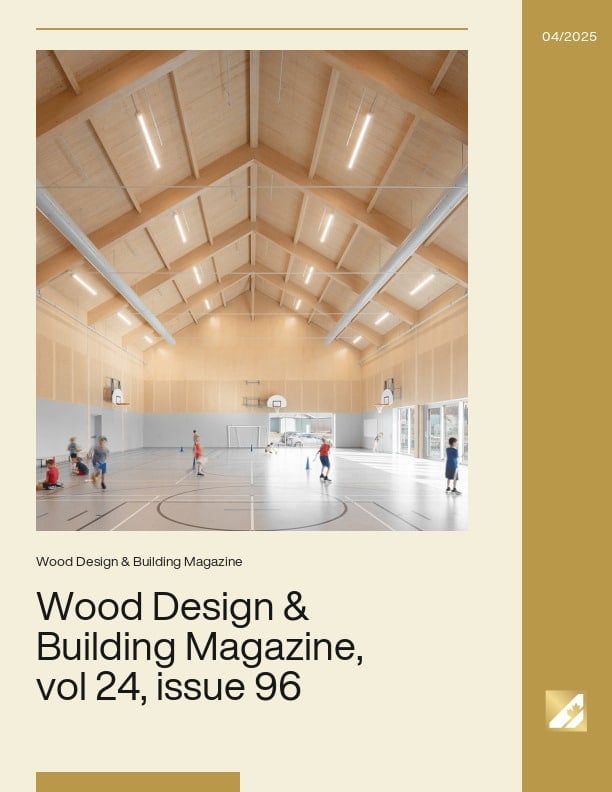
Wood Design & Building Magazine, vol 24, issue 96
Connections Course
Shearwalls Course
Updates to Hem-Fir (N) design values for dimension lumber
Canadian Wood Council Applauds Strategic Federal Investments in B.C.’s Forest Industry
Canadian Wood Council Applauds Federal-Provincial Investment in Advanced Wood Construction in Quebec
Canadian Wood Council Applauds Federal Investment in Nova Scotia’s Mass Timber Industry
Treatment during engineered wood product manufacture
Reassessment of Design Values for Hem-Fir (N) Dimension Lumber (Canadian Market)
Over the last couple of years Quebec City has witnessed significant population growth and there has been a construction boom to meet the ever-growing demand for housing. In...
Since the 2009 change to the British Columbia Building Code (BCBC) that increased the permissible height for wood frame residential buildings from four storeys to six, more...
Templar Flats in Hamilton, Ontario, has the distinction of being the first occupied, modern wood-frame mid-rise building completed in Ontario. It was constructed under...
Although seismic events occur all over the world, the areas most susceptible to large earthquakes are those that lie along active fault lines. These fault lines are found at...
It is significant that wood played such a large role in this type of complex, which is usually done in other materials. The wood structure is a unifying element between the...
Located in Edmonton, Alberta, the Mosaic Centre for Conscious Community and Commerce was designed to be the province’s first “net-zero energy” commercial building and...
Edmonton, the capital of Alberta, is a fast-growing city with a population of 1,200,000 people in the overall metropolitan area. It boasts comprehensive bus and light-rail...
Throughout history, protecting commercial structures from fire has been important. Fire poses risk in terms of safety to occupants, building integrity, business interruption...
The R-Town V6 pilot project is the first 6-storey, mixed-use, multi-unit residential building developed in Ontario that fully employs mass timber as the main structural...
Red Deer College (RDC) Student Residence is a 5,800-sq.m. (60,000-sq.ft.), five-storey wooden structure with 145 units, designed and completed to meet the 300-bed demand for...
This case study examines two wood buildings, both with primary retail commercial occupancies, but which employ different mass timber products to achieve very different...
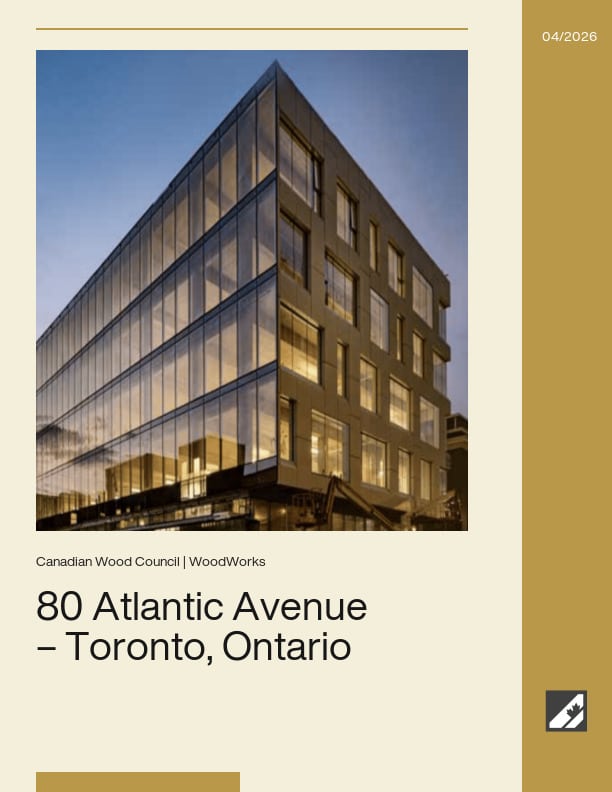
Ontario’s first mass timber commercial building in over 100 years, 80 Atlantic pioneers a new urban office typology for potentially many more timber-frame projects across...

Get Access to Our Resources

Stay in the loop and don’t miss a thing!

1
2
3

Get Access to Our Resources

Stay in the loop and don’t miss a thing!

What’s Your Occupation?

Help us personalize the content for you.

What Interests You the Most?

Help us personalize the content for you.

Filters

Expertise Icon
Field of Expertise
Province Icon
Province
Member Type Icon
WoodWork National Partners

Filters

Post Type Icon
Post Type
Persona Icon
Persona
Language Icon
Language
Tags Icon
Tags
Mass Timber Plus Icon Environment Plus Icon Safety Plus Icon Durability Plus Icon Design Systems Plus Icon Budget Plus Icon Construction Management Plus Icon Fire Resistance Plus Icon Tall Buildings Plus Icon Short Buildings Plus Icon
Date Icon
Date
Line Separator