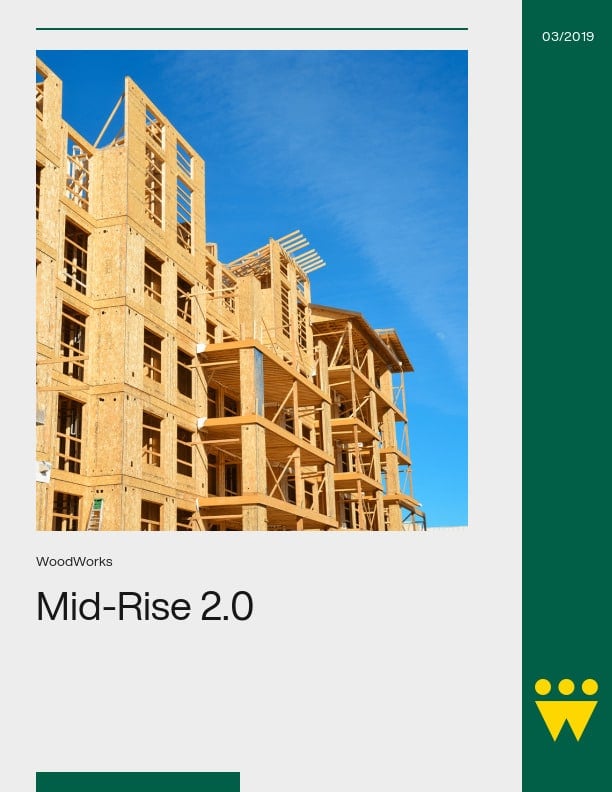
Since the 2009 change to the British Columbia Building Code (BCBC) that increased the permissible height for wood frame residential buildings from four storeys to six, more than 300 of these structures have been completed or are underway around the province.
Most are located in the core of smaller municipalities and in the inner suburbs of larger ones, offering a more sustainable and cost-effective option for densification than concrete or steel equivalents. Most of these buildings have employed wood frame from the ground up, with a five- or six-storey building being constructed on a concrete slab-on-grade, or on top of a concrete basement parking garage; others have been constructed above one or two storeys of commercial accommodation, currently still required to be built in noncombustible construction. This requirement will change when British Columbia adopts the 2015 National Building Code of Canada (NBC), which will allow light wood frame assemblies, mass timber slab elements and wood beams and columns to be used in place of concrete or steel.
Over the past eight years, architects, engineers, municipal authorities and local fire departments have become familiar with the basic parameters of this new building type. Over the same period, market conditions have continued to evolve.
Beyond the energy conservation standards referenced by LEED and mandated by municipalities, there is an increasing interest in ultra-low energy buildings that comply with the Passive House standard, now formally administered in Canada by Passive House Canada.
There is also a growing need to explore new approaches to project delivery, particularly when building on infill lots that have little or no space for vehicles, materials storage and staging, and where the inconvenience to neighbours from the traffic, noise and dust generated by traditional site construction is increasingly disruptive.
Further revisions to the 2015 NBC to be introduced in British Columbia in 2017 will expand the permissible use of six-storey wood construction from multi-family residential (Group C) occupancies to business and personal services occupancies in Group D.
Prior to “modern” building codes, such buildings were often constructed using heavy timber post-and-beam systems, with solid timber floors. However, with the advent of new mass timber panel products, the opportunity has arisen for developers and design teams to explore new forms of wood construction, including hybrid mass timber/light wood frame construction.
In response to these new market conditions, traditional wood frame construction techniques and project delivery methods have been modified or adapted to achieve greater efficiency, economy and performance. This case study looks at three different projects in the Vancouver area, similar in having a predominantly multi-family residential program, but differing considerably in their approach to design, construction details and project delivery