...lost strength may be removed. Be aware that a wood decay fungus may have penetrated well beyond the boundaries of the visibly rotted wood. Since deterioration is underway, a rapid...
Select heartwood where possible to minimize nutrient content of wood surfaces and prevent nutrients migrating through the coating to support fungal growth on the surface. Round all corners to minimum...
Glossary
...Soluble chemicals particularly present in the heartwood of some species which provide the wood with resistance to decay and insects. Fungicide A substance which inhibits the growth of fungus. Often...
...Wood Council is proud to support Woodrise 2025, an international conference coming to Vancouver, British Columbia. As part of this event, the 5th International Congress on tall wood construction, we’ve...
Wood Bridge Design
...the Canadian Highway Bridge Design Code 2014 (CHBDC), CAN/CSA O86-14, and the Ontario Wood Bridge Reference Guide. The material covers wood bridge systems—including decks, superstructures, and substructures—with examples from Canada,...
...between solid wood products. Lateral design, including information on I‐joist diaphragm capacities and the detailing of rim board connections. Fire resistance design, including wood I‐joist assembly requirements and SCL char...
...and some wood species that demonstrate low flame spread ratings (less than 75). For further information, refer to the following resources: Resilient and Adaptive Design Using Wood (Canadian Wood...
Wood in Low-Rise Commercial Buildings
...many are comfortable using wood in traditional applications and in buildings that are relatively small in scale, not all have the requisite experience working with wood (whether traditional light wood-frame,...
Mid-Rise 2.0 – Innovative Approaches to Mid-Rise Wood Frame Construction
...arisen for developers and design teams to explore new forms of wood construction, including hybrid mass timber/light wood frame construction. In response to these new market conditions, traditional wood frame...
...preservative-treated wood can have 5 to 10 times the service life of untreated wood. This extension of life saves the equivalent of 12.5% of Canada’s annual log harvest. Preserved wood...
...materials, largely because of reduced thermal bridging through the wood structural elements, including the wood studs, columns, beams, and floors. Wood loses less heat through conduction than other building materials...
Nailing is the most basic and most commonly used means of attaching members in wood frame construction. Common nails and spiral nails are used extensively in all types of wood...
Since remedial treatment is intended to solve a known insect or decay problem, the first thing to do is investigate the extent of the problem and, if necessary, provide...
Select heartwood where possible to minimize nutrient content of wood surfaces and prevent nutrients migrating through the coating to support fungal growth on the surface....
Acrylic A type of water-borne coating product containing acrylic polymers. Alkyd A type of polyester resin. Term often used to signify solvent-borne coatings, e.g., oil...
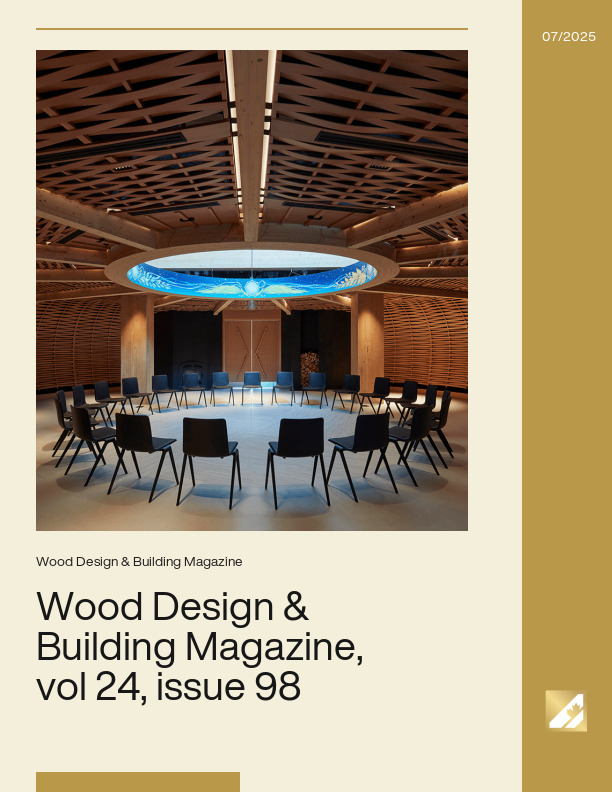
What does it take to deliver better buildings? In this issue, we explore that question from a couple of different angles—primarily through a look at standout wood projects...
Resource Description This comprehensive pedagogical resource presents two detailed mass timber projects, developed to support educators in teaching advanced wood construction...
Course Overview While many designers are familiar with engineered wood products such as I‐joists and structural composite lumber, it is important to understand the...
Individuals in the design and construction community are increasingly choosing materials, design techniques and construction procedures that improve a structure’s ability...
Course Overview In Canada, we are fortunate to have both structural engineers and architects who, because of the numerous benefits, would like to work with wood whenever they...
Since the 2009 change to the British Columbia Building Code (BCBC) that increased the permissible height for wood frame residential buildings from four storeys to six, more...
When you want to use wood that is not naturally decay resistant in a wet application (outdoors, for example) or where it may be at risk for insect attack, you need to specify...
Of all the energy used in North America, it is estimated that 30 to 40 percent is consumed by buildings. In Canada, the majority of operational energy in residential...
Nailing is the most basic and most commonly used means of attaching members in wood frame construction. Common nails and spiral nails are used extensively in all types of...




 Environment


