
en-ca

Searching for: Wood

Searching results for “Wood”
403 results found...
Sort By Dropdown Icon

Four-Storey Wood School Design in British Columbia: An Analysis of Structural System Cost Comparisons

As land values continue to rise, particularly in higher-density urban environments, schools with smaller footprints will become increasingly necessary to satisfy enrollment demands. There are currently several planned new school projects throughout British Columbia that anticipate requiring either three-or four storey buildings, and it is forecast that demand for school buildings of this size will continue to rise.

Though timber construction would offer a viable structural material option for these buildings, the British Columbia Building Code (BCBC 2018) currently limits schools comprised of timber construction to a maximum of two storeys, while also imposing limits on the overall floor area. Given these constraints, the development of viable structural options that would accommodate larger and taller schools constructed primarily with timber materials has not been a key focus.

With the above factors in mind, the purpose of this report is to build upon the findings of the previously published Design Options for Three- and Four-Storey Wood School Buildings in British Columbia prepared by Fast + Epp and Thinkspace dated November 2019. Specifically, this report supplements the previous one by providing guidance in assessing and comparing the various framing options considered in the previous report primarily on a cost basis.

Wood Design Manual 2020

The Wood Design Manual is the Canadian reference on the design of timber structures, under gravity and lateral loadings, according to Part 4 of the National Building Code of Canada (NBC) and the “Engineering design in wood” standard (CSA O86). It provides guidance and design examples on sawn and engineered wood members, their connections and fire design. The most common design situations encountered by practicing engineers are covered through intuitive Selection Tables. In addition, the Wood Design Manual contains the latest CSA O86 Standard, as well as a technical commentary written by timber design experts including members of the Standard’s technical committee.

The 2020 Wood Design Manual includes a copy of the CSA O86:19 Standard, incorporating Update No.3 – July 2021. The main changes in this edition are:

  1. Updates to NBC 2020, including guidance on the new “transient live load” in serviceability load combinations.
  2. New sawn lumber joist vibration tables, based on the new vibration design method in O86:19 Annex A.
  3. Updated bending and tension tables for Hem-Fir beam and stringer grade, based on the changes in Hem-Fir design values in O86:19.
  4. Updated CLT deflection tables, based on the removal of the 1.2 form factor in O86:19.
  5. Updated CLT combined loading tables, again, based on the removal of the 1.2 form factor in O86:19.
  6. Improved bolt tables that can be directly used to obtain bolt resistances and failure modes.
  7. Updated shearwall and diaphragm selection tables based on the new alternative f1 equation.
  8. Updated design example of CLT shearwall to account for O86:19 additional provisions and provides design and deflection expressions for multi-panel CLT shearwalls.

Wood Design Awards, 2019

Design Options for Three- and Four Storey Wood School Buildings in British Columbia

As land values continue to rise, particularly in higher-density urban environments, schools with smaller footprints will become increasingly more necessary to satisfy enrollment demands. There are currently a number of planned new school projects throughout British Columbia that anticipate requiring either three-or four-storey buildings, and it is forecasted that the demand for school buildings of this size will continue to rise.

Though timber construction would offer a viable structural material option for these buildings, the British Columbia Building Code (BCBC 2018) currently limits schools comprised of timber construction to a maximum of two storeys, while also imposing limits on the overall floor area. Given these constraints, to date there has not been much effort put into the development of viable structural options that would accommodate larger and taller schools constructed primarily with timber materials.

With the above factors in mind, the purpose of this study is to illustrate the range of possible timber construction approaches for school buildings that are up to four storeys in height. Given this emphasis on four-storey construction, this study focuses on the main classroom blocks within a school building, as these portions of the building are the ones that are the most likely to take advantage of an increased number of storeys. While other portions of school buildings, such as gymnasiums, shops, and multi-purpose areas are also strong candidates for wood construction systems, since there are already numerous examples of this type of construction these areas are not emphasized in this report.

Shane Homes YMCA At Rocky Ridge CALGARY, AB

Calgary’s aspirations to become a world-class city are supported by its recent investments in infrastructure and architecture, including the $192-million Shane Homes YMCA at Rocky Ridge, which was bolstered by the largest private donation ever contributed to the local YMCA. Shane Homes is a Calgary-based development company, established in 1979, that contributed $3.5 million for the project.

This is the first recreational facility for the northwest corner of the city, serving a community of more than 100,000 residents. Nestled in Calgary’s rolling foothills, the curvilinear design of the Shane Homes YMCA at Rocky Ridge is inspired by the surrounding landscape. The building is sited within a natural park featuring reconstructed wetlands. Multiple pathways and a timber pedestrian bridge curve throughout the site, linking to the regional pathway system.

Glulam timber is the primary structural component, allowing for a geometrically complex design at considerably less cost than other materials. The dramatic silhouette is dened by the largest freeform timber roof structure in North America. Construction began in 2014, and since opening to the public in January 2018, this new recreation centre has become a bustling hub of sport and activity. The Shane Homes YMCA has won numerous awards, including a 2019 Wood WORKS! Prairie Wood Design Award, a 2018 Canadian Wood Council Award and a 2017 CanBIM Best in BIM Award.

Wood Design Awards, 2018

Mid-Rise Best Practice Guide Proven Construction Techniques for Five-and Six-Storey Wood-Frame Buildings

When the provincial government changed the British Columbia Building Code (BCBC) in 2009 by increasing the permissible height for wood-frame construction from four storeys to six for residential buildings, it joined many other jurisdictions around the world in recognizing the role that wood construction should play in the creation of a sustainable, built environment.

Scientific evidence and independent research had shown that such buildings could meet the performance requirements of the BCBC in regard to structural integrity, fire safety, and life safety. That evidence has now also contributed to the addition of new prescriptive provisions for wood construction, as well as paved the way for future changes that will include more permissible uses and ultimately greater permissible heights.

As a result of this research, and the successful implementation of many mid-rise wood-frame residential buildings in BC, the Canadian Commission on Building and Fire Codes approved similar changes to the National Model Construction Codes. The 2015 edition of the National Building Code of Canada (NBC) now permits the construction of six-storey residential, business, and personal services buildings using traditional combustible construction materials. The changes to Part 3 of the NBC, which are being considered for adoption by British Columbia in late 2018, address the objectives of safety, fire, and structural protection of buildings.

With more than 100 five- and six-storey woodframe buildings completed in BC since 2009, and many others either designed or under construction, there is clear market confidence in this new type of building. This construction supports the goals of many municipalities: to find affordable and sustainable ways to accommodate their growing populations, as well as create more complete and resilient communities.

With each completed building, architects, engineers, builders, and developers have added to their knowledge base and refined their best practices for mid-rise wood-frame construction. The five projects featured in this publication are representative of the diverse and varied application of these techniques to different geographic and market conditions, from small towns to dense urban centres and from affordable rental accommodation to high-end condominiums.

Introduction to Wood Design 2018

Introduction to Wood Design has been prepared to facilitate and encourage the instruction of wood engineering at Canadian universities and colleges. The publication is a supplement to the Wood Design Manual 2017.

Wood Design Awards, 2017

Wood Use In Low Rise Educational Buildings Ontario Reference Guide 2012

Wood-frame construction is an important option for school buildings as well as an important choice toward meeting a sustainable future for Ontario. The facts behind this statement are demonstrated by first exploring how wood-frame construction addresses the three major components of sustainable development: what is best for the environment, what is best for the economy, and what is best for society. Factors that owners, funding partners and design teams must consider when developing a project will then be identified, above and beyond sustainability objectives. In practical terms, the impact of building code requirements, geography, and climate on budget and construction scheduling are explored.

Wood construction systems and their components available for use in low-rise school buildings in Ontario are introduced. Site-built and pre-fabricated options, including the innovative cross-laminated timber system, are explained along with the benefits that can be expected from each. The requirements of the Ontario Building Code (OBC) as they pertain to wood construction are elaborated upon.

All references to the Ontario Building Code are based on an extensive review of the OBC as it pertains to wood use in low-rise educational buildings undertaken by code experts Morrison Hershfield for Ontario Wood WORKS! Parts 3, 4 and 5 of the OBC were reviewed to identify pertinent conditions, limitations or restrictions. The report of their analysis is attached in its entirety as Appendix B (page 33).

Unsprinklered one and two-storey school buildings up to 2,400 m2 can be built entirely with wood construction systems, provided certain requirements are met; adding sprinklers to these buildings brings that maximum area up to 4,800 m2 . With the use of firewalls to compartmentalize a larger building into a series of connected smaller buildings, this maximum area can be considerably increased.

A requirement for non-combustible construction does not necessarily imply that school buildings must miss out completely on the benefits of wood construction systems, such as heavy timber roof systems or wood interior elements and finishes. There are also alternative options for complying with OBC requirements which allow for the use of developing wood technologies.

The importance of a wood construction system in terms of benefits to building users and to the environment is explored in detail. Beneficial attributes of wood as a building material include its renewability and its natural ability to capture CO2 from the atmosphere and lock it away in its fibres; that it is sourced from sustainably managed Ontario forests; that manufacturing efficiencies result in a more responsible use of energy and reduced pollutants to the atmosphere when compared with other major building materials; these attributes all help to mitigate climate change.

The benefits of a wood construction system during the construction phase, in terms of material delivery times and optimized construction scheduling are also explored, along with benefits during the life of the building. Some of these benefits are a result of wood’s natural thermal and acoustical properties; others, such as durability and adaptability, result from wood’s natural properties combined with the correct use of the products. There are also less quantifiable though equally important effects, such as the warmth of a natural system and its impact on the learning environment. Five case studies, four schools across the country, and one in the United States, are included to help demonstrate these benefits.

Ontario Tall Wood Reference Guide

The target audience for this technical resource includes building officials, fire service, architects, engineers, builders, code consultants and developers and other parties involved in the design and approvals of tall wood noted in Table 1 below. This technical resource is expected to help illustrate to applicants how tall wood buildings could be designed as alternative solutions in a way that achieves the level of performance required by Ontario’s Building Code.

A tall wood building is defined as a building over six-storeys that uses wood for its structural system and is built using mass timber construction. Mass timber refers to large dimension solid lumber, gluedlaminated lumber, cross-laminated lumber or other large dimension wood products referenced in this technical resource as opposed to conventional stick-frame construction typically used in low-rise and midrise buildings in Ontario. Mass timber offers the advantages of improved dimensional stability and better fire performance during construction and occupancy. Tall wood buildings are not new to Ontario – many such buildings are still in use in Ontario after nearly 100 years in service, however over time, changes to building codes and the introduction of steel and concrete for high-rise construction resulted in a decline in construction of tall wood buildings over the decades. But with new wood products and modern means of fire engineering, modern tall wood buildings are now being built in Canada. The new products and the way in which they are pre-fabricated and constructed offer tremendous opportunities to improve quality and speed of construction for buildings in Ontario.

Mass timber products have environmental advantages as well. Trees get their energy from the sun and absorb carbon from the atmosphere. As they grow, trees store carbon and by sustainably harvesting trees, the carbon is sequestered, which helps to reduce greenhouse gas. The carbon stored in wood is not released into the atmosphere when it is harvested. As new trees are planted to replace the harvested trees, the new trees will continue the cycle of carbon storage. Ontario and Canada have significant forest resources which, combined with sustainable forestry management practices, make tall wood buildings an attractive alternate to other materials which do not have these attributes. This technical resource has two main sections: Fire Safety and Structural Design.

These two major topics are normally of most concern during design and review of tall wood buildings and are at times interrelated. Thus, it is expected that design teams and building departments will work together at the early stages of design since structural decisions can affect fire performance and vice versa. The sections go into detail on aspects of compliance, methods of analysis, methods of design and the expected performance requirements for fire and structure. Other topics such as thermal performance, acoustic performance and constructability are covered in other references as noted throughout this technical resource.

Fire Fighting in Canada Article – Timber Tower

Article by Len Garis and Karin Mark.

When assistant deputy fire chief Ray Bryant heard about construction of the tallest wood building in the world in Vancouver, his reaction was predictable. “I thought it was an insane idea,” Bryant said. But once Bryant learned about the compartment-style construction of the student residence at the University of British Columbia, his opinion changed. “I couldn’t believe how safe it is,” he said. Read the article.

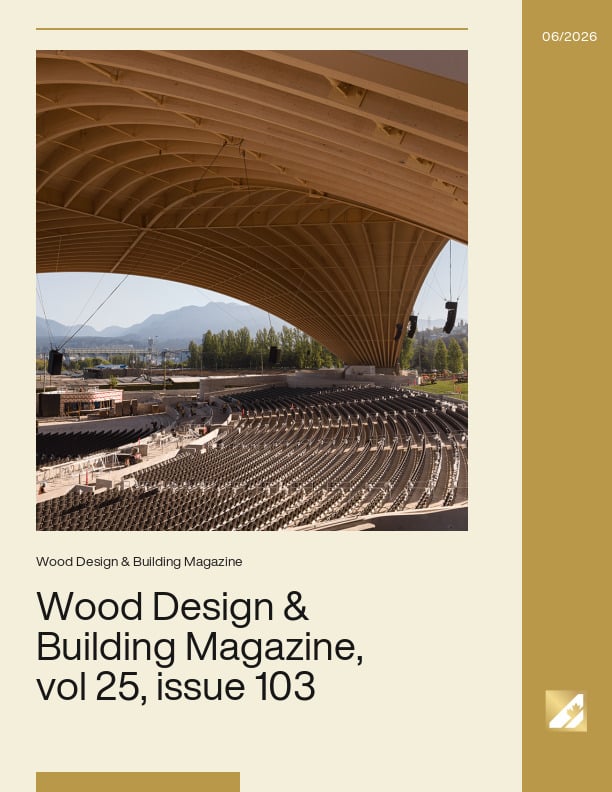
Wood Design & Building Magazine, vol 25, issue 102
Building Canada’s Future With Wood
Scaling Affordable Rental Housing with Tall Mass Timber
Unlocking Affordable Timber Innovations in Structure, Prefabrication, and Code
Webinar – Online Tools for Wood Construction: CodeCHEK, FRR & STC & EMTC Calculator
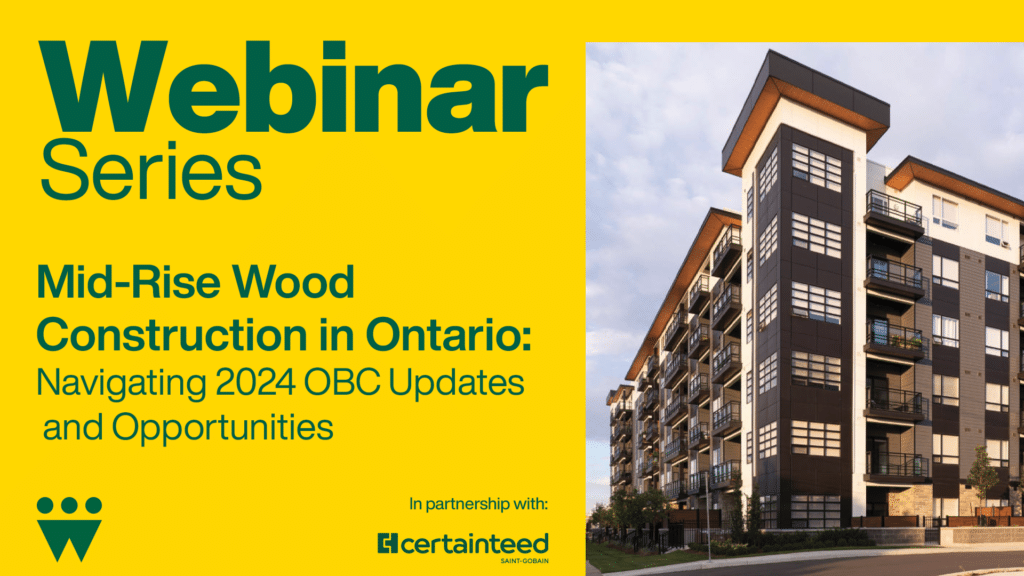
Guide to Mid-Rise Wood Construction in the Ontario Building Code
Exposed Mass Timber Calculator
WoodWorks Building Tour – Pictou County Mass Timber Buildings
Federal Call for Proposals Opens Under $500M Forest Sector Transformation Investment
Wood Design & Building Magazine – Sign Up
Wood Design & Building Magazine, vol 25, issue 101
FRAMEWORK for Success: Prefabricated Wood Systems and Design Innovation
This issue of Wood Design & Building explores how intentional design can carry culture, support community, and foster connection. The projects featured here demonstrate...
Course Overview This session will feature thought leaders in a podcast-style conversation exploring the evolving role of wood in Canadian construction. Through a series of...
Course Overview As cities face growing pressures around affordability, climate resilience and livability, innovative projects like Catalyst's 18-storey CLT rental development...
Course Overview Bond Tower is a 7-storey mixed-use prototype that asks a critical question: how can mass timber be made cost-effective in the Prairies, where supply chains...
Second Edition Applicable to the 2024 OBC (O. Reg. 163/24) – In Effect January 1, 2025 Overview The Guide to Mid-Rise Wood Construction in the Ontario Building Code (Second...
The Canadian Wood Council is pleased to introduce a new design tool: the Exposed Mass Timber Calculator. Developed to support practitioners working with encapsulated mass...
February 25, 2026 (Ottawa, ON) — The Canadian Wood Council (CWC) welcomes today’s launch of a national Call for Proposals by the Honourable Tim Hodgson, Minister of...
  Stay connected to the ideas, projects, and technical insights shaping wood design and construction across Canada and beyond. Wood Design & Building magazine is...
Every issue of Wood Design & Building tells a different story about how wood is shaping contemporary construction. Some editions revolve around a clear theme such as our...
Course Overview This presentation explores the transformative impact of prefabricated light wood frame construction systems in multi-residential development, focusing on...

Get Access to Our Resources

Stay in the loop and don’t miss a thing!

1
2
3

Get Access to Our Resources

Stay in the loop and don’t miss a thing!

What’s Your Occupation?

Help us personalize the content for you.

What Interests You the Most?

Help us personalize the content for you.

Filters

Expertise Icon
Field of Expertise
Province Icon
Province
Member Type Icon
WoodWork National Partners

Filters

Post Type Icon
Post Type
Persona Icon
Persona
Language Icon
Language
Tags Icon
Tags
Mass Timber Plus Icon Environment Plus Icon Safety Plus Icon Durability Plus Icon Design Systems Plus Icon Budget Plus Icon Construction Management Plus Icon Fire Resistance Plus Icon Tall Buildings Plus Icon Short Buildings Plus Icon
Date Icon
Date
Line Separator