en-ca

Searching for: wood

Searching results for “wood”
252 results found...
Sort By Dropdown Icon

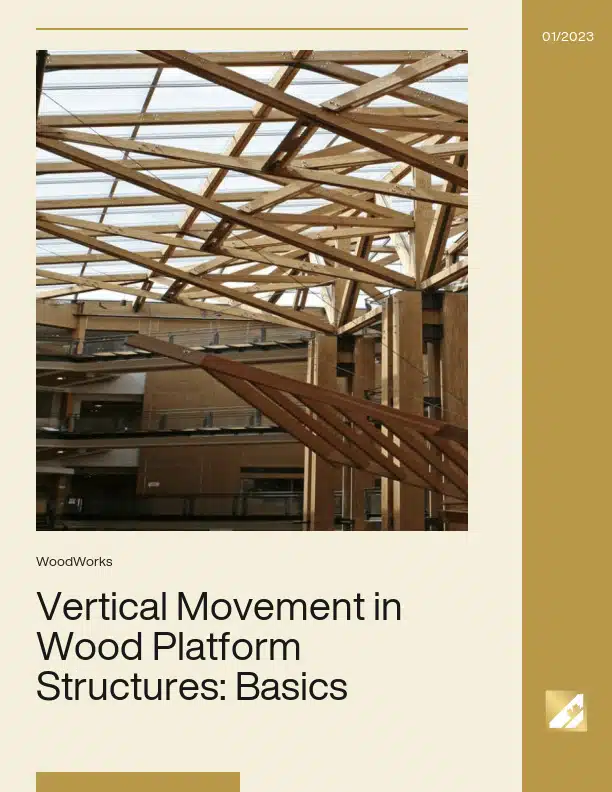
Vertical Movement in Wood Platform Structures: Basics

Movement in structures due to environmental condition changes and loads must be considered in design. Temperature changes will cause movement in concrete, steel and masonry structures. For wood materials, movement is primarily related to shrinkage or swelling caused by moisture loss or gain when the moisture content is below 28% (wood fiber saturation point). Other movement in wood structures may also include: settlement (bedding-in movement) due to closing of gaps between members and deformation due to compression loads, including instantaneous elastic deformation and creep. Differential movement can occur where wood frame is connected to rigid components such as masonry cladding, concrete elevator shafts, mechanical services and plumbing, and where mixed wood products such as lumber, timbers, and engineered wood products are used.

Evidence from long-term wood frame construction practices shows that for typical light frame construction up to three storeys high, differential movement can be relatively easily accommodated such as through specifying “S-Dry” lumber. However, differential movement over the height of wood-frame buildings becomes a very important consideration for taller buildings due to its cumulative effect. The APEGBC Technical and Practice Bulletin provides general design guidance and recommends the use of engineered wood products and dimension lumber with 12% moisture content for floor joists to reduce and accommodate differential movement in 5 and 6-storey wood frame buildings. Examples of differential movement concerns and solutions in wood-frame buildings can also be found in the Best Practice Guide published by the Canadian Mortgage and Housing Corporation and the Building Enclosure Design Guide –Wood Frame Multi-Unit Residential Buildings published by the Homeowner Protection Office of BC Housing.

This document illustrates the causes and other basic information related to vertical movement in wood platform frame buildings and recommendations on material handling and construction sequencing to protect wood from rain and reduce the vertical movement.

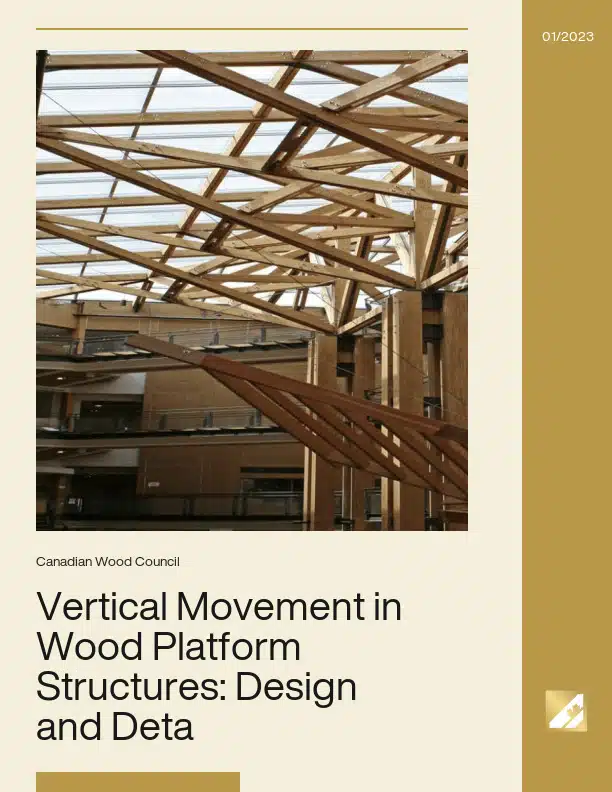
Vertical Movement in Wood Platform Structures: Design and Detailing Solutions

Most buildings are designed to accommodate a certain range of movement. In design, it is important for designers to identify locations where potential differential movement could affect structural integrity and serviceability, predict the amount of differential movement and develop proper detailing to accommodate it. To allow non-structural materials to be appropriately constructed, estimate of anticipated differential movement should be provided in the design drawings.

Simply specifying wood materials with lower MC at time of delivery does not guarantee that the wood will not get wet on construction sites and will deliver lower shrinkage amounts as anticipated. It is therefore important to ensure that wood does not experience unexpected wetting during storage, transportation and construction. Good construction sequencing also plays an important role in reducing wetting, the consequent wood shrinkage and other moisture-related issues.

Existing documents such as the APEGBC Technical and Practice Bulletin on 5- and 6-Storey Wood Frame Residential Building Projects, the Best Practice Guide published by the Canadian Mortgage and Housing Corporation (CMHC), the Building Enclosure Design Guide – Wood Frame Multi-Unit Residential Buildings published by the BC Housing- Homeowner Protection Office (HPO) provide general design guidance on how to reduce and accommodate differential movement in platform frame construction.

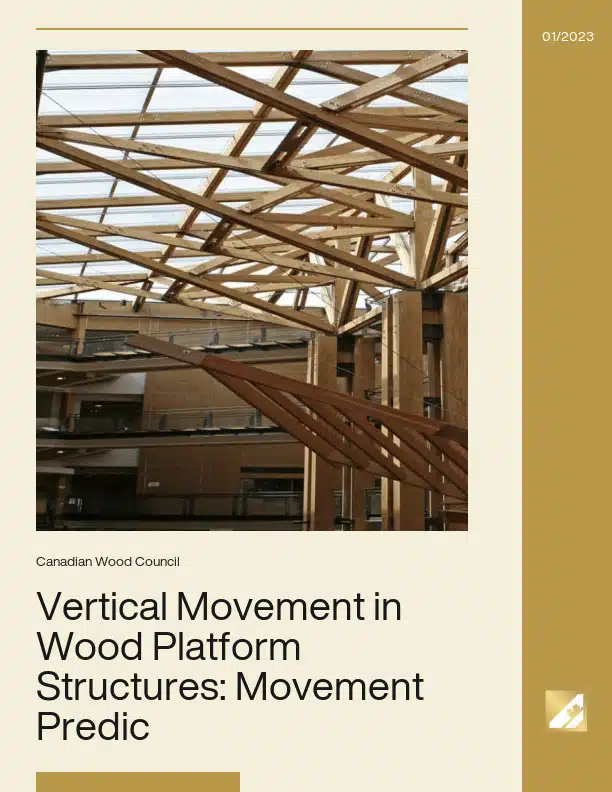
Vertical Movement in Wood Platform Structures: Movement Prediction

It is not possible or practical to precisely predict the vertical movement of wood structures due to the many factors involved in construction. It is, however, possible to obtain a good estimate of the vertical movement to avoid structural, serviceability, and building envelope problems over the life of the structure.

Typically “S-Dry” and “S-Grn” lumber will continue to lose moisture during storage, transportation and construction as the wood is kept away from liquid water sources and adapts to different atmospheric conditions. For the purpose of shrinkage prediction, it is usually customary to assume an initial moisture content (MC) of 28% for “S-Green” lumber and 19% for “S-Dry” lumber. “KD” lumber is assumed to have an initial MC of 15% in this series of fact sheets.

Different from solid sawn wood products, Engineered Wood Products (EWP) are usually manufactured with MC levels close to or even lower than the equilibrium moisture content (EMC) in service. Plywood, Oriented Strand Board (OSB), Laminated Veneer Lumber (LVL), Laminated Strand Lumber (LSL), and Parallel Strand Lumber (PSL) are usually manufactured at MC levels ranging from 6% to 12%. Engineered wood I-joists are made using kiln dried lumber (usually with moisture content below 15%) or structural composite lumber (such as LVL) flanges and plywood or OSB webs, therefore they are usually drier and have lower shrinkage than typical “S-Dry” lumber floor joists. Glued-laminated timbers (Glulam) are manufactured at MC levels from 11% to 15%, so are the recently-developed Cross-laminated Timbers (CLT). For all these products, low shrinkage can be achieved and sometimes small amounts of swelling can be expected in service if their MC at manufacturing is lower than the service EMC. In order to fully benefit from using these dried products including “S-Dry” lumber and EWP products, care must be taken to prevent them from wetting such as by rain during shipment, storage and construction. EWPs may also have lower shrinkage coefficients than solid wood due to the adhesives used during manufacturing and the more mixed grain orientations in the products, including the use of cross-lamination of veneers (plywood) or lumber (CLT). The APEGBC Technical and Practice Bulletin emphasizes the use of EWP and dimension lumber with 12% moisture content for the critical horizontal members to reduce differential movement in 5 and 6-storey wood frame buildings.

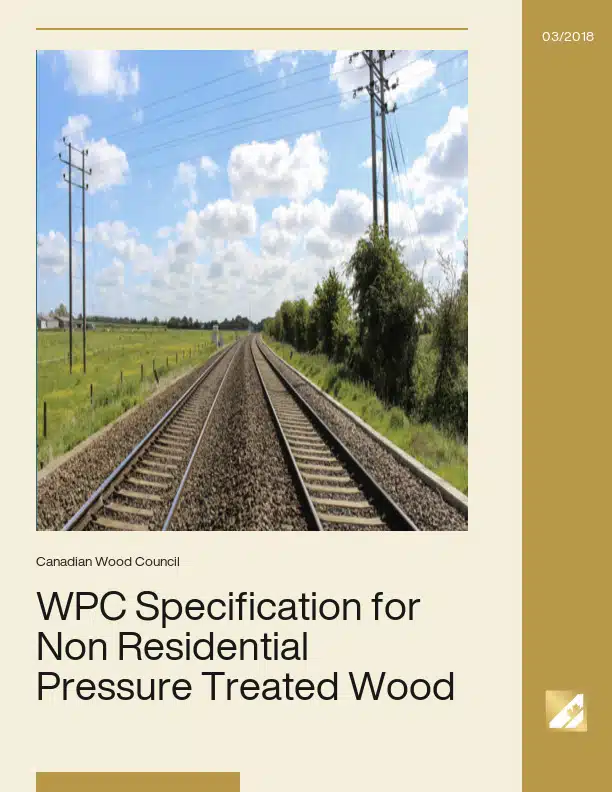
WPC Specification Guide for Non Residential Pressure Treated Wood Products Web

Wood is the only renewable building material within the three major building material types. In exterior applications, wood is subject to deterioration from natural elements and biological attack, but when properly protected, its service life can be extended for many years. The most effective way of protecting exposed wood is the use of wood preservatives. Preserved wood products can have 5 to 10 times the service life of untreated wood. This extension of life saves the equivalent of 12.5% of Canada’s annual log harvests (source durable-wood.com). The preservation of the wood is important, especially when it is specified for use in critical infrastructure applications such as railway ties, bridge timbers, utility poles and guardrail posts for highways. Pressure treated wood ensures that these critical structures remain strong and safe for the duration of their service lives. Pressure treated wood products are also commonly used in agricultural applications such fence rails, posts and building poles, as well as in commercial decks, fences, and other heavy duty outdoor applications. Depending on the required application and the level of protection needed for the wood products, there are a variety pressure treatment methods and approved preservatives that are available in Canada. Pressure treatment is a process that forces preservatives into the wood to protect against fungal decay and destructive insects such as termites and marine borers. In Canada, wood preservatives are registered with Health Canada’s Pest Management Regulatory Agency (PMRA). Individual treating facilities undergo regular environmental assessments and follow the recommendations for the design and operation of wood preservative facilities as outlined in Environment Canada’s Technical Recommendation Document (TRD).

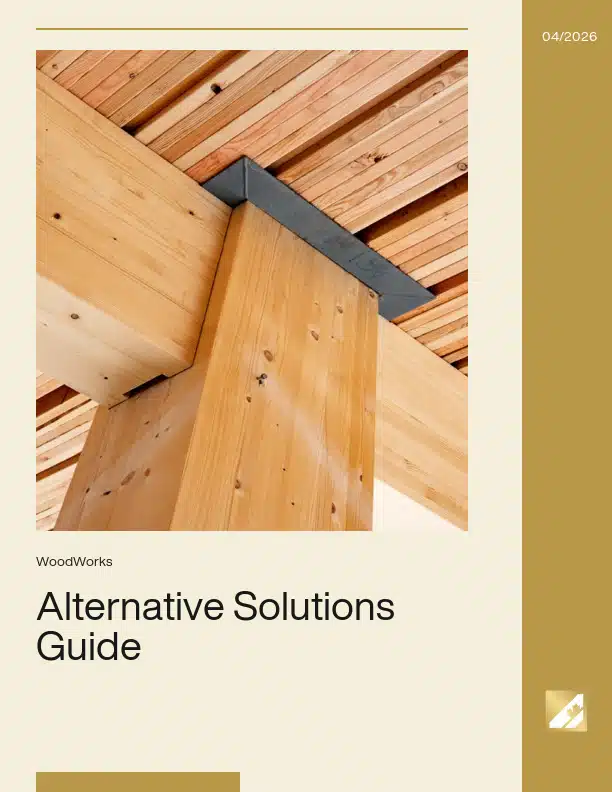
Alternative Solutions Guide

While alternative solutions have been an important feature of the National Building Code of Canada since 2005, there remains a lack of understanding among building professionals on how to approach their use. As the construction industry evolves, with increasing innovation in design and construction capabilities, new ways of building that may not be well addressed by building codes will emerge. At the same time, tools for performance testing and simulation are becoming more widespread. In light of the diverse and evolving building industry, alternative solutions that enable new ways of building are likely to become more commonplace. A critical area where alternative solutions may be employed is in the use of mass timber construction. The introduction of mass timber construction techniques, enabled by a range of engineered wood products, associated connection technologies, and fabrication methods, has resulted in a wide range of possible building solutions that may not have been considered by building codes.

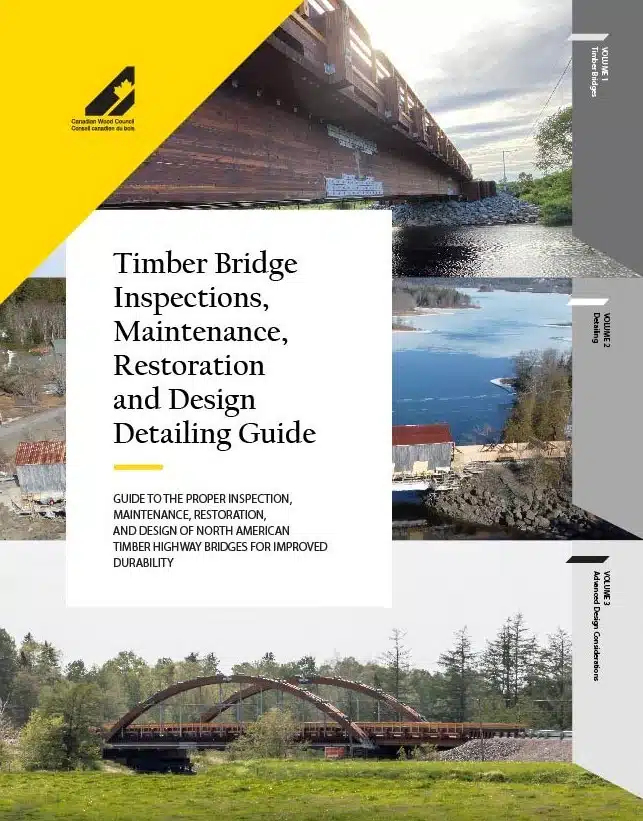
Timber Bridge Inspection, Maintenance, Restoration and Design Detailing Guide

This 3-volume guide on timber bridge inspection, maintenance, restoration, and detailing covers everything you need to know about detailing durable wood bridges, starting with a thorough description of wood’s unique and often advantageous properties, and concluding with advanced topics that will be of interest to engineers world-wide.

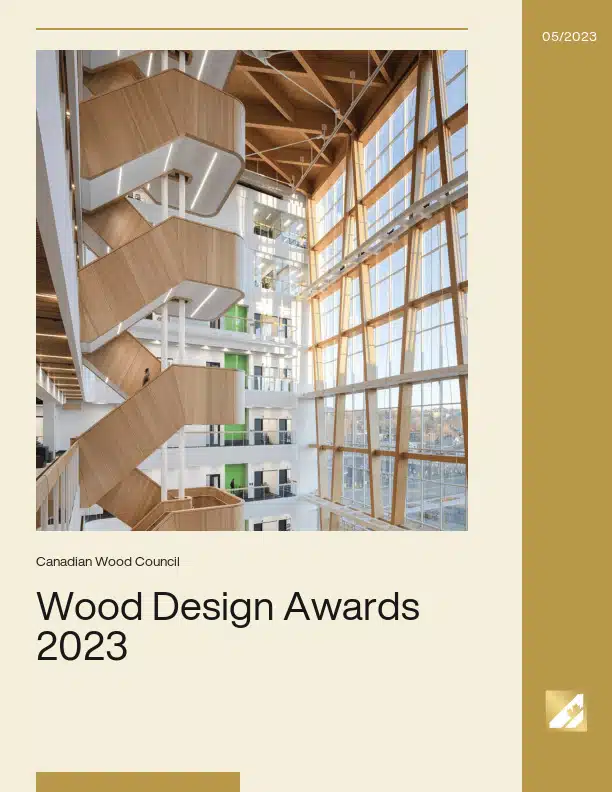
Wood Design Awards, 2023

Promoting Health and Wellness with Wood Architecture

The year 2020 will forever be synonymous with COVID-19. After experiencing the pandemic and its ripple effects, few would question the importance of health and wellness. What people may not consider is the impact that our surrounding environments have on our health. Research shows that incorporating wood and other natural elements into buildings can have a positive effect on occupants’ overall health and well-being. The term for this effect is called biophilia, which refers to humanity’s innate need to connect with nature.

Many industries are embracing biophilic design and its benefits. Employers are eager to create inviting spaces for their teams, hospital designs have shifted from cold and industrial-like to bright environments with wayfinding elements, and homeowners are expanding their living spaces with decks, fences, and pergolas so they can gather with friends and family outdoors. The wellness impacts of wood extend beyond the biophilic advantages of finished spaces. Mass timber buildings also benefit workers throughout the construction process by reducing construction time, and prefabricated elements contribute to cleaner, safer building sites.

The team at the Canadian Wood Council/Wood WORKS! is committed to providing design and construction professionals with the tools and information needed to build with wood. We’re going taller, we’re getting bigger, and, from coast to coast, we’re not stopping. Building with wood is the right choice, for the environment and for everyone’s well-being.

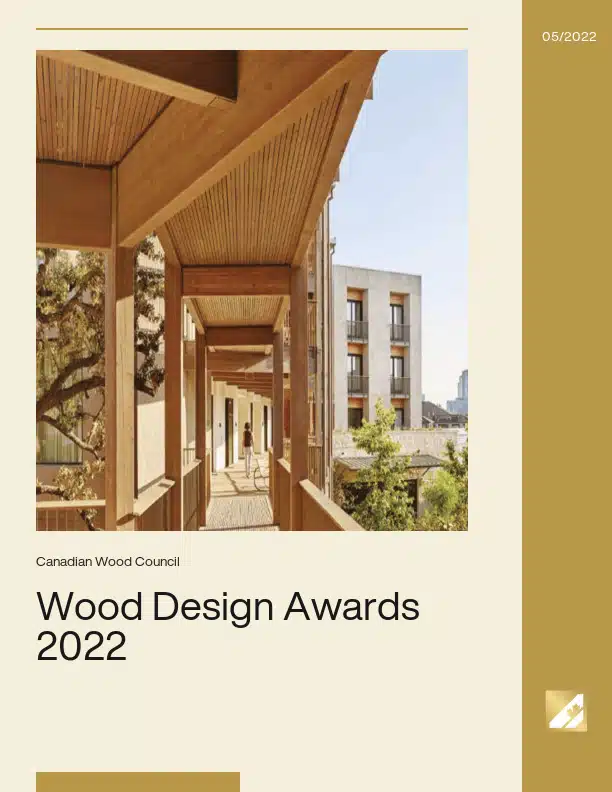
Wood Design Awards, 2022

Specification Guide for Non-Residential Pressure Treated Wood Products

Wood is the only renewable building material within the three major building material types. In exterior applications, wood is subject to deterioration from natural elements and biological attack, but when properly protected, its service life can be extended for many years. The most effective way of protecting exposed wood is the use of wood preservatives. Preserved wood products can have 5 to 10 times the service life of untreated wood. This extension of life saves the equivalent of 12.5% of Canada’s annual log harvests (source durable-wood.com).

The preservation of the wood is important, especially when it is specified for use in critical infrastructure applications such as railway ties, bridge timbers, utility poles and guardrail posts for highways. Pressure treated wood ensures that these critical structures remain strong and safe for the duration of their service lives. Pressure treated wood products are also commonly used in agricultural applications such fence rails, posts and building poles, as well as in commercial decks, fences, and other heavy duty outdoor applications. Depending on the required application and the level of protection needed for the wood products, there are a variety pressure treatment methods and approved preservatives that are available in Canada.

Pressure treatment is a process that forces preservatives into the wood to protect against fungal decay and destructive insects such as termites and marine borers. In Canada, wood preservatives are registered with Health Canada’s Pest Management Regulatory Agency (PMRA). Individual treating facilities undergo regular environmental assessments and follow the recommendations for the design and operation of wood preservative facilities as outlined in Environment Canada’s Technical Recommendation Document (TRD).

Wood Design Awards, 2021

Low-Rise Commercial Construction in Wood

Across Canada, the low-rise non-residential sector—think offices, retail stores, warehouses, and restaurants—presents a major growth opportunity for structural wood systems, including light wood-frame, heavy timber, mass timber, and hybrid construction.

Together, retail, office, and light industrial warehouse buildings account for nearly 75% of new floor space in this market each year. Yet despite their scale, these segments continue to show low uptake of structural wood.

As retailers adapt to the shift toward online shopping and businesses compete to attract talent, the design and performance of their buildings matter more than ever. Wood offers a sustainable, visually appealing solution that enhances employee well-being and elevates commercial spaces.

This new technical publication explores the market potential, challenges, and the role wood can play in redefining this sector.

Termites
...flying ants by the equal size of all four termite wings. Three types of termites can be distinguished on the basis of their moisture requirements: Damp-wood termites Dry-wood termites Subterranean...
Controlling Termites
...and regional building codes, an overview of such measures may be of use to Canadian marketers of wood products and manufactured homes. Termite control measures can be broadly grouped into...
Applying Treatment
...other holes or penetrations, checks and delaminations. Moisture flow in wood may be 100 to 1000 times faster along than across the grain. Patterns of moisture distribution in wood are...
Preservative Treated Wood
...www.durable-wood.com Wood Preservation Canada Canadian Wood Preservation Association CSA O80 Series Wood preservation CSA O86 Engineering design in wood Pest Management Regulatory Agency of Health Canada American Wood Protection Association...
Canadian Species
Canadian species of visually graded lumber There are more than a hundred softwood species in North America. To simplify the supply and use of structural softwood lumber, species having similar...
Adhesives
Adhesives can also be referred to as resins. Many engineered wood products, including finger-joined lumber, plywood, oriented strand board (OSB), glulam, cross-laminated timber (CLT), wood I-joists and other structural composite...
Bolts
Bolts are widely used in wood construction. They are able to resist moderately heavy loads with relatively few connectors. Bolts may be used in wood-to-wood, wood-to-steel and wood-to-concrete connection types....
Framing Connectors
...of Canada CSA S347 Method of Test for Evaluation of Truss Plates used in Lumber Joints ASTM D1761 Standard Test Methods for Mechanical Fasteners in Wood Canadian Wood Truss Association...
Nails
Nailing is the most basic and most commonly used means of attaching members in wood frame construction. Common nails and spiral nails are used extensively in all types of wood...
Screws
...screws commonly used are shown in Figure 5.4, below. For more information on wood screws, refer to the following resources: ASME B18.6.1 Wood Screws CSA O86 Engineering design in wood...
Timber Joinery
...the ends of timbers are carved out so that they fit together like puzzle pieces. The variations and configurations of wood-to-wood joints is quite large and complex. Some common wood-to-wood...
OSB
Oriented Strand Board (OSB)
...on OSB, please refer to the following resources: APA – The Engineered Wood Association National Building Code of Canada CSA O86 Engineering design in wood CSA O325 Construction sheathing CSA...
The Mid-Rise project and the ensuing publication were conceived in order to provide a guide for opportunities that have been created by Canadian Code Provisions progressing...
The rate at which flame spreads on the exposed interior surfaces or a room or space can have an impact on the rate of fire growth within an area, especially if the materials...
The vulnerability of any building, regardless of the material used, in a fire situation is higher during the construction phase when compared to the susceptibility of the...
Climate change is one of the largest threats facing the planet today. The construction industry accounts for 11% of global carbon emissions, playing a significant part in the...
As land values continue to rise, particularly in higher-density urban environments, schools with smaller footprints will become increasingly necessary to satisfy enrollment...
The Wood Design Manual is the Canadian reference on the design of timber structures, under gravity and lateral loadings, according to Part 4 of the National Building Code of...
As land values continue to rise, particularly in higher-density urban environments, schools with smaller footprints will become increasingly more necessary to satisfy...
Calgary’s aspirations to become a world-class city are supported by its recent investments in infrastructure and architecture, including the $192-million Shane Homes YMCA...
When the provincial government changed the British Columbia Building Code (BCBC) in 2009 by increasing the permissible height for wood-frame construction from four storeys to...

Get Access to Our Resources

Stay in the loop and don’t miss a thing!

1
2
3

Get Access to Our Resources

Stay in the loop and don’t miss a thing!

What’s Your Occupation?

Help us personalize the content for you.

What Interests You the Most?

Help us personalize the content for you.

Filters

Expertise Icon
Field of Expertise
Province Icon
Province
Member Type Icon
WoodWork National Partners

Filters

Post Type Icon
Post Type
Persona Icon
Persona
Language Icon
Language
Tags Icon
Tags
Mass Timber Plus Icon Environment Plus Icon Safety Plus Icon Durability Plus Icon Design Systems Plus Icon Budget Plus Icon Construction Management Plus Icon Fire Resistance Plus Icon Tall Buildings Plus Icon Short Buildings Plus Icon
Date Icon
Date
Line Separator