

R-Town Vertical 6 | Mass Timber Midrise

The R-Town V6 pilot project is the first 6-storey, mixed-use, multi-unit residential building developed in Ontario that fully employs mass timber as the main structural system. The energy-efficient wood building was designed to Passive House standards and built with lower embodied carbon materials. The decision to use Cross Laminated Timber (CLT) for the elevator cores and exit stair enclosures helped simplify the build by eliminating the challenge of integrating a noncombustible core into a wood building. It required the team to obtain approval for an alternative solution because this approach to construction currently falls outside the prescriptive requirements for 6-storey combustible construction in Ontario’s building code. It was the development team’s vision to bring the benefits of offsite manufacturing to the midrise market in Toronto and the panelized, tallwood design developed for R-Town V6 streamlined the assembly process and successfully demonstrated proof of concept for challenging infill developments. This modern approach to construction accelerates and improves project delivery and the versatile, repeatable design contributes to a sustainable and much-needed increase in density along urban arterial roads, creating more attractive, desirable housing in established, walkable neighbourhoods.
The Roger Bacon Bridge – Nappan, Nova Scotia

The Roger Bacon bridge, in Nappan, Nova Scotia, opened in December 2019. The new bridge, named after a former local MLA and provincial premier, reopened after two years of closure. The former Nappan bridge had succumbed to the elements and had to be closed to traffic in 2017. It has since been replaced with the longest clear span, three-lane design timber bridge in Canada. The 40-meter span bridge provides a direct link between the towns of Amherst and Springhill on Nova Scotia provincial highway 2. The new bridge uses pressure treated glue laminated timber (glulam) arch construction that is significantly lighter in weight and more resistant to the local environmental conditions than competing structural materials. With an estimated service life of 75 years, the total cost of the bridge replacement project was $3 million.
Red Deer College Student Residence – Red Deer, Alberta
Red Deer College (RDC) Student Residence is a 5,800-sq.m. (60,000-sq.ft.), five-storey wooden structure with 145 units, designed and completed to meet the 300-bed demand for the Canada Winter Games in early 2019. RDC envisioned a building that would be a welcoming, fun home base for students; the college was well aware that isolation and lack of community support for students have a negative influence on their ability to perform in the classroom and can negatively impact their mental health and well-being. The goal was to create a “residence” that felt more like a home. Manasc Isaac Architects, led by Vedran Škopac, proposed a hybrid between a student residence and a set of seven distinct “public gathering spaces,” scattered around the perimeter of all five storeys of the building. As part of the plan, Škopac’s team increased the conventional amount of social space by a factor of 10. The residence also functions as a hotel, providing accommodation for short- and longterm visits. Another design mandate was to incorporate sustainable features, which influenced the decision to utilize a wood structure with a high performance building envelope that maximizes thermal performance and comfort. With a construction budget of $18.5 million, funding allowed for photovoltaic panels cladding the east, south and west faces, which provides approximately 45 percent of all energy the student residence requires. Although the building was not aiming for certification, it was designed to a LEED Gold standard. As an example of an innovative approach to dormitory housing, Red Deer College Student Residence prioritizes quality of life and sustainability, while using mass timber construction to achieve both goals. These are some of the reasons it won a 2019 Wood Design & Building Canadian Wood Council Award.
Wood in Civic Buildings
This case study examines two wood buildings, both with primary retail commercial occupancies, but which employ different mass timber products to achieve very different effects. Askew’s Uptown Supermarket in Salmon Arm, BC, features an expansive nail-laminated timber (NLT) roof that appears to float above the retail floor (Figure 1.1), while the Whistler Community Services Society Building in Whistler, BC, uses a robust, utilitarian exposed glued-laminated timber (glulam) and cross-laminated timber (CLT) structure as befits the building’s industrial setting (Figure 1.2). In April 2019 John Horgan, Premier of British Columbia, announced a new directive to require municipalities and the BC government to strongly consider the use of wood in public buildings, both as a structural material and for interior finishes. The goal of this initiative is to increase demand for BC’s wood products and to assist the forest industry in dealing with the significant impacts of climate change. To date, these have included the mountain pine beetle infestation and an increase in the frequency and severity of forest fires, both of which have had widespread negative consequences for the industry across the province. When announcing the initiative, Premier Horgan stated: “We will expect the result to maximize the potential of the existing timber supply, maintain jobs, incorporate First Nations’ interests, and address the economic, cultural, recreational and other uses of BC’s land base.” New engineered mass timber products, supported by new legislation, now make it possible for wood to be used in a wide range of projects, both urban and rural. This case study showcases two recent projects that illustrate the value and versatility of wood, both in its response to technical challenges and in its contribution to economic and social sustainability in communities around the province. In Vancouver, Fire Hall No. 5 (Figure 1.1) is an example of an innovative response to rising land costs and the shortage of affordable social housing; while in the Kootenay village of Radium Hot Springs, a wealth of local wood products, manufacturing capabilities and craft skills combine in a community hall and library that can truly be called a ‘100-mile building’ (Figure 1.2).
80 Atlantic Avenue – Toronto, Ontario

Ontario’s first mass timber commercial building in over 100 years, 80 Atlantic pioneers a new urban office typology for potentially many more timber-frame projects across the province, and the country. Comprising four storeys of mass timber above a one-storey concrete podium, the 8,825-sq.m. (95,000-sq.ft.) building completes a courtyard with 60 Atlantic to create a paired commercial development. Revisions to the Ontario Building Code in 2015 made it possible to build commercial wood buildings up to six storeys high. The developer and architect saw this as an opportunity to demonstrate leadership in the rapidly developing field of mass timber, and to attract tenants seeking a premium workplace environment associated with innovation and sustainability. The client requested that the building harmonize with the Liberty Village neighbourhood, noted for its wealth of converted factories and warehouses, which attract high-calibre, creative tenants in this section of downtown Toronto.
Green Gables Visitors’ Centre – Cavendish, PE

Mark Twain called Anne of Green Gables, “The sweetest creation of child life yet written.” He sent the author Lucy Maud Montgomery a letter of praise, congratulating her on her writing. This was over 100 years ago and, ever since, the story of Anne has captured the imaginations of people from all over the world. Green Gables, the name of a 19th-century farm in Cavendish, Prince Ed – ward Island, is the setting for the popular Anne of Green Gables novels by L.M. Montgomery. The property has become one of the most visited Federal Parks in Canada, and an iconic tourist destination. Visitors travel here to reconnect with their own childhood memories of Anne, or to create new ones. Part of Parks Canada since the 1930s, the property includes the main Green Gables house, the Haunted Wood trail and Lovers Lane. A 2015 study revealed a need for more exhibit space and enhanced amenities on site to not only tell the story of Anne, but also that of her creator, Lucy Maud Montgomery. Parks Canada acted on the study by creating an extensive program which would be constructed in three distinct phases. Phase I was completed in the spring of 2017. The Green Gables Visitors’ Centre, Phase II, consisting of an exhibit hall, gift shop, ticket/ information areas, offices and new washrooms and lobby, was completed in the spring of 2019. Phase III was to decommission the temporary gift shop in Phase I and transform it into a new café and commercial kitchen.
Wood in Commercial Buildings
In 2009, the British Columbia Building Code (BCBC) was amended to permit residential buildings of up to six storeys to be constructed in wood. Since then, through a five-year code process of consultation and research, the potential for expanding these provisions to other building occupancies has been under consideration at the national code level. Changes introduced in the 2015 edition of the National Building Code of Canada (NBC) and adopted in British Columbia in 2018, have expanded these provisions to office-type buildings, but also permit mixed-type occupancies on the first two storeys. As a result, wood building types now include office, residential, mercantile, assembly, low hazard or storage/ garage uses. This case study examines two wood buildings, both with primary retail commercial occupancies, but which employ different mass timber products to achieve very different effects. Askew’s Uptown Supermarket in Salmon Arm, BC, features an expansive nail-laminated timber (NLT) roof that appears to float above the retail floor (Figure 1.1), while the Whistler Community Services Society Building in Whistler, BC, uses a robust, utilitarian exposed glued-laminated timber (glulam) and cross-laminated timber (CLT) structure as befits the building’s industrial setting (Figure 1.2).
Laurentian University McEwen School of Architecture – Sudbury, ON
Located in Sudbury, Ontario, Laurentian University’s McEwen School of Architecture is the first new school of architecture to be built in Canada in 40 years. Its mandate is to provide a uniquely integrated, uniquely focused education to Indigenous, Anglophone, and Francophone students. It is the only school of architecture outside of Québec to offer French-language studio courses, and the first to include offices for Indigenous Elders, who play a central role in the school. The curriculum addresses resilient architecture and fabrication techniques for northern latitudes, with an emphasis on Indigenous culture, wood construction, local ecologies and resources, and design for the impact of climate change. The school is a didactic instrument with structural and HVAC design elements purposefully exposed in each of the various buildings. The multi-phase development of the McEwen school began with the adaptive reuse of the site’s two existing heritage structures. The two storey CPR ticket and telegraph building (circa 1914) became faculty offices and a boardroom, and the single-storey market building became a temporary studio before ultimately transforming into the fabrication laboratory once the new studio spaces were constructed. Phase two of the project included the construction of a 36,480 ft2 steel-and-concrete Studio Wing, and the new 15,670 ft2 CLT Library Wing which is the focus of this case study. By combining the two repurposed heritage buildings with 52,150 ft2 of new construction, the McEwen School of Architecture demonstrates the properties of wood, steel, concrete, and masonry construction, and illustrates to students the structural potential and aesthetic qualities of each.
IBS4 – Sustainability and Life Cycle Analysis for Residential Buildings
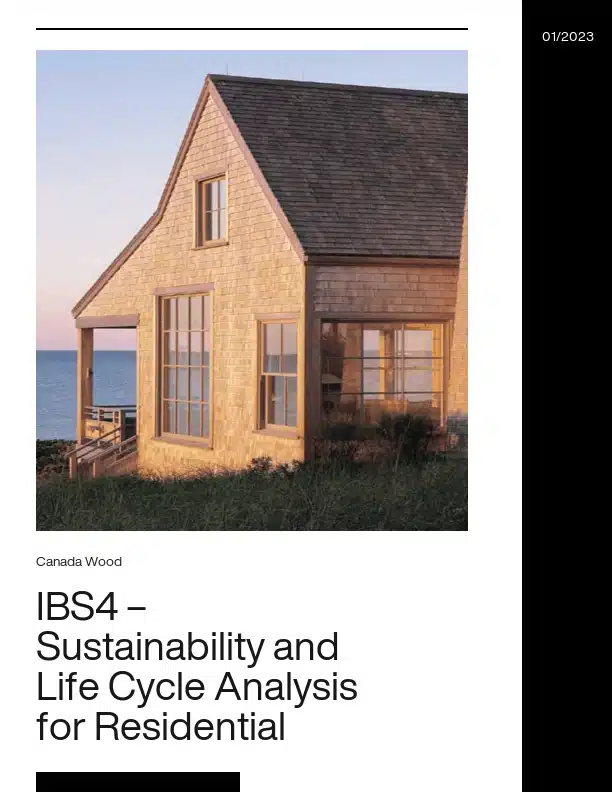
Environmental awareness in building design, construction and operation is stronger than ever. But how can we meet the world’s rapidly growing need for buildings and still be environmentally responsible? Although construction is never fully benign for the environment, designers and builders can make choices to minimize the impact. Wood plays an important part in sustainable design, as shown by scientific analysis.
Vertical Movement in Wood Platform Structures: Basics
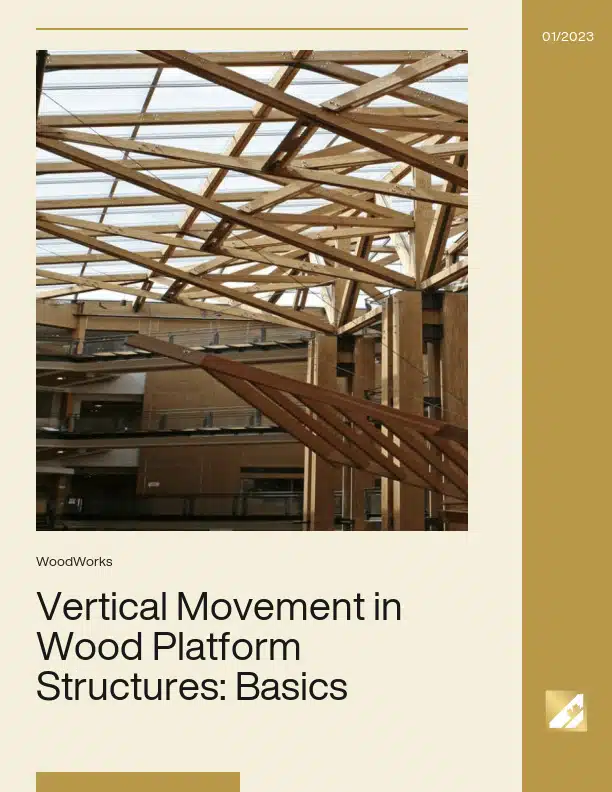
Movement in structures due to environmental condition changes and loads must be considered in design. Temperature changes will cause movement in concrete, steel and masonry structures. For wood materials, movement is primarily related to shrinkage or swelling caused by moisture loss or gain when the moisture content is below 28% (wood fiber saturation point). Other movement in wood structures may also include: settlement (bedding-in movement) due to closing of gaps between members and deformation due to compression loads, including instantaneous elastic deformation and creep. Differential movement can occur where wood frame is connected to rigid components such as masonry cladding, concrete elevator shafts, mechanical services and plumbing, and where mixed wood products such as lumber, timbers, and engineered wood products are used. Evidence from long-term wood frame construction practices shows that for typical light frame construction up to three storeys high, differential movement can be relatively easily accommodated such as through specifying “S-Dry” lumber. However, differential movement over the height of wood-frame buildings becomes a very important consideration for taller buildings due to its cumulative effect. The APEGBC Technical and Practice Bulletin provides general design guidance and recommends the use of engineered wood products and dimension lumber with 12% moisture content for floor joists to reduce and accommodate differential movement in 5 and 6-storey wood frame buildings. Examples of differential movement concerns and solutions in wood-frame buildings can also be found in the Best Practice Guide published by the Canadian Mortgage and Housing Corporation and the Building Enclosure Design Guide –Wood Frame Multi-Unit Residential Buildings published by the Homeowner Protection Office of BC Housing. This document illustrates the causes and other basic information related to vertical movement in wood platform frame buildings and recommendations on material handling and construction sequencing to protect wood from rain and reduce the vertical movement.
Vertical Movement in Wood Platform Structures: Design and Detailing Solutions
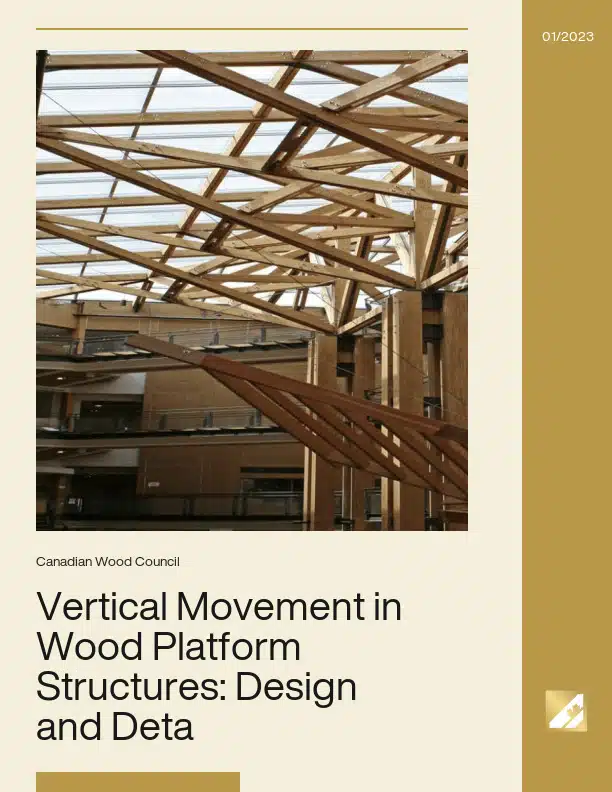
Most buildings are designed to accommodate a certain range of movement. In design, it is important for designers to identify locations where potential differential movement could affect structural integrity and serviceability, predict the amount of differential movement and develop proper detailing to accommodate it. To allow non-structural materials to be appropriately constructed, estimate of anticipated differential movement should be provided in the design drawings. Simply specifying wood materials with lower MC at time of delivery does not guarantee that the wood will not get wet on construction sites and will deliver lower shrinkage amounts as anticipated. It is therefore important to ensure that wood does not experience unexpected wetting during storage, transportation and construction. Good construction sequencing also plays an important role in reducing wetting, the consequent wood shrinkage and other moisture-related issues. Existing documents such as the APEGBC Technical and Practice Bulletin on 5- and 6-Storey Wood Frame Residential Building Projects, the Best Practice Guide published by the Canadian Mortgage and Housing Corporation (CMHC), the Building Enclosure Design Guide – Wood Frame Multi-Unit Residential Buildings published by the BC Housing- Homeowner Protection Office (HPO) provide general design guidance on how to reduce and accommodate differential movement in platform frame construction.
Vertical Movement in Wood Platform Structures: Movement Prediction
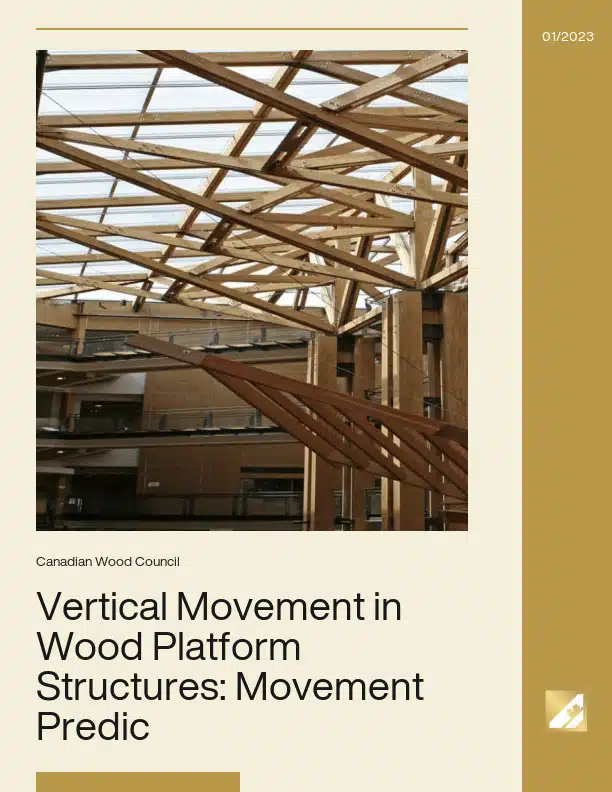
It is not possible or practical to precisely predict the vertical movement of wood structures due to the many factors involved in construction. It is, however, possible to obtain a good estimate of the vertical movement to avoid structural, serviceability, and building envelope problems over the life of the structure. Typically “S-Dry” and “S-Grn” lumber will continue to lose moisture during storage, transportation and construction as the wood is kept away from liquid water sources and adapts to different atmospheric conditions. For the purpose of shrinkage prediction, it is usually customary to assume an initial moisture content (MC) of 28% for “S-Green” lumber and 19% for “S-Dry” lumber. “KD” lumber is assumed to have an initial MC of 15% in this series of fact sheets. Different from solid sawn wood products, Engineered Wood Products (EWP) are usually manufactured with MC levels close to or even lower than the equilibrium moisture content (EMC) in service. Plywood, Oriented Strand Board (OSB), Laminated Veneer Lumber (LVL), Laminated Strand Lumber (LSL), and Parallel Strand Lumber (PSL) are usually manufactured at MC levels ranging from 6% to 12%. Engineered wood I-joists are made using kiln dried lumber (usually with moisture content below 15%) or structural composite lumber (such as LVL) flanges and plywood or OSB webs, therefore they are usually drier and have lower shrinkage than typical “S-Dry” lumber floor joists. Glued-laminated timbers (Glulam) are manufactured at MC levels from 11% to 15%, so are the recently-developed Cross-laminated Timbers (CLT). For all these products, low shrinkage can be achieved and sometimes small amounts of swelling can be expected in service if their MC at manufacturing is lower than the service EMC. In order to fully benefit from using these dried products including “S-Dry” lumber and EWP products, care must be taken to prevent them from wetting such as by rain during shipment, storage and construction. EWPs may also have lower shrinkage coefficients than solid wood due to the adhesives used during manufacturing and the more mixed grain orientations in the products, including the use of cross-lamination of veneers (plywood) or lumber (CLT). The APEGBC Technical and Practice Bulletin emphasizes the use of EWP and dimension lumber with 12% moisture content for the critical horizontal members to reduce differential movement in 5 and 6-storey wood frame buildings.


