
Explore how BC cities are advancing mass timber through planning policies, permitting reforms, sustainability goals, and housing.

en-ca
Popular Topics: Get Started Mass Timber Fire Safety Sustainability Events
Filters


Explore how BC cities are advancing mass timber through planning policies, permitting reforms, sustainability goals, and housing.

Mass Timber Insurance Action Plan – Phase 1 Report examines one of the most significant barriers to scaling mass timber construction in Canada: access to affordable and reliable insurance.
While mass timber offers clear advantages in sustainability, performance, and long-term value, course-of-construction insurance rates remain disproportionately high—often several times those of concrete and steel—driven largely by limited data and insurer unfamiliarity rather than demonstrated risk.
Led by the Climate Smart Buildings Alliance and the Canadian Wood Council, and supported by Natural Resources Canada, this report summarizes the findings from Phase 1 of a national action plan developed in collaboration with insurance and building industry stakeholders. It evaluates the feasibility of four targeted solutions focused on data sharing, insurer-relevant research, contractor verification, and expanding insurance capacity.
Bringing together technical insight and industry perspectives, the report outlines practical pathways to reduce risk perception, improve market confidence, and unlock greater adoption of mass timber construction across Canada.

Tall Wood Feasibility Study: Mass Timber and Concrete explores the economic, construction, and environmental performance of a proposed 12-storey residential development in Dartmouth, Nova Scotia.
Developed through a side-by-side comparison of optimized mass timber and concrete schemes, this study examines how material choice influences project cost, schedule, financial returns, and embodied carbon. Beyond a direct cost comparison, it provides insight into how mass timber can support construction efficiency, earlier occupancy, long-term asset value, and meaningful product differentiation in the rental market.
The publication includes detailed analysis of design strategy, risk mitigation, development economics, scheduling, and structural carbon impacts—offering developers, investors, designers, and project teams practical data that demonstrates the viability of tall wood construction at this scale.

This issue of Wood Design & Building explores how intentional design can carry culture, support community, and foster connection. The projects featured here demonstrate how a clear vision can transform a building into an environment grounded in purpose, identity, and care, reflecting both people and place.
Several projects in this issue centre Indigenous perspectives and priorities. The Membertou First Nation office building, the Weliankweyasimk Women’s Shelter, and the Chief Leonard George residential building each reflect cultural knowledge, respond to community needs, and create spaces of safety, continuity, and belonging.
Wood is a consistent presence throughout. Long associated with shelter and refuge, it is also a material of gathering, warmth, and shared experience. It is no coincidence that projects grounded in human wellbeing so often turn to wood. This connection is present in many cultures. Our WoodWare feature on FinnFox, for example, highlights the part wooden saunas play supporting health and building community in Nordic (and Canadian) sauna culture.
At the same time, building with wood is not simply a return to the past. While it reconnects us with cultural knowledge and longstanding practices, it also reflects a growing recognition of wood as a high-performance, renewable material for contemporary construction. This is evident in the Chief Leonard George Building, Canada’s first tall mass timber residential building constructed to the Passive House standard. It demonstrates how thoughtful wood design can both preserve cultural continuity and point toward the future of high-performance, low-carbon construction.

Every issue of Wood Design & Building tells a different story about how wood is shaping contemporary construction. Some editions revolve around a clear theme such as our recent issue on strategic additions and adaptive reuse; others, like this one, reflect the diversity of challenges, innovations, and contexts that define wood construction today. What unites the features in this issue is not a single building type or region, but a shared commitment to thoughtful planning, ingenuity, and execution.
We begin in the mountains of British Columbia, where the Robson Cabin project pushes the limits of planning and coordination. Accessible only by helicopter, the remote alpine site demanded meticulous preparation, high levels of prefabrication, and an unwavering attention to detail. Alongside the technical complexity, the construction crew also contended with less predictable site conditions—including a persistent population of porcupines, whose curiosity added a memorable twist to an already remarkable build.
From there, we turn to one of the most sought-after—and often elusive—topics in the industry: cost. Reliable, project-specific costing data for mass timber buildings remains rare, and cost uncertainty can be a barrier to wider adoption of mass timber construction. This issue features an overview of a new mass timber business case study published by WoodWorks BC, which presents detailed cost, schedule, and design data from three projects. By comparing mass timber systems to conventional construction approaches across three building types, the study offers valuable insight into real-world construction costs, decision-making, and the strategies that can bring mass timber into cost parity.
Our final feature takes us to Trenton, Nova Scotia, for a virtual construction tour of the Pictou County Sports Heritage Hall of Fame, a community-focused project being realized through close collaboration between designers, builders, and trades. The one-storey building brings together panelized engineered wood walls, traditional light wood frame construction, and a central mass timber foyer, showcasing a deliberate “right material in the right place” approach. Built using offsite fabrication and carefully sequenced installation, the project demonstrates how coordination and precision can be leveraged to deliver a refined wood building that balances efficiency, constructability, and architectural expression.
Together, these stories offer a snapshot of a sector defined by creativity, technical rigor, and resilience—whether navigating rugged mountain terrain, unpacking the realities of construction costs, or reimagining how cultural buildings are delivered. We hope they inform, inspire, and perhaps even entertain.

The Nordic X-Lam Technical Guide is a comprehensive technical resource for architects, engineers, and construction professionals designing with cross-laminated timber (CLT) systems from Nordic Structures. The guide provides essential information to support the effective specification and integration of Nordic X-Lam panels in mass timber buildings.
The document details panel properties, structural performance, and typical applications, with guidance on sizing, spans, loading conditions, and connections. It also addresses key design considerations including fire performance, acoustics, vibration, and building code compliance, helping project teams evaluate system suitability across a range of project types.
Developed as a practical design reference, the Nordic X-Lam Technical Guide supports coordinated, efficient project delivery by providing a clear technical framework for incorporating CLT systems into contemporary wood construction.

The Nordic Structures LAM+™ Technical Guide is a comprehensive reference for designers, engineers, and builders working with LAM+™ mass timber floor and roof systems. Developed by Nordic Structures, the guide provides practical technical information to support the efficient and reliable specification of LAM+™ panels in a wide range of building types.
The document outlines system characteristics, structural performance considerations, and typical applications, with clear guidance on panel configuration, spans, loading, and integration with supporting structural systems. It also addresses key design considerations such as vibration performance, fire resistance, acoustics, and constructability to help project teams make informed decisions early in design.
Intended as a design aid, the LAM+™ Technical Guide supports collaboration between architects, structural engineers, and contractors, offering a consistent technical foundation for incorporating LAM+™ systems into mass timber projects.

This document provides guidance on common and effective procurement delivery methods for mass timber buildings in Canada, outlining how different approaches shape responsibility, decision-making, risk allocation, and communication across project teams. Emphasis is placed on the need for flexibility within procurement frameworks to accommodate the unique requirements of mass timber construction. Intended for owners, architects, engineers, contractors, and developers, the guide supports informed selection and implementation of procurement strategies that help address challenges related to supply, detailing, approvals, and delivery, enabling project teams to achieve coordinated, efficient project outcomes.

Reaching one hundred issues is a milestone worthy of both celebration and reflection. Wood Design & Building, once upon a time called Wood le Bois, began as a modest trade magazine dedicated to showcasing excellence in wood architecture. Over the years we added special features and technical content that helped us grow a loyal readership and community of wood design advocates.
Recently, our cherished print magazine evolved into a digital, multi-media publication. While this transformation involved a small sense of loss for the printed ways of our past, we remain excited by the expanded potential the new format affords, with a reach far wider than we ever imagined at the outset of this journey. So, while the format may have changed, and content options expanded, our purpose has remained remarkably steady. Issue after issue, we have tried to capture not just great buildings, but the innovations, insights, and architectural aspirations that continue to expand wood’s role in contemporary design and construction.
As we look back, there is a sense of gratitude for all that has unfolded across these pages. Past editions captured early explorations in modern timber construction, the resurgence of adaptive reuse, and the steady shift toward high-performance, low-carbon buildings. Today, advances in mass timber systems, hybrid approaches, and industrialized processes are reshaping how buildings come together. Throughout this evolution, wood has been at the center of conversations about sustainability, long-term value, and design expression. The body of work published over the years reflects not only changing technologies but the steady influence of a material with deep cultural and environmental roots.
It is fitting that our 100th issue is also our special awards edition, honouring the winners of the 2025 Wood Design & Building Awards. These celebrated projects are the latest chapter in the architectural story we have been privileged to document for decades. What distinguishes them is not only their accomplishment today, but what they suggest about tomorrow: a more sustainable built environment defined by technical excellence, architectural warmth, and memorable experiences that transcend program or scale.
To everyone who has contributed, read, shared, and championed this publication—thank you. Reaching 100 issues is deeply meaningful, not because of the number alone, but because it represents a sustained conversation within a community that cares about design, innovation, and the future of building. We remain committed to documenting that evolution, and we look forward to continuing the conversation with you, discovering new stories, and celebrating the work yet to come.

Connection design variability is often considered to be a significant cost driver for mass timber projects, yet designers often lack clear guidance on what standard solutions could look like. The purpose of this document is to provide the construction industry with standardized detailing practices that cover a wide range of connections commonly found in mass timber buildings in Canada. These details can be adapted across multiple projects with various design teams and suppliers. The focus is on providing high-capacity, simple installation, and overall cost-effectiveness for timber connections.
Six details are presented based on typical beam, column, and wall connections. This document also outlines the design focus areas that were prioritized during detail development. Lastly, a checklist is provided for detailers to ensure that all priorities are considered. Companion 3D versions of these details can downloaded here.

As the design and construction industry collectively strives towards a more sustainable built environment, one of the more interesting challenges in architecture today is how to work with what already exists. When existing structures are adapted and repurposed rather than demolished once they outlive their original use, resources are conserved, greenhouse gas emissions are lowered, heritage is preserved, and decarbonization goals are advanced.
Whether it’s adapting a historic structure to a new use or extending the life of a contemporary one with a creative renovation or addition, designers are exploring the possibilities and finding ways to integrate wood into projects that build on the foundations of the past, figuratively and literally, to meet the needs of the present.
In this issue, two feature stories explore different approaches to giving existing buildings new, expanded purpose. One project breathes new life into a traditional fieldstone barn through adaptive reuse, while another demonstrates how a lightweight mass timber vertical addition can expand an existing apartment building, adding new units to help meet growing housing needs. Both illustrate how wood enables design solutions that are respectful, efficient, and forward-looking.
Projects like these remind us that innovation is a form of evolution, and sometimes, the most sustainable, creative, and community-minded choice is to work with what you’ve already got.
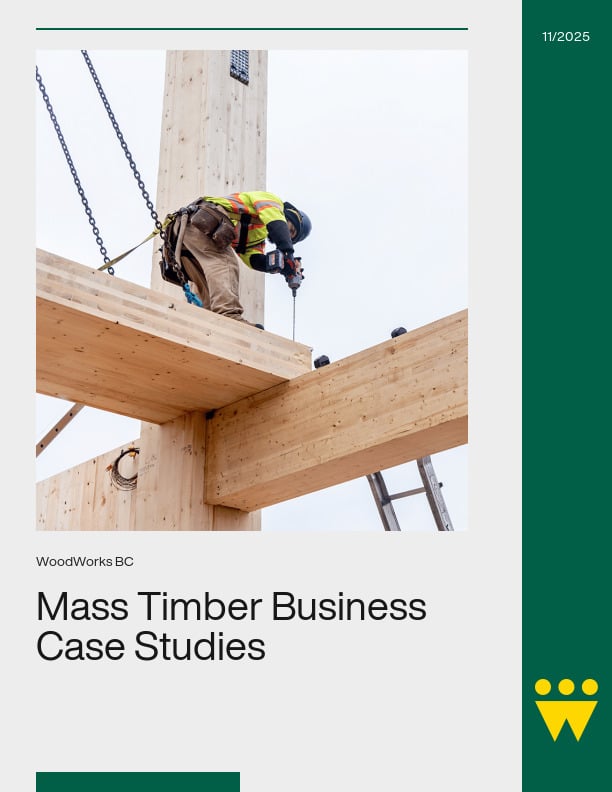
This document presents a series of business case studies that explore the financial performance of mass timber projects, providing quantitative data and qualitative insights to help developers and investors assess its economic viability.
Each case study measures investment success, challenges, and lessons learned from the developer’s and project team’s perspectives. Moreover, by analyzing strategy, risk, revenue, cost and schedule, these case studies enable direct comparisons between mass timber and traditional construction methods.
WoodWorks is seeking developers and owners with completed mass timber projects to share data for analysis, supporting education and training in the mass timber sector. The goal is to continuously expand case studies across various sectors and markets. To participate or learn more, please contact a WoodWorks staff member.
Stay in the loop and don’t miss a thing!


 Environment
Safety
Durability
Design Systems
Budget
Construction Management
Fire Resistance
Tall Buildings
Short Buildings
Environment
Safety
Durability
Design Systems
Budget
Construction Management
Fire Resistance
Tall Buildings
Short Buildings 
