en-ca

Searching for: Wood

Searching results for “Wood”
403 results found...
Sort By Dropdown Icon

Vandusen Gardens

The VanDusen Botanical Garden in Vancouver, British Columbia, was founded in 1971; doors opened to the public in 1975. By the year 2000, two existing buildings, the Floral Hall and the Garden Pavilion, were seeing much wear and the Garden’s entrance needed higher visibility. There was also a desire to attract more visitors and reach out to a younger demographic. Changes were needed. In keeping with existing buildings on the site which were built of heavy timber construction, any new building would also use a wood-based construction system. It seemed the most appropriate choice for a natural garden setting.

North Bay Regional Health Centre

Located at the eastern end of Lake Nipissing on the voyageur route linking Lake Superior to salt water, North Bay, in modern times, has a diversified economy and also serves as a transportation and service hub for resource-rich northern Ontario. With a local population of 56,000 and a much larger regional population, investigations began in the late 1990s to review the adequacy of three aging hospitals and options for refurbishment or replacement. Detailed analysis of the existing facilities and the region’s health care needs resulted in the decision to build a new facility. The North Bay Regional Health Centre (NBRHC) is comprised of the District Hospital (acute care) and the Regional Mental Health Centre (specialized and forensic mental health services). The North Bay Regional Health Centre is a new model for health care in Canada. In addition to the generous use of structural and decorative wood elements to help create a healing environment, it includes many firsts for Canadian health care.
Outstanding Wood Buildings (Bâtiments En Bois Exceptionnels)

Bill Fisch Forest Stewardship and Education Centre

The Bill Fisch Forest Stewardship and Education Centre (Education Centre) was planned and built to educate residents of the Regional Municipality of York about the importance of natural resources and forest ecosystems. The Regional Municipality of York, located on the Oak Ridges Moraine between Toronto and Lake Simcoe, includes the York Regional Forest, which is internationally recognized as a leader in site restoration and forest management, and is the first public forest in Canada to be certified by the Forest Stewardship Council (FSC). Constructed of wood and accented with stone, the Education Centre reflects the materials of the surrounding forest. The use of wood in the design was integral to the building’s performance and appropriate to its function as a forest education centre.

Angus Glen Community Centre and Library

Situated adjacent to Toronto, Markham, Ontario is a fast-growing community with a burgeoning need for recreational facilities. To help meet this demand, the Angus Glen Community Centre and Library was designed to provide a first-class recreational experience for one area of Markham.

The centre is situated on a 6.5 hectare (16 acre) site (Figure 1) and includes two skating rinks, a gymnasium, an Aquatics Centre, change rooms, multi-purpose rooms, and a district Library. The building has been enthusiastically endorsed by the public, with huge demand for the various swimming programs, hockey leagues and community clubs.

In its first year, the building attracted 1.2 million visitors with demand for all activities far exceeding initial projections. The Library is but one example of this success, breaking all records for Library visits in Markham with an average 11,000 users per week.

Much of the architectural appeal of the centre can be attributed to the use of wood as the key structural material in the Aquatics Centre, Library, the main entrances and ‘main street’ corridors, and decoratively in several other locations. The glued-laminated (glulam) roof structure, especially the one in the Aquatics Centre, has resulted in numerous inquiries from passers-by and visiting municipal officials interested in replicating the success of the Angus Glen Community Centre and Library in their own municipalities.

Art Gallery of Ontario (Renovation and Addition)

The Art Gallery of Ontario (AGO) was founded in 1900 as the Art Museum of Toronto. In 1919 it became the Art Gallery of Toronto and in 1966, took on its present name. The original gallery was a home (The Grange) built around 1817, located on the south side of the AGO facing Grange Park (Figure 1). In fall 2008, the Art Gallery of Ontario received wide acclaim when its recent renovation and addition, designed by Frank Gehry, was opened to the public. The work involved the renovation of existing spaces and the addition of 9,016 m2 (92,000 ft.2) of new floor space. The renovation and addition to the AGO is notable for several reasons. First, the design needed to unify and enhance previous constructions done in 1918, 1929, the 1970s and the 1980s. The design team made extraordinary use of structural and decorative wood elements to achieve this goal, as well as to lure, calm, entice and amaze visitors. In addition, the AGO needed to remain functional for prolonged periods during the construction process. Finally, the wood design, fabrication and erection was very complex. In the words of Bill Downing of Structurlam Products Ltd., the glulam supplier, in reference to the Galleria Italia portion of the AGO, “This is the most complex wood structure in North America.”

Banff Recreation Centre

The Town of Banff is located in Banff National Park, Canada’s first national park and a UNESCO World Heritage Site. It is home to over 8,700 residents and greets more than three million visitors from around the world each year. Constructed in 1958, the town’s recreation centre was in dire need of improvement—the roof of the curling rink was considered to be deficient, the hockey rink locker rooms were no longer adequate, the ice refrigeration piping system needed replacement, and additional skating space was needed. The solution was a combination of demolition and reconstruction, refurbishment, and new construction. Completed in 2011 to the LEED® Silver standard, the redeveloped Banff Recreation Centre has a new curling rink, a refurbished hockey arena, a new NHL-sized hockey arena, and new meeting rooms, lounges and a concourse. The new construction uses wood and glass to provide views of the mountains, while providing superior thermal performance.

CentrePlace Manitoba

CentrePlace Manitoba was commissioned by the Province of Manitoba, with a goal of creating a temporary Olympic pavilion that represented the energy of the province and its people while reinforcing its commitment to sustainability. Designed as a dynamic, uniquely Manitoban architectural statement that transcends the “white fabric tent”, the 232 m² (2500 square foot) pavilion was initially showcased at the 2010 Vancouver Olympic and Paralympic Games as both an interactive exhibit space and as a venue for business and cultural receptions.

The design concept was initiated through a visioning session in June 2009 where Manitobans from diverse backgrounds came together to discuss what best represented the province they called home. The recurring themes drawn from this session gave the design team their starting point of creating an inviting space that drew upon the spirit and nature of the people of Manitoba. The simple contrast of wood and light became the basis for the creation of a pavilion that would become a beacon, welcoming visitors through a generous front porch and an oversized pivoting door.

The design team met client design objectives by making a number of strategic decisions to ensure that the project would showcase the province’s commitment to sustainability and provide a legacy building that would serve beyond the pavilion’s initial five-week purpose. One of the key objectives was to ensure Universal Design and Access. To achieve all these design requirements, CentrePlace Manitoba had to:

utilize Manitoba labour and regional materials

offer an interactive exhibit space showcasing Manitoba’s unique culture

be efficient in material use and energy consumption

be compact, transportable, and 100% reusable at a future site

favour passive systems over dedicated ones

Innovative Applications of Engineered Wood

Arbora – An Exposed Wood Structure in A Major Residential Project

Montreal’s Griffintown district is home to a world record-breaking building: Arbora is the world’s largest residential complex made of solid engineered wood. It boasts three 8-storey buildings, each 25 m high, for a total of 55,515 m2 and 434 housing units. Records can be broken, but the unmatched aesthetic quality of Arbora’s exposed wood beams and columns will endure. Sotramont has assembled a team of skilled professionals to complete this project, the first of its kind in Canada.

Industrial Buildings – A case study

Over the past two decades, new engineered mass timber products and construction techniques have changed the way we think about wood as a building material. Historic perceptions about strength, durability and fire performance have been overturned by scientific evidence and full-scale testing of prototype structures.

As a result, mass timber has begun to make its mark in the residential and commercial sectors, particularly on Canada’s West Coast. However, the market for industrial buildings continues to be dominated by tilt-up concrete and steel-frame construction, both of which have a significant environmental footprint. Tiltup concrete in particular has inherent disadvantages; concrete cannot be poured in the freezing conditions typical of Canadian winters, nor can it be easily insulated to reduce the operating energy requirements of the building.

However, the National Building Code of Canada states that a roof assembly in a building of up to two storeys is permitted to be of heavy timber construction regardless of the building area or the type of construction required, provided the building is sprinklered. In addition, the structural members in the storey immediately below the roof assembly are also permitted to be of heavy timber construction. These requirements apply equally to industrial buildings, meaning that heavy timber is a viable alternative to the materials traditionally used, and single storey industrial buildings may be constructed entirely of heavy timber.

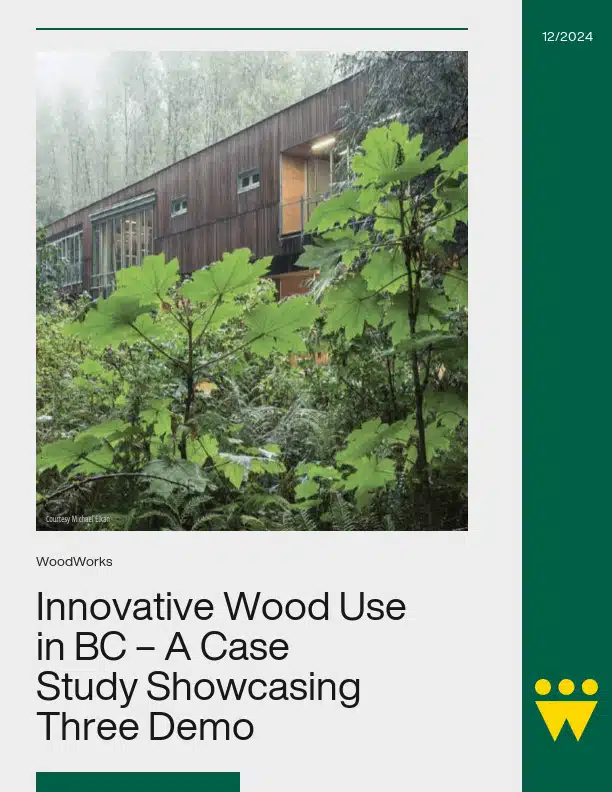
This case study examines three recently completed industrial buildings in southern British Columbia, each of which uses engineered mass timber products and systems in a distinct and different way. Together, they offer insights into how industrial construction might evolve to offer greater environmental performance, speed and flexibility of construction, at little additional cost over traditional methods.

Design Example of Designing for Openings In Wood Diaphragm

The effects of a single opening size and location on diaphragm shear, chord forces and framing member forces were investigated for a typical wood diaphragm. In conclusion, the maximum shear in the diaphragm with opening is greater than that in the diaphragm without opening. Increasing the distance between the edges of opening and diaphragm can reduce this increase in maximum shear significantly. When the dimension of the opening is no greater than 15% of the corresponding dimension of the diaphragm in both directions, and the distance of opening edge from diaphragm edge is no less than 3 times the larger dimension of the opening and that the portion of diaphragm alongside the opening satisfies the maximum aspect ratio requirement, the increase in maximum shear is less than 10%.

Wood Design & Building Magazine, vol 25, issue 102
Building Canada’s Future With Wood
Scaling Affordable Rental Housing with Tall Mass Timber
Unlocking Affordable Timber Innovations in Structure, Prefabrication, and Code
Webinar – Online Tools for Wood Construction: CodeCHEK, FRR & STC & EMTC Calculator
Guide to Mid-Rise Wood Construction in the Ontario Building Code
Exposed Mass Timber Calculator
WoodWorks Building Tour – Pictou County Mass Timber Buildings
Federal Call for Proposals Opens Under $500M Forest Sector Transformation Investment
Wood Design & Building Magazine – Sign Up
Wood Design & Building Magazine, vol 25, issue 101
FRAMEWORK for Success: Prefabricated Wood Systems and Design Innovation
Course Overview The Shearwalls Course introduces learners to the WoodWorks Shearwalls Program, a tool designed for modeling and analyzing wood-frame structures. This course...
The Canadian Wood Council is proud to share the National Lumber Grades Authority (NLGA) latest updates to the design values for Hem-Fir (N) dimension lumber, effective April...
OTTAWA, March 25, 2025 – The Canadian Wood Council welcomes the Government of Canada’s announcement of over $20 million in funding for 67 projects that support the growth...
OTTAWA, March 24, 2025 – The Canadian Wood Council (CWC) applauds the joint investment of over $8.5 million by Natural Resources Canada and Quebec’s Ministry of Natural...
OTTAWA, ON, 21 MAR 2025 – The Canadian Wood Council (CWC) applauds the Government of Canada’s strategic investment in Nova Scotia’s mass timber sector, recognizing its...
Some engineered wood panel products, such as plywood and laminated veneer lumber (LVL) are able to be treated after manufacture with preservative solutions, whereas thin...
The design values for visually graded and mechanically graded Hem-Fir (N) dimension lumber have been updated in response to the routine assessment of strength and stiffness...
Purpose:This publication provides detailed guidance on the BC Building Code 2024 requirements for lateral bracing in Part 9 wood-frame houses. It explains the building...
Course Overview The Sizer Course provides an in-depth introduction to the WoodWorks Sizer Program, a powerful tool for designing and analyzing structural elements such as...
Course Overview The Aspen Art Museum, designed by architect Shigeru Ban, includes a long-span three-dimensional wood space-frame roof. Ban’s charge was to create a wood...

Get Access to Our Resources

Stay in the loop and don’t miss a thing!

1
2
3

Get Access to Our Resources

Stay in the loop and don’t miss a thing!

What’s Your Occupation?

Help us personalize the content for you.

What Interests You the Most?

Help us personalize the content for you.

Filters

Expertise Icon
Field of Expertise
Province Icon
Province
Member Type Icon
WoodWork National Partners

Filters

Post Type Icon
Post Type
Persona Icon
Persona
Language Icon
Language
Tags Icon
Tags
Mass Timber Plus Icon Environment Plus Icon Safety Plus Icon Durability Plus Icon Design Systems Plus Icon Budget Plus Icon Construction Management Plus Icon Fire Resistance Plus Icon Tall Buildings Plus Icon Short Buildings Plus Icon
Date Icon
Date
Line Separator