en-ca

Searching for: Wood

Searching results for “Wood”
365 results found...
Sort By Dropdown Icon

Brock Commons Tallwood House – University of British Columbia Vancouver Campus

A stunning coastal forest in Vancouver, BC is the gateway to the University of British Columbia (UBC) which has provided inspiration for the institution’s long-standing relationship with wood. The result is an enviable inventory of wood buildings interspersed throughout the campus which showcases ground-breaking technologies and sustainable design.

UBC’s commitment to promoting locally sourced, environmentally responsible, leading-edge engineered wood products and building technologies has culminated in the most recent addition to the UBC Vancouver Campus: the Brock Commons Tallwood House. The newest of the UBC’s student residence buildings, Brock Commons Tallwood House currently stands as the tallest contemporary hybrid mass timber building in the world.

Over the years, with an ever-increasing demand for student housing, UBC developed a preferred typology for its student residences, creating mixed-use residential hubs to enhance campus life. For this latest project, the University was determined to demonstrate the applicability of an advanced systems solution to BC’s development and construction industries while advancing its reputation as a hub of sustainable and innovative design.

Wood use from the 18th to the early 20th centuries frequently included seven-storey wood buildings; taller wood structures such as church towers and pagodas were built worldwide earlier still. Today, pushing the envelope of wood use comes with challenges. Authorities having jurisdiction and oversight of the approval process for a new generation of tall wood building designs require comprehensive scientific data to evaluate their safety since there are no prescriptive provisions in the Canadian building codes to permit them. Until such a time as building codes establish provisions for tall wood buildings, performance aspects of their design must be proven on a design-by-design basis.

Natural Resources Canada (NRCan), in recognition of the technical challenges inherent in the design and construction of modern tall wood structures, has provided targeted funding to support demonstration projects that use innovative engineered wood products and construction systems.

Mid-Rise 2.0 – Innovative Approaches to Mid-Rise Wood Frame Construction

Seismic Design with Wood: Solutions for British Columbia Schools

Celebrating Edmonton’s Wood Architecture

It is significant that wood played such a large role in this type of complex, which is usually done in other materials. The wood structure is a unifying element between the spaces of the centre. The design is coherent, consistent, elegant and expresses wood beautifully.

Edmonton Transit System – LRT Stations

Edmonton, the capital of Alberta, is a fast-growing city with a population of 1,200,000 people in the overall metropolitan area. It boasts comprehensive bus and light-rail transit (LRT) transportation provided by the Edmonton Transit System (ETS). The North LRT line is a 3.3 km extension of the light rail transit system from the Churchill LRT Station in downtown Edmonton to the Northern Alberta Institute of Technology (NAIT) (Figure 1). It’s the first segment of a planned LRT expansion to the northwest Edmonton city limits. Light rail service on this line will commence in July 2014 and bring two new LRT stations and one bus transfer station into service. The NAIT LRT Station will have modular, temporary shelters until land use planning for the City Centre Airport lands has been completed. The North LRT line to NAIT is expected to serve 13,200 weekday passengers, with many more expected as the new line is eventually extended to the city limit near St. Albert. Wood was used for both structural and architectural elements for the MacEwan and Kingsway/Royal Alex LRT Stations, and for the Kingsway/Royal Alex Bus Transit Station. Glulam decking and beams were used for the platform and building roofs. In addition, the MacEwan LRT Station has a decorative wood ceiling in the main heated waiting area. The roof structures for both LRT stations are cantilevered from pairs of columns located at the centre of the platforms so that the edges of the platforms are not obstructed.

Fire Safety and Insurance In Commercial Buildings

Throughout history, protecting commercial structures from fire has been important. Fire poses risk in terms of safety to occupants, building integrity, business interruption and the economic health of a community. Consequently, reduction in the risk of fire for commercial buildings has been a significant goal for society, achieved through a better understanding of all the factors that contribute to fire risk. Designing and building structures in compliance with building and fire code requirements, and insurance industry guidelines, contributes to the reduction of fire losses. Wood has had a long history of use in commercial construction. Some of the reasons for this are:

high strength-to-weight ratio,

ease of use and constructability,

known performance characteristics,

resource abundance and renewability,

economy in construction, and

architectural aesthetics.

Wood construction that makes use of good design and appropriate fire protection measures provides a level of fire safety that is comparable to other types of construction. This document discusses some of the basic factors that affect fire risk and property insurance rates, as well as some common misconceptions regarding what conditions make commercial buildings fire-safe.

Wood in Civic Buildings

80 Atlantic Avenue – Toronto, Ontario

Ontario’s first mass timber commercial building in over 100 years, 80 Atlantic pioneers a new urban office typology for potentially many more timber-frame projects across the province, and the country. Comprising four storeys of mass timber above a one-storey concrete podium, the 8,825-sq.m. (95,000-sq.ft.) building completes a courtyard with 60 Atlantic to create a paired commercial development. Revisions to the Ontario Building Code in 2015 made it possible to build commercial wood buildings up to six storeys high. The developer and architect saw this as an opportunity to demonstrate leadership in the rapidly developing field of mass timber, and to attract tenants seeking a premium workplace environment associated with innovation and sustainability. The client requested that the building harmonize with the Liberty Village neighbourhood, noted for its wealth of converted factories and warehouses, which attract high-calibre, creative tenants in this section of downtown Toronto.

Wood in Commercial Buildings

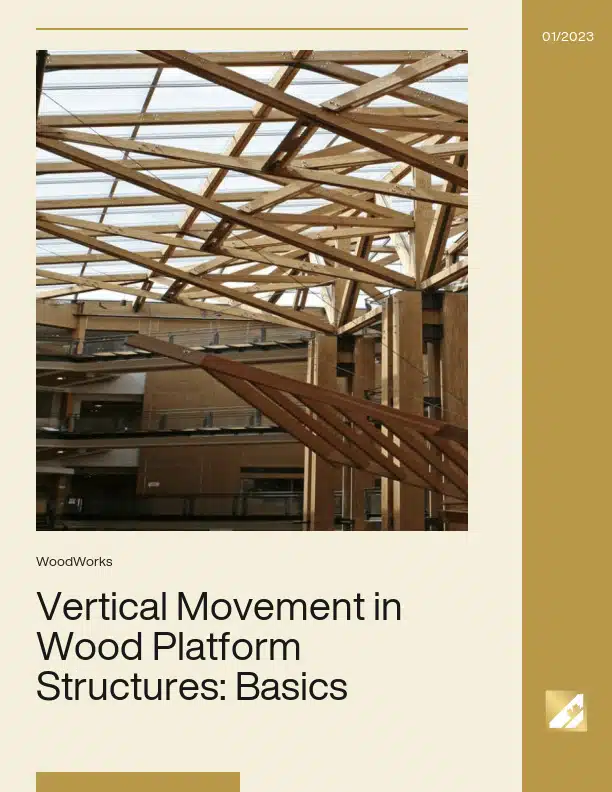
Vertical Movement in Wood Platform Structures: Basics

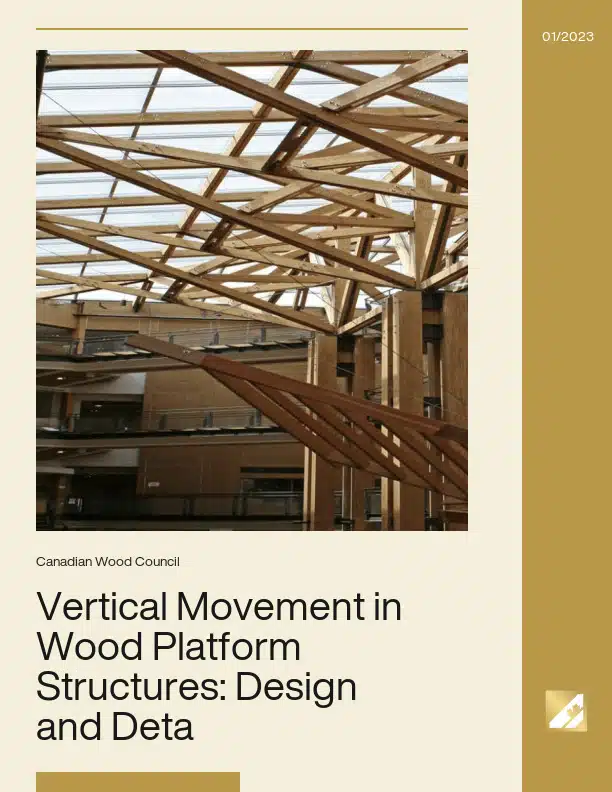
Vertical Movement in Wood Platform Structures: Design and Detailing Solutions

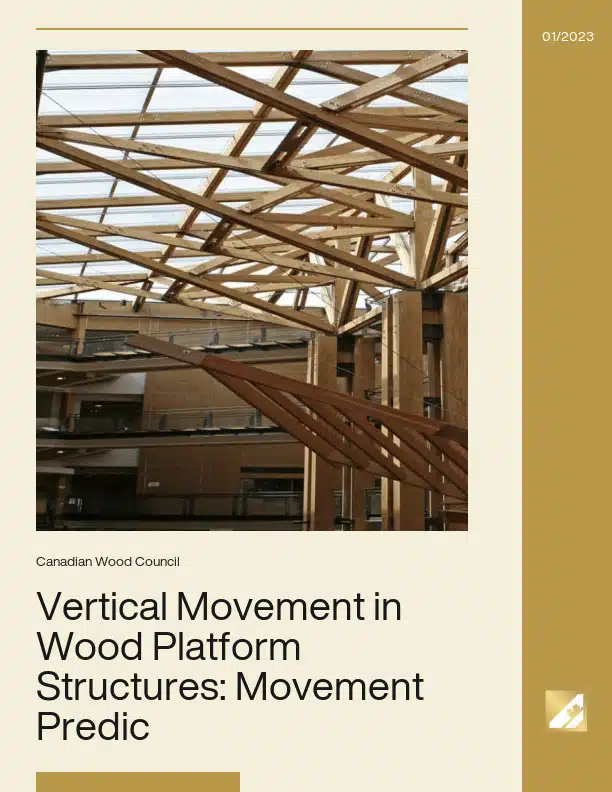
Vertical Movement in Wood Platform Structures: Movement Prediction

Privacy Policy
Terms of Use
The 2025 Ottawa Wood Solutions Conference will be presented on February 5, 2025 at the National Arts Centre
Wood Solutions Conference Ottawa 2025
Wood Design & Building Magazine, vol 23, issue 94
Environmental product declarations (EPDs)
Assessing and Restoration of Decay
Choosing and Applying Exterior Wood Coatings
June 13, 2024 (Ottawa)– Earlier today, The Transition Accelerator unveiled The Mass Timber Roadmap at the Press Conference Room in the West Block on Parliament Hill. The...
Toronto, ON – The Canadian Wood Council is pleased to announce the winning projects of the 40th annual Wood Design & Building Awards program. This prestigious awards...
Province: OntarioCity: TorontoProject Category: InstitutionalMajor Classification: D  - OfficesHeight: 14 StoreysBuilding Area: 176,549 ft2 Description: The University...
Vancouver, BC, September 19, 2024 – Informa Connect and the Canadian Wood Council announce their collaboration, WoodWorks at BUILDEX, integrating WoodWorks’ technical...
While alternative solutions have been an important feature of the National Building Code of Canada since 2005, there remains a lack of understanding among building...
Ottawa, Toronto | 27 March 2024] – The Canadian Wood Council (CWC) and George Brown College’s Brookfield Sustainability Institute (BSI) are thrilled to announce a...
OTTAWA, Ontario – 27 septembre 2023 – C’est avec grand plaisir que le Conseil canadien du bois (CCB) a annoncé le lancement de la nouvelle identité de marque du...
OTTAWA, Ontario – September 27, 2023 – The Canadian Wood Council (CWC) is delighted to announce the launch of an updated brand identity for its WoodWorks program. This...

Get Access to Our Resources

Stay in the loop and don’t miss a thing!

1
2
3

Get Access to Our Resources

Stay in the loop and don’t miss a thing!

What’s Your Occupation?

Help us personalize the content for you.

What Interests You the Most?

Help us personalize the content for you.

Filters

Expertise Icon
Field of Expertise
Province Icon
Province
Member Type Icon
WoodWork National Partners

Filters

Post Type Icon
Post Type
Persona Icon
Persona
Language Icon
Language
Tags Icon
Tags
Mass Timber Plus Icon Environment Plus Icon Safety Plus Icon Durability Plus Icon Design Systems Plus Icon Budget Plus Icon Construction Management Plus Icon Fire Resistance Plus Icon Tall Buildings Plus Icon Short Buildings Plus Icon
Date Icon
Date
Line Separator