en-ca

Searching for: Wood

Searching results for “Wood”
408 results found...
Sort By Dropdown Icon

WoodWorks Building Tour – Pictou County Mass Timber Buildings

Federal Call for Proposals Opens Under $500M Forest Sector Transformation Investment

February 25, 2026 (Ottawa, ON) — The Canadian Wood Council (CWC) welcomes today’s launch of a national Call for Proposals by the Honourable Tim Hodgson, Minister of Energy and Natural Resources, under Natural Resources Canada’s forest sector transformation programs. Backed by a $500-million federal commitment, the funding is now open for applications from eligible businesses and organizations across Canada.

The call supports projects through four key programs:


“This strategic investment comes at a pivotal time for Canada’s forest sector,” said Rick Jeffery, President and CEO of the Canadian Wood Council. “These programs can help accelerate modernization, support innovation, and expand the use of advanced wood solutions—strengthening our industry and opportunities within our domestic market while positioning Canada as a global leader in sustainable construction.”

Wood solutions are central to Canada’s built environment and economic future. Expanded use of wood in construction can support housing supply goals, reduce embodied carbon, and create new opportunities for growth and value-added manufacturing.

The Canadian Wood Council encourages members, partners, and wood products manufacturers to explore these funding opportunities to:

  • innovate and diversify production
  • strengthen domestic demand
  • expand the use of wood in construction
  • support Indigenous participation
  • access emerging markets


About the Canadian Wood Council

The Canadian Wood Council (CWC) is Canada’s unifying voice for the wood products industry. As a national federation of associations, our members represent hundreds of manufacturers across the country. Our mission is to support our members by accelerating market demand for wood products and championing responsible leadership through excellence in codes, standards, and regulations. We also deliver technical support and knowledge transfer for the construction sector through our market leading WoodWorks program.


For media inquiries, please contact:

Sarah Hicks
Communications and Outreach Manager
Canadian Wood Council
shicks@cwc.ca  | 1-705-796-3381

Wood Design & Building Magazine – Sign Up

Wood Design & Building Magazine - Sign Up


Stay connected to the ideas, projects, and technical insights shaping wood design and construction across Canada and beyond. Wood Design & Building magazine is published six times per year and delivers award-winning projects, expert perspectives, and practical guidance on all forms of wood construction. Whether you’re an architect, engineer, builder, developer, or wood enthusiast, subscribing ensures each issue arrives directly in your inbox—keeping you informed, inspired, and ready to bring more wood into your work.


Wood Design & Building Magazine – Sign Up


Limberlost Place: Video Case Study

Discover the world’s first 10-storey exposed mass timber academic tower at George Brown College. This landmark project proves that sustainable, innovative, and human-centred design can stand tall together.


Building What’s Possible

George Brown College’s Limberlost Place redefines what’s possible with mass timber construction. Rising 10 storeys above the college’s Toronto waterfront campus, this project is currently the largest exposed mass timber building of its occupancy type in the world.

Designed by Moriyama & Teshima Architects in joint venture with Acton Ostry Architects, built by PCL Construction, and realized in partnership with George Brown College, Limberlost Place demonstrates how innovation and collaboration can create a new model for sustainable development.


Sustainability at Scale

Mass timber is more than a building material — it’s a climate solution. This project shows that Canada’s design and construction industry is leading the way to a net-zero future.

By prioritizing wood construction, Limberlost:

  • Reduces carbon emissions significantly.
  • Creates healthy, biophilic spaces that support learning and well-being.
  • Proves that large-scale, low-carbon construction is achievable today.


Powered by Partnerships

Limberlost Place was made possible through strong collaboration. George Brown College worked alongside architects, engineers, and construction partners to deliver a bold vision: a living classroom where future designers, builders, and innovators can study inside the very spaces shaping tomorrow’s built environment.


A Blueprint for the Future

Limberlost Place is more than a single project. It’s a blueprint for how to build smarter and faster. By combining mass timber with hybrid engineering solutions, this project has set a new benchmark for low carbon construction in Canada and beyond.


Limberlost Place: Video Case Study

Limberlost Place: Video Case Study

Limberlost Place: Video Case Study

Limberlost Place: Video Case Study

Limberlost Place: Video Case Study

Limberlost Place: Video Case Study


This video case study was made possible through funding support from Natural Resources Canada and the Canadian Wood Council.

Wood Design & Building Magazine, vol 25, issue 101

Every issue of Wood Design & Building tells a different story about how wood is shaping contemporary construction. Some editions revolve around a clear theme such as our recent issue on strategic additions and adaptive reuse; others, like this one, reflect the diversity of challenges, innovations, and contexts that define wood construction today. What unites the features in this issue is not a single building type or region, but a shared commitment to thoughtful planning, ingenuity, and execution.

We begin in the mountains of British Columbia, where the Robson Cabin project pushes the limits of planning and coordination. Accessible only by helicopter, the remote alpine site demanded meticulous preparation, high levels of prefabrication, and an unwavering attention to detail. Alongside the technical complexity, the construction crew also contended with less predictable site conditions—including a persistent population of porcupines, whose curiosity added a memorable twist to an already remarkable build.

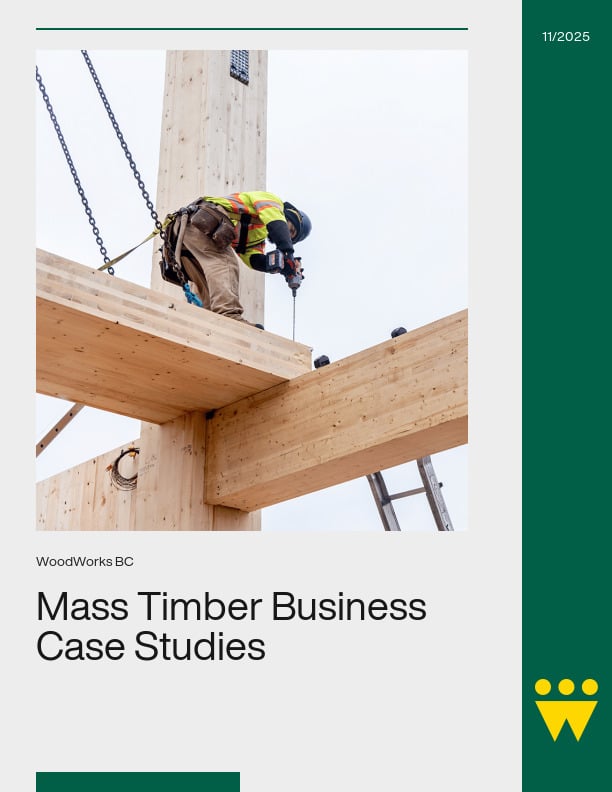
From there, we turn to one of the most sought-after—and often elusive—topics in the industry: cost. Reliable, project-specific costing data for mass timber buildings remains rare, and cost uncertainty can be a barrier to wider adoption of mass timber construction. This issue features an overview of a new mass timber business case study published by WoodWorks BC, which presents detailed cost, schedule, and design data from three projects. By comparing mass timber systems to conventional construction approaches across three building types, the study offers valuable insight into real-world construction costs, decision-making, and the strategies that can bring mass timber into cost parity.

Our final feature takes us to Trenton, Nova Scotia, for a virtual construction tour of the Pictou County Sports Heritage Hall of Fame, a community-focused project being realized through close collaboration between designers, builders, and trades. The one-storey building brings together panelized engineered wood walls, traditional light wood frame construction, and a central mass timber foyer, showcasing a deliberate “right material in the right place” approach. Built using offsite fabrication and carefully sequenced installation, the project demonstrates how coordination and precision can be leveraged to deliver a refined wood building that balances efficiency, constructability, and architectural expression.

Together, these stories offer a snapshot of a sector defined by creativity, technical rigor, and resilience—whether navigating rugged mountain terrain, unpacking the realities of construction costs, or reimagining how cultural buildings are delivered. We hope they inform, inspire, and perhaps even entertain.

FRAMEWORK for Success: Prefabricated Wood Systems and Design Innovation

Course Overview

This presentation explores the transformative impact of prefabricated light wood frame construction systems in multi-residential development, focusing on VanMar’s FRAMEWORK methodology and its application in the new 150 Wissler Road project in Waterloo. FRAMEWORK is a highly efficient, panelized light wood frame system designed for buildings up to six storeys, delivering rapid, sustainable, and cost-effective construction that meets and exceeds energy and greenhouse gas reduction targets. The session will highlight VanMar’s extensive experience in affordable housing, the advantages of offsite prefabrication, and the collaborative process that accelerates project delivery. 

Learning Objectives

  1. Participants will understand the benefits of prefabricated wood frame construction for multi-residential buildings.
  2. Participants will understand the FRAMEWORK system’s approach to speed, cost-effectiveness, and sustainability.
  3. Participants will be shown how collaborative offsite construction methods accelerated the 150 Wissler Road project.
  4. Participants will learn strategies for overcoming design challenges and achieving efficiencies in fire walls, shafts, and acoustics.

Course Video

Speakers Bio

Jordan Zekveld  
Director of Preconstruction
VanMar Constrcutors ON

Jordan is a construction and development professional with deep experience in estimating, preconstruction, and cost strategy for multi-unit residential projects. At VanMar Constructors, he helps developers, REITs, and non-profits bring condominium, rental, and affordable housing projects from concept to construction. Drawing on VanMar’s integrated design-build expertise, Jordan leads collaborative preconstruction processes that align design intent, feasibility, and cost efficiency. His experience spans concrete high-rise and innovative mid-rise wood-frame developments, including the Framework system — VanMar’s sustainable, fast, and cost-effective building solution. With a focus on clarity, constructability, and long-term value, Jordan works at the intersection of planning, design, and execution to help deliver housing that’s efficient, affordable, and built to last.

Mike Philips 
Executive Director
Ontario Structural Wood Association (OSWA)

Mike Phillips has served as Executive Director of OSWA since 2008. Under his leadership, the association has evolved from a truss-fabricator-focused group into Ontario’s leading voice for structural wood component manufacturing. Today, the province is home to 70 certified truss plants and 40 wood-panel manufacturers, with engineered wood products now the preferred choice for floor systems. At the same time, Ontario’s building code has never been more prepared to accommodate advanced wood-construction methods. Mike is a strong advocate for the industrialization of construction and the expanding role of off-site building systems—critical drivers of wood construction’s future growth.

Paul Marchesani 
Operations Manager
Panelized Building Solutions Inc.

Paul Marchesani is the Vice President of Panelized Building Solutions Inc., a family run business where he plays a key leadership role in driving operational excellence, strategic growth, and project execution across the company. Known for his strong work ethic, hands-on approach, and deep industry knowledge, Paul oversees day-to-day operations while supporting long-term planning that aligns with the company’s vision. Before joining Panelized Building Solutions, Paul held key roles in project management and operations within manufacturing and construction environments, where he oversaw production teams, implemented process improvements, and helped streamline workflow efficiencies. His ability to manage both people and complex technical projects made him a natural fit for leadership. Respected by colleagues, clients, and trade partners alike, Paul combines technical expertise with strong leadership, making him an essential pillar of the company’s continued success.

International Perspectives on Sustainable Housing Development

Course Overview

Around the world there is a significant and growing housing shortage that is exacerbated by rapid urbanization and population growth. This challenge demands innovative solutions that prioritize sustainability, occupant comfort, and efficient land use. This panel discussion brings together three internationally renowned architects: Francine Houben (Mecanoo, the Netherlands), Christophe Ouhayoun (KOZ Architects, France), and Geoff Denton (White Arkitekter, Sweden) to explore their approaches to sustainable housing. Each panelist will share their unique perspective on how to address housing shortages and sustainable densification, offering insights into the latest design strategies, materials, and technologies that can contribute to more resilient and equitable urban environments. Join us for a dynamic conversation that will delve into the future of housing and the role of architecture in creating livable, sustainable cities. 

Learning Objectives

  1. Understand how international architects approach sustainable housing development, including wood‑based construction, urban densification, and low‑carbon strategies.
  2. Compare differing regulatory, cultural, and construction‑industry conditions that influence mass timber, modularity, prefabrication, and approval processes in Sweden, France, and Canada.
  3. Identify urban‑design principles used to create healthy, community‑oriented neighborhoods.

Course Video

Speakers Bio

Francine Houben
Founding Partner, Creative Director
Mecanoo, the Netherlands

Francine Houben is founding partner of Mecanoo (1984) and has led the firm to success in The Netherlands and abroad, amassing a portfolio of work that is wide-ranging, inspired by global challenges and with a sustainable view on society. Mecanoo combines the disciplines of architecture, urban planning, landscape architecture and interior design to produce unorthodox design solutions born from a strong sensitivity to context and a highly interdisciplinary design process. Each of her projects illustrates the four fundamental elements of her architectural vision: People, Place, Purpose, Poetry. Francine Houben was professor of mobility aesthetics at Delft University of Technology and taught at the universities of Harvard, Yale and Mendrisio. As curator of the First International Architecture Biennale Rotterdam (2003), she brought the theme of the aesthetics of mobility to the forefront of international design consciousness. Francine holds Honorary Fellowships of the Royal Institute of British Architects (RIBA), the American Institute of Architects (AIA), the Royal Architectural Institute of Canada (RAIC) and was granted lifelong membership to the Akademie der Künste in Berlin as well as receiving the International Honorary Fellow Award by the Architecture Institute of Taiwan. In 2014 Francine was named Woman Architect of the Year by the Architects’ Journal and in November 2015 Queen Máxima of The Netherlands presented her with the Prins Bernhard Cultuurfonds Prize for her wide-ranging career. Francine was awarded Honorary Doctorates from the Université de Mons, Belgium (2017) and the Utrecht University (2016). In 2018 she received the BNA Kubus Award for her oeuvre; the International Prize, Prix des Femmes Architectes (2019) and distinguished with the TU Delft Alumnus of the Year (2020). In 2024, King Willem-Alexander appointed Francine Houben as a Knight in the Order of the Netherlands Lion.

Christophe Ouhayoun
Founding Partner Architect
KOZ Architects, France

Christophe Ouhayoun is a graduate of the École Nationale Supérieure d’Architecture de Paris-Belleville. He currently serves as a State Architect Advisor in the Aveyron department. In 1999, he co-founded KOZ Architectes with Nicolas Ziesel. A pioneer in wood architecture since 2001, he recently delivered Lot E of the Paris 2024 Athletes’ Village as co-coordinator within the Nexity-Eiffage team. In addition to his architectural work, he co-founded: KOZTO, a workshop dedicated to the creation of up-cycled furniture. PLAN01, a collaborative “”second office”” active from 2003 to 2014, in partnership with Atelier du Pont, BP Architectures, and Philéas. PLAN02, an integrated environmental consulting firm. Alongside his private practice, Christophe Ouhayoun works as a visiting professor at the École Nationale Supérieure d’Arts et Métiers and at the École spéciale d’architecture de Paris.

Geoff Denton
Partner Architect
White Arkitekter, Sweden

Geoff Denton is an architect and urban designer who has led residential, educational and mixed-use urban design and architectural projects across the UK, Europe and North America. Educated at Sheffield University in the UK, his career in Sweden notably led him to the role of lead architect for the implementation of Greenwich Millennium Village for Ralph Erskine Architect. This project marked the beginning of his focus on socially and environmentally sustainable urban development and regeneration. He joined White Arkitekter in 2011 and is now a partner and member of the board of directors. During his time at White he has led award winning urban design projects and was responsible for starting White Arkitekter’s London Studio. The studio has been built on the goal to share knowledge and experience of sustainable development and offsite fabrication methods used throughout the Nordics. Key projects developed during the first years of the London studio include the Climate Innovation District in Leeds and the Gascoigne estate regeneration in London. Geoff is now based in Stockholm where he works with diverse complex international projects. His approach to architecture is collaborative and he strongly believes that good design solutions are very much about creating places where people feel secure and invigorated.

Design and Construction of Permanent Wood Foundations – The Buildings Show 2025

Course Overview

This session will provide requirements and guidance on the design and construction of permanent wood foundations (PWF) based on the Canadian standard; CSA S406-16 – ‘Specification of permanent wood foundations for housing and small buildings’. Further information on site selection, backfilling, PWF floor systems, air and vapour barriers, insulation techniques, crawl spaces and design requirements for high wind and seismic zones will be discussed. This session will provide attendees with an overview of the design requirements and construction methods for PWF, with a focus on the structural system and building science considerations. 

Learning Objectives

  1. Apply the design requirements of CSA S406-16 for permanent wood foundations in housing and small buildings.
  2. Identify key building-science considerations for PWF systems, including drainage, air and vapour control, insulation, and crawl space design.
  3. Evaluate site and structural requirements for permanent wood foundations in high wind and seismic regions.

Course Video

Speakers Bio

Adam Robertson
Co-founder and Principal
Sustainatree

Adam completed his Bachelor of Applied Science in Civil Engineering at the University of Toronto and also holds a Master of Applied Science degree from the Department of Wood Science at the University of British Columbia. He is the past Chair of the CSA Subcommittee on Permanent Wood Foundations and acted as a primary author and editor during the update and revisions to the Canadian Wood Council’s Permanent Wood Foundations publication. He is the co-founder and principal of Sustainatree Consulting, a small firm specializing in sustainability and engineering design of wood building systems. Prior to opening his own practice, Adam was previously employed by the Canadian Wood Council and has also worked as a consulting structural engineer and within the building development and construction management fields.

Building Success: The Nshwaasnangong Child Care and Family Centre Story

Course Overview

This session will explore the transformative journey of the Nshwaasnangong Child Care & Family Centre, a project that began as a response to the Truth and Reconciliation Commission’s Calls to Action. Led by Two Row Architect and supported by various community partners, the project highlights the innovative use of mass timber to create culturally meaningful and sustainable spaces. Attendees will learn about the collaborative design process, the integration of traditional materials with modern building practices, and the impact of the centre on the local community. The session will also provide insights into accessing technical resources and project support for wood construction through WoodWorks Ontario.

Learning Objectives

  1. Explore the use of mass timber to create culturally meaningful and sustainable spaces, demonstrated through the Nshwaasnangong Child Care & Family Centre.
  2. Understand the collaborative design and prefabrication process, integrating community input, modern construction practices, and workflow planning with mass‑timber manufacturers for complex geometries.

Course Video

Speakers Bio

Matthew Hickey
Architect
Two Row Architect

Matthew Hickey is Mohawk from the Six Nations First Nation and is a licensed architect with 12 years of experience working in an on-reserve architecture firm. He received his Masters of Architecture from the University of Calgary and his Bachelor of Design from Ontario College of Art and Design, winning both the Alberta Association of Architects Presidents Medal and the Medal for Best Thesis, respectively. Mr. Hickey’s focus is on regenerative design – encompassing ecological, cultural, and economic principles. His research includes Indigenous history and the adaptation of traditional sustainable technologies to the modern North American climate. He currently instructs at OCAD U, for the OAA and the Canada Green Building Council.

ProTEKtor II® – Technical Data Sheets

The ProTEKtor II® Technical Data Sheet provides detailed product and performance information for BarrierTEK’s ProTEKtor II® fire-protectant treatment used on wood frame and sheet components. The document is intended for designers, builders, specifiers, and code officials who require clear, concise technical data to support product evaluation and specification.

The TDS outlines key product characteristics, application parameters, and performance attributes for treated wood framing members and sheet goods, including compatibility considerations and relevant fire performance data. It serves as a practical reference for understanding how ProTEKtor II® is applied to enhance fire protection in both exposed and concealed wood-frame assemblies.

Developed as a technical reference, this data sheet supports accurate specification and informed use of ProTEKtor II®, helping project teams integrate fire-protectant-treated wood products into wood-frame construction with confidence and consistency.

AtTEK – Fire Protection for Attic Applications

The AtTEK® – Fire Protection for Attic Applications Technical Data Sheet provides detailed product and performance information for BarrierTEK’s AtTEK® fire-protectant treatment used in wood-frame attic assemblies. The document is intended for designers, builders, specifiers, and code officials requiring concise technical data to support product evaluation and specification.

The TDS outlines key product attributes, application parameters, and performance characteristics relevant to attic framing components, including treatment coverage, compatibility with wood products, and applicable fire performance considerations. It serves as a quick-reference resource for understanding how AtTEK® is used to enhance fire protection in concealed roof spaces.

Developed as a technical reference, this data sheet supports accurate specification and informed use of AtTEK® in attic applications, helping project teams integrate fire-protectant-treated wood into wood-frame buildings with clarity and confidence.

Assurance with Insurance

BarrierTEK’s Assurance with Insurance document outlines how the use of BarrierTEK fire-protectant-treated wood products can support risk management and insurance considerations in wood-frame construction. The resource is intended for building owners, developers, designers, and construction professionals seeking greater clarity on how fire performance measures may influence insurability and project risk profiles.

The document discusses the role of fire-protectant treatments in reducing fire risk, with a focus on concealed and exposed wood framing applications. It highlights how enhanced fire performance can align with insurer expectations and loss prevention strategies, helping project teams better understand the relationship between material selection, fire safety, and insurance outcomes.

Developed as an informational reference, Assurance with Insurance supports informed conversations between project stakeholders and insurance providers, offering insight into how proactive fire protection strategies can contribute to improved confidence and resilience in wood-frame buildings.

WoodWorks Building Tour – Pictou County Mass Timber Buildings
Federal Call for Proposals Opens Under $500M Forest Sector Transformation Investment
Wood Design & Building Magazine – Sign Up
Limberlost Place: Video Case Study
Wood Design & Building Magazine, vol 25, issue 101
FRAMEWORK for Success: Prefabricated Wood Systems and Design Innovation
International Perspectives on Sustainable Housing Development
Design and Construction of Permanent Wood Foundations – The Buildings Show 2025
Building Success: The Nshwaasnangong Child Care and Family Centre Story
AtTEK – Fire Protection for Attic Applications
Vancouver, BC – September 23, 2025 – The Canadian Wood Council is pleased to announce the winning projects of the 41st annual Wood Design & Building Awards program....
This prestigious awards program recognizes and celebrates the outstanding work of architectural professionals from Canada and around the world for excellence in wood design...
National Provincial Canadian Wood Council WoodWorks Forest Products Association of Canada Certification Canada Mass timber road map Natural Sciences and Engineering Research...
Innovative Strategies for Light-Frame Mid-Rise Buildings in High-Seismic Regions presents a detailed design example and practical guidance for engineers and builders...
Industrialized offsite construction, also known as prefabricated or modular construction, is a construction method where building materials and components are manufactured...
September 15, 2025, Ottawa, ON: The Canadian Wood Council (CWC) welcomes the federal government’s launch of the Build Canada Homes (BCH) agency, announced yesterday by...
Ottawa, Ontario – September 9, 2025 — The Canadian Wood Council (CWC) is pleased to welcome BarrierTEK as a new national partner of its WoodWorks program. This...
The Canadian Wood Council partnered with federal and provincial governments and organizations, as well as key experts, to conduct a series of five fire research burns on a...
Ottawa, ON — September 4, 2025 — The Canadian Wood Council (CWC) and the Canadian Institute of Steel Construction (CISC) are pleased to announce a strategic partnership...
Resource Description This comprehensive course package provides educators with a ready-to-use framework for teaching structural wood design, aligned with CSA O86 and the Wood...
Resource Description This comprehensive pedagogical resource presents two detailed mass timber projects, developed to support educators in teaching advanced wood construction...
Resource Description This 8-lecture module provides a comprehensive introduction to the principles of thermodynamics and hydrodynamics as they apply to wood buildings. It...

Get Access to Our Resources

Stay in the loop and don’t miss a thing!

1
2
3

Get Access to Our Resources

Stay in the loop and don’t miss a thing!

What’s Your Occupation?

Help us personalize the content for you.

What Interests You the Most?

Help us personalize the content for you.

Filters

Expertise Icon
Field of Expertise
Province Icon
Province
Member Type Icon
WoodWork National Partners

Filters

Post Type Icon
Post Type
Persona Icon
Persona
Language Icon
Language
Tags Icon
Tags
Mass Timber Plus Icon Environment Plus Icon Safety Plus Icon Durability Plus Icon Design Systems Plus Icon Budget Plus Icon Construction Management Plus Icon Fire Resistance Plus Icon Tall Buildings Plus Icon Short Buildings Plus Icon
Date Icon
Date
Line Separator