en-ca

Searching for: Wood

Searching results for “Wood”
384 results found...
Sort By Dropdown Icon

Wood in non-combustible buildings

The National Building Code of Canada (NBC) requires that some buildings be of ‘noncombustible construction’ under its prescriptive requirements.

Noncombustible construction is, however, something of a misnomer, in that it does not exclude the use of ‘combustible’ materials but rather, it limits their use. Some combustible materials can be used since it is neither economical nor practical to construct a building entirely out of ‘noncombustible’ materials.

Wood is probably the most prevalent combustible material used in noncombustible buildings and has numerous applications in buildings classified as noncombustible construction under the NBC. This is due to the fact that building regulations do not rely solely on the use of noncombustible materials to achieve an acceptable degree of fire safety. Many combustible materials are allowed in concealed spaces and in areas where, in a fire, they are not likely to seriously affect other fire safety features of the building.

For example, there are permissions for use of heavy timber construction for roofs and roof structural supports. It may also be used in partition walls and as wall finishes, as well as furring strips, fascia and canopies, cant strips, roof curbs, fire blocking, roof sheathing and coverings, millwork, cabinets, counters, window sashes, doors, and flooring.

Its use in certain types of buildings such as tall buildings is slightly more limited in areas such as exits, corridors and lobbies, but even there, fire-retardant treatments can be used to meet NBC requirements. The NBC also allows the use of wood cladding for buildings designated to be of noncombustible construction.

In sprinklered noncombustible buildings not more than two-storeys in height, entire roof assemblies and the roof supports can be heavy timber construction. To be acceptable, the heavy timber components must comply with minimum dimension and installation requirements. Heavy timber construction is afforded this recognition because of its performance record under actual fire exposure and its acceptance as a fire-safe method of construction. Fire loss experience has shown, even in unsprinklered buildings, that heavy timber construction is superior to noncombustible roof assemblies not having any fire-resistance rating.

In other noncombustible buildings, heavy timber construction, including the floor assemblies, is permitted without the building being sprinklered.

In sprinklered buildings permitted to be of combustible construction, no fire-resistance rating is required for the roof assembly or its supports when constructed from heavy timber. In these cases, a heavy timber roof assembly and its supports would not have to conform to the minimum member dimensions stipulated in the NBC.

NBC definitions:

Combustible means that a material fails to meet the acceptance criteria of CAN/ULC-S114, “Test for Determination of Non-Combustibility in Building Materials.”

Combustible construction means that type of construction that does not meet the requirements for noncombustible construction.

Heavy timber construction means that type of combustible construction in which a degree of fire safety is attained by placing limitations on the sizes of wood structural members and on thickness and composition of wood floors and roofs and by the avoidance of concealed spaces under floors and roofs.

Noncombustible construction means that type of construction in which a degree of fire safety is attained by the use of noncombustible materials for structural members and other building assemblies.

Noncombustible means that a material meets the acceptance criteria of CAN/ULC-S114, “Test for Determination of Non-Combustibility in Building Materials.”

For further information, refer to the following resources:

Wood Design Manual, Canadian Wood Council

National Building Code of Canada

CAN/ULC-S114 Test for Determination of Non-Combustibility in Building Materials

Stairs and storage lockers in noncombustible buildings

Stairs within a dwelling unit can be made of wood, as can storage lockers in residential buildings. These are permitted, as their use is not expected to present a significant fire hazard.

Wood roofing materials in noncombustible buildings

In the installation of roofing, wood cant strips, roof curbs, nailing strips, and similar components may be used. Wood roofs defined as ‘heavy timber construction’ in the NBC are permitted in any noncombustible building two-storeys or less in height when the building is protected by a sprinkler system.

Roof sheathing and sheathing supports of wood are permitted in noncombustible buildings provided:

  • they are installed above a concrete deck;
  • the concealed space does not extend more than 1 m (39 in) above the deck;
  • the concealed roof space is compartmented by fire blocks;
  • openings through the concrete deck are located in noncombustible shafts;
  • parapets are provided at the deck perimeter extending at least 150 mm (6 in) above the sheathing; and
  • no building services are located on the roof other than those placed in noncombustible shafts.

The noncombustible parapets and shafts are required to prevent roof materials igniting from flames projecting from openings in the building face or roof deck.
Roof coverings have often been contributing factors in conflagrations. Most roof coverings, even today, are combustible by the very nature of the materials used to make them waterproof.

The objective of the NBC is to require that the risks associated with a roof covering be minimized for the type of building, its location and use.

The NBC permits roof coverings that meet a Class C rating to be used for any building regulated by Part 3, including any noncombustible building, regardless of height or area.

This C rating can be met easily using fire-retardant-treated wood (FRTW) shakes or shingles, asphalt shingles, or roll roofing.

In buildings that are required to be of noncombustible construction, the roof coverings must have a fire classification of Class A, B or C. In such cases, the use of FRTW shakes and shingles on sloped roofs is allowed.

Small assembly occupancy buildings not more than two-storeys in building height and less than 1000 m2 (10,000 ft2) in building area do not require a classification for the roof covering. In these traditional cases, untreated wood shingles are acceptable if they are underlaid with a noncombustible material to reduce the potential for burn through.

Wood partitions in noncombustible buildings

Wood framing has many applications in partitions in both low-rise and high-rise buildings required to be of noncombustible construction. The framing can be located in most types of partitions, with or without a fire- resistance rating.

Wood framing and sheathing is permitted in partitions, or alternatively, solid lumber partitions at least 38 mm (2 in nominal) thick are permitted, provided:

  • the partitions are not used in a care, treatment or detention occupancy;
  • the area of the fire compartment, if not sprinklered, is limited to 600 m2 (the area of the fire compartment is unlimited in a floor area that is sprinklered); and,
  • the partitions are not required by the Code to be fire separations.

Alternatively, wood framing is permitted in partitions throughout floor areas, and can be used in most fire separations with no limits on compartment size or a need for sprinkler protection provided:

  • the buildings is not more than three-storeys in height;
  • the partitions are not used in a care, treatment or detention occupancy; and,
  • the partitions are not installed as enclosures for exits or vertical service spaces.

Similarly, as a final option, wood framing is permitted in buildings with no restriction on building height provided:

  • the building is sprinklered;
  • the partitions are not used in a care, treatment or detention occupancy;
  • the partitions are not installed as enclosures for exits or vertical service spaces; and,
  • the partitions are not used as fire separations to enclose a mezzanine.

These allowances in the code are based on the performance of fire-rated wood stud partitions compared to steel stud partitions. This research showed similar performance for wood and steel stud assemblies.

Also, the increase in the amount of combustible framing material permitted is not large compared to what is permitted as contents. In many cases, the framing is protected and only burns later in a fire once all combustible contents have been consumed, by which time the threat to life safety is not high.
The exclusion of the framing in care and detention occupancies and in applications around critical spaces such as shafts and exits are applied to keep the level of risk as low as practical in these applications.

Wood furring in noncombustible buildings

Wood is particularly useful as a nailing base (also called a nailer) for different types of cladding and interior finishes.

Wood furring strips can be used to attach interior finishes such as gypsum wallboard, provided:

  • The strips are fastened to noncombustible backing or recessed into it.
  • The concealed space created by the wood elements is not more than 50 mm (2 in) thick.
  • The concealed space created by the wood elements is fire blocked.

Experience has shown that a lack of oxygen in these shallow concealed spaces prevents rapid development of fire.

Wood nailer strips can also be used on parapets, provided the facings and any roof membrane covering the facings are protected by sheet metal. This is permitted because it is considered that a nailing base such as plywood or oriented strand board (OSB) does not constitute an undue fire hazard.

Wood flooring and stages in noncombustible buildings

Combustible sub-flooring and finished flooring, such as wood strip or parquet, is allowed in any noncombustible building, including high rises. Finished wood flooring is not a major concern. During a fire, the air layer close to the floor remains relatively cool in comparison with the hot air rising to the ceiling.

Wood supports for combustible flooring are also permitted provided:

  • they are at least 50 mm but no more than 300 mm high;
  • they are applied directly onto or are recessed into a noncombustible floor slab; and,
  • the concealed spaces are fire blocked (as in Figure 1 below)

This allows the use of wood joists or wood trusses, the latter providing more flexibility for running building services within the space.

Since stages are normally fairly large and considerably higher than 300 mm which creates a large concealed space. Because of this, wood stage flooring must be supported by noncombustible structural members.

Wood in non-combustible buildings

Figure 1. Raised wood floor

Fire stops in noncombustible buildings

Wood is commonly used for fire stops in combustible construction and it may also be used in noncombustible assemblies. Wood is permitted as a fire stop material for dividing concealed spaces into compartments in roofs of combustible construction.

However, wood fire stops must must meet the criteria for fire stops when the assembly is subject to the standard fire test used to determine fire resistance.

Interior wood finishes in noncombustible buildings

Wood finishes may be used in noncombustible buildings on walls and partitions within and outside suites and to a lesser extent, in areas such as exits and lobbies. The use of interior finishes is mostly regulated by restrictions on their flame-spread rating (FSR). Wood finishes not exceeding 25 mm (1 in) in thickness and having a FSR of 150 or less may be used extensively in noncombustible buildings that are not considered high buildings. However, where finishes are used as protection for foamed plastic insulation, they are required to act as a thermal barrier.

Some restrictions do apply in certain areas of a building. The area permitted to have a FSR of 150 or less is limited as follows:

  • in exits – only 10 percent of total wall area
  • in certain lobbies – only 25 percent of total wall area
  • in vertical spaces – only 10 percent of total wall area

The use of wood finishes on the ceilings in noncombustible buildings is much more restricted, but not totally excluded. In such cases, the FSR must be 25 or less. In certain cases, ordinary wood finishes (FSR of 150 or less) can also be used on 10 percent of the ceiling area of any one fire compartment, as well as on the ceilings of exits, lobbies and corridors.

Fire-retardant-treated wood (FRTW) must be used to meet the most restrictive limit of FSR 25. Consequently, it is permitted extensively throughout noncombustible buildings as a finish. The only restriction is that it cannot exceed 25 mm (1 in) in thickness when used as a finish, except when used as wood battens on a ceiling, in which case no maximum thickness applies. The NBC requirement for interior finishes in non-combustible buildings requires that the FSR be applicable to any surface of the material that may be exposed by cutting through the material. FRTW is exempted from this requirement because the treatment is applied through pressure impregnation. Fire retardant coatings are not exempt because they are surface applied only.

The FSR 75 limit for interior wall finishes in certain corridors does not exclude all wood products. For example, western red cedar, amabilis fir, western hemlock, western white pine and white or sitka spruce all have FSR at or lower than 75.

Corridors requiring FSR 75 include:

  • public corridors in any occupancy;
  • corridors used by the public in assembly or care or detention occupancies;
  • corridors serving classrooms; and,
  • corridors serving sleeping rooms in care and detention occupancies.

If these corridors are located in a sprinklered building, wood finishes having FSR 150 or less may be used to cover the entire wall surface.

In high rise buildings regulated by NBC (Division B, Subsection 3.2.6.), wood finishes are permitted within suites or floor areas much as for other buildings of noncombustible construction. However, certain additional restrictions apply for:

  • exit stairways;
  • corridors not within suites;
  • vestibules to exit stairs;
  • certain lobbies;
  • elevators cars; and,
  • service spaces and service rooms.

Wood cladding in noncombustible buildings

The NBC contains rules on the use of combustible claddings and supporting assemblies on certain types of buildings required to be of noncombustible construction. Specifically, the use of wall assemblies containing both combustibles cladding elements and non-loadbearing wood framing members is allowed.

These wall assemblies can be used as in-fill or panel type walls between structural elements, or be attached directly to a load-bearing noncombustible structural system. This applies in unsprinklered buildings up to three- storeys and sprinklered buildings of any height.

The wall assembly must satisfy the criteria of a test that determines its degree of flammability and the interior surfaces of the wall assembly must be protected by a thermal barrier (for example, 12.7 mm gypsum board) to limit the impact of an interior fire on the wall assembly.

These requirements stem from fire research that indicated that certain wall assemblies containing combustible elements do not promote exterior fire spread beyond a limited distance.

Each assembly must be tested in accordance with CAN/ULC-S134 to confirm compliance with fire spread and heat flux limitations specified in the NBC.

Fire-retardant-treated wood (FRTW) decorative cladding is permitted on first floor canopy fascias. In this case, the wood must undergo accelerated weathering before testing to establish the flame-spread rating. A FSR of 25 or less is required.

Millwork and window frames in noncombustible buildings

Wood millwork such as interior trim, doors and door frames, show windows and frames, aprons and backing, handrails, shelves, cabinets and counters are also permitted in noncombustible construction. Because these elements contribute minimally to the overall fire hazard it is not necessary to restrict their use.

Wood frames and sashes are permitted in noncombustible buildings provided each window is separated from adjacent windows by noncombustible construction and meets a limit on the aggregate area of openings in the outside face of a fire compartment.

Glass typically fails early during a fire, allowing flames to project from the opening and thereby creating serious potential for the vertical spread of fire. The requirement for noncombustible construction between windows is intended to limit fire spread along combustible frames closely set into the outside face of the building.

CSA O86 Engineering design in wood

CSA O86 Engineering design in wood

The National Building Code of Canada (NBC) contains requirements regarding the engineering design of structural wood products and systems. The CSA O86 standard is referenced in Part 4 of the NBC and in provincial building codes for the engineered design of structural wood products. The first edition of CSA O86 was published in 1959.

CSA O86 provides criteria for the structural design and evaluation of wood structures or structural elements. It is written in the limit states design (LSD) format and provides resistance equations and specified strength values for structural wood products, including: graded lumber, glued-laminated timber, cross-laminated timber (CLT), unsanded plywood, oriented strandboard (OSB), composite building components, light-frame shearwalls and diaphragms, timber piling, pole-type construction, prefabricated wood I-joists, structural composite lumber (SCL) products, permanent wood foundations (PWF), and their structural connections.

The CSA O86 provides rational approaches for structural design checks related to ultimate limit states, such as flexure, shear, and bearing, as well as serviceability limit states, such as deflection and vibration. The CSA O86 also contains strength modification factors for behaviour related to duration of load, size effects, service condition, lateral stability, system effects, preservative and fire-retardant treatment, notches, slenderness, and length of bearing.

Structural design of wood buildings and components is undertaken using the loads defined in Part 4 of the NBC and the material resistance values obtained using the CSA O86 standard. Housing and other small buildings can be built without a full structural design using the prescriptive requirements outlined in Part 9 ‘Housing and Small Buildings’ of the NBC.

For further information, refer to the following resources:

Wood Design Manual (Canadian Wood Council)

Introduction to Wood Design (Canadian Wood Council)

National Building Code of Canada

CSA O86 Engineering design in wood

CSA S-6 Canadian Highway Bridge Design Code

As identified in the design philosophy of the CSA S-6, safety is the overriding concern in the design of highway bridges in Canada. For wood products, the CSA S-6 addresses design criteria associated with ultimate limit states and serviceability limit states (primarily deflection, cracking, and vibration). Fatigue limit states are also required to be consider for steel connection components in wood bridges. The structure design life in the CSA S-6 has been established at 75 years for all bridge types, including wood bridges.

The CSA S-6 applies to the types of wood structures and components likely to be required for highways, including; glued-laminated timber, sawn lumber, structural composite lumber (SCL), nail-laminated decks, laminated wood-concrete composite decks, prestressed laminated decks, trusses, wood piles, wood cribs and wood trestles. The standard does not apply to falsework or formwork.

CSA S-6 considers design of wood members under flexure, shear, compression and bearing. In addition, the standard provides guidance and requirements related to the camber and curvature of wood members. Further information on durability, drainage and preservative treatment of wood in bridges is also discussed.

CSA S406 Permanent Wood Foundations

CSA S406 Specification of permanent wood foundations for housing and small buildings

CSA S406 is the design and construction standard for permanent wood foundations (PWF) that is referenced in Part 9 of the NBC and in provincial building codes. The first edition of CSA S406 was published in 1983, with subsequent revisions and updates to the standard published in 1992, 2014, and 2016. The CSA S406 applies to the selection of materials, the design, the fabrication and installation of PWF. The standard also contains information on site preparation, materials, cutting and machining, footings, sealants and dampproofing, exterior moisture barriers, backfilling and site grading.

Specific details and prescriptive requirements are provided in CSA S406 for buildings constructed on PWF that fall under Part 9 of the National Building Code of Canada (NBC), that is, buildings up to three-storeys in height above the foundation and having a building area not exceeding 600 m2. CSA S406 provides for the optional use of wood sleeper, poured concrete slab, and suspended wood basement floor systems as components of the PWF, and for the use of PWF as crawl space enclosures. The standard does not exclude PWFs which may also be engineered for larger buildings, using the same principles of design, provided building code requirements are met.

The CSA S406 standard includes many selection tables and isometric figures, aimed at increasing design efficiency and the understanding of PWF construction details. The standard was developed based on specific engineering design assumptions regarding installation procedures, soil type, clear spans for floors and roofs, dead and live loads, modification factors, deflections and backfill height.

For conditions that go beyond the scope of CSA S406, similar details may be used provided they are based on accepted engineering principles that ensure a level of performance equivalent to that set forth in CSA S406. If any of the design conditions are different from or more severe than the assumptions, the PWF must be designed by a professional engineer or architect and installed in conformance with the standard. Regardless of the building size and conformance with the design assumptions of CSA S406, some authorities having jurisdiction require a design professional’s seal in order to issue a building permit.

For further information, refer to the following resources:

Permanent Wood Foundations (Canadian Wood Council)

Wood Preservation Canada

National Building Code of Canada

CSA 080 Wood Preservation

The National Building Code of Canada (NBC) contains requirements regarding the use of treated wood in buildings and the CSA O80 Series of standards is referenced in the NBC and in provincial building codes for the specification of preservative treatment of a broad range of wood products used in different applications. The first edition of CSA O80 was published in 1954, with eleven subsequent revisions and updates to the standard, with the most recent edition published in 2015.

The manufacture and application of wood preservatives are governed by the CSA O80 Series of standards. These consensus-based standards indicate the wood species that may be treated, the allowable preservatives and the retention and penetration of preservative in the wood that must be achieved for the use category or application. The CSA O80 Series of standards also specifies requirements related to the fire retardance of wood through chemical treatment using both pressure and thermal impregnation of wood. The overarching subjects covered in the CSA O80 Series of standards also include materials and their analysis, pressure and thermal impregnation procedures, and fabrication and installation.

Canadian standards for wood preservation are based on the American Wood Protection Association (AWPA) standards, modified for Canadian conditions. Only wood preservatives registered by the Canadian Pest Management Regulatory Agency are listed.

The required preservative penetrations and loadings (retentions) vary according to the exposure conditions a product is likely to encounter during its service life. Each type of preservative has distinct advantages and the preservative used should be determined by the end use of the material.

Processing and treating requirements in the CSA O80 Series are designed to assess the exposure conditions which pressure treated wood will be subjected to during the service life of a product. The level of protection required is determined by hazard exposure (e.g., climatic conditions, direct ground contact or exposure to salt water), the expectations of the installed product (e.g., level of structural integrity throughout the service life) and the potential costs of repair or replacement over the life cycle.

The technical requirements of CSA O80 are organized in the Use Category System (UCS). The UCS is designed to facilitate selection of the appropriate wood species, preservative, penetration, and retention (loading) by the specifier and user of treated wood by more accurately matching the species, preservative, penetration, and retention for typical moisture conditions and wood biodeterioration agents to the intended end use.

The CSA O80.1 Standard specifies four Use Categories (UC) for treated wood used in construction:

  • UC1 covers treated wood used in dry interior construction;
  • UC2 covers treated wood and wood-based materials used in dry interior construction that are not in contact with the ground but can be exposed to dampness;
  • UC3 covers treated wood used in exterior construction that is not in ground contact;
    • UC3.1 covers exterior, above ground construction with coated wood products and rapid run off of water;
    • UC3.2 covers exterior, above ground construction with uncoated wood products or poor run off of water;
  • UC4 covers treated wood used in exterior construction that is in ground or freshwater contact;
    • UC4.1 covers non-critical components;
    • UC4.2 covers critical structural components or components that are difficult to replace;
  • UC5A covers treated wood used in Coastal waters including; brackish water, salt water and adjacent mud zone.

This CSA O80 Series of standards consists of five standards, as follows:

  1. CSA O80.0 General requirements for wood preservation; specifies requirements and provides information applicable to the entire series of standards.
  2. CSA O80.1 Specification of treated wood; is intended to help specifiers and users of treated wood products identify appropriate requirements for preservatives for various wood products and end use environments.
  3. CSA O80.2 Processing and treatment; specifies minimum requirements and process limitations for treating wood products.
  4. CSA O80.3 Preservative formulations; specifies requirements for preservatives not referenced elsewhere.
  5. CSA O80.4 has been withdrawn.
  6. CSA O80.5 CCA Additives — Utility Poles; specifies requirements for preparation and use of CCA preservative/additive combinations for utility poles permitted by CSA O80.1 and CSA O80.2.


For further information, refer to the following resources:

www.durable-wood.com

CSA O80 Wood preservation

Wood Preservation Canada

National Building Code of Canada

Pest Management Regulatory Agency

American Wood Protection Association

ISO 21887 Durability of wood and wood-based products Use classes

Structural Composite Lumber

Structural Composite Lumber (SCL)

Structural composite lumber (SCL) is a term used to encompass the family of engineered wood products that includes laminated veneer lumber (LVL), parallel strand lumber (PSL), laminated strand lumber (LSL) and oriented strand lumber (OSL).

With its ability to be manufactured using small, fast-grow and underutilized trees, SCL products represent an efficient use of forest resources as they help to meet the increasing demand for structural lumber products that have highly reliable strength and stiffness properties.

SCL consists of dried and graded wood veneers, strands or flakes that are layered upon one another and bonded together with a moisture resistant adhesive into large blocks known as billets. The grain of each layer of veneer or flakes run primarily in the same direction. These SCL billets are subsequently resawn into specified dimensions and lengths.

SCL has been successfully used in a variety of applications, such as rafters, headers, beams, joists, truss chords, I-joist flanges, columns and wall studs.

SCL is produced in a number of standard sizes. Some SCL products are available in a number of thicknesses while others are available in the 45 mm (1-3/4 in) thickness only. Typical depths of SCL members range from 241 to 606 mm (9-1/2 to 24 in). Single SCL members may be nailed or bolted together to form built-up beams. Generally, SCL is available in lengths of up to 20 m (65 ft).

SCL is produced at a low moisture content so that very little shrinkage will occur after installation. This low moisture content also allows for SCL to be virtually free from checking, splitting or warping while in service.

SCL products are proprietary products and therefore, the specific engineering properties and sizes are unique to each manufacturer. Thus, SCL products do not have a common standard of production and common design values. Design values are derived from test results analysed in accordance with CSA O86 and ASTM D5456 and the design values are reviewed and approved by the Canadian Construction Materials Centre (CCMC). Products meeting the CCMC guidelines receive an Evaluation Number and Evaluation Report that includes the specified design strengths for the SCL product, which are subsequently listed in CCMC’s Registry of Product Evaluations. The manufacturer’s name or product identification and the stress grade is marked on the material at various intervals, but due to end cutting it may not be present on every piece.

For further information, refer to the following resources:

APA – The Engineered Wood Association

Canadian Construction Materials Centre (CCMC), Institute for Research in Construction

CSA O86 Engineering design in wood

ASTM D5456 Standard Specification for Evaluation of Structural Composite Lumber Products

Mass Timber

Advancements in wood product technology and systems are driving the momentum for innovative buildings in Canada. Products such as cross-laminated timber (CLT), nailed-laminated timber (NLT), glued-laminated timber (GLT), laminated strand lumber (LSL), laminated veneer lumber (LVL) and other large-dimensioned structural composite lumber (SCL) products are part of a bigger classification known as ‘mass timber’.

Although mass timber is an emerging term, traditional post-and-beam (timber frame) construction has been around for centuries. Today, mass timber products can be formed by mechanically fastening and/or bonding with adhesive smaller wood components such as dimension lumber or wood veneers, strands or fibres to form large pre-fabricated wood elements used as beams, columns, arches, walls, floors and roofs. Mass timber products have sufficient volume and cross-sectional dimensions to offer significant benefits in terms of fire, acoustics and structural performance, in addition to providing construction efficiency.

Light-frame Trusses

A truss is a structural frame relying on a triangular arrangement of webs and chords to transfer loads to reaction points. This geometric arrangement of the members gives trusses high strength-to-weight ratios, which permit longer spans than conventional framing. Light-frame truss can commonly span up to 20 m (60 ft), although longer spans are also feasible.

The first light-frame trusses were built on-site using nailed plywood gusset plates. These trusses offered acceptable spans but demanded considerable time to build. Originally developed in the United States in the 1950s, the metal connector plate transformed the truss industry by allowing efficient prefabrication of short and long span trusses. The light-gauge metal connector plates allow for the transfer of load between adjoining members through punched steel teeth that are embedded into the wood members. Today, light-frame wood trusses are widely used in single- and multi-family residential, institutional, agricultural, commercial and industrial construction.

The shape and size of light-frame trusses is restricted only by manufacturing capabilities, shipping limitations and handling considerations. Trusses can be designed as simple or multi-span and with or without cantilevers. Economy, ease of fabrication, fast delivery and simplified erection procedures make light-frame wood trusses competitive in many roof and floor applications. Their long span capability often eliminates the need for interior load bearing walls, offering the designer flexibility in floor layouts. Roof trusses offer pitched, sloped or flat roof configurations, while also providing clearance for insulation, ventilation, electrical, plumbing, heating and air conditioning services between the chords.

Light-frame wood trusses are prefabricated by pressing the protruding teeth of the steel truss plate into 38 mm (2 in) wood members, which are pre-cut and assembled in a jig. Most trusses are fabricated using 38 x 64 mm (2 x 3 in) to 38 x 184 mm (2 x 8 in) visually graded and machine stress-rated (MSR) lumber. To provide different grip values, the truss connector plates are stamped from galvanized light-gauge sheet steel of different grades and gauge thicknesses. Many sizes of truss plates are manufactured to suit any shape or size of truss or load to be carried.

Light frame trusses are manufactured according to standards established by the Truss Plate Institute of Canada. The capacities for the plates vary by manufacturer and are established through testing. Truss plates must conform to the requirements of CSA O86 and must be approved by the Canadian Construction Materials Centre (CCMC). To obtain approval, the truss plates are tested in accordance with CSA S347. During design, light-frame trusses are generally engineered by the truss plate manufacturer on behalf of the truss fabricator.

When light-frame trusses arrive at the job site they should be checked for any permanent damage such as cross breaks in the lumber, missing or damaged metal connector plates, excessive splits in the lumber, or any damage that could impair the structural integrity of the truss. Whenever possible, trusses should be unloaded in bundles on dry, relatively smooth ground. They should not be unloaded on rough terrain or uneven spaces that could result in undue lateral strain that could possibly distort the metal connector plates or damage parts of the trusses.

Light-frame trusses can be stored horizontally or vertically. If stored in the horizontal position, trusses should be supported on blocking spaced at 2.4 to 3 m (8 to 10 ft) centres to prevent lateral bending and reduce moisture gain from the ground. When stored in the vertical position, trusses should be placed on a stable horizontal surfaced and braced to prevent toppling or tipping. If trusses need to be stored for an extended period of time measures must be taken to protect them from the elements, keeping the trusses dry and well ventilated.

Light-frame trusses require temporary bracing during erection, prior to the installation of permanent bracing. Truss plates should not be used with incised lumber. Contact the truss manufacturer for further guidance on the use of light-frame trusses in corrosive environments, wet service conditions, or when treated with a fire retardant.

For further information, refer to the following resources:

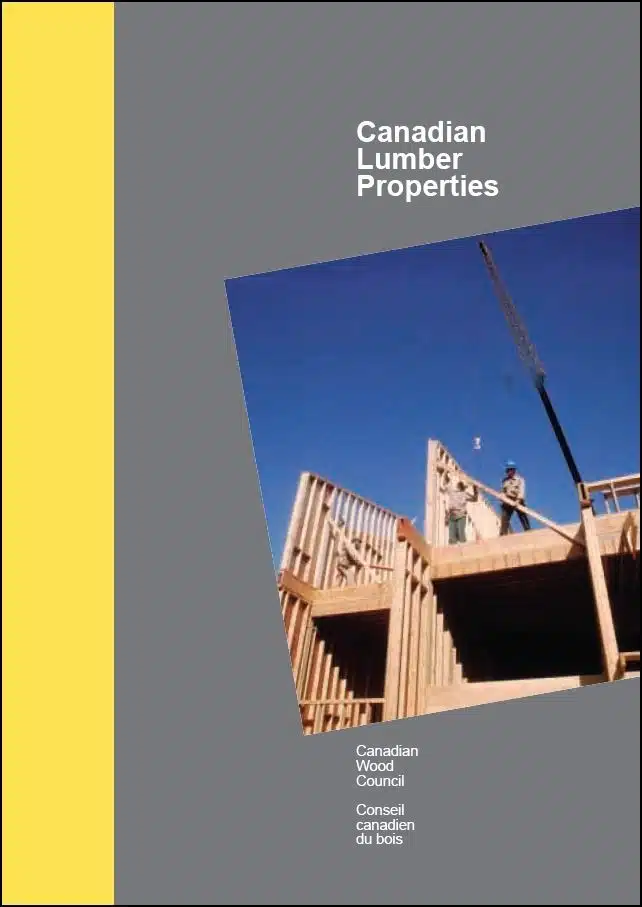
Lumber

Dimension lumber is solid sawn wood that is less than 89 mm (3.5 in) in thickness. Lumber can be referred to by its nominal size in inches, which means the actual size rounded up to the nearest inch or by its actual size in millimeters. For instance, 38 × 89 mm (1-1/2 × 3-1/2 in) material is referred to nominally as 2 × 4 lumber. Air-dried or kiln dried lumber (S-Dry), having a moisture content of 19 percent or less, is readily available in the 38 mm (1.5 in) thickness. Dimension lumber thicknesses of 64 and 89 mm (2-1/2 and 3-1/2 in) are generally available as surfaced green (S-Grn) only, i.e., moisture content is greater than 19 percent.

The maximum length of dimension lumber that can be obtained is about 7 m (23 ft), but varies throughout Canada.

The predominant use of dimension lumber in building construction is in framing of roofs, floors, shearwalls, diaphragms, and load bearing walls. Lumber can be used directly as framing materials or may be used to manufacture engineered structural products, such as light frame trusses or prefabricated wood I-joists. Special grade dimension lumber called lamstock (laminating stock) is manufactured exclusively for glulam.

2x4 lumber board

Quality assurance of Canadian lumber is achieved via a complex system of product standards, engineering design standards and building codes, involving grading oversight, technical support and a regulatory framework.

Lumber

Checking and splitting

Checking and splitting Checking occurs when lumber is rapidly dried. The surface dries quickly, while the core remains at a higher moisture content for some time. As a result, the surface attempts to shrink but is restrained by the core. This restraint causes tensile stresses at the surface, which if large enough, can pull the fibres apart, thereby creating a check. Splits are through checks that generally occur at the end of wood members. When a wood member dries, moisture is lost very rapidly from the end of the member. At midlength, however, the wood is still at a higher moisture content. This difference in moisture content creates tensile stresses at the end of the member. When the stresses exceed the strength of the wood, a split is formed. Large dimension solid sawn timbers are susceptible to checking and splitting since they are always dressed green (S-Grn). Furthermore, due to their large size, the core dries slowly and the tensile stresses at the surface and at the ends can be large. Minor checks confined to the surface areas of a wood member very rarely have any effect on the strength of the member. Deep checks could be significant if they occur at a point of high shear stress. Checks in columns are not of structural importance, unless the check develops into a through split that will increase the slenderness ratio of the column. The specified shear strengths of dimension lumber and timbers have been developed to consider the maximum amount of checking or splitting permitted by the applicable grading rule. The possibility and severity of splitting and checking can be reduced by controlling the rate at which drying occurs. This may be done by keeping wood out of direct sunlight and away from any artificial heat sources. Furthermore, the ends may be coated with an end sealer to retard moisture loss. Other actions which will minimize dimension change and the possibility of checking or splitting are:

  • specifying wood products that are as close as possible in moisture content to the expected equilibrium moisture content of the end use
  • ensuring dry wood products are protected by proper storage and handling

Fingerjoined lumber

Fingerjoined products are manufactured by taking shorter pieces of kiln-dried lumber, machining a ‘finger’ profile in each end of the short-length pieces, adding an appropriate structural adhesive, and end-gluing the pieces together to make a longer length piece of lumber. The length of a fingerjoined lumber is not limited by the length of the log. In fact, the manufacturing process can result in the production of joists and rafters in lengths of 12 m (40 ft) or more. The process of fingerjoining is also used within the manufacturing process for several other engineered wood products, including glued-laminated timber and wood I-joists. The specific term “fingerjoined lumber” applies to dimension lumber that contains finger joints.

Lumber

Fingerjoining derives greater value from the forest resource by using short length pieces of lower grade lumber as input for the manufacture of a value-added engineered wood product. The fingerjoining process utilizes short off cut pieces of lumber and results in more efficient use of the harvested wood fibre. Fingerjoined lumber can be manufactured from any commercial species or species group. The most commonly used species group from which fingerjoined lumber is produced is Spruce-Pine-Fir (S-P-F).

Design advantages of fingerjoined lumber

Fingerjoined lumber is an engineered wood product that is desirable for several reasons:

  • straightness
  • dimensional stability
  • interchangeability with non-fingerjointed lumber
  • highly efficient use of wood fibre

The design and performance advantages of this engineered wood product are its straightness and dimensional stability. The straightness and dimensional stability of fingerjoined lumber is a result of short length pieces of lumber, consisting of relatively straight grain and fewer natural defects, being combined with one another to form a longer length piece of lumber. The grain pattern along fingerjoined lumber becomes non-uniform and random by attaching many short pieces together. This results in fingerjoined lumber being less prone to warping than solid sawn lumber. The fingerjoining process also results in the reduction or removal of strength reducing defects, producing a structural wood product with less variable engineering properties than solid sawn dimensional lumber. The most common use of finger-joined lumber is as studs in shearwalls and vertical load bearing walls.

The most important factor for studs is straightness. Fingerjoined studs will stay straighter than solid sawn dimensional lumber studs when subjected to changes in temperature and humidity. This feature results in significant benefits to the builder and homeowner including a superior building, the elimination of nail pops in drywall and other problems related to dimensional changes. This also makes fingerjoined lumber an ideal candidate for non-load bearing partitions used in dry-service conditions.

Finger-joined lumber is also commonly used for flange material in wood I-joists. This application of the product requires the wood fibres and the glued joint to resist long term tension loads when in use. For this reason, fingerjoined lumber used for the manufacture of I-Joists must comply with the requirements of NLGA SPS 1. Wood I-joist manufacturers undertake additional quality assessment procedures during production.

Types of fingerjoined lumber

Canadian fingerjoined lumber is manufactured in conformance with either NLGA Special Products Standards SPS 1, Fingerjoined Structural Lumber, SPS 3, Fingerjoined “Vertical Stud Use Only” Lumber, or SPS 4, Fingerjoined Machine Graded Lumber. In almost all cases, fingerjoined lumber manufactured to the requirements of SPS 1 is interchangeable with solid sawn lumber of the same species, grade and length, and can be used for either horizontal or vertical load bearing applications, such as joists, rafters, columns and wall studs. Fingerjoined lumber manufactured according to SPS 3 can only be used as vertical end-loaded members in compression, e.g., wall studs, where bending and tension loading components do not exceed short term duration and where the moisture content of the wood will not exceed 19% and the temperature will not exceed 50 °C for an extended period of time. SPS 3 lumber is manufactured in section sizes up to 38 x 140 mm (2 x 6), in lengths up to 3.66 m (12 ft). Fingerjoined machine graded lumber manufactured in accordance with SPS 4 can be used for wood I-joist flanges and metal plate connected truss applications. SPS 4 graded fingerjoined lumber designated as “Dry Use Only” shall only be used in applications where the equilibrium moisture content of the lumber is not expected to exceed 19%. Fingerjoined lumber is typically produced from lumber that has no more than 19% moisture content for ease of manufacturing the joint to meet the strict quality control standards. For this reason, fingerjoined lumber is almost always sold as ‘S-Dry’.

There are several different types of adhesives used in the manufacture of fingerjoined lumber. The National Lumber Grades Authority (NLGA) Special Product Standards (SPS) outline what types of adhesives can be used in SPS 1, SPS 3 and SPS 4 fingerjoined lumber as well as the test standards that those adhesives must meet. SPS 1, sometimes referred to as a structural fingerjoint, uses a phenol-resorcinol formaldehyde (PRF) adhesive, similar to what is used in structural panel products or in glued-laminated timber. SPS 3 typically uses a polyvinyl acetate adhesive. Adhesives used in the manufacture of SPS 3 fingerjoined lumber are not suitable for joining wet lumber and therefore only ‘S-Dry’ lumber is utilized in order to ensure a quality joint.

Adhesives used in fingerjoined lumber are designated as either a Heat Resistant Adhesive (HRA) or Non-Heat Resistant Adhesive (Non-HRA). Qualification as an HRA adhesive requires an adhesive to be exposed to elevated temperatures during a standard fire resistance test of a loadbearing fingerjoined stud wall assembly loaded to 100 percent of the wall’s allowable design load. All SPS 1 products must be manufactured using HRA adhesives. SPS 3 products may be manufactured with either HRA or non-HRA adhesives. All SPS 4 products must be manufactured using HRA adhesives.

Structural testing protocols for fingerjoined lumber

The strength of the finger joints is controlled by stipulating the quality of wood which must be present in the area of the joint. For the majority of fingerjoined lumber, the segments between the fingerjoints are visually graded in accordance with the NLGA rules for the lumber grade indicated on the grade stamp. Near the fingerjoints, more restrictive visual limits are generally imposed. The structural properties are confirmed through a comprehensive quality assurance program with independent third party verification. Daily structural tests are certified to verify that the product meets the requirements as set out by the North American lumber grading system. Each piece must be comprised of species from the same species group, and strict tolerances are established for the machining of the fingers; the quality, the mixing, and the curing of the adhesive. Depending on the type of fingerjoined lumber being manufactured, edge and flat bending tests and tension tests are performed on each piece to ensure the joint can meet the engineering design values for the lumber.Fingerjoint lumber test requirements are selected to enable the same specified strength and stiffness as non-finger-joined lumber of the same grade and size to be assigned to the fingerjoined lumber. Test methods (e.g. bending or tension tests) and target test load (e.g. minimum and 5th percentile finger joint strengths) for samples of single fingerjoints are not only linked to the size, grade and species to be joined, but also take into account the average fingerjoint spacing. Fingerjoints used at lower average fingerjoint spacing need to achieve a higher 5th percentile strength level than the same fingerjoints used at higher average fingerjoint spacing. In selecting the tests, only some properties, such as bending strength, are directly tested. Others characteristics are established by correlation to the property monitored, or implied by the specification imposed on the adhesive (e.g. adhesive bondline performance). For further information on the performance of adhesives in fingerjoined lumber in fireresistance-rated wall assemblies, refer to the following document

Fingerjoined lumber grading and grade stamps Fingerjoined lumber must meet the identical requirements found in the grading rules for regular sawn lumber. Grading rules do not consider the presence of finger joints to reduce strength properties. Fingerjoined lumber must also meet special product standards on quality control requirements for strength and durability of the joints. The National Lumber Grades Authority (NLGA) Special Product Standards SPS 1, SPS 3 and SPS 4 in Canada or Western Wood Products Association (WWPA) Glued Products Procedures & Quality Control, C/QC 101.97 are examples of these product standards. All fingerjoined lumber manufactured to the Canadian NLGA Standards carries a grade stamp indicating: • the species or species combination identification • the seasoning designation (S-Dry or S-Green) • the registered symbol of the grading agency • the grade • the mill identification • the type of adhesive used (HRA or Non-HRA) • the NLGA standard number and the designation SPS 1 CERT FGR JNT (certified finger joint), or SPS 3 CERT FGR JNT-VERT STUD USE ONLY (certified finger joint for vertical use only), or SPS 4 CERT FGR JNT (certified finger joint) Additional information on SPS 1 and SPS 3 fingerjoined lumber is provided in Table 1 below.

Grade Stamp Designation Grade Stamp Facsimile Product Standards Comparison to Non-Finger-joined Lumber Permissible Uses Adhesives Grades Allowed Dimensions and Lengths
VERTICAL STUD USE ONLY – SPS 3 CERT FGR JNT Lumber SPS 3 and C/QCl0l.97 Intended for use as wall studs, limited to normal short-term bending and tension loads Load-bearing studs, non-load-bearing studs, dry-service conditions only Typically polyvinyl acetate, but any glue meeting standards Stud, Construction, Standard, No.1, No.2, No.3 2×2, 2×3, 2×4, 2×6, 8′ to 12′
STRUCTURAL FINGERJOINT – SPS 1 CERT FGR JNT Lumber SPS 1 and C/QCl0l.97 Fully interchangeable with lumber of the same grade and species Load-bearing and non-load-bearing studs, headers, lintels, beams, joists Phenol-resorcinol or equivalent, dark-colored Select Structural (SS), No.1, No.2 2×2, 2×3, 2×4, 2×6, 2×8, 2×10, 2×12, 8′ to 40′

Dimension Lumber Sizes

Surfaced Dry (S-Dry), Size, mm Surfaced Dry (S-Dry), Size, in. (actual) Rough Sawn Size, in. (nom.) Surfaced Green (S-Grn) Size, in. (actual)
38 x 38 1-1/2 x 1-1/2 2 x 2 1-9/16 x 1-9/16
38 x 64 1-1/2 x 2-1/2 2 x 3 1-9/16 x 2-9/16
38 x 89 1-1/2 x 3-1/2 2 x 4 1-9/16 x 3-9/16
38 x 140 1-1/2 x 5-1/2 2 x 6 1-9/16 x 5-5/8
38 x 184 1-1/2 x 7-1/4 2 x 8 1-9/16 x 7-3/8
38 x 235 1-1/2 x 9-1/4 2 x 10 1-9/16 x 9-1/2
38 x 286 1-1/2 x 11-1/4 2 x 12 1-9/16 x 11-1/2
64 x 64 2-1/2 x 2-1/2 3 x 3 2-9/16 x 2-9/16
64 x 89 2-1/2 x 3-1/2 3 x 4 2-9/16 x 3-9/16
64 x 140 2-1/2 x 5-1/2 3 x 6 2-9/16 x 5-5/8
64 x 184 2-1/2 x 7-1/4 3 x 8 2-9/16 x 7-3/8
64 x 235 2-1/2 x 9-1/4 3 x 10 2-9/16 x 9-1/2
64 x 286 2-1/2 x 11-1/4 3 x 12 2-9/16 x 11-1/2
89 x 89 3-1/2 x 3-1/2 4 x 4 3-9/16 x 3-9/16
89 x 140 3-1/2 x 5-1/2 4 x 6 3-9/16 x 5-5/8
89 x 184 3-1/2 x 7-1/4 4 x 8 3-9/16 x 7-3/8
89 x 235 3-1/2 x 9-1/4 4 x 10 3-9/16 x 9-1/2
89 x 286 3-1/2 x 11-1/4 4 x 12 3-9/16 x 11-1/2

Notes:

  • 38mm (2″ nominal) lumber is readily available as S-Dry.
  • S-Dry lumber is surfaced at a moisture content of 19 percent or less.
  • After drying, S-Green lumber sizes will be approximately the same as S-Dry lumber.
  • Tabulated metric sizes are equivalent to Imperial S-Dry sizes rounded to the nearest millimeter.
  • S-Dry is the final size for seasoned lumber in place and is the size used in design calculations.

Moisture content

Wood will gain or lose moisture depending on the environmental conditions to which the wood is subjected. Changes in moisture affect wood products in two ways. First, change in moisture content causes dimensional changes (shrinkage and swelling) of the wood. Secondly, when combined with other necessary preconditions, excessive moisture can result in deterioration of wood by decay. Moisture content (MC) is the weight of water contained in the wood compared to the wood’s oven-dry weight. A change in the size of a piece of lumber is related to the amount of water it absorbs or loses. For moisture contents from 0 to about 28 percent, the moisture is held within the walls of the wood cells. At about 28 percent MC the cell walls reach their capacity or fibre saturation point (FSP) and any additional water must be held in the cell cavities.

Moisture content stamps

Lumber stamped ‘S-Grn’ (surfaced green) is lumber which had a moisture content exceeding 19 percent at the time of manufacture (planing or dressing). S-Grn lumber is also called unseasoned lumber or green lumber. Lumber stamped ‘S-Dry’ (surfaced dry) is lumber that had a maximum moisture content of 19 percent or less at the time of manufacture. The moisture content stamp will not indicate whether seasoning resulted from air drying or kiln drying. Some mills apply a voluntary stamp, ‘KD’, indicating that the lumber was kiln dried. Both air dried lumber and kiln dried lumber have the same specified strengths used for engineering design. S-Dry lumber is up to 15 percent more expensive than S-Grn lumber, as a result of increased costs related to packaging and drying.

Moisture content measurement

Measurement of moisture content of wood products can be difficult, particularly if done in variable site conditions. Guidelines should be followed to measure and interpret results to correctly assess whether wood products are dry at installation time. For example, when measuring the moisture content of a piece of wood the following factors affect the individual result:

  • type of test (oven dry is most accurate)
  • type of meter (dielectric, DC resistance)
  • product type
  • temperature
  • wood species
  • variation of wood (wet pockets)
  • frequency, location and depth of sampling to correctly represent the entire piece

The following factors should be considered when measuring and assessing the performance of a wood structure, under given end use conditions and moisture changes:

  • moisture distribution throughout structure
  • location(s) in which moisture will accumulate
  • number of storeys
  • construction type(s)
  • orientation, exposure and shading
  • sampling and analysis of individual results

Resources in PDF:

Connections

As for all other building materials, a critical aspect of wood structures is the manner by which members are connected. Wood products are building materials which are easily drilled, chiseled, or otherwise shaped to facilitate the connection of members, and a number of methods and a wide range of products are available for connecting wood. The installation of metal fasteners is the most common method of connecting wood products and a wide range of hardware is available. These range from the nails and the light connectors used for light framing construction to the bolts, side plates and other hardware used for heavy member connections. Each type of fastener is designed to be used with a particular type of construction.

For many applications, such as nailing for light-frame wall construction, metal fasteners serve only a structural purpose, and will be hidden from view by interior and exterior finishes. In other cases where wood members serve a structural purpose and are left exposed to add visual interest to a design and give a robust appearance to a structure, thought must be given to the connection layout and the selection and finishing of the wood products themselves. In other instances, where metal fasteners are exposed to view, the designer might want them to be as inconspicuous as possible. This can be done by selecting fasteners such as split rings and bolts, by reducing the visual impact of hardware through recessing it within the wood members, or by using painting to reduce the prominence of a connection.


i -Joists

Prefabricated wood I-joists are proprietary structural wood members that consist of fingerjoined solid sawn lumber or laminated veneer lumber (LVL) flanges attached to a plywood or oriented strand board (OSB) web using adhesive. Web panel joints are glued and mated by several methods such as butting of square panel ends, scarfing of the panel ends, or shaping of either a toothed or tongue and groove type joint. Exterior rated, waterproof adhesives such as phenol-formaldehyde and phenol-resorcinol are the principally used for the web to web and web to flange joints. Different combinations of flange and web materials using alternative connections between the web and the flanges are available from several manufacturers (refer to Figure 3.20, below). Wood I-joists are available in a variety of standard depths and in lengths of up to 20 m (66 ft).

Each manufacturer produces I-joists with unique strength and stiffness characteristics. To ensure that proprietary products have been manufactured under a quality assurance program supervised by an independent third-party certification organization, manufacturers typically have their products evaluated and registered under the requirements and guidelines of the Canadian Construction Material Centre (CCMC).

The cross-sectional “I” shape of these structural wood products provides a higher strength to weight ratio than traditional solid sawn lumber. The uniform stiffness, strength, and light weight of these prefabricated elements allow for use in longer span joist and rafter applications for both residential and commercial construction. Wood I-joists are usually manufactured using untreated flange and web material and therefore, are typically not used for exterior applications. Wood I-joist are also dimensionally stable as they are manufactured with a moisture content between 6 and 12 %.

For the installation of mechanical and electrical services, many manufacturers provide requirements and guidance for the shape, size and location of openings, notches, holes and cuts. Most wood I-joist suppliers also stock standard joist hangers and other prefabricated connection hardware specially designed for use with wood I-joists.

For further information on wood I-joists, refer to the following resources:

APA – The Engineered Wood Association

Canadian Construction Material Centre (CCMC), Institute for Research in Construction (NRC)

Wood I-Joist Manufacturers Association (WIJMA)

CSA O86 Engineering design in wood

ASTM D5055 Standard Specification for Establishing and Monitoring Structural Capacities of Prefabricated Wood I-Joists

i -Joists

i -Joists

Panel Products

By using roundwood that is often not be suitable for lumber production, wood-based panels make efficient use of the forest resource by providing engineered wood products with defined strength and stiffness properties.

Wood-based structural panels such as plywood and oriented strand board (OSB) are widely used in residential and commercial construction. Wood-based panels are often overlaid on joists or light frame trusses and used as structural sheathing for floor, roofs and wall assemblies. These products provide rigidity to the supporting main structural members in addition to their function as a component of the building envelope. In addition, they are often an integral component of the lateral force resisting system of a wood building.

In order to qualify for a particular end use, such as structural sheathing, flooring or exterior siding, wood-based panels must meet performance criteria related to three aspects: structural performance, physical properties and bond performance. For more information on performance rating and potential end uses of wood-based panel products, refer to APA – The Engineered Wood Association.

Wood in non-combustible buildings
CSA O86 Engineering design in wood
CSA S-6 Canadian Highway Bridge Design Code
CSA S406 Permanent Wood Foundations
CSA 080 Wood Preservation
Structural Composite Lumber
Mass Timber
Mass Timber
Light-frame Trusses
Connections
i -Joists
Panel Products
First used during World War II to make airplane propellers, laminated veneer lumber (LVL) has been available as a construction product since the mid-1970s. LVL is the most...
Laminated Strand Lumber (LSL) is one of the more recent structural composite lumber (SCL) products to come into widespread use. LSL provides attributes such as high strength...
Oriented Strand Lumber (OSL) Oriented Strand Lumber (OSL) provides attributes such as high strength, high stiffness and dimensional stability. The manufacturing process of...
Parallel Strand Lumber (PSL) Parallel Strand Lumber (PSL) provides attributes such as high strength, high stiffness and dimensional stability. The manufacturing process of...
Cross-laminated timber (CLT) is a proprietary engineered wood product that is prefabricated using several layers of kiln-dried lumber, laid flat-wise, and glued together on...
Glulam (glued-laminated timber) is an engineered structural wood product that consists of multiple individual layers of dimension lumber that are glued together under...
Plank decking may be used to span farther and carry greater loads than panel products such as plywood and oriented strand board (OSB). Plank decking is often used where the...
With advanced construction technologies and modern mass timber products such as glued-laminated timber, cross-laminated timber and structural composite lumber, building tall...
When it comes to wood construction, many people think of basic 2×4 framing, panels or flooring for single-family homes. However, advances in wood science and building...
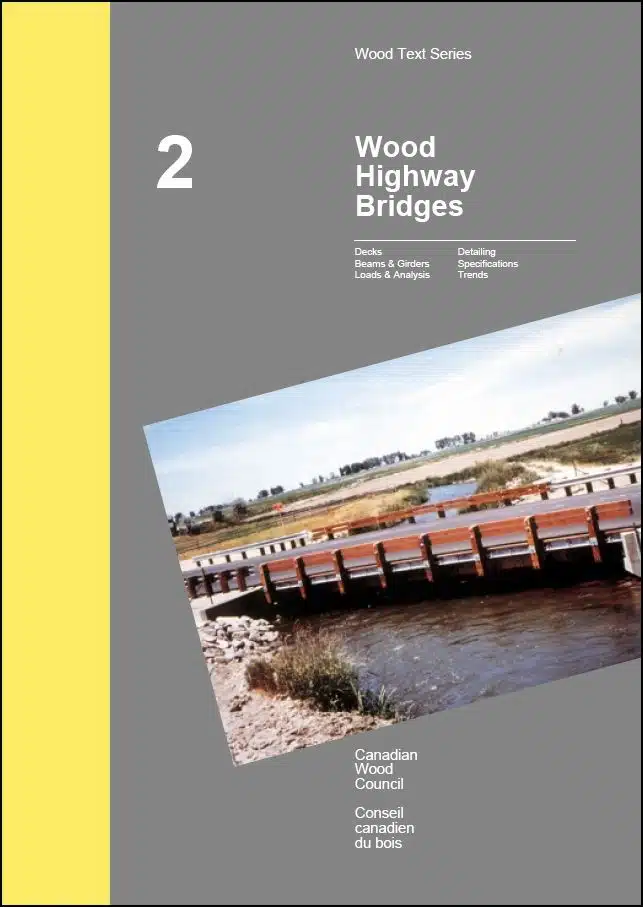
Timber bridges have a long history as vital components of the roadway, railway and logging road networks within Canada. Dependent on the availability of materials...
Tests Current research includes the World’s largest mass timber fire test – click here for updates on the test results currently being conducted https://firetests.cwc.ca/...
Studies General “The Historical Development of the Building Size Limits in the National Building Code of Canada“, by Sereca for CWC (2015)  (17 Mb) Structural &...

Get Access to Our Resources

Stay in the loop and don’t miss a thing!

1
2
3

Get Access to Our Resources

Stay in the loop and don’t miss a thing!

What’s Your Occupation?

Help us personalize the content for you.

What Interests You the Most?

Help us personalize the content for you.

Filters

Expertise Icon
Field of Expertise
Province Icon
Province
Member Type Icon
WoodWork National Partners

Filters

Post Type Icon
Post Type
Persona Icon
Persona
Language Icon
Language
Tags Icon
Tags
Mass Timber Plus Icon Environment Plus Icon Safety Plus Icon Durability Plus Icon Design Systems Plus Icon Budget Plus Icon Construction Management Plus Icon Fire Resistance Plus Icon Tall Buildings Plus Icon Short Buildings Plus Icon
Date Icon
Date
Line Separator