en-ca

Searching for: wood

Searching results for “wood”
399 results found...
Sort By Dropdown Icon

From Forest to Form: Sourcing Local Wood for BC Projects

Course Overview

Wood and mass timber are increasingly being specified for all kinds of buildings and spaces in BC, including mid-rise and taller residential apartments, schools, and healthcare facilities. Does this mean BC will cut down more trees? On this panel, hear BC’s Chief Forester discuss the province’s forest management practices and wood supply. Learn from a recently completed project that effectively sourced local wood materials and discover the tools and resources available to assist in procuring wood products from BC’s forests.

Learning Objectives

  1. Explain how British Columbia’s forest management framework governs timber supply, old-growth protection, and sustainable harvesting for wood construction projects.
  2. Identify key challenges and opportunities in sourcing local wood for BC buildings, including certification systems, Indigenous rights, supply-chain transparency, and societal expectations.
  3. Recognize strategies designers and project teams can use to responsibly procure BC wood, including collaboration with vertically integrated suppliers, community forests, and forest stewards.

Course Video

Speakers Bio

Helen Goodland
Principal, Head of Research and Innovation
Scius Advisory Inc.

Helen Goodland is an architect registered in the UK and has an MBA from the University of BC. As head of research and innovation for Scius, she brings over 30 years of experience working on transformative solutions for the real estate and construction industries in Canada and around the world. Helen is firmly committed to achieving truly sustainable buildings within the next decade. She is also passionate about advancing leadership opportunities for women in construction technology. To this end, she participates on numerous boards and committees. Currently she serves on the Board of Directors of Building Transformations (formerly CanBIM), the BC Digital Advisory Council, the BCIT Mass Timber Education Advisory Board and the University of Victoria’s Green Civil Engineering Advisory Council. She is also past chair of the UN Sustainable Buildings Initiative’s Materials Technical Committee.

Shane Berg
Assistant Deputy Minister and Chief Forester
Ministry of Forests, Province of British Columbia

Shane Berg is an Assistant Deputy Minister, and the Chief Forester, for the Province of BC with the Ministry of Forests. Shane obtained his BSc. in Forestry from the University of Alberta and has more than 35 years of experience working within BC’s Public Service. Shane is a registered professional forester (RPF) and has worked throughout the province, beginning as a silviculture technician in Invermere, a silviculture forester in Grand Forks, a forest planning manager in Squamish, and eventually taking on district manager roles over a span of 14 years with the BC Forest Service in northern BC (Hazelton) and the southern interior (Kamloops). He spent six years working as a regional executive director with the Ministry of Aboriginal Relations and Reconciliation until he returned to FLNR as an executive director and the deputy chief forester in 2017, a role that he held until has appointment as BC’s 18th chief forester in June of 2022. The mantra for the Office of the Chief Forester is “Caring for BC’s Forests”…and Shane’s goal as chief forester is to promote BC as a world leader in sustainable forest management.

Ayme Sharma
Associate Principal
ZGF Architects

Ayme leads ZGF Vancouver’s Building and Project Performance Team, drawing on almost 20 years of professional experience in architecture centered on building performance and environmental stewardship. Trained as both an ecologist and an architect, Ayme brings deep expertise in embodied carbon, healthy materials, high-performance envelope design including Passive House and LEED certification. Her current research delves into linking the biogenic value of wood to sustainable forest management practices in BC to understand carbon and ecosystem benefits. Ayme has cultivated an extensive network of wood industry partners that spans the entire supply chain-from First Nations forest stewards to both small- and large-scale product fabricators. Ayme brings expertise in designing one of the first CLT elementary schools in British Columbia that promotes student health and well-being.

Rebecca Holt
Senior Director, Sustainability
hcma

Rebecca Holt is an urbanist and passionate advocate for our planet. She spent her career collaborating with design teams, organizations, and researchers on strategies for high-performance buildings, neighborhoods, and cities. She leads hcma’s Impact Team, shaping how we practice, operate, and advocate. A subject matter expert with a foundation in building performance assessment and climate-responsive design, Rebecca brings decades of experience in design guidance. She is a strategist and steward of process dedicated to outcomes that respect the planet and include everyone.

Challenging Convention With Innovative Timber Applications

Course Overview

This dynamic session explores cutting-edge applications of mass timber in Canadian construction through three compelling case studies that showcase how timber is revolutionizing the building industry. Attendees will discover Spearhead’s visionary approach to next-generation manufacturing through their innovative glulam facility in British Columbia. This groundbreaking project challenges conventional thinking and reimagines timber production processes, setting new standards for what’s possible in wood manufacturing. The session will also feature Intelligent City’s remarkable achievement—Canada’s first tall timber Passive House facade. This case study reveals how mass timber building envelopes can deliver exceptional environmental performance while meeting the most demanding energy efficiency standards, creating sustainable structures that perform as beautifully as they look. Finally, the session will present ETRO’s 837 Beatty project, where heritage preservation meets modern timber innovation. This thoughtful integration creates a harmonious dialogue between historical architecture and forward-thinking construction methodologies, demonstrating timber’s versatility across different building contexts.

Learning Objectives

  1. Describe innovative timber applications across three case studies, including prefabricated mass timber envelope systems on tall wood buildings, next-generation glulam manufacturing, and heritage adaptive reuse with new timber additions.
  2. Identify key technical considerations for prefabricated timber building envelopes—panel sizing, air/water tightness strategies, moisture risk reduction through rapid enclosure, and crane sequencing/logistics constraints.
  3. Recognize construction and detailing approaches highlighted in the case studies, including NLT and glulam integration, concealed connection strategies (e.g., glued-in rod concepts as discussed), and coordination methods that support efficient, low-carbon timber delivery.

Course Video

Speakers Bio

Shaun St-Amour
Retrofit (Revive) Manager
ETRO Construction

Shaun brings a unique combination of expertise, leadership, and passion for high-performance buildings. With extensive knowledge of high-performance building standards and hands-on experience with sustainable materials and methods, he bridges the gap between design intent and construction execution. Beyond ETRO, Shaun contributes to the Passive House Accelerator, organizes Zero Carbon Building Tours with ZEBx, and hosts building science meet-ups. His expertise plays a key role in driving decarbonization, resiliency, and efficiency in both new and existing buildings.

Josh Hall
Partner, Director of Business Development
Spearhead

Josh is a Partner and Director of Business Development at Spearhead, where he helps shape the company’s vision and strategic direction. With over fifteen years of experience spanning architecture, digital fabrication, and commercial construction, his knowledge of design, process, and project delivery plays a key role in guiding Spearhead’s continued growth and evolution. Josh holds a Master of Architecture from the University of British Columbia and a Bachelor of Architectural Science from the British Columbia Institute of Technology.

Shawn Keyes
VP, Strategic Growth & Business Development
Intelligent City

Shawn is a structural engineer and commercial executive with more than a decade of experience leading innovation in mass timber and industrialized construction. As Vice President of Strategic Growth at Intelligent City, he leads commercialization, market strategy, and partnerships to scale the company’s prefabricated housing systems. Previously, Shawn served as Executive Director of WoodWorks BC, where he led a strategic transformation that strengthened partnerships, technical leadership, and influence across the development, AEC, and policy sectors. Before that, he spent over six years at Fast + Epp, developing deep expertise in mass timber and hybrid structural systems. Shawn’s teams have supported more than 150 mass timber projects across Canada, and he has served on advisory councils for BC Housing, BCIT, and the BC Office of Mass Timber Implementation. He holds an MBA from UBC Sauder, a Master of Engineering from Carleton University, and is a licensed Professional Engineer in BC and Ontario.

Tall Timber and Affordable Housing: A Case Study

Course Overview

As cities face growing pressures around affordability, climate resilience, and livability, innovative projects like Catalyst’s 18-storey CLT rental development in North Vancouver offer necessary solutions. Targeted toward architects, engineers, developers, and municipal leaders, this session explores sustainable mass timber construction and affordable housing. Attendees will gain insights into using CLT in construction and the unique challenges. In-depth review of challenges such as structural grid constraints, moisture protection, and prefabricated balcony systems, and how the team transformed these into creative solutions. Furthermore, it will provide insight into integrated mixed-use programming, BIM-enhanced coordination, and the permitting process for tall wood buildings, with practical takeaways for implementing similar projects in other cities.

Learning Objectives

  1. Identify how and why hybridization is commonly required at height when it comes to mass timber buildings.
  2. Explain key technical constraints and solutions for tall CLT buildings, including structural grid/panelization limits, diaphragm load paths to the core, rolling shear considerations, and balcony-to-envelope integration strategies.
  3. Apply practical construction and coordination lessons for tall mass timber—moisture management, prefabricated enclosure sequencing, BIM-based clash detection, and early supplier/contractor involvement—to reduce risk and protect the CLT during construction.

Course Video

Speakers Bio

Rhys Leitch
Principal
Integra Architecture Inc.

Rhys Leitch has been a principal at Integra since 2018, he has worked on award-winning projects ranging from sustainable design, high-end single-family, multi-family, and mixed-use residential developments. Originally from Australia, Rhys brings a unique approach to contemporary west coast architecture, paying special attention to the way materials, massing, and design respond to the context of a site. Recently his focus has been CLT mid and high rise projects, pushing the boundaries in different mass timber housing typologies.

Sean Binns
Project Director
Kindred Construction

Sean is a proven construction leader with over 20 years of experience delivering major residential and commercial projects across the UK and Canada. As Project Director at Kindred Construction, he leads complex builds and champions innovation in mass timber, Passive House, and modular construction. A mentor and speaker, Sean fosters industry talent through strong partnerships with local universities.

Harrison Glotman
Principal
Glotman Simpson Consulting Engineers

Harrison Glotman is a Principal at Glotman Simpson with several years of experience working on complex projects across Canada and the U.S. Prior to joining Glotman Simpson, Harrison worked on high-end homes and retrofits in some of the most iconic buildings in New York and San Francisco. He completed his Master of Science in Structural Engineering with a full scholarship to Stanford University where he specialized in seismic engineering. The knowledge gained through this degree has proven to be incredibly valuable in building design on the West Coast.

The Business Case for Mass Timber

Course Overview

Mass timber is redefining how we design and deliver buildings. This session spotlights two projects at the forefront: The Exchange office building in Kelowna and a planned residential tower in Vancouver. Alongside these case studies, the speakers will present a business case analysis, breaking down costs, risks, and opportunities. Together, the speakers will share how mass timber is being applied today, the lessons learned, and why it is becoming a viable choice for development in today’s market.

Learning Objectives

  1. Explain how mass timber systems are being applied in commercial and residential projects to achieve cost competitiveness with concrete construction.
  2. Identify key design, supply chain, and construction decisions that influence risk, schedule, and cost outcomes in mass timber buildings.
  3. Evaluate the business case drivers – cost, schedule, risk, and market acceptance – that affect developer decision-making for mass timber projects.

Course Video

Speakers Bio

Annabelle Hamilton
Executive Director
WoodWorks BC

Following the completion of her postgraduate degree from Ulster University in Northern Ireland, Annabelle has worked for several multi-family development companies, overseeing various multi-million dollar projects through the project lifecycle from acquisitions and municipal approvals to construction completion.

Graham Brewster
Director of Development
Wesgroup Properties

Graham is Director of Development at Wesgroup Properties, one of Western Canada’s largest private real estate organizations. Graham is leading Wesgroup’s mass timber exploration and execution, with an eye to not only build better buildings, but building the understanding to build a robust and sustainable industry in BC.

Tim McLennan
CEO
Faction Projects

As co-founder and CEO of Faction Projects Inc., Tim oversees a vertically integrated group of companies including Faction Architecture Inc., Faction Construction, and multiple subsidiaries—delivering full-spectrum project services from concept to construction. He leads the company’s long-term strategy, corporate governance, and financial stewardship. His leadership drives innovation across the group’s project delivery platforms—anchoring Faction’s reputation for integrated, regionally responsive, and technically advanced solutions.

Neil McGowan
Partner, Senior Advisor
BTY Group

Neill is a Partner at BTY and is responsible for providing planning and cost consulting services to financial institutions, government agencies, real estate developers and contractors. He has over 35 years of experience in British Columbia providing cost and risk advisory services. Neill is a sustainability leader and has led BTY’s team on a wide variety of projects advancing the understanding of capital and life-cycle costs of energy conservation and GHG-reduction measures for government and institutional clients.

Mass Timber Insurance Action Plan Phase 1 Report

Mass Timber Insurance Action Plan – Phase 1 Report examines one of the most significant barriers to scaling mass timber construction in Canada: access to affordable and reliable insurance.

While mass timber offers clear advantages in sustainability, performance, and long-term value, course-of-construction insurance rates remain disproportionately high—often several times those of concrete and steel—driven largely by limited data and insurer unfamiliarity rather than demonstrated risk.

Led by the Climate Smart Buildings Alliance and the Canadian Wood Council, and supported by Natural Resources Canada, this report summarizes the findings from Phase 1 of a national action plan developed in collaboration with insurance and building industry stakeholders. It evaluates the feasibility of four targeted solutions focused on data sharing, insurer-relevant research, contractor verification, and expanding insurance capacity.

Bringing together technical insight and industry perspectives, the report outlines practical pathways to reduce risk perception, improve market confidence, and unlock greater adoption of mass timber construction across Canada.

How We Will Make Construction More Affordable

Course Overview

Follow a panel of leading developers as they explore innovative strategies to reduce construction costs. Drawing from their extensive portfolios, the panelists will discuss offsite manufacturing, prefabrication, hybrid construction, and repeatable solutions that are transforming the construction industry. Discover practical approaches that streamline project delivery and drive affordability in future developments.

Learning Objectives

  1. Identify strategies used to reduce construction costs through prefabrication, modular construction, and offsite manufacturing.
  2. Explain how hybrid wood systems, including CLT and lightweight panelized assemblies, are applied in mid-rise and multi-residential projects.
  3. Evaluate how standardization, repeatable building solutions, and factory-based production can improve housing affordability and project delivery efficiency.

Course Video

Speakers Bio

Samantha Eby
Executive Director
ReHousing

Samantha Eby is the Executive Director of ReHousing, a non-profit organization dedicated to housing creation through applied research, consultation, and education. Her work through ReHousing, developed in partnership with Michael Piper and Janna Levitt, was awarded the 2023 CMHC President’s Medal for Outstanding Housing Research. Samantha holds a Master of Architecture from the University of Toronto and a Bachelor of Architectural Studies from the University of Waterloo School of Architecture. As an architect and researcher, she explores the intersection of design, policy frameworks, and ownership models, focusing on their impact on housing projects. In 2020, she was awarded the Canada Council for the Arts Prix de Rome for Emerging Practitioners. Alongside her role at ReHousing, Samantha is a sessional instructor at the University of Toronto and an adjunct professor at the University of Waterloo School of Architecture.

Mike Maxwell
President
Maxwell Building Consultants

Mike was drawn to Waterloo for his degree from Laurier University and has seen local real estate development potential ever since. A combination of zoning bylaw rules, site data chart statistics and construction knowledge produce unique results for projects that he is involved with. He loves the math and the problem solving. In an advisory position with local governments, not-for-profit organizations, and CMHC, Mike has created strong partnerships to move the cause of affordable housing forward.

Tobias Oriwol
Senior Vice President, Investments
Tricon Residential

Tobias Oriwol is responsible for providing strategic oversight and day-to-day investment management for Tricon Residential’s Canadian purpose-built rental apartment platform, including sourcing new investment opportunities, acquisition execution, and capital raising. Prior to joining Tricon, Tobias worked at Forum Equity Partners in Toronto. Before that, he worked at Brookfield Asset Management, in both Toronto and New York, where he focused on residential housing investments and developments across market rate and affordable rental apartments, student housing, senior housing, and for-sale condominiums. Tobias has a Master’s degree in urban planning from Harvard University and an undergraduate degree in Urban Studies from Stanford University. He is also a two-time Canadian Olympian, having reached the semi-finals in both the 2008 and 2012 Summer Olympic Games.

Geoff Cape
CEO
Assembly Corp (previously R-Hauz)

For almost 35 years, Geoff Cape has been at the forefront of promoting urban innovation and environmental sustainability across diverse platforms. As CEO of Assembly Corp, Geoff has a long background in real estate and urban planning. Geoff began with a hammer, framing new builds and restoring century homes off the east coast at the age of 19. He has been a builder, planner, operator, and a long time advocate for sustainable cities, and green infrastructure. Geoff is most well known for starting Evergreen in 1991, and transforming the 42 acre site at Evergreen Brick Works in Toronto, into an internationally recognized centre for environmental excellence. Selected in 2018 as a Member of the Order of Canada, and in 1999 as “Top 40 Under 40”, Geoff has also been honoured with the Queen Elizabeth II Golden Jubilee Medal in recognition of “Canadians who have made outstanding and exemplary contributions to their communities or to Canada as a whole.” In 2007, Geoff won the prestigious Schwab Foundation’s “Social Entrepreneur of the Year” award. Geoff was founding Chair of the Sustainability Institute, past Board member of Sustainable Development Technology Canada, and the Peter F. Drucker Foundation Selection Committee. Geoff has been a regular participant and speaker at the World Economic Forum in Davos, Switzerland and on their “Future of Urban Development Advisory Board” and “Technology Pioneers Selection Committee”. Geoff is a Global Fellow of the Rockefeller Foundation. Geoff lives in the Annex neighbourhood in Toronto with his wife Valerie and three boys Toma, Ben and Sebastien, and cycles to work every day—even in blinding snow storms.

Tall Wood Feasibility Study

Tall Wood Feasibility Study: Mass Timber and Concrete explores the economic, construction, and environmental performance of a proposed 12-storey residential development in Dartmouth, Nova Scotia.

Developed through a side-by-side comparison of optimized mass timber and concrete schemes, this study examines how material choice influences project cost, schedule, financial returns, and embodied carbon. Beyond a direct cost comparison, it provides insight into how mass timber can support construction efficiency, earlier occupancy, long-term asset value, and meaningful product differentiation in the rental market.

The publication includes detailed analysis of design strategy, risk mitigation, development economics, scheduling, and structural carbon impacts—offering developers, investors, designers, and project teams practical data that demonstrates the viability of tall wood construction at this scale.

Custom Steel Connections for Mass Timber: Understanding the Basics Step by Step

Course Overview

As mass timber construction continues to grow in popularity, understanding how structural connections work is essential for anyone involved in the design and construction process. This course introduces custom steel hangers as a practical and flexible solution for connecting timber beams and columns, explaining why they are sometimes preferred over off-the-shelf options. Using clear, visual examples, participants will be guided through how forces travel through a connection, what needs to be checked to ensure safety, and how factors like fire performance and moisture are considered in real projects. No advanced engineering background is required to follow along and gain valuable insight into this important aspect of mass timber design.

Learning Objectives

  1. Explain the difference between predesigned and custom steel hangers, and describe situations where a custom connection offers practical advantages in mass timber construction.
  2. Describe in plain terms how structural loads travel through a steel hanger assembly, from the supported beam through to the primary supporting member.
  3. Recognize why eccentricity occurs in hanger connections and understand, at a conceptual level, how it affects the design of the surrounding structure.
  4. Identify key real-world considerations for custom steel connections in mass timber, including fire protection strategies and the importance of accounting for wood shrinkage.

Course Video

Speakers Bio

Patrick Geers
Senior Structural Designer & Head of Quality Control
Western Archrib

Patrick Geers brings over 24 years of expertise in mass timber engineering to his role at Western Archrib, where he leads the design of innovative structural systems and maintains the company’s exceptional quality standards. A passionate carpenter with degrees from both Canadian and German institutions, Patrick combines hands-on craftsmanship with advanced engineering knowledge. His international career spans positions in Austria and Germany, providing him with unique cross-cultural perspectives on structural design and community-centered architecture. Patrick currently serves on multiple technical committees including the CSA 086 Committee for Wood Design Standards and acts as an industry advisor to the ARTS group at the University of Alberta. His work focuses on creating sustainable structures that navigate challenging environments while connecting communities. Through his leadership in both technical innovation and quality assurance, Patrick continues to advance the possibilities of mass timber construction for buildings that serve as community anchors and exemplars of sustainable design.

Low Carbon Buildings AND Energy Systems? Yes, We Wood.

Course Overview

As Toronto grows, so does the need for housing and energy. The use of wood products presents a tremendous opportunity to meet these essential needs while reducing greenhouse gas emissions and growing the local and regional economies. This panel will discuss opportunities to use wood for construction mass timber affordable housing and generation of low carbon heat and power in Toronto.

The panel that ensues will explore how the strategic adoption of innovative biomass district heating systems in urban settings can reduce the carbon footprint of cities while delivering both economic and environmental benefits to rural communities. Experts from Sweden and Canada will discuss how utilizing forest residuals for urban energy needs not only cuts carbon emissions in cities but also supports sustainable forest management and strengthens rural economies. The discussion will explore how Sweden’s successful large-scale implementation of biomass district heating can be replicated in Canadian cities like Toronto, providing a renewable, low-carbon energy solution that bridges the needs of both urban and rural communities.

Learning Objectives

  1. Understand how wood construction, including mass timber, can contribute to lower embodied carbon in urban development projects.
  2. Explain the relationship between building emissions, housing demand, and the need for faster low-carbon construction solutions.
  3. Describe how forest biomass and district energy systems can support low-carbon heat and power generation in cities.

Course Video

Speakers Bio

David MacMillan
Manager, Environment & Climate Division
City of Toronto

Katherine Sparkes
Vice President, Grid Solutions
EnWave

Katherine joined Enwave in 2024 to lead the launch of a new business platform focused on integrating clean electricity solutions with Enwave’s district networks, customer sites and electrical grids. Katherine brings over 15 years of experience in Ontario’s electricity sector, most recently as the Director of Innovation, Research & Development with the Independent Electricity System Operator (IESO). Katherine is recognized across the Canadian energy sector for her leadership in advancing innovative clean electricity solutions, and for her ability to broker productive, effective partnerships between the private sector, utilities, and provincial and federal government. Katherine teaches in the Master of Law, Energy & Infrastructure program at Osgoode Hall and is a member of the Clean 50. Enwave is Canada’s single largest owner and operator of district energy, providing heating and cooling services to buildings through networks in Toronto, Windsor, London and PEI. Leveraging innovative solutions such as deep lake water cooling, biomass, energy from waste, sewer heat recovery, solar PV and storage, Enwave provides affordable, reliable, clean thermal energy and electricity to its real property and utility customers and partners.

Gabriella Sicheri
Vice President, Development
CreateTO

As Vice President, Development at CreateTO, the City of Toronto’s real estate agency, Gabriella Sicheri leads complex master planning projects, including the Bloor-Kipling Six Points 17-acre site created through the decommissioning of the Six Points Interchange. In her role, Gabriella reimagines the use of underutilized City assets in a way that will create meaningful space for end users and their communities, while generating important City-Building outcomes for the City. With over 18 years of experience in the public real estate sector, Gabriella has lead important City-building initiatives and key civic projects across Toronto. Prior to joining Build Toronto (now part of CreateTO), Gabriella worked for the Toronto District School Board, where she negotiated, executed and managed complex redevelopment projects, land transactions and a leased portfolio of three million square feet to leverage public assets and generate revenue in creative ways to support new building construction and renovation. In 2019, Gabriella was recognized as an Urban Land Institute Women’s Leadership Initiative (WLI) Championship Team Member, which represents outstanding women leaders and influencers in real estate and development in the Greater Toronto Region. Gabriella holds a degree from the University of Toronto and a Masters in Environmental Studies from York University.

Ian Dunn
President and CEO
OFIA

Ian has a long history in Ontario’s natural resource sector. Before the OFIA, he worked as a consulting forester and environmental scientist, undertaking projects for clients in the oil and gas, mining and exploration, nuclear energy, government, and forestry sectors. Since joining the OFIA in 2015, Ian has served in various forestry, manufacturing, and environmental policy roles. Appointed as the OFIA’s President & CEO in 2021, Ian currently oversees Association strategy, governance, public relations, and business administration. Working closely with Association membership, Ian developed a comprehensive strategic plan for the OFIA, representing a new direction and approach for the Association. Ian championed the development and continued implementation of Ontario’s Forest Sector Strategy and Biomass Action Plan, focusing on competitive measures designed to attract capital investment and strengthen the sector. He represents the OFIA softwood lumber producer’s interests in the ongoing trade dispute with the United States, developing strategies with members, and coordinating legal efforts with counsel. He actively engages in forest management planning and conservation-related files, including parks and protected areas, species at risk, carbon markets and pricing, and Indigenous relations. Serving as a public appointee to Ontario’s Species at Risk Program Advisory Committee (SARPAC), and the Boreal Caribou Conservation Agreement Working Group, Ian provides strategic advice to the province on its species at risk program. In 2019, Ian was recognized by Canadian Forest Industries magazine as one of the “”Top 10 under 40″” within the forest sector. He frequently speaks on behalf of the Association to the media, including interviews with the CBC, CTV News and Consumer Alert, Toronto Star, Northern Ontario Business, and many other local radio stations and newspapers. He has provided guest lectures at the University of Toronto and Lakehead University on forest policy and current issues in forest management. Ian is a registered professional forester and has been a full member of the Ontario Professional Foresters Association since 2013. He lives in Toronto with his wife and two children.

Tom Antle
Director of Engineering
TorchLight Bioresources

Tom Antle is the Director of Engineering at TorchLight Bioresources. He holds a BASc in Mechatronic Engineering from the University of British Columbia and a dual MSc in Sustainable Energy Systems from KTH in Stockholm, Sweden, and Aalto University in Helsinki, Finland. He has been a Development Engineer at Stockholm Exergi, one of the world’s largest low carbon heating utilities, and a Project Manager and Reliability Engineer in British Columbia’s pulp industry. At Torchlight, he focuses on developing new biomass combined heat and power (CHP) plants and integrating BECCS (bioenergy with carbon capture and storage) into both new facilities and existing pulp mills. His major projects include the Rocky Mountain Carbon BECCS plant and the Heat New Glasgow district heating CHP. Tom is dedicated to leveraging biomass fuels to drive national decarbonization while promoting economic growth in Canada’s forestry economy. He is based in Coquitlam, BC.

2026 Wood Design & Building Awards Call for Submissions Now Open

OTTAWA, ON, April 15, 2026 – The Canadian Wood Council is accepting submissions for the 2026 Wood Design & Building Awards. The prestigious annual program, now in its 42nd year, invites architects, designers, and project teams from across North America and around the world to submit their most inspiring wood projects for consideration.

“The program is a celebration of architectural excellence,” says Ioana Lazea, Senior Manager for the program at the Canadian Wood Council. “Year after year, it brings forward the creativity, ambition, and craft of the industry’s leading designers, those pushing wood to new heights and redefining what’s possible in the built environment.”

In a time when technology is rapidly transforming how we design and build, wood architecture is evolving in remarkable ways. Each year, the program showcases some of the most compelling and beautiful buildings in the world, but increasingly, these projects are also defined by the sophistication of the systems behind them.

Advances in wood products, engineering, and prefabrication are enabling new forms, greater efficiency, and expanded possibilities, while still delivering spaces that feel warm, natural, and deeply human. Wood design innovation is happening at every scale, from refined small projects to ambitious, city-shaping developments. Together they celebrate a material uniquely positioned to respond to some of the most pressing challenges facing the architectural profession today.

Submissions will be reviewed by a distinguished jury of Canadian and American architects. Projects will be evaluated based on creativity, design excellence, and the innovative and appropriate use of wood to achieve project objectives.

Award categories for 2026 include:

  • Non-residential
  • Residential
  • Adaptive Reuse, Additions, and Renovations
  • International Building
  • Other (e.g. exterior structures, bridges)


The program also includes several specialty awards:

  • Sustainable Forestry Initiative (SFI) Award
  • Real Cedar Award
  • Wood Preservation Canada (WPC) Award
  • Regional WoodWorks Awards for Ontario, British Columbia, and the Prairies


Winners will receive a custom wood trophy and be recognized through a media announcement, social media, a feature profile on the Wood Innovation Network, and editorial coverage in Wood Design & Building Magazine (digital edition).


Key Dates:
Early Bird Deadline – May 31, 2026
Submission Deadline – June 26, 2026


For more information and to submit your project, please visit:

https://cwc.ca/wood-design-and-building-awards/


For media inquiries, please contact:

Sarah Hicks
Communications and Outreach Manager
Canadian Wood Council
[email protected] | 1-705-796-3381


About the Canadian Wood Council

The Canadian Wood Council (CWC) is Canada’s unifying voice for the wood products industry. As a national federation of associations, our members represent hundreds of manufacturers across the country. Our mission is to support our members by accelerating market demand for wood products and championing responsible leadership through excellence in codes, standards, and regulations. We also deliver technical support and knowledge transfer for the construction sector through our market leading WoodWorks program.

Webinar – Online Tools for Wood Construction: CodeCHEK, FRR & STC & EMTC Calculator

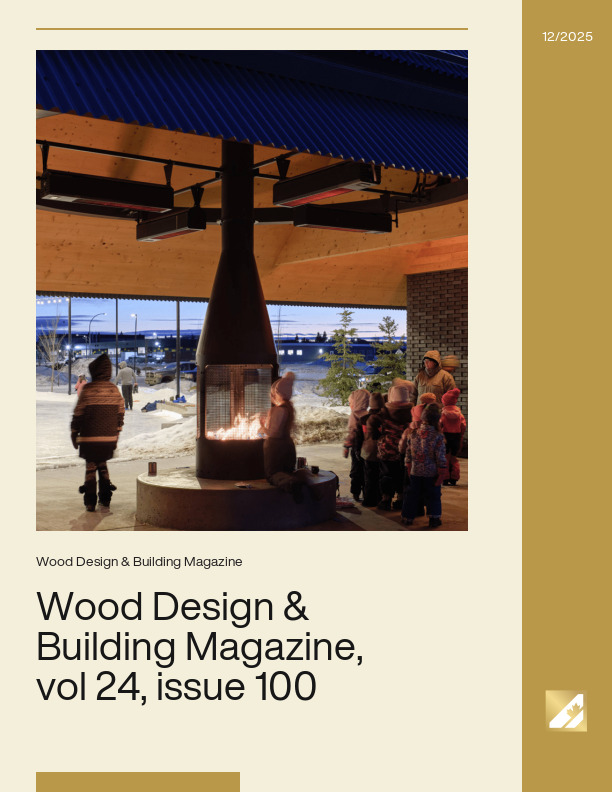
Wood Design & Building Magazine, vol 25, issue 102

This issue of Wood Design & Building explores how intentional design can carry culture, support community, and foster connection. The projects featured here demonstrate how a clear vision can transform a building into an environment grounded in purpose, identity, and care, reflecting both people and place.

Several projects in this issue centre Indigenous perspectives and priorities. The Membertou First Nation office building, the Weliankweyasimk Women’s Shelter, and the Chief Leonard George residential building each reflect cultural knowledge, respond to community needs, and create spaces of safety, continuity, and belonging.

Wood is a consistent presence throughout. Long associated with shelter and refuge, it is also a material of gathering, warmth, and shared experience. It is no coincidence that projects grounded in human wellbeing so often turn to wood. This connection is present in many cultures. Our WoodWare feature on FinnFox, for example, highlights the part wooden saunas play supporting health and building community in Nordic (and Canadian) sauna culture.

At the same time, building with wood is not simply a return to the past. While it reconnects us with cultural knowledge and longstanding practices, it also reflects a growing recognition of wood as a high-performance, renewable material for contemporary construction. This is evident in the Chief Leonard George Building, Canada’s first tall mass timber residential building constructed to the Passive House standard. It demonstrates how thoughtful wood design can both preserve cultural continuity and point toward the future of high-performance, low-carbon construction.

From Forest to Form: Sourcing Local Wood for BC Projects
Challenging Convention With Innovative Timber Applications
Tall Timber and Affordable Housing: A Case Study
The Business Case for Mass Timber
Mass Timber Insurance Action Plan Phase 1 Report
How We Will Make Construction More Affordable
Tall Wood Feasibility Study
Custom Steel Connections for Mass Timber: Understanding the Basics Step by Step
Low Carbon Buildings AND Energy Systems? Yes, We Wood.
2026 Wood Design & Building Awards Call for Submissions Now Open
Webinar – Online Tools for Wood Construction: CodeCHEK, FRR & STC & EMTC Calculator
Wood Design & Building Magazine, vol 25, issue 102
Course Overview This comprehensive course delves into the latest advancements in wood shearwall systems and connections, featuring critical updates from the 2020 National...
Course Overview Canadian Nuclear Labs’ Chalk River Laboratories comprise the largest single complex in Canada’s science and technology community. The site contains more...
Course Overview An overview of traditional, state of the art and innovative wood fasteners and connectors. This course is of particular interest to structural engineers and...
Course Overview Gestimat facilitates the assessment of the carbon footprint of buildings. Developed in Quebec for the Wood Charter and financed by the Fonds vert, Gestimat is...
Course Overview Through the example of the Biomass Power Plant at Hotchkiss School this presentation highlights distinctive and sustainable infrastructure. This Biomass Power...
Course Overview Dowel‐laminated timber is a next generation mass timber product commonly used in Europe, where it is also known as brettstapel. Panels are made from...
Course Overview This webinar will explore the basic design principles and best practices for efficient tall wall design using engineered wood products. Discussion will...
Course Overview This course will explore the use cases for incorporating more wood into a sector that is typically dominated by structural steel construction. We will look at...
Course Overview There are currently a number of planned new school projects throughout British Columbia that require either three ‐ or four‐storey buildings, and this...
Course Overview As part of its work related to wooden buildings, FPInnovations recently published a comprehensive technical Guide for designing timber-concrete composite...
Course Overview A pilot project in Washington State tests the use of CLT to design and construct three modular classroom buildings in Western Washington. Funded by the...
Course Overview This session will help you to formulate effective floor and wall assemblies when designing wood structures, both light wood frame and mass timber. Discussion...

Get Access to Our Resources

Stay in the loop and don’t miss a thing!

1
2
3

Get Access to Our Resources

Stay in the loop and don’t miss a thing!

What’s Your Occupation?

Help us personalize the content for you.

What Interests You the Most?

Help us personalize the content for you.

Filters

Expertise Icon
Field of Expertise
Province Icon
Province
Member Type Icon
WoodWork National Partners

Filters

Post Type Icon
Post Type
Persona Icon
Persona
Language Icon
Language
Tags Icon
Tags
Mass Timber Plus Icon Environment Plus Icon Safety Plus Icon Durability Plus Icon Design Systems Plus Icon Budget Plus Icon Construction Management Plus Icon Fire Resistance Plus Icon Tall Buildings Plus Icon Short Buildings Plus Icon
Date Icon
Date
Line Separator