en-ca

Searching for: wood

Searching results for “wood”
250 results found...
Sort By Dropdown Icon

Vertical Movement in Wood Platform Structures: Movement Prediction

It is not possible or practical to precisely predict the vertical movement of wood structures due to the many factors involved in construction. It is, however, possible to obtain a good estimate of the vertical movement to avoid structural, serviceability, and building envelope problems over the life of the structure.

Typically “S-Dry” and “S-Grn” lumber will continue to lose moisture during storage, transportation and construction as the wood is kept away from liquid water sources and adapts to different atmospheric conditions. For the purpose of shrinkage prediction, it is usually customary to assume an initial moisture content (MC) of 28% for “S-Green” lumber and 19% for “S-Dry” lumber. “KD” lumber is assumed to have an initial MC of 15% in this series of fact sheets.

Different from solid sawn wood products, Engineered Wood Products (EWP) are usually manufactured with MC levels close to or even lower than the equilibrium moisture content (EMC) in service. Plywood, Oriented Strand Board (OSB), Laminated Veneer Lumber (LVL), Laminated Strand Lumber (LSL), and Parallel Strand Lumber (PSL) are usually manufactured at MC levels ranging from 6% to 12%. Engineered wood I-joists are made using kiln dried lumber (usually with moisture content below 15%) or structural composite lumber (such as LVL) flanges and plywood or OSB webs, therefore they are usually drier and have lower shrinkage than typical “S-Dry” lumber floor joists. Glued-laminated timbers (Glulam) are manufactured at MC levels from 11% to 15%, so are the recently-developed Cross-laminated Timbers (CLT). For all these products, low shrinkage can be achieved and sometimes small amounts of swelling can be expected in service if their MC at manufacturing is lower than the service EMC. In order to fully benefit from using these dried products including “S-Dry” lumber and EWP products, care must be taken to prevent them from wetting such as by rain during shipment, storage and construction. EWPs may also have lower shrinkage coefficients than solid wood due to the adhesives used during manufacturing and the more mixed grain orientations in the products, including the use of cross-lamination of veneers (plywood) or lumber (CLT). The APEGBC Technical and Practice Bulletin emphasizes the use of EWP and dimension lumber with 12% moisture content for the critical horizontal members to reduce differential movement in 5 and 6-storey wood frame buildings.

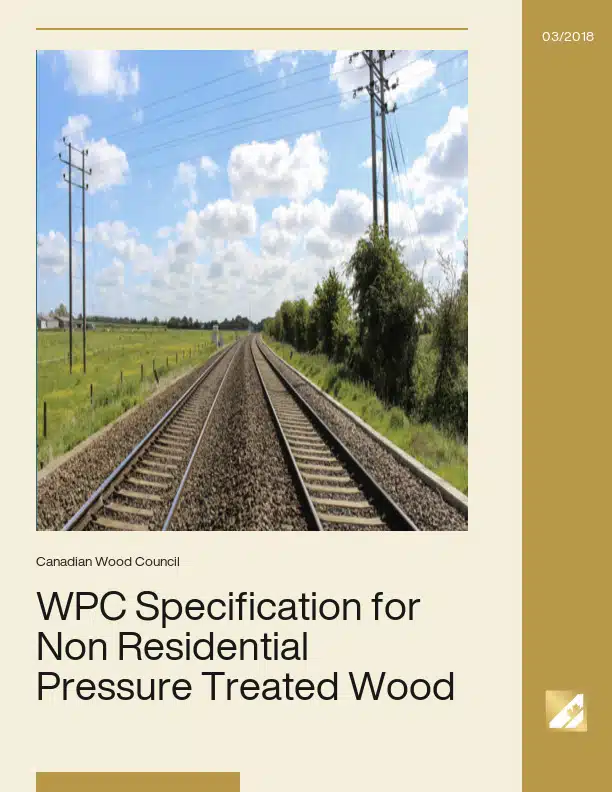
WPC Specification Guide for Non Residential Pressure Treated Wood Products Web

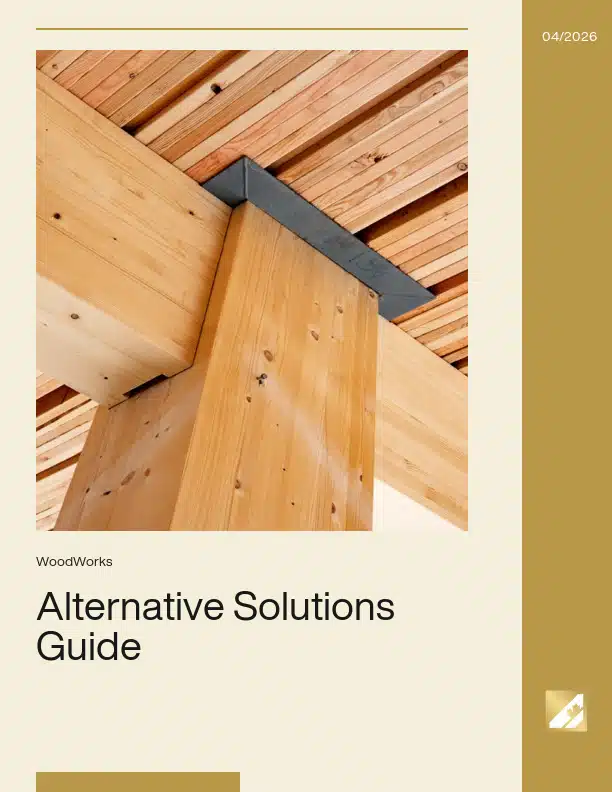
Alternative Solutions Guide

While alternative solutions have been an important feature of the National Building Code of Canada since 2005, there remains a lack of understanding among building professionals on how to approach their use. As the construction industry evolves, with increasing innovation in design and construction capabilities, new ways of building that may not be well addressed by building codes will emerge. At the same time, tools for performance testing and simulation are becoming more widespread. In light of the diverse and evolving building industry, alternative solutions that enable new ways of building are likely to become more commonplace. A critical area where alternative solutions may be employed is in the use of mass timber construction. The introduction of mass timber construction techniques, enabled by a range of engineered wood products, associated connection technologies, and fabrication methods, has resulted in a wide range of possible building solutions that may not have been considered by building codes.

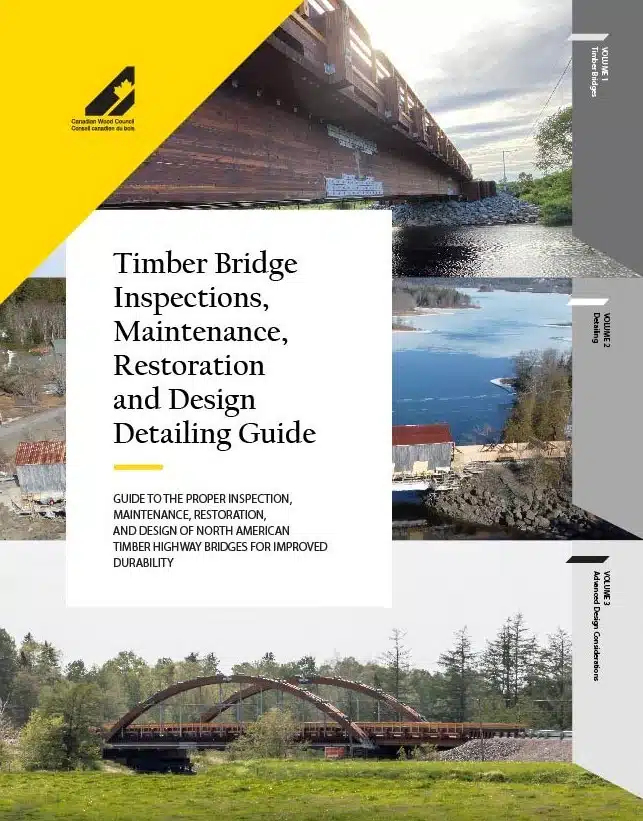
Timber Bridge Inspection, Maintenance, Restoration and Design Detailing Guide

This 3-volume guide on timber bridge inspection, maintenance, restoration, and detailing covers everything you need to know about detailing durable wood bridges, starting with a thorough description of wood’s unique and often advantageous properties, and concluding with advanced topics that will be of interest to engineers world-wide.

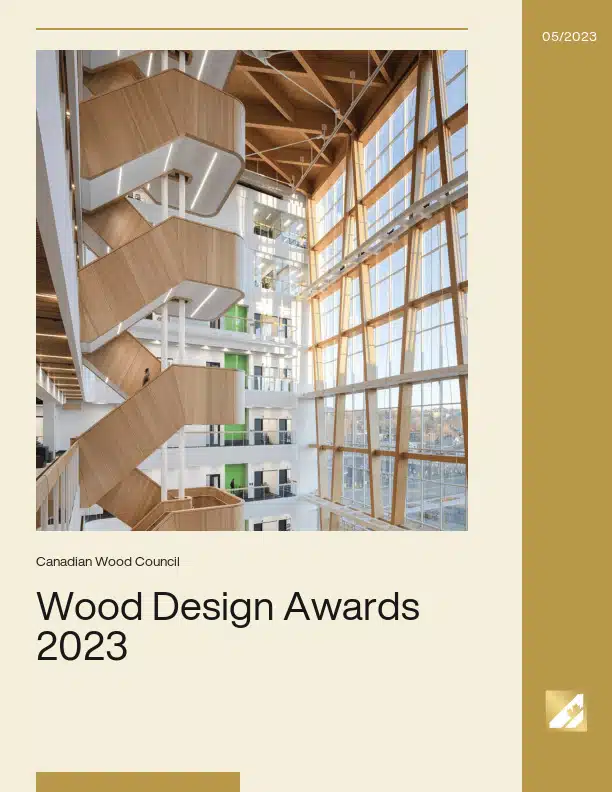
Wood Design Awards, 2023

Promoting Health and Wellness with Wood Architecture

The year 2020 will forever be synonymous with COVID-19. After experiencing the pandemic and its ripple effects, few would question the importance of health and wellness. What people may not consider is the impact that our surrounding environments have on our health. Research shows that incorporating wood and other natural elements into buildings can have a positive effect on occupants’ overall health and well-being. The term for this effect is called biophilia, which refers to humanity’s innate need to connect with nature.

Many industries are embracing biophilic design and its benefits. Employers are eager to create inviting spaces for their teams, hospital designs have shifted from cold and industrial-like to bright environments with wayfinding elements, and homeowners are expanding their living spaces with decks, fences, and pergolas so they can gather with friends and family outdoors. The wellness impacts of wood extend beyond the biophilic advantages of finished spaces. Mass timber buildings also benefit workers throughout the construction process by reducing construction time, and prefabricated elements contribute to cleaner, safer building sites.

The team at the Canadian Wood Council/Wood WORKS! is committed to providing design and construction professionals with the tools and information needed to build with wood. We’re going taller, we’re getting bigger, and, from coast to coast, we’re not stopping. Building with wood is the right choice, for the environment and for everyone’s well-being.

Wood Design Awards, 2022

Specification Guide for Non-Residential Pressure Treated Wood Products

Wood is the only renewable building material within the three major building material types. In exterior applications, wood is subject to deterioration from natural elements and biological attack, but when properly protected, its service life can be extended for many years. The most effective way of protecting exposed wood is the use of wood preservatives. Preserved wood products can have 5 to 10 times the service life of untreated wood. This extension of life saves the equivalent of 12.5% of Canada’s annual log harvests (source durable-wood.com).

The preservation of the wood is important, especially when it is specified for use in critical infrastructure applications such as railway ties, bridge timbers, utility poles and guardrail posts for highways. Pressure treated wood ensures that these critical structures remain strong and safe for the duration of their service lives. Pressure treated wood products are also commonly used in agricultural applications such fence rails, posts and building poles, as well as in commercial decks, fences, and other heavy duty outdoor applications. Depending on the required application and the level of protection needed for the wood products, there are a variety pressure treatment methods and approved preservatives that are available in Canada.

Pressure treatment is a process that forces preservatives into the wood to protect against fungal decay and destructive insects such as termites and marine borers. In Canada, wood preservatives are registered with Health Canada’s Pest Management Regulatory Agency (PMRA). Individual treating facilities undergo regular environmental assessments and follow the recommendations for the design and operation of wood preservative facilities as outlined in Environment Canada’s Technical Recommendation Document (TRD).

Wood Design Awards, 2021

Low-Rise Commercial Construction in Wood

Across Canada, the low-rise non-residential sector—think offices, retail stores, warehouses, and restaurants—presents a major growth opportunity for structural wood systems, including light wood-frame, heavy timber, mass timber, and hybrid construction.

Together, retail, office, and light industrial warehouse buildings account for nearly 75% of new floor space in this market each year. Yet despite their scale, these segments continue to show low uptake of structural wood.

As retailers adapt to the shift toward online shopping and businesses compete to attract talent, the design and performance of their buildings matter more than ever. Wood offers a sustainable, visually appealing solution that enhances employee well-being and elevates commercial spaces.

This new technical publication explores the market potential, challenges, and the role wood can play in redefining this sector.

The Canadian Guide to Mid-Rise Wood Construction 2021

The Mid-Rise project and the ensuing publication were conceived in order to provide a guide for opportunities that have been created by Canadian Code Provisions progressing, allowing 6 storey wood buildings over at least a decade.

The foundation for some of the ideas contained within, came from the Wood WORKS! program hosting regional focus groups, made up of key industry stakeholders. They were held at various locations across Canada during 2019. From the focus-group conversations and the research gathered and analyzed, it was evident that each province was at varying degrees of adoption, understanding and application for wood buildings up to 6 storeys. The opportunities that are available for wood use in mid-rise development are varied and many and it is hoped that some of the illustrations and information contained inside this guide will continue to inspire the design and construction industry.

The Code Matrix captures the variations of code provisions currently in use in each of the Canadian provinces, and highlights Part 3,4 and 5 requirements for wood buildings up to 6 storeys in height. Permissible building types, heights and areas, permitted mixed major occupancies, required fire resistance ratings and sprinkler provisions are illustrated.

The flow of the sections is laid out to mirror basic project planning steps that are generally undertaken by design teams. A keen understanding of what is allowed by code, creates the conversation around ideas for buildings and potential project opportunities. The location of a site, how it fits into local planning and zoning regulations, and a business case that makes it achievable, are all stages a design team navigates early with a client. Many factors drive the business case. Goals set early for greener and environmentally sustainable development, applications of sustainable materials having significantly lower embodied carbon, can be incorporated into design principles. Schedule often drives design and project efficiency, creating consideration into using prefabricated and modular wood structural systems.

Part 5 of the guide contains some technical considerations for 5- and 6- storey wood buildings is laid out to help designers better understand some of the practical considerations needed for the construction and design of mid-rise wood buildings. It is written for design professionals in the construction industry, and builders with the necessary skills to consider taller wood buildings.

This guide is illustrated to be relevant to all design and building professionals involved in building our future environments, including architects, engineers, the development community, material suppliers, manufacturers, building inspectors, municipal officials and planners, project managers, contractors, innovators, and the general public at large.

Wood Design Awards, 2020

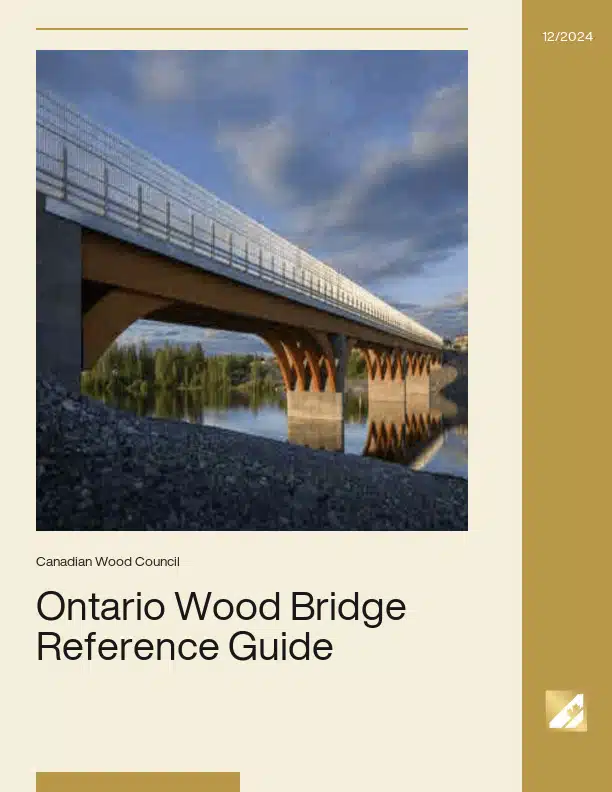
ONTARIO WOOD BRIDGE REFERENCE GUIDE
...the Canadian Wood Council publication Wood Highway Bridges from 1992 are typically referenced by designers of timber bridges in Ontario. This new reference is intended to provide updated background information...
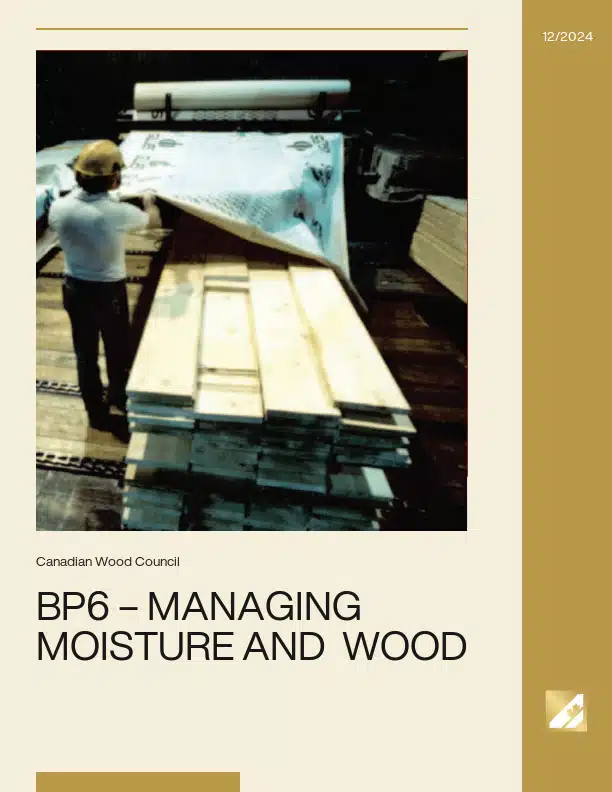
BP6 – MANAGING MOISTURE AND WOOD
...wood frame buildings that have provided strong and lasting housing for a multitude of people. Although wood can withstand much abuse, it needs to be stored and handled properly to...
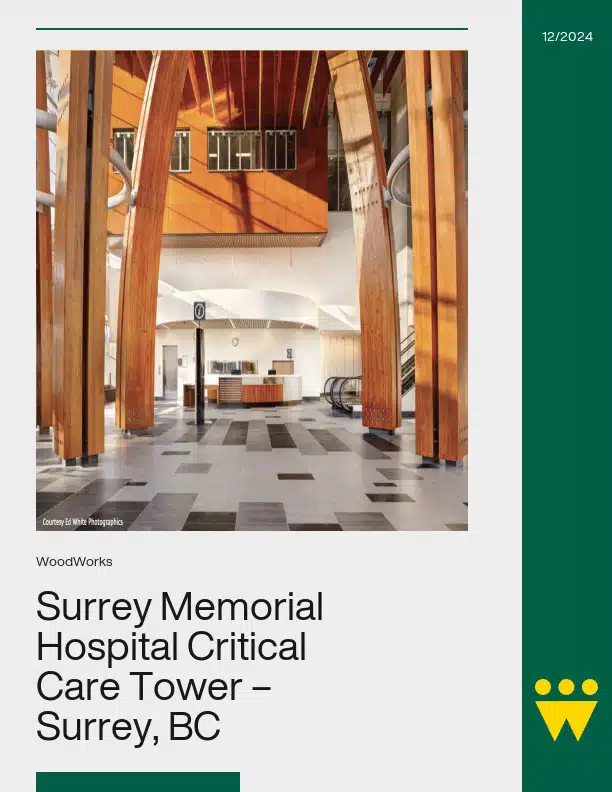
Surrey Memorial Hospital Critical Care Tower – Surrey, BC
...natural materials into healthcare facilities. Wood in particular is visually warm and contributes to a socially positive experience for building occupants. People respond emotionally to wood and are attracted to...
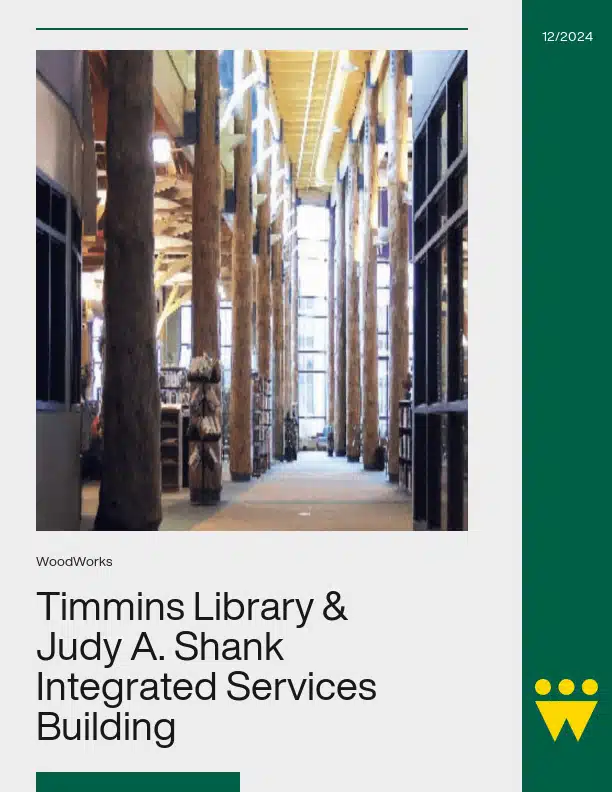
Timmins Library & Judy A. Shank Integrated Services Building
...wished, wherever economically justifiable, to incorporate wood products into the structure and appearance of the Library. In addition, there were obvious benefits to combining the library with the needs of...
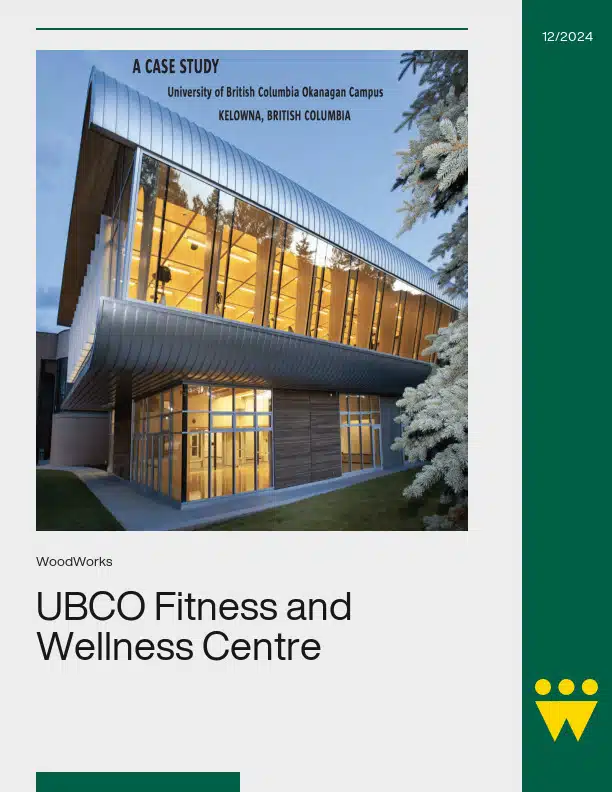
UBCO Fitness and Wellness Centre – University of British Columbia Okanagan Campus
...a design-build competition for the new building. The donor stipulated two conditions for the facility: it needed to have an aviation theme, and it had to demonstrate innovative wood construction....
Innovating with Wood – A Case Study Showcasing Four Demonstration Projects
...use of wood for the construction of the UBC’s Earth Sciences Building (ESB) complemented the relationship between environment and science. The new 5-storey north wing of the ESB will house...
Innovative Wood Use in BC – A Case Study Showcasing Three Demonstration Projects
...projects benefited from BC provincial funding support through the Wood Enterprise Coalition (WEC) demonstration project program. WEC was put in place under the province’s Wood First Initiative,1 and has a...
Living with Lakes Centre
...an extraordinary building with an exceptionally low environmental footprint. The project makes extensive use of wood products harvested and manufactured close to Sudbury, including structural, framing and decorative wood products....
Long-term Care Facilities – Norview Lodge & Parkwood Mennonite Home
...safe, cheery, and bright, and yet economical to construct and maintain. Wood construction offers many advantages—for example, wood-frame construction is economical, and wood finishes and exposed wood members offer architectural...
Meadows Community Recreation Centre and Library
...indoors and outdoors maximizes natural light and materials to create a warm and inviting atmosphere. Wood is used throughout as both a structural and finish material. Because wood is a...
Microtel Inn & Suites – Parry Sound, Ontario
...project’s architect, designed this three-storey building using wood for all structural framing. Prefabricated wood panels designed specifically for the project were used to complete this cost effective, high quality, and...
Mid-Rise Construction In British Columbia – A Case Study Based on The Remy Project In Richmond, BC
Modern six-storey light-frame wood construction in British Columbia (BC) incorporates highly-detailed, researched and safe solutions. the engineering technology being adapted in the province is positioning BC at the forefront of...
Timber bridges have a long history of construction and use throughout North America, including Ontario, for roadways, railways and logging roads. The Canadian Highway Bridge...
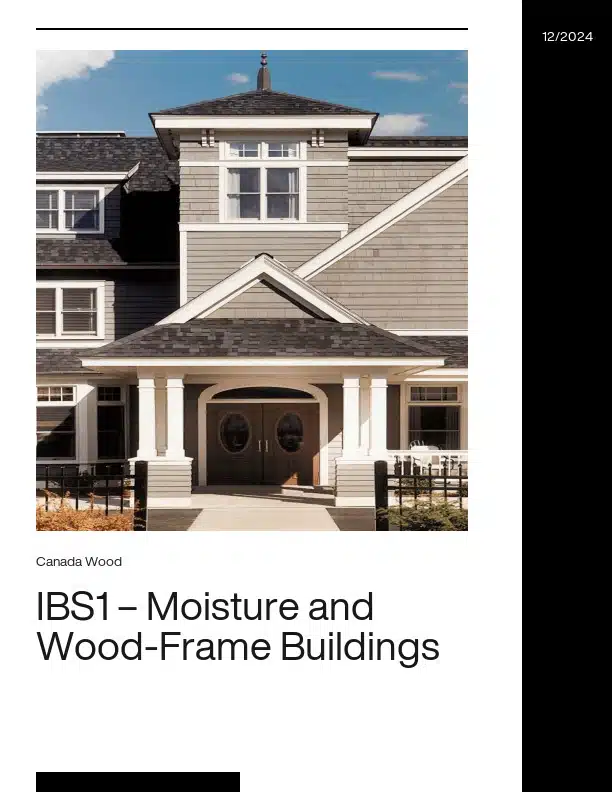
Wood, a long-lasting, economical, and renewable resource, is the building material of choice in North American housing. This is largely due to the proven performance of...
Just as our definition of green building has expanded with time so has our understanding of human health expanded to include not only our physical condition but also our...
The City of Timmins has a population of 45,000 but due to its location in northeastern Ontario, is a regional service centre for 100,000 people. It had become obvious that...
The University of British Columbia - Okanagan (UBCO) is located in the south-central community of Kelowna in BC’s interior. UBCO’s student community numbers just over...
The success of the University of British Columbia's (UBC) Earth Sciences programs resulted in a need for the department to expand in order to accommodate a growing enrollment...
This document includes case studies on the Elkford Community Conference Centre, the North Shore Credit Union Environmental Learning Centre and the City of North Vancouver...
Sudbury, Ontario, located at the edge of a large geological structure known as the Sudbury Basin (a 1.85-billion-year-old meteorite impact crater), is home to Canada’s...
Canada’s ageing population means an increasing demand for more facilities dedicated to providing care for elderly citizens. Facility operators and residents are looking for...
Located in a fast-growing area of south-east Edmonton, the new Meadows Community Recreation Centre, and associated Meadows Branch Edmonton Public Library, provides year round...
Canada’s first Microtel Inn & Suites was opened in Parry Sound, Ontario in May 2006 by Ontarinns, Inc. of Toronto. Henry B. Lowry, president of the company, franchisee...
Modern six-storey light-frame wood construction in British Columbia (BC) incorporates highly-detailed, researched and safe solutions. the engineering technology being adapted...

Get Access to Our Resources

Stay in the loop and don’t miss a thing!

1
2
3

Get Access to Our Resources

Stay in the loop and don’t miss a thing!

What’s Your Occupation?

Help us personalize the content for you.

What Interests You the Most?

Help us personalize the content for you.

Filters

Expertise Icon
Field of Expertise
Province Icon
Province
Member Type Icon
WoodWork National Partners

Filters

Post Type Icon
Post Type
Persona Icon
Persona
Language Icon
Language
Tags Icon
Tags
Mass Timber Plus Icon Environment Plus Icon Safety Plus Icon Durability Plus Icon Design Systems Plus Icon Budget Plus Icon Construction Management Plus Icon Fire Resistance Plus Icon Tall Buildings Plus Icon Short Buildings Plus Icon
Date Icon
Date
Line Separator