en-ca

Searching for: wood

Searching results for “wood”
250 results found...
Sort By Dropdown Icon

Surface Flammability and Flame-Spread Ratings

The rate at which flame spreads on the exposed interior surfaces or a room or space can have an impact on the rate of fire growth within an area, especially if the materials of the exposed surfaces are highly flammable. Therefore, the National Building Code of Canada (NBC)¹ regulates the surface flammability of any material that forms part of the interior surface of walls, ceilings and, in some cases, floors, in buildings. Based on a standard fire-test method, the NBC uses a rating system to quantify surface flammability that allows comparison of one material to another, and the ratings within that system are called flame-spread ratings (FSR).

For some buildings, the smoke generated by materials or products lining some areas of the building when they burn is also regulated by the NBC. Since it may take some additional time for occupants to exit the building, this applies to all unsprinklered high buildings and all elevators or Group B occupancies in high buildings. The FSR and SDC is also regulated for some materials used in ducts and plenums. The smoke produced from a material or product is measured and quantified through another rating system, based on a standard fire-test method — the smoke developed classification (SDC). For most wood products used as interior finishes, both of these properties — the FSR and the SDC — are to be determined in accordance with CAN/ULC-S102, “Standard Method of Test for Surface Burning Characteristics of Building Materials and Assemblies.”² For flooring, CAN/ULC-S102.2 “Standard Method of Test for Surface Burning Characteristics of Flooring, Floor Coverings, and Miscellaneous Materials and Assemblies is to be used when a SDC or FSR is required.

Tall Wood Course of Construction Site Fire Safety

The vulnerability of any building, regardless of the material used, in a fire situation is higher during the construction phase when compared to the susceptibility of the building after it has been completed and occupied. This is because the risks and hazards found on a construction site differ both in nature and potential impact from those in a completed building; and these risks are occurring at a time when the fire prevention elements that are designed to be part of the completed building are not yet in place. For these reasons, construction site fire safety includes some unique challenges. Developing an understanding of these hazards and their potential risks is the first step towards fire prevention and mitigation during the course of construction (CoC).

Four-Storey Wood School Design in British Columbia: Life Cycle Analysis Comparisons

Climate change is one of the largest threats facing the planet today. The construction industry accounts for 11% of global carbon emissions, playing a significant part in the climate crisis. To determine the best solution for future school buildings, not only does practicability, economy and constructability play a part, so does sustainability.

In order to better understand the embodied carbon emissions associated with the construction of new school buildings in British Columbia, the embodied carbon content associated with the four framing systems examples in the companion report, An Analysis of Structural System Cost Comparisons (costing study), was assessed. The purpose of this study is to allow the embodied carbon associated with these systems to become an important factor when choosing a viable scheme.

Embodied carbon is the carbon footprint of a material or product. To determine the embodied carbon of a building you must consider the quantity of greenhouse gases associated with the building. The most effective way to measure this is through Life Cycle Analysis (LCA), a study which determines the embodied carbon from cradle to grave (material extraction to building demolition). Consequently, an LCA was conducted for each of the four schemes presented in the costing study. Additionally, for wood frame Options A and B, WoodWorks online carbon calculator was used to determine the potential carbon savings associated with carbon sequestering.

Four-Storey Wood School Design in British Columbia: An Analysis of Structural System Cost Comparisons

As land values continue to rise, particularly in higher-density urban environments, schools with smaller footprints will become increasingly necessary to satisfy enrollment demands. There are currently several planned new school projects throughout British Columbia that anticipate requiring either three-or four storey buildings, and it is forecast that demand for school buildings of this size will continue to rise.

Though timber construction would offer a viable structural material option for these buildings, the British Columbia Building Code (BCBC 2018) currently limits schools comprised of timber construction to a maximum of two storeys, while also imposing limits on the overall floor area. Given these constraints, the development of viable structural options that would accommodate larger and taller schools constructed primarily with timber materials has not been a key focus.

With the above factors in mind, the purpose of this report is to build upon the findings of the previously published Design Options for Three- and Four-Storey Wood School Buildings in British Columbia prepared by Fast + Epp and Thinkspace dated November 2019. Specifically, this report supplements the previous one by providing guidance in assessing and comparing the various framing options considered in the previous report primarily on a cost basis.

Wood Design Manual 2020

The Wood Design Manual is the Canadian reference on the design of timber structures, under gravity and lateral loadings, according to Part 4 of the National Building Code of Canada (NBC) and the “Engineering design in wood” standard (CSA O86). It provides guidance and design examples on sawn and engineered wood members, their connections and fire design. The most common design situations encountered by practicing engineers are covered through intuitive Selection Tables. In addition, the Wood Design Manual contains the latest CSA O86 Standard, as well as a technical commentary written by timber design experts including members of the Standard’s technical committee.

The 2020 Wood Design Manual includes a copy of the CSA O86:19 Standard, incorporating Update No.3 – July 2021. The main changes in this edition are:

  1. Updates to NBC 2020, including guidance on the new “transient live load” in serviceability load combinations.
  2. New sawn lumber joist vibration tables, based on the new vibration design method in O86:19 Annex A.
  3. Updated bending and tension tables for Hem-Fir beam and stringer grade, based on the changes in Hem-Fir design values in O86:19.
  4. Updated CLT deflection tables, based on the removal of the 1.2 form factor in O86:19.
  5. Updated CLT combined loading tables, again, based on the removal of the 1.2 form factor in O86:19.
  6. Improved bolt tables that can be directly used to obtain bolt resistances and failure modes.
  7. Updated shearwall and diaphragm selection tables based on the new alternative f1 equation.
  8. Updated design example of CLT shearwall to account for O86:19 additional provisions and provides design and deflection expressions for multi-panel CLT shearwalls.

Wood Design Awards, 2019

Design Options for Three- and Four Storey Wood School Buildings in British Columbia

As land values continue to rise, particularly in higher-density urban environments, schools with smaller footprints will become increasingly more necessary to satisfy enrollment demands. There are currently a number of planned new school projects throughout British Columbia that anticipate requiring either three-or four-storey buildings, and it is forecasted that the demand for school buildings of this size will continue to rise.

Though timber construction would offer a viable structural material option for these buildings, the British Columbia Building Code (BCBC 2018) currently limits schools comprised of timber construction to a maximum of two storeys, while also imposing limits on the overall floor area. Given these constraints, to date there has not been much effort put into the development of viable structural options that would accommodate larger and taller schools constructed primarily with timber materials.

With the above factors in mind, the purpose of this study is to illustrate the range of possible timber construction approaches for school buildings that are up to four storeys in height. Given this emphasis on four-storey construction, this study focuses on the main classroom blocks within a school building, as these portions of the building are the ones that are the most likely to take advantage of an increased number of storeys. While other portions of school buildings, such as gymnasiums, shops, and multi-purpose areas are also strong candidates for wood construction systems, since there are already numerous examples of this type of construction these areas are not emphasized in this report.

Shane Homes YMCA At Rocky Ridge CALGARY, AB

Calgary’s aspirations to become a world-class city are supported by its recent investments in infrastructure and architecture, including the $192-million Shane Homes YMCA at Rocky Ridge, which was bolstered by the largest private donation ever contributed to the local YMCA. Shane Homes is a Calgary-based development company, established in 1979, that contributed $3.5 million for the project.

This is the first recreational facility for the northwest corner of the city, serving a community of more than 100,000 residents. Nestled in Calgary’s rolling foothills, the curvilinear design of the Shane Homes YMCA at Rocky Ridge is inspired by the surrounding landscape. The building is sited within a natural park featuring reconstructed wetlands. Multiple pathways and a timber pedestrian bridge curve throughout the site, linking to the regional pathway system.

Glulam timber is the primary structural component, allowing for a geometrically complex design at considerably less cost than other materials. The dramatic silhouette is dened by the largest freeform timber roof structure in North America. Construction began in 2014, and since opening to the public in January 2018, this new recreation centre has become a bustling hub of sport and activity. The Shane Homes YMCA has won numerous awards, including a 2019 Wood WORKS! Prairie Wood Design Award, a 2018 Canadian Wood Council Award and a 2017 CanBIM Best in BIM Award.

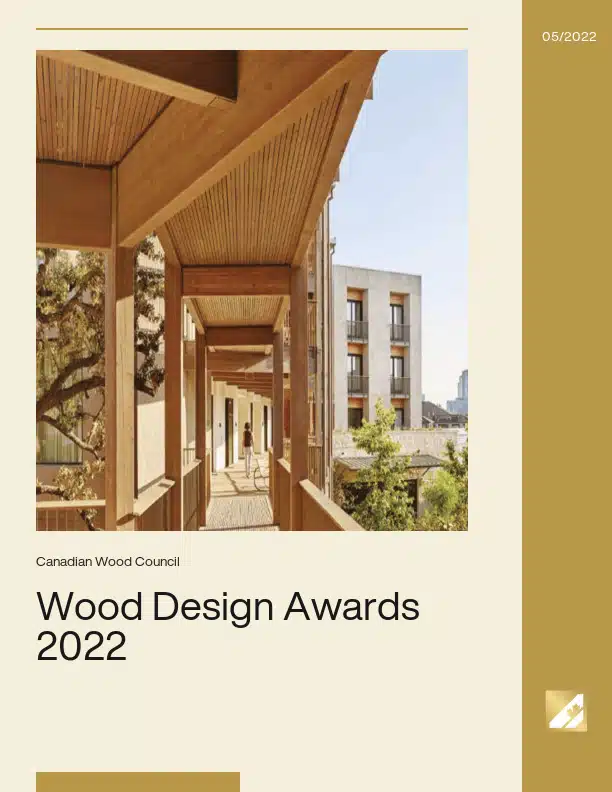
Wood Design Awards, 2018

Mid-Rise Best Practice Guide Proven Construction Techniques for Five-and Six-Storey Wood-Frame Buildings

When the provincial government changed the British Columbia Building Code (BCBC) in 2009 by increasing the permissible height for wood-frame construction from four storeys to six for residential buildings, it joined many other jurisdictions around the world in recognizing the role that wood construction should play in the creation of a sustainable, built environment.

Scientific evidence and independent research had shown that such buildings could meet the performance requirements of the BCBC in regard to structural integrity, fire safety, and life safety. That evidence has now also contributed to the addition of new prescriptive provisions for wood construction, as well as paved the way for future changes that will include more permissible uses and ultimately greater permissible heights.

As a result of this research, and the successful implementation of many mid-rise wood-frame residential buildings in BC, the Canadian Commission on Building and Fire Codes approved similar changes to the National Model Construction Codes. The 2015 edition of the National Building Code of Canada (NBC) now permits the construction of six-storey residential, business, and personal services buildings using traditional combustible construction materials. The changes to Part 3 of the NBC, which are being considered for adoption by British Columbia in late 2018, address the objectives of safety, fire, and structural protection of buildings.

With more than 100 five- and six-storey woodframe buildings completed in BC since 2009, and many others either designed or under construction, there is clear market confidence in this new type of building. This construction supports the goals of many municipalities: to find affordable and sustainable ways to accommodate their growing populations, as well as create more complete and resilient communities.

With each completed building, architects, engineers, builders, and developers have added to their knowledge base and refined their best practices for mid-rise wood-frame construction. The five projects featured in this publication are representative of the diverse and varied application of these techniques to different geographic and market conditions, from small towns to dense urban centres and from affordable rental accommodation to high-end condominiums.

Introduction to Wood Design 2018

Introduction to Wood Design has been prepared to facilitate and encourage the instruction of wood engineering at Canadian universities and colleges. The publication is a supplement to the Wood Design Manual 2017.

Wood Design Awards, 2017

Mid-Rise Construction In British Columbia – A Case Study Based on The Remy Project In Richmond, BC
Modern six-storey light-frame wood construction in British Columbia (BC) incorporates highly-detailed, researched and safe solutions. the engineering technology being adapted in the province is positioning BC at the forefront of...
Mountain Equipment Co-op Head Office – Vancouver, BC
...four million members and annual sales of more than $300 million. With each new building project, MEC has endeavoured to advance its own sustainability agenda, and in this respect wood...
Operations Centre – Gulf Islands National Park Reserve
...ease of installation and local availability, the glulam provides interior ambience for the exposed structure. Wood-frame walls are used for a large proportion of the exterior walls and western red...
Rock Community Church – Planned for Growth
Rock Community Church is located in Woodbridge, Ontario, directly north of Toronto. Several years ago, the congregation bought a large, wooded property and used an existing residence and outbuildings for...
Social Services Administration Board – The District of Thunder Bay
...The building is wood post and beam construction with woodframe floors and infill walls. Glulam columns were left exposed. This aesthetically pleasing expression of the structure, combined with wood millwork...
Brock Commons Tallwood House – University of British Columbia Vancouver Campus
...wood buildings; taller wood structures such as church towers and pagodas were built worldwide earlier still. Today, pushing the envelope of wood use comes with challenges. Authorities having jurisdiction and...
Origine – Pointe-Aux-Lièvres Ecocondos – Quebec City
...Nordic Structures, EBC, and Synchro Immobilier, wanted to push the boundaries of wood materials. Origine’s great innovation resides in its lateral resistance system made entirely of wood. It is actually...
Mid-Rise 2.0 – Innovative Approaches to Mid-Rise Wood Frame Construction
...arisen for developers and design teams to explore new forms of wood construction, including hybrid mass timber/light wood frame construction. In response to these new market conditions, traditional wood frame...
Templar Flats – Hamilton, ON
Templar Flats in Hamilton, Ontario, has the distinction of being the first occupied, modern wood-frame mid-rise building completed in Ontario. It was constructed under provisions (O. Reg. 191.14) added to...
Seismic Design with Wood: Solutions for British Columbia Schools
...earthquake behaviour has evolved. The experience gained from a succession of major earthquake events has confirmed that well-designed, ductile wood buildings performed well, especially from the standpoint of life safety....
Celebrating Edmonton’s Wood Architecture
It is significant that wood played such a large role in this type of complex, which is usually done in other materials. The wood structure is a unifying element between...
The Mosaic Centre for Conscious Community and Commerce – Edmonton, Alberta
...analysis favoured wood construction to meet all building science challenges and also provide an enhanced interior work environment. Construction started in mid-March 2014 and was completed in the fall of...

Get Access to Our Resources

Stay in the loop and don’t miss a thing!

1
2
3

Get Access to Our Resources

Stay in the loop and don’t miss a thing!

What’s Your Occupation?

Help us personalize the content for you.

What Interests You the Most?

Help us personalize the content for you.

Filters

Expertise Icon
Field of Expertise
Province Icon
Province
Member Type Icon
WoodWork National Partners

Filters

Post Type Icon
Post Type
Persona Icon
Persona
Language Icon
Language
Tags Icon
Tags
Mass Timber Plus Icon Environment Plus Icon Safety Plus Icon Durability Plus Icon Design Systems Plus Icon Budget Plus Icon Construction Management Plus Icon Fire Resistance Plus Icon Tall Buildings Plus Icon Short Buildings Plus Icon
Date Icon
Date
Line Separator