en-ca

Searching for: wood

Searching results for “wood”
250 results found...
Sort By Dropdown Icon

Nordic X-Lam Technical Guide

The Nordic X-Lam Technical Guide is a comprehensive technical resource for architects, engineers, and construction professionals designing with cross-laminated timber (CLT) systems from Nordic Structures. The guide provides essential information to support the effective specification and integration of Nordic X-Lam panels in mass timber buildings.

The document details panel properties, structural performance, and typical applications, with guidance on sizing, spans, loading conditions, and connections. It also addresses key design considerations including fire performance, acoustics, vibration, and building code compliance, helping project teams evaluate system suitability across a range of project types.

Developed as a practical design reference, the Nordic X-Lam Technical Guide supports coordinated, efficient project delivery by providing a clear technical framework for incorporating CLT systems into contemporary wood construction.

Wood Design & Building Magazine, vol 24, issue 100

Reaching one hundred issues is a milestone worthy of both celebration and reflection. Wood Design & Building, once upon a time called Wood le Bois, began as a modest trade magazine dedicated to showcasing excellence in wood architecture. Over the years we added special features and technical content that helped us grow a loyal readership and community of wood design advocates.

Recently, our cherished print magazine evolved into a digital, multi-media publication. While this transformation involved a small sense of loss for the printed ways of our past, we remain excited by the expanded potential the new format affords, with a reach far wider than we ever imagined at the outset of this journey. So, while the format may have changed, and content options expanded, our purpose has remained remarkably steady. Issue after issue, we have tried to capture not just great buildings, but the innovations, insights, and architectural aspirations that continue to expand wood’s role in contemporary design and construction.

As we look back, there is a sense of gratitude for all that has unfolded across these pages. Past editions captured early explorations in modern timber construction, the resurgence of adaptive reuse, and the steady shift toward high-performance, low-carbon buildings. Today, advances in mass timber systems, hybrid approaches, and industrialized processes are reshaping how buildings come together. Throughout this evolution, wood has been at the center of conversations about sustainability, long-term value, and design expression. The body of work published over the years reflects not only changing technologies but the steady influence of a material with deep cultural and environmental roots.

It is fitting that our 100th issue is also our special awards edition, honouring the winners of the 2025 Wood Design & Building Awards. These celebrated projects are the latest chapter in the architectural story we have been privileged to document for decades. What distinguishes them is not only their accomplishment today, but what they suggest about tomorrow: a more sustainable built environment defined by technical excellence, architectural warmth, and memorable experiences that transcend program or scale.

To everyone who has contributed, read, shared, and championed this publication—thank you. Reaching 100 issues is deeply meaningful, not because of the number alone, but because it represents a sustained conversation within a community that cares about design, innovation, and the future of building. We remain committed to documenting that evolution, and we look forward to continuing the conversation with you, discovering new stories, and celebrating the work yet to come.

Wood Design & Building Magazine, vol 24, issue 99

As the design and construction industry collectively strives towards a more sustainable built environment, one of the more interesting challenges in architecture today is how to work with what already exists. When existing structures are adapted and repurposed rather than demolished once they outlive their original use, resources are conserved, greenhouse gas emissions are lowered, heritage is preserved, and decarbonization goals are advanced.

Whether it’s adapting a historic structure to a new use or extending the life of a contemporary one with a creative renovation or addition, designers are exploring the possibilities and finding ways to integrate wood into projects that build on the foundations of the past, figuratively and literally, to meet the needs of the present.

In this issue, two feature stories explore different approaches to giving existing buildings new, expanded purpose. One project breathes new life into a traditional fieldstone barn through adaptive reuse, while another demonstrates how a lightweight mass timber vertical addition can expand an existing apartment building, adding new units to help meet growing housing needs. Both illustrate how wood enables design solutions that are respectful, efficient, and forward-looking.

Projects like these remind us that innovation is a form of evolution, and sometimes, the most sustainable, creative, and community-minded choice is to work with what you’ve already got.

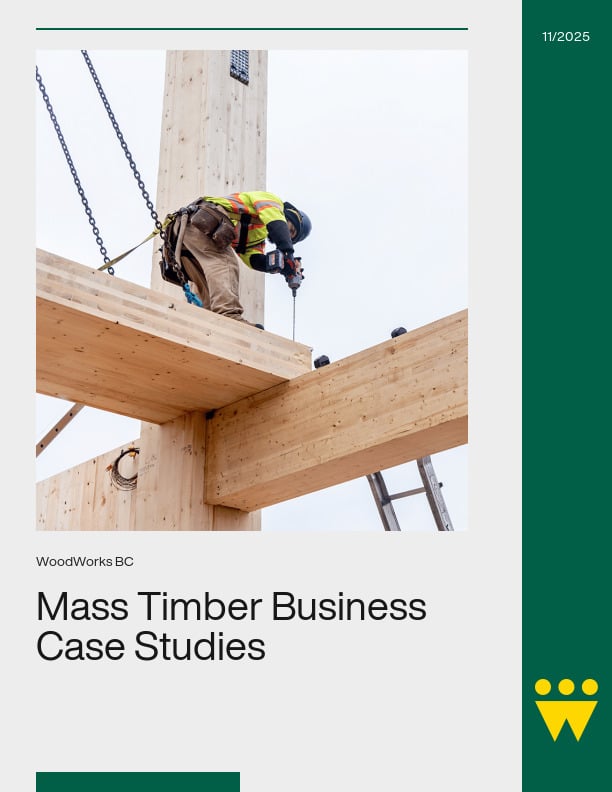
Mass Timber Business Case Studies

This document presents a series of business case studies that explore the financial performance of mass timber projects, providing quantitative data and qualitative insights to help developers and investors assess its economic viability.

Each case study measures investment success, challenges, and lessons learned from the developer’s and project team’s perspectives. Moreover, by analyzing strategy, risk, revenue, cost and schedule, these case studies enable direct comparisons between mass timber and traditional construction methods.

WoodWorks is seeking developers and owners with completed mass timber projects to share data for analysis, supporting education and training in the mass timber sector. The goal is to continuously expand case studies across various sectors and markets. To participate or learn more, please contact a WoodWorks staff member.

Acoustic Comparative Study

In a context where wood construction is gaining momentum, acoustics remains a key challenge in ensuring occupant comfort and compliance with standards. With this in mind, AcoustiTECH, an expert in acoustic solutions, has partnered with FPInnovations, a leader in research and development in the wood sector, to conduct an in-depth comparative study in its laboratory facility.

Who We Are

AcoustiTECH is a broker specializing in acoustic solutions, supporting building professionals in selecting highperformance materials that meet and exceed industry standards. With 25 years of experience and unique expertise, we offer customized assemblies through a specialized brand ecosystem and reliable data. Our personalized service, backed by dedicated technical and engineering teams, ensures tailored and effective
solutions that enhance the acoustic comfort of occupants. FPInnovations is a globally recognized, private, non-profit organization specializing in research and development for the forestry sector. Its mission is to support businesses and building professionals in innovating and optimizing wood-based materials. With ISO 17025-accredited laboratories and state-of-the-art facilities, FPInnovations assesses the performance of wood structures in terms of acoustics, vibrations, fire resistance, and more.

Study Objective

At AcoustiTECH, our goal is to continuously innovate by delivering new data and acoustic solutions tailored to the specific requirements of each project. This collaboration with FPInnovations marks a significant milestone in our acoustic analysis of wood structures, as it represents our first large-scale data collection on a GLT masstimber slab and our second mass-timber campaign overall, building on a prior study.

Through this study, we obtain precise acoustic measurements for this structural system and conduct rigorous comparisons across numerous innovative market solutions. We take into account key project criteria such as acoustic performance, budget, thickness, weight, and even design, as different acoustic solutions can also influence the choice of floor coverings.

Grounded in a scientific approach and conducted in controlled environments with FPInnovations, this research aims to evaluate various acoustic configurations optimized for mass timber construction. By combining technical expertise, innovation, and in-depth analysis, we provide architects, engineers, and developers with high-performance solutions that meet and exceed the industry standards.

Innovative Strategies for Light-Frame Mid-Rise Buildings in High-Seismic Regions

Innovative Strategies for Light-Frame Mid-Rise Buildings in High-Seismic Regions presents a detailed design example and practical guidance for engineers and builders responding to rising seismic demands on Canada’s West Coast. With the 2020 National Building Code of Canada significantly increasing seismic forces—particularly in Vancouver and Vancouver Island—conventional light-wood-frame (dimensional lumber) shearwall systems often no longer meet code requirements without costly additions.

This guide, prepared by WHM Structural Engineers for WoodWorks BC and the Canadian Wood Council, explores two high-capacity shearwall solutions: Mid+Std walls, a code-compliant adaptation of Midply construction that achieves roughly 50% greater capacity than standard walls without increasing wall length, and Double Nail walls, a research-based approach using double rows of edge nails to match Mid+Std strength. Combined with lightweight floor topping strategies, these systems enable six-storey light-frame buildings to remain viable and cost-competitive even on poor soils and in the highest seismic regions.

Cost analysis shows Mid+Std walls incur about a 30% framing cost increase over baseline, while Double Nail walls add about 20%, both more economical than doubling corridor wall lines. The publication includes complete design calculations, construction considerations, and conceptual connection details to help practitioners implement these strategies confidently.

This resource equips designers, contractors, and owners with practical, innovative approaches to maintain the competitiveness of light-frame wood construction while meeting the stringent seismic requirements of the latest building codes.

Offsite Wood Construction Handbook

Industrialized offsite construction, also known as prefabricated or modular construction, is a construction method where building materials and components are manufactured and assembled offsite in factories before being transported to the project site for the final assembly. This approach can improve efficiency, reduce cost, and enhance quality compared to the traditional onsite construction. Industrialized offsite construction results from the reality of labour shortages, as well as the desire to automate manufacturing processes and shorten delivery schedules.

As the construction industry evolves and processes are becoming automated, FPInnovations has been working on industrialized offsite construction for the last decade to ensure that the Canadian wood industry maintains its competitiveness. Guided by a comprehensive roadmap developed by FPInnovations and its partners in 2019 to identify the knowledge gaps, FPInnovations accelerated in the past five years to address the impacts of manufacturing and construction changes across the value chain.

Inside the guide

This in-depth guide on offsite wood construction includes chapters on the following topics:

  • Design process associated with offsite construction
  • Offsite manufacturing process
  • Lumber and engineered wood product portfolio available in Canada for offsite construction
  • Performance of buildings manufactured offsite
  • Essential activities outside of manufacturing plants for offsite construction
  • Environmental impacts of offsite construction

Wood Design & Building Magazine, vol 24, issue 98

What does it take to deliver better buildings? In this issue, we explore that question from a couple of different angles—primarily through a look at standout wood projects that demonstrate wood design excellence, but also through a thoughtful feature on offsite prefabrication that invites the construction industry to think critically about how we build and what it will take to build better. Through enhanced collaboration and the expanded use of technology, prefabricated construction—an approach especially well-suited to wood—is transforming the way we design and deliver buildings.

This fall, the Canadian Wood Council is proud to support Woodrise 2025, an international conference coming to Vancouver, British Columbia. As part of this event, the 5th International Congress on tall wood construction, we’ve curated nine immersive tours that offer attendees a unique opportunity to step inside some of the region’s most compelling wood projects for a firsthand look at the leadership and innovation happening here.

If you believe one of the best ways to learn about a building is to walk through it—this is your chance. The full tour lineup is available now at www.woodrise2025.com/offsite-tours. Join us to explore everything from sustainable forest management and advanced manufacturing to some of the region’s most iconic mass timber buildings – experiences that bring together the people, materials, and design approaches shaping the future of low-carbon construction in B.C. and beyond.

We hope this issue inspires you to keep exploring what’s possible with wood—whether in your own projects or out with us on tour.

Feasibility of Point-Supported Mass Timber

Tall wood buildings offer tremendous potential for low-carbon, high-performance construction, but they also introduce a distinct set of challenges not typically encountered in conventional approaches. Design teams new to this form of construction may be unfamiliar with the systematic approach needed to enhance affordability and efficiency in these buildings.

Within the spectrum of structural solutions for mass timber, point-supported CLT is a compelling option for tall building applications. Teams must understand how to harness its unique benefits and navigate its limitations to unlock its full potential. When applied effectively, point-supported approaches can improve efficiency, reduce material usage, and unlock new pathways to cost-competitive tall timber construction.

2024 CWC Annual Report

We are pleased to share the Canadian Wood Council’s 2024 Annual Report, offering a clear view of the progress, resilience, and impact achieved over the past year.

In his message, Chairman Kevin Pankratz reflects on the Council’s strategic leadership during a year marked by economic pressures and shifting market conditions. Emphasis is placed on the value of collaboration, strong governance, and industry alignment as essential to maintaining momentum and ensuring long-term competitiveness. The report reinforces the importance of maintaining a united voice across our membership and fostering clarity in our purpose as a national federation.

From the President & CEO’s perspective, Rick Jeffery outlines how the organization navigated 2024 with focus and adaptability—delivering trusted technical guidance, growing influence in codes and standards, and expanding national education and outreach efforts. With renewed government investment and increased awareness of low-carbon construction, the Council is well-positioned to lead the next chapter of growth for Canada’s wood sector.

Wood Design & Building Magazine, vol 24, issue 97

In wood construction, success is rarely improvised. It’s the earned result of early design coordination, clearly communicated expectations, and a shared commitment to getting the details right—from design concept through to completion. Whether a project’s priority is accelerated construction timelines, lasting architectural impact, future disassembly and reuse, or all these things and more, the through line is thoughtful, deliberate planning.

As a structural system, timber calls for a high degree of coordination—especially as its applications continue to evolve and expand. It rewards teams who design with intent: those who understand that every exposed surface carries architectural weight, that detecting clashes early in the design phase avoids costly rework during construction, and that planning for a building’s end-of-life is just as essential as designing its first impression.

Society’s growing demand for low-carbon construction brings new urgency—and opportunity—to these conversations. As we continue to advance prefabricated, high-performance, and demountable wood building systems, the need for early alignment—between architect and engineer, builder and client—is not just integral to the success of individual projects, but to the advancement of the industry as a whole.

This issue of Wood Design & Building leans into that reality. As construction methods evolve, we examine how clear communication and coordination don’t just mitigate risk—they drive better outcomes for the built environment. In a construction landscape that values speed, efficiency, and low-carbon outcomes, it’s advanced planning and clear communication that turn ambition into meaningful results.

We’re not just building with wood. We’re building with purpose, intention, and care. And that process starts long before the first beam or panel is lifted into place.

Wood Decay and Repair

LEAKY BUILDINGS AND DECAYING WOOD – WHAT’S HAPPENING?

The news across North America seems to frequently contain stories about serious moisture failures in wood-frame buildings. Whether it’s Vancouver’s “leaky condo crisis” or the “EIFS disaster” in North Carolina, homeowners are struggling with wood decay wherever the other components of the building’s walls and roof aren’t properly protecting the wood structure from excessive moisture. Interestingly, leaks are also getting attention in steel and concrete high-rises, causing rust in steel studs and fasteners and degradation of gypsum wallboard.

Why are we suddenly finding so many failures in buildings, including in our tried-and-true wood construction? This is a frustrating problem for everyone in the building industry, because there are no easy answers. It’s convenient to blame unskilled or unethical practitioners in the building industry. Other occasional targets for blame include municipalities for developing zoning ordinances that conflict with performance issues; energy efficiency codes for making our building envelopes tighter; new and complicated materials in our building envelopes; the building occupants for not practising proper maintenance; or the wood, which some seem to feel has declined in quality. The bottom line: many people have opinions, but so far there is little firm technical data to answer these questions. Please see our Links page for some of the research institutions working in this area.

Buildings have probably always leaked, although it is only recently that moisture seems to be a problem. Some believe that the difference is that today’s buildings are less tolerant of those leaks; that perhaps the older buildings were able to dry out. Another theory is that today’s leaky buildings leak more than in the past, due to design errors, sloppy construction, lack of overhangs, etc.

Thankfully, many people working in the building industry have turned their attention towards better design and construction practice for moisture control. A number of “best practice guides” are listed in our Links section.

HOW CAN I TELL IF WOOD IS DECAYED?

If wood is badly decayed, this will be quite obvious. The wood will be soft and perhaps even be breakable by hand. Decayed wood breaks with a carrot-like snap versus the splintering of sound wood. Use the pick test to be sure.

MY WOOD IS STAINED – IS IT DECAY?

Probably not, if this is new lumber. There are many harmless sources of wood stains, including dirt, iron filings, or staining fungi that merely colour the wood without damaging it. Please see the fact sheet “Discolourations on wood products: Causes and Implications” for a thorough explanation including photos. If the discoloured wood is found in a leaky building under repair and may have been wet, perform the pick test to see if it is rotted – see our page on Assessing decay.

I HAVE DECAYED WOOD – WHAT SHOULD I DO?

Remove all decayed wood and additionally remove another two feet of sound wood all around the decayed section. Any sound wood that is left in place when decayed wood around it has been removed should be field treated with a penetrating preservative. Also field treat any wood that may continue to get wet after repairs. We recommend preservatives containing a diffusible low-toxicity fungicide such as sodium borate, and low-toxicity formulating agents which assist in penetrating dry wood, such as propylene glycol. By the time the cladding has been removed, the structure has been inspected and the decayed wood has been removed, the wood left in place will likely have dried too much for effective use of formulations without a penetration aid. Under conditions of high relative humidity, the propylene glycol may cause a short term increase in the moisture content at the wood surface. For more information, please see our page on Assessing decay.

IS KILN-DRIED LUMBER MORE RESISTANT TO DECAY THAN GREEN OR AIR-DRIED LUMBER?

One advantage of kiln-dried lumber is that any live fungi present in the green lumber will have been killed by the heat of the kiln; in other words, KD lumber is sterile after leaving the kiln. However, if it gets sufficiently wet afterwards, then it is at the same risk of decay as any other wood.

ARE COMPOSITE WOOD PRODUCTS MORE RESISTANT TO DECAY THAN SOLID LUMBER?

No. Composite products (glulam, OSB, laminated veneer lumber, etc.) have the same resistance to decay as the wood from which they were made. The adhesives used in composites do not affect decay resistance.

DO WE HAVE TERMITES IN CANADA?

Yes, in a few limited areas across the country and to a greater extent around Toronto, termite species causing damage to buildings are present. Although termites are a significant problem in parts of southern Ontario, overall they are only a mild concern in this country. They prefer warmer conditions and are a far greater problem in parts of the United States. In Canada we do not have the voracious Formosan subterranean termite causing so much damage in the southeastern US.

WHAT IS DRY ROT?

Contrary to popular usage, dry rot does not mean rot that can happen in dry wood, or wood that has rotted and dried out. Dry rot is a specific kind of fungus, although the term is very commonly misused to describe all wood rot. This is unfortunate, because it disassociates rot from moisture. Wood rot always requires moisture, and the key to wood durability is the control of moisture. Wood that rotted long ago and is now dry was moist at the time of the rot. The true dry rot fungus has the ability to tap into a water source and conduct water to what would otherwise be dry wood. However, it has to wet the wood before it can attack the wood. The true dry rot fungus is more likely to be found in buildings that contain brick or stone than in all-wood buildings.

HOW FAST DOES WOOD DECAY?

It’s impossible to say; there are so many variables that influence the process. In a laboratory, under ideal conditions for decay fungi, wood can rot quite quickly. However, in real life applications, the entire process is slower and unpredictable.

Nordic X-Lam Technical Guide
...types. Developed as a practical design reference, the Nordic X-Lam Technical Guide supports coordinated, efficient project delivery by providing a clear technical framework for incorporating CLT systems into contemporary wood...
Wood Design & Building Magazine, vol 24, issue 100
Reaching one hundred issues is a milestone worthy of both celebration and reflection. Wood Design & Building, once upon a time called Wood le Bois, began as a modest trade...
Wood Design & Building Magazine, vol 24, issue 99
...the possibilities and finding ways to integrate wood into projects that build on the foundations of the past, figuratively and literally, to meet the needs of the present. In this...
Mass Timber Business Case Studies
...case studies enable direct comparisons between mass timber and traditional construction methods. WoodWorks is seeking developers and owners with completed mass timber projects to share data for analysis, supporting education...
Acoustic Comparative Study
...and optimizing wood-based materials. With ISO 17025-accredited laboratories and state-of-the-art facilities, FPInnovations assesses the performance of wood structures in terms of acoustics, vibrations, fire resistance, and more. Study Objective At...
Innovative Strategies for Light-Frame Mid-Rise Buildings in High-Seismic Regions
...additions. This guide, prepared by WHM Structural Engineers for WoodWorks BC and the Canadian Wood Council, explores two high-capacity shearwall solutions: Mid+Std walls, a code-compliant adaptation of Midply construction that...
Offsite Wood Construction Handbook
...in-depth guide on offsite wood construction includes chapters on the following topics: Design process associated with offsite construction Offsite manufacturing process Lumber and engineered wood product portfolio available in Canada...
Wood Design & Building Magazine, vol 24, issue 98
...Wood Council is proud to support Woodrise 2025, an international conference coming to Vancouver, British Columbia. As part of this event, the 5th International Congress on tall wood construction, we’ve...
Feasibility of Point-Supported Mass Timber
Tall wood buildings offer tremendous potential for low-carbon, high-performance construction, but they also introduce a distinct set of challenges not typically encountered in conventional approaches. Design teams new to this...
2024 CWC Annual Report
We are pleased to share the Canadian Wood Council’s 2024 Annual Report, offering a clear view of the progress, resilience, and impact achieved over the past year. In his message,...
Wood Design & Building Magazine, vol 24, issue 97
In wood construction, success is rarely improvised. It’s the earned result of early design coordination, clearly communicated expectations, and a shared commitment to getting the details right—from design concept through...
Wood Decay and Repair
...this will be quite obvious. The wood will be soft and perhaps even be breakable by hand. Decayed wood breaks with a carrot-like snap versus the splintering of sound wood....

Get Access to Our Resources

Stay in the loop and don’t miss a thing!

1
2
3

Get Access to Our Resources

Stay in the loop and don’t miss a thing!

What’s Your Occupation?

Help us personalize the content for you.

What Interests You the Most?

Help us personalize the content for you.

Filters

Expertise Icon
Field of Expertise
Province Icon
Province
Member Type Icon
WoodWork National Partners

Filters

Post Type Icon
Post Type
Persona Icon
Persona
Language Icon
Language
Tags Icon
Tags
Mass Timber Plus Icon Environment Plus Icon Safety Plus Icon Durability Plus Icon Design Systems Plus Icon Budget Plus Icon Construction Management Plus Icon Fire Resistance Plus Icon Tall Buildings Plus Icon Short Buildings Plus Icon
Date Icon
Date
Line Separator