en-ca

Searching for: wood

Searching results for “wood”
250 results found...
Sort By Dropdown Icon

Advanced Wood Construction Action Plan

As part of Sustainable Growth: Ontario’s Forest Sector Strategy, the Government of Ontario committed to increasing the use of wood in construction to grow and diversify the market for Ontario’s wood products. This commitment will drive economic prosperity in the province, help to bolster the supply of available housing and support workforce development, all while helping to mitigate climate change stemming from buildings sector emissions.

Guideline to Insuring Timber in Canada

To ensure that the financial investment of a construction project can be protected in the event of unexpected circumstances and project derailment, builders are required to obtain Builder’s Risk Insurance, also known as “Course of Construction” insurance.

In Canada, timber construction is utilized primarily in the residential market, with notable applications in low-rise industrial, institutional, and commercial buildings. The insurance rates for timber, classified as combustible construction, are generally much higher than that of non-combustible alternatives. Since timber applications have been consistent in the aforementioned markets, the associated insurance has not been substantial relative to overall project budget. However, with recent code changes and advancements in mass timber products, we can build larger and taller with timber than ever before, leading to changes in insurance rates as well.

The methodology for determining insurance rates for taller wood buildings is similar to that of low-rise builds. Combine that with the relatively new nature of these building typologies and the nuances of a stressed insurance market, we are seeing policies that are becoming a significant cost of the overall project budget.

This document is intended to support your timber builds by outlining practical steps to ensure that your application for insurance is favourable, and that your project is maximizing the potential to mitigate risk. Developed with the input of insurance stakeholders, we are confident that this insider insight will increase the success of your project.

Insuring Timber Strategy

Recognizing the barriers to adoption, the Canadian Wood Council has proactively mobilized a response strategy. As a first step, we have commissioned several studies to investigate and understand the workings of the Canadian and global insurance industry as it pertains to timber construction. As Canada’s voice for wood products, we have taken it upon ourselves to begin correcting the assumptions and misinformation associated with timber construction, while providing technical leadership to the insurance industry, the construction sector, and our partners


ICC-ES Listing report for self-tapping screws for Canada

The ICC-ES Listing Report for Self-Tapping Screws for Canada provides third-party evaluation and listing information for self-tapping screws intended for use in Canadian construction applications. The document is intended for designers, engineers, specifiers, and code officials who require verified compliance information to support product approval and specification.

The report outlines evaluated products, applicable standards, and conditions of use relevant to Canadian building codes and regulatory requirements. It serves as a reference for understanding the scope of the listing, including performance attributes, installation parameters, and limitations associated with the evaluated self-tapping screw systems.

Developed as a compliance and reference document, the ICC-ES Listing Report supports informed decision-making and facilitates code acceptance for self-tapping screws used in wood and hybrid construction in Canada.

Hybrid buildings: what they are and why they’re gaining ground in the construction industry

This Rothoblaas document examines the growing use of hybrid building systems and the factors driving their increased adoption across the construction industry. Intended for architects, engineers, and construction professionals, the document provides an overview of how wood is combined with materials such as steel and concrete to achieve performance, efficiency, and design objectives.

The document outlines common hybrid building configurations, key structural and construction considerations, and the benefits these systems can offer, including improved constructability, structural efficiency, and project flexibility. It also explores why hybrid approaches are gaining traction, particularly in response to evolving building codes, sustainability goals, and project delivery demands.

Developed as an educational resource, this document supports a clearer understanding of hybrid construction strategies, helping project teams evaluate when and how hybrid systems can be effectively applied in contemporary building projects.

Timber screws and connections: preventing failure through correct installation

This Rothoblaas document explores the critical role that correct installation plays in the performance and reliability of timber screws and structural connections. Aimed at designers, engineers, and construction professionals, the document highlights how improper installation practices can compromise load capacity, durability, and overall structural performance in wood construction.

The document examines common causes of connection failure, including incorrect screw selection, installation angle, spacing, and edge distances. It also outlines best practices and practical considerations to help ensure timber screws and connections perform as intended, from design through on-site installation.

Developed as an educational resource, this document supports improved understanding of connection behaviour in timber structures, helping project teams reduce risk, improve build quality, and achieve reliable performance through proper installation techniques.

Historical Tall-Wood Toronto

Courtesy of the Mass Timber Institute

There is much to learn from the resilient and adaptable warehouse buildings that line the streets of Canada’s historic manufacturing districts. ‘Historical Tall-Wood Toronto’ is an evidentiary database of late 19th and early 20th century vernacular brick and beam buildings that were built using the fire restrictive specifications and construction technology of Heavy Timber Mill-Construction (mill-construction) in Toronto.

Durability

Throughout history, wherever wood has been available as a resource, it has found favour as a building material for its durability, strength, cost-competitiveness, ease-of-use, sustainability, and beauty.  Wood-frame and timber buildings have an established record of long-term durability. From the ancient temples of China and Japan built in the 1000s, and the great stave churches of Norway to the numerous  North American buildings built in the 1800s, wood construction has proven it can stand the test of time.

Although wood building technology has been changing over time, wood’s natural durability properties will continue to make it the material of choice.

This website helps designers, construction professionals, and building owners understand what durability hazards exist for wood, and describes durability solutions that ensure wood, as a building material, will perform well for decades, and even centuries, to come.


Durability Guidelines

Wood structures, properly designed and properly treated, will last indefinitely. This section includes guidance on specific applications of structures that have constant exposure to the elements.

Mass timber exteriors

Modern Mass Timber Construction includes building systems otherwise known as post-and-beam, or heavy-timber, and cross laminated timber (CLT). Typical components include solid sawn timbers, glue-laminated timbers (glulam), parallel strand lumber (PSL) laminated veneer lumber (LVL) laminated strand (LSL), and CLT. Heavy-timber post and beam with infill walls of various materials is one of the oldest construction systems known to man. Historic examples still standing range from Europe through Asia to the long-houses of the Pacific Coastal first nations. Ancient temples in Japan and China dating back thousands of years are basically heavy timber construction with some components semi-exposed to the weather. Heavy-timber-frame warehouses with masonry walls dating back 100 years or more are still serviceable and sought-after as residences or office buildings in cities like Toronto, Montreal and Vancouver (Koo 2013). Besides their historic value, these old warehouses offer visually impressive wood structures, open plan floors and resultant flexibility of use and repurposing. Building on this legacy, modern mass timber construction is becoming increasingly popular in parts of Canada and the USA for non-residential construction, recreational properties and even multi-unit residential buildings. Owners and architects typically see a need to express these structural materials, particularly glulam, on the exterior of the building where they are at semi-exposed to the elements. In addition wood components are being increasingly used to soften the exterior look of non-wood buildings and make them more appealing. They are anticipated to remain structurally sound and visually appealing for the service life. However, putting wood outside creates a risk of deterioration that needs to be managed. Similar to wood used for landscaping, the major challenges to wood in these situations are decay, weathering and black-stain fungi. This document provides assistance to architects and specifiers in making the right decisions to maximize the durability and minimize maintenance requirements for glulam and other mass timber on the outside of residential and non-residential buildings. It focusses on general principles, rather than providing detailed recommendations. This is primarily focussed on a Canadian and secondarily on a North American audience.

Click here to read more

Disaster Relief Housing

Shelter needs after natural disasters come in three phases:

Immediate shelter: normally supplied by tarpaulins or light tents
Transition shelter: may be heavy-duty tents or more robust medium-term shelters.
Permanent buildings: Ultimately permanent shelters need to be constructed when the local economy recovers.

Immediate and transition shelters are typically supplied by aid agencies. Light wood frame is ideal for rapid provision of medium- to long-term shelter after natural disasters. However, there are challenges in certain climates for wood frame construction that must be addressed in order to sustainably and responsibly build them. For example, many of the regions which experience hurricanes, earthquakes and tsunamis also have severe decay and termite hazards including aggressive Coptotermes species and drywood termites. In extreme northern climates, high occupancy loads are common and when combined with the need for substantial thermal insulation to ensure comfortable indoor temperatures, can result in condensation and mould growth if wall and roof systems are not carefully designed.

The desire of aid organizations to maximize the number of shelters delivered tends to drive down the allowable cost dictating simplified designs with fewer moisture management features. It may also be difficult to control the quality of construction in some regions. Once built, “temporary” structures are commonly used for much longer than their design life. Occupier improvements over the longer term can potentially increase moisture and termite problems. All of these factors mean that the wood used needs to be durable.

One method of achieving more durable wood products is by treating the wood to prevent decay and insect/termite attack. However, commonly available preservative treated wood in Canada may not be suitable for use in other countries. Selection of the preservative and treatment process must take into account the regulations in both the exporting and receiving countries, including consideration of the potential for human contact with the preserved wood, where the product will be within the building design, the treatability of wood species, and the local decay and termite hazard. Simple design features, such as ensuring wood does not come into contact with the ground and is protected from rain, can reduce moisture and termite problems.

Building with concrete and steel does not eliminate termite problems. Termites will happily forage in a concrete or masonry block buildings looking for wood components, furniture, cupboards, and other cellulosic materials, such as the paper on drywall, cardboard boxes, books etc. Mud tubes running 10ft over concrete foundations to reach cellulosic building materials have been documented. Indeed, termites have caused major economic damage to cellulosic building materials even in concrete and steel high-rises in Florida and in southern China.

Timber bridges

Timber bridges are an excellent way to showcase the strength and durability of wood structures, even under harsh conditions, when material selection, design, construction and maintenance are done well. They could also be critical infrastructure elements that span fast rivers or deep gorges. Consequences of failure of these structures can be severe in loss of life and loss of access to communities. Durability is as critical as engineering to ensure safe use of timber bridges for the design life, typically 75 years in North America.

There are numerous examples of old wood bridges still in service in North America (Figure 1). The oldest are traditional covered bridges (Figure 2), three of which are around 190 years old. In Southeast China, Fujian and Zhejiang provinces have numerous covered bridges that are almost 1000 years old (Figure 3). The fact that these bridges are still standing is a testament to the craftsmen that selected the materials, designed the structures, built them, monitored their condition and kept them maintained and repaired. They would have selected the most durable wood species available, likely Chestnut or cedars in North America, china fir (china cedar) in southeast China. They would have adzed off the thin perishable sapwood exposing only the naturally durable heartwood. The fact the covered bridges around today all look similar is because those were the tried and tested designs that worked. They clearly designed those bridges to shed water with a wood shingle roof, vertical siding projecting below the deck and structural elements sheltered from all but the worst wind-driven rain. Any rain that did not drip off the bottom of the vertical siding and wicked up the end grain would also dry out reasonably rapidly. Slow decay that did occur at the bottom of these boards was inconsequential because it was remote from connections to structural elements. Construction must have been meticulously performed by experienced craftsmen. Those craftsmen may well have been locals that would continue to monitor the bridge over its life and make any repairs necessary. Of course, not every component in those ancient bridges is original, particularly shingle roofs that typically last 20-30 years depending on climate. These bridges have all been repaired due to decay and in some cases dismantled and re-built over the years for various reasons (e.g., due to changes in traffic loads, arson, flooding, fire, hurricanes, etc.). The Wan’an Bridge in Fujian is known to have been built in 1090, refaced in 1708 and rebuilt in 1845, 1932 and 1953. The apparently increasing frequency of rebuilding may suggest a loss of knowledge and skills, but all repairs and reconstruction prior to 1845 may not have been recorded.

Permanent Wood Foundations

A permanent wood foundation (PWF) is a strong, durable and proven construction method that has a number of unique advantages over other foundation systems for both the builder and the homeowner. The first Canadian examples were built as early as 1950 and are still being used today. PWFs can also be designed for projects such as crawl spaces, room additions and knee-wall foundations for garages and mobile homes. Concrete slab-on-grade, wood sleeper floors and suspended wood floors can all be used with PWFs.

A permanent wood foundation is an in-ground engineered construction system designed to turn a home’s foundation into useable living space. A below-grade stud wall constructed of preservative treated plywood and lumber supports the structure and encloses the living space. PWFs are suitable for all types of light-frame construction covered under Part 9 (Housing and Small Buildings) of the National Building Code of Canada, under clauses 9.15.2.4.(1) and 9.16.5.1.(1). This includes single-family detached houses, townhouses, low-rise apartments, and institutional and commercial buildings. In addition, the recently revised CSA S406 standard, Specification of permanent wood foundations for housing and small buildings, allows for three-storey construction supported by PWF.

Click here to read more


Durability Solutions

Wood has been a valuable and effective structural material since the earliest days of human civilisation. With normal good practice, wood can deliver many years of reliable service. But, like other building materials, wood can suffer as a result of mistakes made in storage, design, construction, and maintenance practices.

How can you ensure long life of a wood building? The best approach is always to remember that wood meant for dry application must stay dry. Start out by buying dry wood, store it carefully to keep it dry, design the building to protect the wood elements, keep wood dry during construction, and practice good maintenance of the building. This approach is called durability by design.

If wood won’t stay dry, you have two choices in approach. Because wet wood is at risk of decay, you must select a product with decay resistance. One choice is to choose a naturally durable species like Western red cedar. This approach is called durability by nature.

Most of our construction lumber is not naturally durable, but we can make it decay resistant by treating it with a preservative. Preservative-treated lumber is more reliably resistant to decay than naturally durable lumber. This approach is called durability by treated wood.

The level of attention you give to durability issues during the course of design depends on your decay hazard. In other words, the more that your circumstances put wood at risk, the more care you must take in protecting against  decay. In outdoor applications, for example, any wood in contact with the ground is at high risk of decay and should be pressure-treated with a preservative. For wood that is exposed to the weather but not in direct ground contact, the degree of hazard correlates with climate. The fungi that harm wood generally grow best in moist environments with warm temperatures. Researchers have developed hazard zones in North America using mean monthly temperature and number of rainy days. This map in particular shows the rainfall hazard and applies to exposed uses of wood such as decks, shingles and fence boards. A high degree of hazard would indicate a need to carefully choose a wood species or preservative treatment for maximum service life. In the future, building codes may provide more specific directives as a function of decay hazard. For wood not exposed to weather, such as framing lumber, this map is only moderately useful. This is because the environmental conditions in the wall may be substantially different than those outdoors.


Durability Hazards

Moisture, Decay, and Termites

Wood is a natural, biodegradable material.  That means certain insects and fungi can break wood down to be recycled via earth into new plant material.

Decay, also called rot, is the decomposition of organic material by fungal activity.  A few specialized species of fungi can do this to wood.  This is an important process in the forest.  But it is obviously a process to be avoided for wood products in service.

The key to controlling decay is controlling excessive moisture.  Water by itself doesn’t cause harm to wood, but water enables these fungal organisms to grow.  Wood is actually quite tolerant of water and forgiving of many moisture errors.  But too much unintended moisture (for example, a major wall leak) can lead to a significant decay hazard.  If a wood product is to be used in an application that will frequently be wet for extended periods, then measures need to be taken to protect the wood against decay.

Various types of insects can damage wood, but the predominant ones causing problems are termites.  Termites live everywhere in the world where the climate is warm or temperate.


Durability – FAQ

Please refer to the pdf documents below for Frequently Asked Questions pertaining to durability:

The Durability site is a joint CWC/ FPInnovations – website whose intent is to provide current information on the durability of wood products in order to ensure long service life of wood structures. The site is maintained and updated regularly by both groups, which ensures that architects, engineers, builders, and homeowners get answers to their inquiries regarding wood durability.

Durability

Wood Design & Building Magazine, vol 23, issue 94

Buildings

Wall Types for Water Control

Building envelope experts generally speak of three or four different approaches to design of a wall for moisture control. Face seal walls are designed to achieve water tightness and air tightness at the face of the cladding. An example would be stucco applied directly to sheathing or masonry without a moisture barrier membrane such as building paper. Joints in the cladding and interfaces with other wall components are sealed to provide continuity. The exterior face of the cladding is the primary – and only – drainage path. There is no moisture control redundancy, i.e., there is no back-up system. A face seal system must be constructed and maintained in perfect condition to effectively control rain water intrusion. In general, these walls are only recommended in low risk situations, such as wall areas under deep overhangs or in dry climates. Concealed barrier walls are designed with an acceptance that some water may pass beyond the surface of the cladding. These walls incorporate a drainage plane within the wall assembly, as a second line of defense against rain water.

The face of the cladding remains the primary drainage path, but secondary drainage is accomplished within the wall. This drainage plane consists of a membrane such as building paper, which carries water down and out of the wall assembly. An example is siding or stucco applied over building paper. Concealed barrier walls are appropriate in areas of low to moderate exposure to rain and wind. Rainscreen walls take water management one step further by incorporating a cavity between the back of the cladding and the building paper. This airspace ventilates the back of the cladding, helping it to dry out. The cavity also acts as a capillary break between cladding and building paper, thereby keeping most water from making contact with the building paper. An example of a rainscreen wall is stucco or siding applied to vertical strapping over the building paper. Rainscreen walls are appropriate in high rain and wind exposures. An advancement of the rainscreen technology is the pressure-equalized rainscreen. These walls use vents to equalize the pressure between the exterior and the cavity air, thereby removing one of the driving forces for water penetration (when it is pushed through cracks due to high pressure on the face of the wall and low pressure in the cavity). These walls are for very high risk exposures.

Importance of an Overhang

In a rainy climate, an overhang is one of the simplest and most effective ways to reduce the risk of water intrusion. An overhang is an umbrella for the wall, and the deeper the better. A survey of leaky buildings in British Columbia commissioned by Canada Mortgage and Housing Corporation in 1996 showed a strong inverse correlation between depth of overhang and percent of walls with problems. However, even a small overhang can help protect the wall, largely due to its effect on driving rain. One important benefit of overhangs and peaked roofs often not appreciated is the effect of these elements on wind pressure. Wind-driven rain is typically the largest source of moisture for walls. An overhang and/or sloped roof will help direct the wind up and over the building, which reduces the pressure on the wall and thereby reduces the force of the driving rain striking the wall. This means water is less likely to be pushed by wind through cracks in the wall.

Minimize the Holes

Most rainwater problems are due to water leaking into the wall through holes. If care isn’t taken to protect discontinuities in the envelope, water can leak around window framing and dryer vents, at intersections like balconies and parapets, and at building paper joints, for example. Good design detailing and careful construction is critical! So is maintenance of short-life sealants like caulk around window frames. BC Housing-Homeowner Protection Office has updated the “Best Practice Guide for Wood-Frame Envelopes in the Coastal Climate of British Columbia” originally developed by Canada Mortgage and Housing Corporation and published “Building Enclosure Design Guide for Wood-Frame Multi-Unit Residential Buildings” with extensive information on design and construction detailing.

Use our Effective R calculator to determine not only the thermal resistance of walls, but also a durability assessment of the wall based on representative climate conditions across Canada.

Related Publications
For on-line design and construction tips, try the following:The Build a Better Home program, operated by APA-The Engineered Wood Association, runs training courses, operates a demonstration houses, and offers publications. The web site offers construction information and provides links to all relevant APA publications.

Buildings

Building Enclosure Design Guide: Wood-Frame Multi-Unit Residential Buildings.

Buildings


Environmental Issues

Safe Handling

Using common sense and standard safety equipment (personal protection and wood-working machinery) applies when working with any building products. Gloves, dust masks and goggles are appropriate for use with all woodworking. Here are a few key points specific to treated wood:

  • Pressure-treated wood is not a pesticide, and it is not a hazardous product. In most municipalities, you may dispose of treated wood by ordinary garbage collection. However, you should check with your local regulations.
  • Never burn treated wood because toxic chemicals may be produced as part of the smoke and ashes.
  • If preservatives or sawdust accumulate on clothes, launder before reuse. Wash your work clothes separately from other household clothing.
  • Treated wood used for patios, decks and walkways should be free of surface preservative residues.
  • Treated wood should not be used for compost heaps where free organic acids produced early in the composting process can remove the fixed chemicals. It is, however, safe to use for growing vegetables in raised soil beds. If, after reading this, you are still concerned, place a layer of plastic sheet between the soil and the treated wood wall.
  • Treated wood should not be cleaned with harsh reducing agents since these can also remove the fixed chemicals.

Environmental Concerns

All wood preservatives used in the U.S. and Canada are registered and regularly re-examined for safety by the U.S. Environmental Protection Agency and Health Canada’s Pest Management and Regulatory Agency, respectively. 

Wood preservation is not an exact science, due to the biological – and therefore variable and unpredictable – nature of both wood and the organisms that destroy it. Wood scientists are trying to understand more about how wood decays to ensure that durability is achieved through smart design and construction choices where possible, so that as a society we can be selective in our use of preservatives.

Comparing treated wood to alternative products

A series of life cycle assessments has been completed comparing preservative treated wood to alternative products. In most cases, the treated wood products had lower environmental impacts.

Environmental Issues Environmental Issues


Click for consumer safety information on handling treated wood (Canada).

Read More

Treated Wood

When you want to use wood that is not naturally decay resistant in a wet application (outdoors, for example) or where it may be at risk for insect attack, you need to specify preservative-treated wood. This is lumber that has been chemically treated to make it unattractive to fungi and other pests. In the same way that you would specify galvanized steel where it would be at risk of rusting, you specify treated wood where it will be used in a setting conducive to decay. 

Wood does not deteriorate just because it gets wet. When wood breaks down, it is because an organism is eating it as food. Preservatives work by making the food source inedible to these organisms.

Properly preservative-treated wood can have 5 to 10 times the service life of untreated wood. This extension of life saves the equivalent of 12.5% of Canada’s annual log harvest.

Preserved wood is used most often for railroad ties, utility poles, marine piles, decks, fences and other outdoor applications. Various treatment methods and types of chemicals are available, depending on the attributes required in the particular application and the level of protection needed.

Nordic X-Lam Technical Guide
...types. Developed as a practical design reference, the Nordic X-Lam Technical Guide supports coordinated, efficient project delivery by providing a clear technical framework for incorporating CLT systems into contemporary wood...
Wood Design & Building Magazine, vol 24, issue 100
Reaching one hundred issues is a milestone worthy of both celebration and reflection. Wood Design & Building, once upon a time called Wood le Bois, began as a modest trade...
Wood Design & Building Magazine, vol 24, issue 99
...the possibilities and finding ways to integrate wood into projects that build on the foundations of the past, figuratively and literally, to meet the needs of the present. In this...
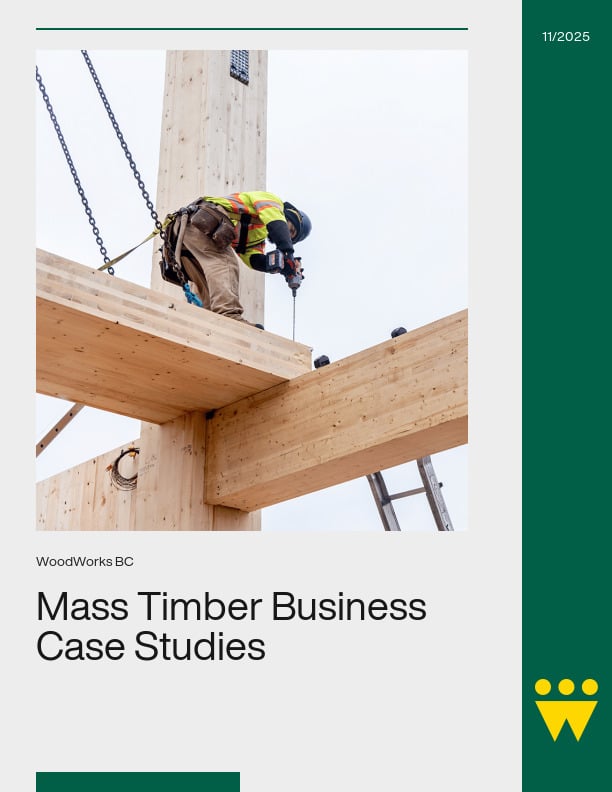
Mass Timber Business Case Studies
...case studies enable direct comparisons between mass timber and traditional construction methods. WoodWorks is seeking developers and owners with completed mass timber projects to share data for analysis, supporting education...
Acoustic Comparative Study
...and optimizing wood-based materials. With ISO 17025-accredited laboratories and state-of-the-art facilities, FPInnovations assesses the performance of wood structures in terms of acoustics, vibrations, fire resistance, and more. Study Objective At...
Innovative Strategies for Light-Frame Mid-Rise Buildings in High-Seismic Regions
...additions. This guide, prepared by WHM Structural Engineers for WoodWorks BC and the Canadian Wood Council, explores two high-capacity shearwall solutions: Mid+Std walls, a code-compliant adaptation of Midply construction that...
Offsite Wood Construction Handbook
...in-depth guide on offsite wood construction includes chapters on the following topics: Design process associated with offsite construction Offsite manufacturing process Lumber and engineered wood product portfolio available in Canada...
Wood Design & Building Magazine, vol 24, issue 98
...Wood Council is proud to support Woodrise 2025, an international conference coming to Vancouver, British Columbia. As part of this event, the 5th International Congress on tall wood construction, we’ve...
Feasibility of Point-Supported Mass Timber
Tall wood buildings offer tremendous potential for low-carbon, high-performance construction, but they also introduce a distinct set of challenges not typically encountered in conventional approaches. Design teams new to this...
2024 CWC Annual Report
We are pleased to share the Canadian Wood Council’s 2024 Annual Report, offering a clear view of the progress, resilience, and impact achieved over the past year. In his message,...
Wood Design & Building Magazine, vol 24, issue 97
In wood construction, success is rarely improvised. It’s the earned result of early design coordination, clearly communicated expectations, and a shared commitment to getting the details right—from design concept through...
Wood Decay and Repair
...this will be quite obvious. The wood will be soft and perhaps even be breakable by hand. Decayed wood breaks with a carrot-like snap versus the splintering of sound wood....
On September 23, 2014, after many years of research, development, stakeholder feedback and discussion, the Ontario Ministry of Municipal Affairs and Housing announced...
This document is design example of Wood Diaphragm on Reinforced CMU Shearwalls. It uses a school gymnasium located in Surrey, British Columbia as the example. The plan...
This document is a design example of Wood Diaphragm Using Envelope Method. it uses a typical one-storey commercial building located in Vancouver, BC as the example. The plan...
The 2009 edition of CSA Standard O86, Engineering Design in Wood (CSA 2009), provides an equation for determining the deflection of shear walls. It is important to note that...
This document is a Design example of Stacked Multi-Storey Wood Shearwalls Using A Mechanics Based Approach. It shows a floor plan and elevation along with the preliminary...
With the height limit for combustible construction limited to four stories under the National Building Code of Canada, it was uncommon for designers to perform detailed...
Algonquin College is a major provider of post-secondary education in Eastern Ontario, with campuses in Ottawa, Perth and Pembroke. The Perth Campus is located in the Town of...
The Greenfield Community Resource Centre and Elementary School is located in a small, isolated forestry community in Nova Scotia where 16.1 % of employment is provided by the...
The Richmond Olympic Oval is the largest structure to be built for the Vancouver 2010 Olympic Winter Games. Designed to accommodate the long track speed-skating events before...
The Engineering Guide for Wood Frame Construction has been produced by CWC to provide guidance to engineers, building designers, building officials, builders, and students of...
Acknowledging the growing importance of designing sustainable buildings and addressing overpopulation concerns, the development of engineered wood products has introduced the...

Get Access to Our Resources

Stay in the loop and don’t miss a thing!

1
2
3

Get Access to Our Resources

Stay in the loop and don’t miss a thing!

What’s Your Occupation?

Help us personalize the content for you.

What Interests You the Most?

Help us personalize the content for you.

Filters

Expertise Icon
Field of Expertise
Province Icon
Province
Member Type Icon
WoodWork National Partners

Filters

Post Type Icon
Post Type
Persona Icon
Persona
Language Icon
Language
Tags Icon
Tags
Mass Timber Plus Icon Environment Plus Icon Safety Plus Icon Durability Plus Icon Design Systems Plus Icon Budget Plus Icon Construction Management Plus Icon Fire Resistance Plus Icon Tall Buildings Plus Icon Short Buildings Plus Icon
Date Icon
Date
Line Separator