

Solid-Sawn Heavy Timber
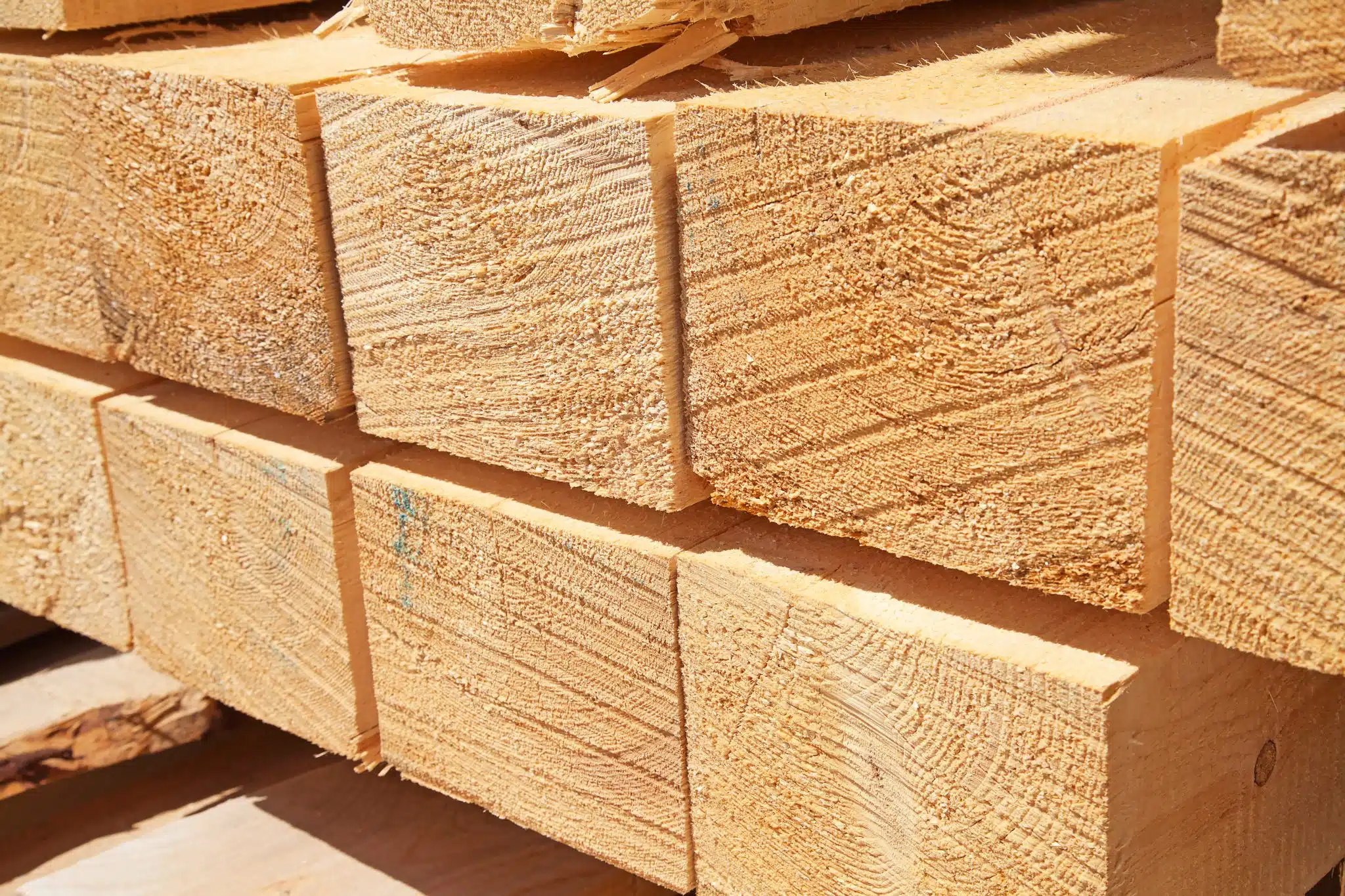
Solid-sawn heavy timber members are predominantly employed as the main structural elements in post and beam construction. The term ‘heavy timber’ is used to describe solid sawn lumber which is 140 mm (5-1/2 in) or more in its smallest cross-sectional dimension. Large dimension timbers offer increased fire resistance compared to dimensional lumber and can be used to meet the heavy timber construction requirements outlined in the Part 3 of the National Building Code of Canada. Sawn timbers are produced in accordance with CSA O141 Canadian Standard Lumber and graded in accordance with the NLGA Standard Grading Rules for Canadian Lumber. There are two categories of timbers; rectangular “Beams and Stringers” and square “Posts and Timbers”. Beams and Stringers, whose larger dimension exceeds its smaller dimension by more than 51 mm (2 in), are typically used as bending members, whereas, Posts and Timbers, whose larger dimension exceeds its smaller dimension by 51 mm (2 in) or less, are typically used as columns. Sawn timbers range in size from 140 to 394 mm (5-1/2 to 15-1/2 in). The most common sizes range from 140 x 140 mm (5-1/2 x 5-1/2 in) to 292 x 495 mm (11-1/2 x 19-1/2 in) in lengths of 5 to 9 m (16 to 30 ft). Sizes up to 394 x 394 mm (15-1/2 x 15-1/2 in) are generally available from Western Canada in the Douglas Fir-Larch and Hem-Fir species combinations. Timbers from the Spruce-Pine-Fir (S-P-F) and Northern species combinations are only available in smaller sizes. Timbers may be obtained in lengths up to 9.1 m (30 ft), but the availability of large size and long length timbers should always be confirmed with suppliers prior to specifying. A table of available timber sizes is shown below. Both categories of timbers, Beams and Stringers, and Posts and Timbers, contain three stress grades: Select Structural, No.1, and No.2, and two non-stress grades (Standard and Utility). The stress grades are assigned design values for use as structural members. Non-stress grades have not been assigned design values. No.1 or No.2 are the most common grades specified for structural purposes. No.1 may contain varying amounts of Select Structural, depending on the manufacturer. Unlike Canadian dimension lumber, there is a difference between design values for No.1 and No.2 grades for timbers. Select Structural is specified when the highest quality appearance and strength are desired. The Standard and Utility grades have not been assigned design values. Timbers of these grades are permitted for use in specific applications of building codes where high strength is not important, such as blocking or short bracing. Cross cutting can affect the grade of timber in the Beams and Stringers category because the allowable size of knot varies along the length of the piece (a larger knot is allowed near the ends than in the middle). Timbers must be regraded if cross cut. Timbers are generally not grade marked (grade stamped) and a mill certificate can be obtained to certify the grade. The large size of timbers makes kiln drying impractical due to the drying stresses which would result from differential moisture contents between the interior and exterior of the timber. For this reason, timbers are usually dressed green (moisture content above 19 percent), and the moisture content of timber upon delivery will depend on the amount of air drying which has taken place. Like dimension lumber, timber begins to shrink when its moisture content falls below about 28 percent. Timbers exposed to the outdoors usually shrink from 1.8 to 2.6 percent in width and thickness, depending on the species. Timbers used indoors, where the air is often drier, experience greater shrinkage, in the range of 2.4 to 3.0 percent in width and thickness. Length change in either case is negligible. Allowances for anticipated shrinkage should be made in the design and construction. Shrinkage should also be considered when designing connections. Minor checks on the surface of a timber are common in both wet and dry service conditions. Consideration has been made for these surface checks in the establishment of specified design strengths. Checks in columns are not of structural importance unless the check develops into a through split that will divide the column. For further information, refer to the following resources: Timber Framers Guild International Log Builders’ Association BC Log & Timber Building Industry Association
Plank Decking

Plank decking may be used to span farther and carry greater loads than panel products such as plywood and oriented strand board (OSB). Plank decking is often used where the appearance of the decking is desired as an architectural feature or where the fire performance must meet the heavy timber construction requirements outlined in Part 3 of the National Building Code of Canada. Plank decking is usually used in mass timber or post and beam structures and is laid with the flat or wide face over supports to provide a structural deck for floors and roofs. Plank decking can be used in either wet or dry service conditions and can be treated with preservatives, dependent on the wood species. Nails and deck spikes are used to fasten adjacent pieces of plank decking to one another and are also used to fasten the deck to its supports. Decking is generally available in the following species: Douglas fir (D.Fir-L species combination) Pacific coast hemlock (Hem-Fir species combination) Various species of spruce, pine and fir (S-P-F species combination) Western red cedar (Northern species combination) In order to product plank decking, sawn lumber is milled into a tongue and groove profile with special surface machining, such as a V-joint. Plank decking is normally produced in three thicknesses: 38 mm (1-1/2 in), 64 mm (2-1/2 in) and 89 mm (3-1/2 in). The 38 mm (1-1/2 in) decking has a single tongue and groove while the thicker sizes have a double tongue and groove. Thicknesses greater than 38 mm (1-1/2 in) also have 6 mm (1/4 in) diameter holes at 760 mm (2.5 ft) spacing so that each piece may be nailed to the adjacent one with deck spikes. The standard sizes and profiles are shown below. Plank decking is most readily available in random lengths of 1.8 to 6.1 m (6 to 20 ft). Decking can be ordered in specific lengths, but limited availability and extra costs should be expected. A typical specification for random lengths could require that at least 90 percent of the plank decking be 3.0 m (10 ft) and longer, and at least 40 percent be 4.9 m (16 ft) and longer. Plank decking is available in two grades: Select grade (Sel) Commercial grade (Com) Select grade has a higher quality appearance and is also stronger and stiffer than commercial grade. Plank decking is required to be manufactured in accordance with CSA O141 and graded under the NLGA Standard Grading Rules for Canadian Lumber. Since plank decking is not grade stamped like dimensional lumber, verification of the grade should be obtained in writing from the supplier or a qualified grading agency should be retained to check the supplied material. To minimize shrinkage and warping, plank decking consists of sawn lumber members that are dried to a moisture content of 19 percent or less at the time of surfacing (S-Dry). The use of green decking can result in the loosening of the tongue and groove joint over time and a reduction in structural and serviceability performance. Individual planks can span simply between supports, but are generally random lengths spanning several supports for economy and to take advantage of increased stiffness. There are three methods of installing plank decking: controlled random, simple span and two span continuous. A general design rule for controlled random plank decking is that spans should not be more than 600 mm (2 ft) longer than the length which 40 percent of the decking shipment exceeds. Both the latter methods of installation require planks of predetermined length and a consequently there could be an associated cost premium. Profiles and Sizes of Plank Decking
Wood in non-combustible buildings

The National Building Code of Canada (NBC) requires that some buildings be of ‘noncombustible construction’ under its prescriptive requirements. Noncombustible construction is, however, something of a misnomer, in that it does not exclude the use of ‘combustible’ materials but rather, it limits their use. Some combustible materials can be used since it is neither economical nor practical to construct a building entirely out of ‘noncombustible’ materials. Wood is probably the most prevalent combustible material used in noncombustible buildings and has numerous applications in buildings classified as noncombustible construction under the NBC. This is due to the fact that building regulations do not rely solely on the use of noncombustible materials to achieve an acceptable degree of fire safety. Many combustible materials are allowed in concealed spaces and in areas where, in a fire, they are not likely to seriously affect other fire safety features of the building. For example, there are permissions for use of heavy timber construction for roofs and roof structural supports. It may also be used in partition walls and as wall finishes, as well as furring strips, fascia and canopies, cant strips, roof curbs, fire blocking, roof sheathing and coverings, millwork, cabinets, counters, window sashes, doors, and flooring. Its use in certain types of buildings such as tall buildings is slightly more limited in areas such as exits, corridors and lobbies, but even there, fire-retardant treatments can be used to meet NBC requirements. The NBC also allows the use of wood cladding for buildings designated to be of noncombustible construction. In sprinklered noncombustible buildings not more than two-storeys in height, entire roof assemblies and the roof supports can be heavy timber construction. To be acceptable, the heavy timber components must comply with minimum dimension and installation requirements. Heavy timber construction is afforded this recognition because of its performance record under actual fire exposure and its acceptance as a fire-safe method of construction. Fire loss experience has shown, even in unsprinklered buildings, that heavy timber construction is superior to noncombustible roof assemblies not having any fire-resistance rating. In other noncombustible buildings, heavy timber construction, including the floor assemblies, is permitted without the building being sprinklered. In sprinklered buildings permitted to be of combustible construction, no fire-resistance rating is required for the roof assembly or its supports when constructed from heavy timber. In these cases, a heavy timber roof assembly and its supports would not have to conform to the minimum member dimensions stipulated in the NBC. NBC definitions: Combustible means that a material fails to meet the acceptance criteria of CAN/ULC-S114, “Test for Determination of Non-Combustibility in Building Materials.” Combustible construction means that type of construction that does not meet the requirements for noncombustible construction. Heavy timber construction means that type of combustible construction in which a degree of fire safety is attained by placing limitations on the sizes of wood structural members and on thickness and composition of wood floors and roofs and by the avoidance of concealed spaces under floors and roofs. Noncombustible construction means that type of construction in which a degree of fire safety is attained by the use of noncombustible materials for structural members and other building assemblies. Noncombustible means that a material meets the acceptance criteria of CAN/ULC-S114, “Test for Determination of Non-Combustibility in Building Materials.” For further information, refer to the following resources: Wood Design Manual, Canadian Wood Council National Building Code of Canada CAN/ULC-S114 Test for Determination of Non-Combustibility in Building Materials Stairs and storage lockers in noncombustible buildings Stairs within a dwelling unit can be made of wood, as can storage lockers in residential buildings. These are permitted, as their use is not expected to present a significant fire hazard. Wood roofing materials in noncombustible buildings In the installation of roofing, wood cant strips, roof curbs, nailing strips, and similar components may be used. Wood roofs defined as ‘heavy timber construction’ in the NBC are permitted in any noncombustible building two-storeys or less in height when the building is protected by a sprinkler system. Roof sheathing and sheathing supports of wood are permitted in noncombustible buildings provided: The noncombustible parapets and shafts are required to prevent roof materials igniting from flames projecting from openings in the building face or roof deck.Roof coverings have often been contributing factors in conflagrations. Most roof coverings, even today, are combustible by the very nature of the materials used to make them waterproof. The objective of the NBC is to require that the risks associated with a roof covering be minimized for the type of building, its location and use. The NBC permits roof coverings that meet a Class C rating to be used for any building regulated by Part 3, including any noncombustible building, regardless of height or area. This C rating can be met easily using fire-retardant-treated wood (FRTW) shakes or shingles, asphalt shingles, or roll roofing. In buildings that are required to be of noncombustible construction, the roof coverings must have a fire classification of Class A, B or C. In such cases, the use of FRTW shakes and shingles on sloped roofs is allowed. Small assembly occupancy buildings not more than two-storeys in building height and less than 1000 m2 (10,000 ft2) in building area do not require a classification for the roof covering. In these traditional cases, untreated wood shingles are acceptable if they are underlaid with a noncombustible material to reduce the potential for burn through. Wood partitions in noncombustible buildings Wood framing has many applications in partitions in both low-rise and high-rise buildings required to be of noncombustible construction. The framing can be located in most types of partitions, with or without a fire- resistance rating. Wood framing and sheathing is permitted in partitions, or alternatively, solid lumber partitions at least 38 mm (2 in nominal) thick are permitted, provided: Alternatively, wood framing is permitted in partitions throughout floor areas, and can be used in most fire separations with no limits on compartment size or a need for sprinkler protection provided: Similarly, as a final
Fire Code

National Fire Code of Canada The National Building Code of Canada (NBC) and the National Fire Code of Canada (NFC), both published by the National Research Council of Canada (NRC) and developed by the Canadian Commission on Building and Fire Codes (CCBFC), are developed as companion documents. The NBC establishes minimum standards for the health and safety of the occupants of new buildings. It also applies to the alteration of existing buildings, including changes in occupancy. The NBC is not retroactive. That is, a building constructed in conformance with a particular edition of the NBC, which is in effect at the time of its construction, is not automatically required to conform to the subsequent edition of the NBC. That building would only be required to conform to an updated version of the NBC if it were to undergo a change in occupancy or alterations which invoke the application of the new NBC in effect at the time of the change in occupancy or major alteration. The NFC addresses fire safety during the operation of facilities and buildings. The requirements in the NFC, on the other hand, are intended to ensure the level of safety initially provided by the NBC is maintained. With this objective, the NFC regulates: the conduct of activities causing fire hazards the maintenance of fire safety equipment and egress facilities limitations on building content, including the storage and handling of hazardous products the establishment of fire safety plans The NFC is intended to be retroactive with respect to fire alarm, standpipe and sprinkler systems. In 1990, the NFC was revised to clarify that such systems “shall be provided in all buildings where required by and in conformance with the requirements of the National Building Code of Canada.” This ensures that buildings are adequately protected against the inherent risk at the same level as the NBC would require for a new building. It does not concern other fire protection features such as smoke control measures or firefighter’s elevators. The NFC also ensures that changes in building use do not increase the risk beyond the limits of the original fire protection systems. The NBC and the NFC are written to minimize the possibility of conflict in their respective contents. Both must be considered when constructing, renovating or maintaining buildings. They are complementary, in that the NFC takes over from the NBC once the building is in operation. In addition, older structures which do not conform to the most current level of fire safety can be made safer through the requirements of the NFC. The most recent significant changes in the NFC relate the construction of six-storey buildings using combustible construction. As a result, eight additional protection measures related to mid-rise combustible buildings have been added to address fire hazards during construction when fire protection features are not yet in place.
Energy Code

The National Energy Code of Canada for Buildings (NECB) aims to help save on energy bills, reduce peak energy demand, and improve the quality and comfort of the building’s indoor environment. Through each code development cycle, the NECB intends to implement a tiered approach toward Canada’s goal for new buildings, as presented in the “Pan-Canadian Framework on Clean Growth and Climate Change”, of achieving ‘Net Zero Energy Ready’ buildings by 2030. The NECB is available for free online; published by the National Research Council (NRC) and developed by the Canadian Commission on Building and Fire Codes in collaboration with Natural Resources Canada (NRCan). CWC maintains ongoing participation in the development and updating of the NECB. The NECB sets out technical requirements for energy efficient design and construction and outlines the minimum energy efficiency levels for code compliance of all new buildings. The NECB applies to all building types, except housing and small buildings, which are addressed under Clause 9.36 of the National Building Code of Canada. The NECB offers three compliance paths: prescriptive, trade-off and performance. The most cost-effective time to incorporate energy efficiency measures into a building is during the initial design and construction phase. It is much more expensive to retrofit later. This is particularly true for the building envelope, which includes exterior walls, windows, doors and roofing. The NECB addresses considerations such as air infiltration rates (air leakage) and thermal transmission of heat through the building envelope. Considering the different climate zones in Canada, the NECB also provides requirements related to maximum overall (effective) thermal transmittance for above-ground opaque wall assemblies and effective thermal resistance of assemblies in contact with ground, e.g., permanent wood foundations. In addition, the NECB specifies the maximum fenestration and door to wall ratio based on the climate zone in which the building in located. As energy efficiency requirements for buildings are increased, wood is a natural solution to pair with other insulating and weatherizing materials to develop buildings with high operational energy performance and provide consistent indoor comfort for occupants. For further information on the NECB, visit the Codes Canada at the National Research Council Canada.
Combustible construction

The provision of fire safety in a building is a complex matter; far more complex than the relative combustibility of the main structural materials used in a building. To develop safe code provisions, prevention, suppression, movement of occupants, mobility of occupants, building use, and fuel control are but a few of the factors that must be considered in addition to the combustibility of the structural components. Fire-loss experience shows that building contents play a large role in terms of fuel load and smoke generation potential in a fire. The passive fire protection provided by the fire-resistance ratings on the floor and wall assemblies in a building assures structural stability in a fire. However, the fire-resistance rating of the structural assemblies does not necessarily control the movement of smoke and heat, which can have a large impact on the level of safety and property damage resulting from fire. The National Building Code of Canada (NBC) categorizes wood buildings as ‘combustible construction’. Despite being termed combustible, common construction techniques can give wood frame construction fire-resistance ratings up to two hours. When designed and built to code requirements, wood buildings provide the same level of life safety and property protection required for comparably sized buildings defined under the NBC as ‘noncombustible construction’. Wood has been used for virtually all types of buildings, including; schools, warehouses, fire stations, apartment buildings, and research facilities. The NBC sets out guidelines for the use of wood in applications that extend well beyond the traditional residential and small building sector. The NBC allows wood construction of up to six storeys in height, and wood cladding for buildings designated to be of noncombustible construction. When meeting the area and height limits for the various NBC building categories, wood frame construction can meet the life safety requirements by making use of wood-frame assemblies (usually protected by gypsum wallboard) that are tested for fire-resistance ratings. The allowable height and area restrictions can be extended by using fire walls to break a large building area into smaller separate building areas. The recognized positive contribution to both life safety and property protection which comes from the use of automatic sprinkler systems can also be used to increase the permissible area of wood buildings. Sprinklers typically operate very early in a fire thereby quickly controlling the damaging effects. For this reason, the provision of automatic sprinkler protection within a building greatly improves the life safety and property protection prospects of all buildings including those constructed of noncombustible materials. The NBC permits the use of ‘heavy timber construction’ in buildings where combustible construction is required to have a 45-minute fire-resistance rating. This form of heavy timber construction is also permitted to be used in large noncombustible buildings in certain occupancies. To be acceptable, the components must comply with minimum dimension and installation requirements. Heavy timber construction is afforded this recognition because of its performance record under actual fire exposure and its acceptance as a fire-safe method of construction. In sprinklered buildings permitted to be of combustible construction, no fire-resistance rating is required for the roof assembly or its supports when constructed from heavy timber. In these cases, a heavy timber roof assembly and its supports would not have to conform to the minimum member dimensions stipulated in the NBC. Mass timber elements may also be used whenever combustible construction is permitted. In those instances, however, such mass timber elements need to be specifically designed to meet any required fire-resistance ratings. NBC definitions: Combustible means that a material fails to meet the acceptance criteria of CAN/ULC-S114, “Test for Determination of Non-Combustibility in Building Materials.” Combustible construction means that type of construction that does not meet the requirements for noncombustible construction. Heavy timber construction means that type of combustible construction in which a degree of fire safety is attained by placing limitations on the sizes of wood structural members and on thickness and composition of wood floors and roofs and by the avoidance of concealed spaces under floors and roofs. Noncombustible construction means that type of construction in which a degree of fire safety is attained by the use of noncombustible materials for structural members and other building assemblies. Noncombustible means that a material meets the acceptance criteria of CAN/ULC-S114, “Test for Determination of Non-Combustibility in Building Materials.” For further information, refer to the following resources: National Building Code of Canada CAN/ULC-S114 Test for Determination of Non-Combustibility in Building Materials Wood Design Manual 2017
Encapsulated mass timber construction
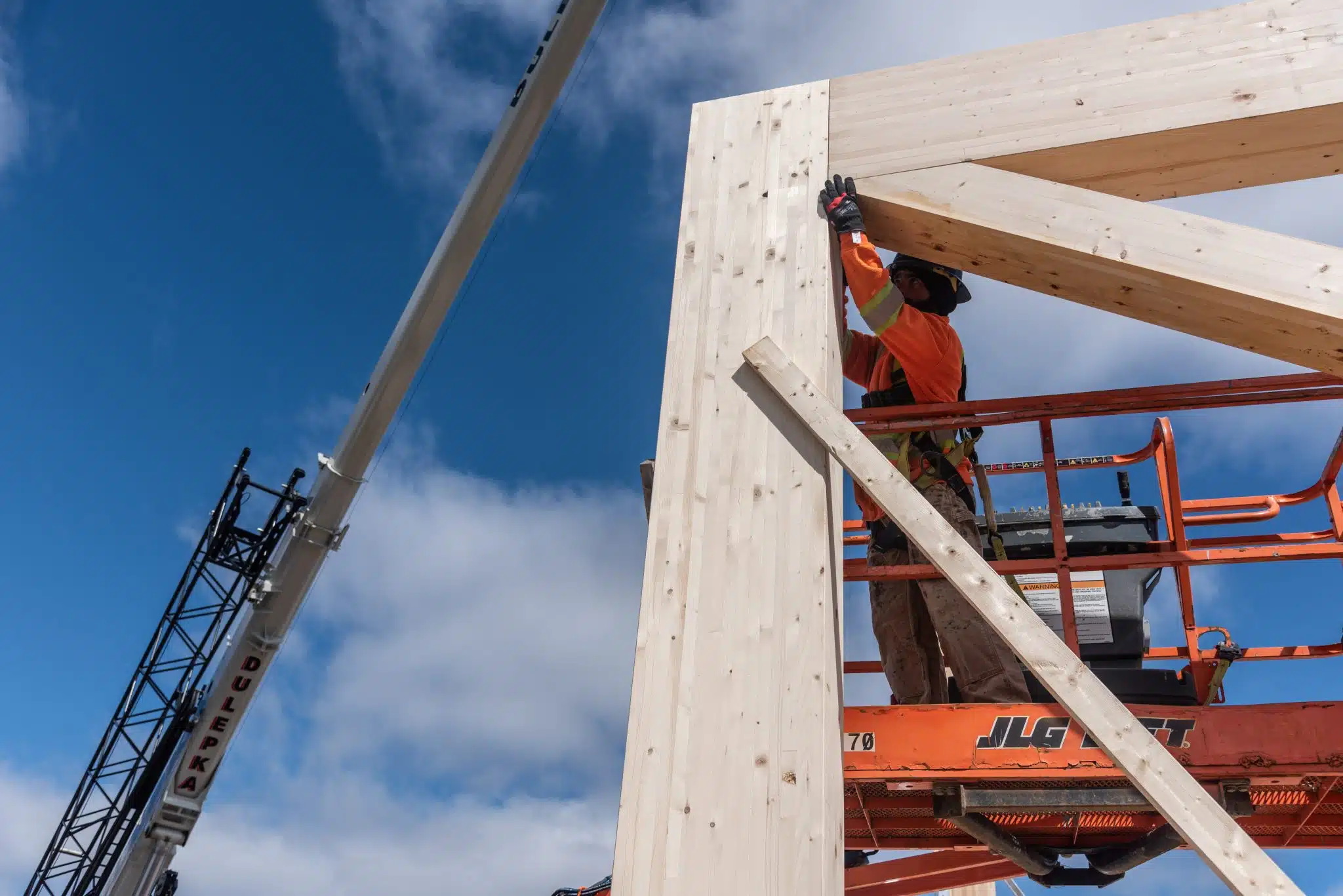
In addition to combustible, heavy timber and noncombustible construction, a new construction type is presently being considered for inclusion into the National Building Code of Canada (NBC). Encapsulated mass timber construction (EMTC) is proposed to be defined as the “type of construction in which a degree of fire safety is attained by the use of encapsulated mass timber elements with an encapsulation rating and minimum dimensions for the structural timber members and other building assemblies.” EMTC is neither ‘combustible construction’ nor ‘heavy timber construction’ nor ‘noncombustible construction’, as defined within the NBC. EMTC is required to have an encapsulation rating. The encapsulation rating is the time, in minutes, that a material or assembly of materials will delay the ignition and combustion of encapsulated mass timber elements when it is exposed to fire under specified conditions of test and performance criteria, or as otherwise prescribed by the NBC. The encapsulation rating for EMTC is determined through the ULC S146 test method. In order for structural wood elements to be considered ‘mass timber’, they must meet minimum size requirements, which are different for horizontal (walls, floors, roofs, beams) and vertical (columns, arches) load-bearing elements and dependent on the number of sides that the element is exposed to fire. EMTC construction in Canada is expected to be limited to a height of twelve-storeys, that is, the uppermost floor level may be a maximum of 42 m (137 ft) above the first floor. An EMTC building must be sprinklered throughout according to NFPA 13 and it is likely that some mass timber will also be able to be exposed in the suites. All EMTC elements are expected to have a minimum two-hour fire resistance rating and the building floor area to be limited to 6,000 m2 for Group C occupancy and 7,200 m2 for Group D occupancy. There are restrictions on the use of exterior cladding elements in EMTC, as well as other restrictions on the use of; combustible roofing materials, combustible window sashes and frames, combustible components in exterior walls, nailing elements, combustible flooring elements, combustible stairs, combustible interior finishes, combustible elements in partitions, and concealed spaces. If any encapsulation material is damaged or removed, it will be required to be repaired or replaced so that the encapsulation rating of the materials is maintained. Additionally, requirements related to construction site fire safety are to be applied to construction access, standpipe installation and protective encapsulation. EMTC and its related provisions are anticipated to be included in the NBC 2020. NBC definitions: Combustible means that a material fails to meet the acceptance criteria of CAN/ULC-S114, “Test for Determination of Non-Combustibility in Building Materials.” Combustible construction means that type of construction that does not meet the requirements for noncombustible construction. Heavy timber construction means that type of combustible construction in which a degree of fire safety is attained by placing limitations on the sizes of wood structural members and on thickness and composition of wood floors and roofs and by the avoidance of concealed spaces under floors and roofs. Noncombustible construction means that type of construction in which a degree of fire safety is attained by the use of noncombustible materials for structural members and other building assemblies. Noncombustible means that a material meets the acceptance criteria of CAN/ULC-S114, “Test for Determination of Non-Combustibility in Building Materials.” For further information, refer to the following resources: Guide to Encapsulated Mass Timber Construction in the Ontario Building Code ULC S146 Standard Method of Test for the Evaluation of Encapsulation Materials and Assemblies of Materials for the Protection of Mass Timber Structural Members and Assemblies Fire performance of mass-timber encapsulation methods and the effect of encapsulation on char rate of cross-laminated timber (Hasburgh et al., 2016) CAN/ULC-S114 Test for Determination of Non-Combustibility in Building Materials NFPA 13 Standard for the Installation of Sprinkler Systems
Acoustics

Wood is composed of many small cellular tubes that are predominantly filled with air. The natural composition of the material allows for wood to act as an effective acoustical insulator and provides it with the ability to dampen vibrations. These sound-dampening characteristics allow for wood construction elements to be specified where sound insulation or amplification is required, such as libraries and auditoriums. Another important acoustical property of wood is its ability to limit impact noise transmission, an issue commonly associated with harder, more dense materials and construction systems. The use of topping or a built-up floating floor system overlaid on light wood frame or mass timber structural elements is a common approach to address acoustic separation between floors of a building. Depending on the type of materials in the built-up floor system, the topping can be applied directly to the wood structural members or over top of a moisture barrier or resilient layer. The use of gypsum board, absorptive (batt/loose-fill) insulation and resilient channels are also critical components of a wood-frame wall or floor assembly that also contribute to the acoustical performance of the overall assembly. Acoustic design considers a number of factors, including building location and orientation, as well as the insulation or separation of noise-producing functions and building elements. Sound Transmission Class (STC), Apparent Sound Transmission Class (ASTC) and Impact Insulation Class (IIC) ratings are used to establish the level of acoustic performance of building products and systems. The different ratings can be determined on the basis of standardized laboratory testing or, in the case of ASTC ratings, calculated using methodologies described in the NBC. Currently, the National Building Code of Canada (NBC) only regulates the acoustical design of interior wall and floor assemblies that separate dwelling units (e.g. apartments, houses, hotel rooms) from other units or other spaces in a building. The STC rating requirements for interior wall and floor assemblies are intended to limit the transmission of airborne noise between spaces. The NBC does not mandate any requirements for the control of impact noise transmission through floor assemblies. Footsteps and other impacts can cause severe annoyance in multifamily residences. Builders concerned about quality and reducing occupant complaints will ensure that floors are designed to minimize impact transmission. Beyond conforming to the minimum requirements of the NBC in residential occupancies, designers can also establish acoustic ratings for design of non-residential projects and specify materials and systems to ensure the building performs at that level. In addition to limiting transmission of airborne noise through internal structural walls and floors, flanking transmission of sound through perimeter joints and sound transmission through non-structural partition walls should also be considered during the acoustical design. Further information and requirements related to STC, ASTC and IIC ratings are provided in Appendix A of the NBC in sections A-9.10.3.1. and A-9.11.. This includes, inter alia, Tables 9.10.3.1-A and 9.10.3.1.-B that provide generic data on the STC ratings of different types of wood stud walls and STC and IIC ratings for different types of wood floor assemblies, respectively. Tables A-9.11.1.4.-A to A-9.11.1.4.-D present generic options for the design and construction of junctions between separating and flanking assemblies. Constructing according to these options is likely to meet or exceed an ASTC rating of 47 that is mandated by the NBC. Table A-Table 9.11.1.4. presents data about generic floor treatments that can be used to improve the flanking sound insulation performance of lightweight framed floors, i.e., additional layers of material over the subfloor (e.g. concrete topping, OSB or plywood) and finished flooring or coverings (e.g., carpet, engineered wood).
2024 Catherine Lalonde Memorial Scholarships Celebrate Students Driving Innovation in the Wood Industry

Ottawa, ON, December 12, 2024 – The Canadian Wood Council (CWC) announced the recipients of the 2024 Catherine Lalonde Memorial Scholarships: Laura Walters (McMaster University) and Jiawen Shen (University of British Columbia). Both students were recognized for their academic excellence and impactful research projects in the structural wood products industry. Established nineteen years ago, the memorial scholarships are awarded each year to graduate students whose wood research exemplifies the same level of passion for wood and the wood products industry that Catherine Lalonde tirelessly demonstrated as a professional engineer and president of the CWC. Laura Walters Laura is a 3rd-year graduate student pursuing a Master of Applied Science in Civil Engineering under a joint collaboration between McMaster University and the University of Northern British Columbia (UNBC). Her research project explores the use of pre-engineered beam hangers in mass timber post-and-beam systems, with a focus on the implications of design and modelling assumptions on the evaluation of structural load paths. Her work provides valuable insights into the design considerations and assumptions required for more accurate and reliable design of mass timber columns when pre-engineered beam hangers are used. Jiawen Shen Jiawen is a 1st year graduate student pursuing a Master in Wood Science at the University of British Columbia. Her research project focuses on the development of binderless composite bark-board cladding and insulation panels that are durable, ignition resistant, carbon neutral, and manufactured from an underutilized by-product that would otherwise be burned, landfilled, or used for low-value purposes. Collaborating with a Vancouver-based architecture firm on this project, her work is key to advancing the commercial application of these innovative cladding products. “This year marks a historic milestone for the Catherine Lalonde Memorial Scholarship program as, for the first time, it is awarded to two exceptional women,” said Martin Richard, VP of Market Development and Communications at the CWC. “Their achievements highlight the outstanding talent driving innovation in wood research and construction. We are inspired by their contributions and the growing diversity shaping the future of wood-based solutions.”
Vandusen Gardens

The VanDusen Botanical Garden in Vancouver, British Columbia, was founded in 1971; doors opened to the public in 1975. By the year 2000, two existing buildings, the Floral Hall and the Garden Pavilion, were seeing much wear and the Garden’s entrance needed higher visibility. There was also a desire to attract more visitors and reach out to a younger demographic. Changes were needed. In keeping with existing buildings on the site which were built of heavy timber construction, any new building would also use a wood-based construction system. It seemed the most appropriate choice for a natural garden setting.
North Bay Regional Health Centre

Located at the eastern end of Lake Nipissing on the voyageur route linking Lake Superior to salt water, North Bay, in modern times, has a diversified economy and also serves as a transportation and service hub for resource-rich northern Ontario. With a local population of 56,000 and a much larger regional population, investigations began in the late 1990s to review the adequacy of three aging hospitals and options for refurbishment or replacement. Detailed analysis of the existing facilities and the region’s health care needs resulted in the decision to build a new facility. The North Bay Regional Health Centre (NBRHC) is comprised of the District Hospital (acute care) and the Regional Mental Health Centre (specialized and forensic mental health services). The North Bay Regional Health Centre is a new model for health care in Canada. In addition to the generous use of structural and decorative wood elements to help create a healing environment, it includes many firsts for Canadian health care.
B.C. Restaurants (The Old Vines & The Hooded Merganser)

Eating and drinking are social activities best enjoyed in a warm, relaxing and comfortable atmosphere. These activities have had a long association with wood, which has traditionally been used for making tables, chairs and other furniture as well as for wine casks and beer barrels. Wood floors and exposed beams have been features of hostelries and restaurants across the world for centuries, and continue to lend a unique quality to contemporary dining establishments. The two examples included here are both located in the Okanagan Valley in the southern interior of British Columbia. Although they are very different in architectural character, they both use wood with great effectiveness to create the appropriate dining ambience.


