

Banff Recreation Centre

The Town of Banff is located in Banff National Park, Canada’s first national park and a UNESCO World Heritage Site. It is home to over 8,700 residents and greets more than three million visitors from around the world each year. Constructed in 1958, the town’s recreation centre was in dire need of improvement—the roof of the curling rink was considered to be deficient, the hockey rink locker rooms were no longer adequate, the ice refrigeration piping system needed replacement, and additional skating space was needed. The solution was a combination of demolition and reconstruction, refurbishment, and new construction. Completed in 2011 to the LEED® Silver standard, the redeveloped Banff Recreation Centre has a new curling rink, a refurbished hockey arena, a new NHL-sized hockey arena, and new meeting rooms, lounges and a concourse. The new construction uses wood and glass to provide views of the mountains, while providing superior thermal performance.
B.C. Restaurants (The Old Vines & The Hooded Merganser)

Eating and drinking are social activities best enjoyed in a warm, relaxing and comfortable atmosphere. These activities have had a long association with wood, which has traditionally been used for making tables, chairs and other furniture as well as for wine casks and beer barrels. Wood floors and exposed beams have been features of hostelries and restaurants across the world for centuries, and continue to lend a unique quality to contemporary dining establishments. The two examples included here are both located in the Okanagan Valley in the southern interior of British Columbia. Although they are very different in architectural character, they both use wood with great effectiveness to create the appropriate dining ambience.
CentrePlace Manitoba

CentrePlace Manitoba was commissioned by the Province of Manitoba, with a goal of creating a temporary Olympic pavilion that represented the energy of the province and its people while reinforcing its commitment to sustainability. Designed as a dynamic, uniquely Manitoban architectural statement that transcends the “white fabric tent”, the 232 m² (2500 square foot) pavilion was initially showcased at the 2010 Vancouver Olympic and Paralympic Games as both an interactive exhibit space and as a venue for business and cultural receptions. The design concept was initiated through a visioning session in June 2009 where Manitobans from diverse backgrounds came together to discuss what best represented the province they called home. The recurring themes drawn from this session gave the design team their starting point of creating an inviting space that drew upon the spirit and nature of the people of Manitoba. The simple contrast of wood and light became the basis for the creation of a pavilion that would become a beacon, welcoming visitors through a generous front porch and an oversized pivoting door. The design team met client design objectives by making a number of strategic decisions to ensure that the project would showcase the province’s commitment to sustainability and provide a legacy building that would serve beyond the pavilion’s initial five-week purpose. One of the key objectives was to ensure Universal Design and Access. To achieve all these design requirements, CentrePlace Manitoba had to: utilize Manitoba labour and regional materials offer an interactive exhibit space showcasing Manitoba’s unique culture be efficient in material use and energy consumption be compact, transportable, and 100% reusable at a future site favour passive systems over dedicated ones
Innovative Applications of Engineered Wood
Art Gallery of Ontario (Renovation and Addition)

The Art Gallery of Ontario (AGO) was founded in 1900 as the Art Museum of Toronto. In 1919 it became the Art Gallery of Toronto and in 1966, took on its present name. The original gallery was a home (The Grange) built around 1817, located on the south side of the AGO facing Grange Park (Figure 1). In fall 2008, the Art Gallery of Ontario received wide acclaim when its recent renovation and addition, designed by Frank Gehry, was opened to the public. The work involved the renovation of existing spaces and the addition of 9,016 m2 (92,000 ft.2) of new floor space. The renovation and addition to the AGO is notable for several reasons. First, the design needed to unify and enhance previous constructions done in 1918, 1929, the 1970s and the 1980s. The design team made extraordinary use of structural and decorative wood elements to achieve this goal, as well as to lure, calm, entice and amaze visitors. In addition, the AGO needed to remain functional for prolonged periods during the construction process. Finally, the wood design, fabrication and erection was very complex. In the words of Bill Downing of Structurlam Products Ltd., the glulam supplier, in reference to the Galleria Italia portion of the AGO, “This is the most complex wood structure in North America.”
Bill Fisch Forest Stewardship and Education Centre

The Bill Fisch Forest Stewardship and Education Centre (Education Centre) was planned and built to educate residents of the Regional Municipality of York about the importance of natural resources and forest ecosystems. The Regional Municipality of York, located on the Oak Ridges Moraine between Toronto and Lake Simcoe, includes the York Regional Forest, which is internationally recognized as a leader in site restoration and forest management, and is the first public forest in Canada to be certified by the Forest Stewardship Council (FSC). Constructed of wood and accented with stone, the Education Centre reflects the materials of the surrounding forest. The use of wood in the design was integral to the building’s performance and appropriate to its function as a forest education centre.
Armstrong-Spallumcheen Arena

The City of Armstrong, British Columbia and its neighbouring Township of Spallumcheen are situated between the sunny, rolling Okanagan Valley and the cooler, forested Shuswap Valley. (The name Spallumcheen is derived from the First Nations term meaning “beautiful valley.”) Until recently, indoor skating activities for the 10,000 city and township residents took place at a 55 year-old facility. In the spring of 2004, a design team was retained to undertake a feasibility analysis and develop preliminary designs for a new multiuse facility, anchored by an NHL-sized ice surface, to be situated on the Armstrong Fairgrounds (Figure 1). The facility’s proximity to the existing swimming pool, skateboard park and baseball diamonds create a recreational area that will serve the needs of the community for many years to come. Sixty-two parking stalls are located beside the facility and additional parking is available at the adjacent Fairgrounds for special events.
Oakville Fire Station 8

The Town of Oakville selected an Integrated Project Delivery (IPD) method for the design and construction of a new 11,450 ft2 (1064 m2) fire station. Design objectives for Oakville Fire Station 8 (OFS) specified that the building should promote staff retention, optimize efficiencies and layout flexibility, and incorporate appropriate and durable construction materials and building systems. The new facility was required to consider life cycle costs and be easy to operate and maintain. Solutions provided by the design team were innovative and cost efficient, providing value to the town. The project pursued sustainable construction methodologies to mitigate climate risk and achieve the LEED silver certification target. The layout and design of the fire station, utilizes space efficiently, accommodating two full fire crews, two captains, two fire trucks and storage space for spare fire apparatus.
Metis Crossing Case Study

The Métis Crossing grounds sit on a 512-acre site – river lot titles from the original Métis settlers to the region in the late 1800s – along the North Saskatchewan River, just outside Smoky Lake, Alberta (about 120 km northeast of Edmonton). As the first major Métis cultural interpretive centre in the province, it is a premier destination for Métis cultural education and public gatherings. The Cultural Gathering Centre site is bordered by Victoria Trail (north), an access road to the existing barn (west), the riverbank (south) and a zipline along an existing ravine (east). Camping, guided tours and other activities are hosted on the property; the facility is open year-round. A boutique lodge is under construction and will accommodate 40 families by the fall of 2021. The new Cultural Gathering Centre provides over 10,000 sq.ft. of gathering spaces, meeting rooms, classrooms and interpretive spaces. Designed to seat over 350 people indoors, it is an ideal venue for weddings and large gatherings, such as corporate retreats. The expansive 2,600-sq.ft. deck and canopy on the south side provides stunning views of the river valley. Timber was a natural choice for the primary structural material, given its long history of use in traditional Métis construction practices. In keeping with the structure’s connection to its heritage, the building was designed by Métis architect Tiffany Shaw-Collinge, from Manasc Isaac Architects, now Reimagine Architects.
Arbora – An Exposed Wood Structure in A Major Residential Project

Montreal’s Griffintown district is home to a world record-breaking building: Arbora is the world’s largest residential complex made of solid engineered wood. It boasts three 8-storey buildings, each 25 m high, for a total of 55,515 m2 and 434 housing units. Records can be broken, but the unmatched aesthetic quality of Arbora’s exposed wood beams and columns will endure. Sotramont has assembled a team of skilled professionals to complete this project, the first of its kind in Canada.
Industrial Buildings – A case study
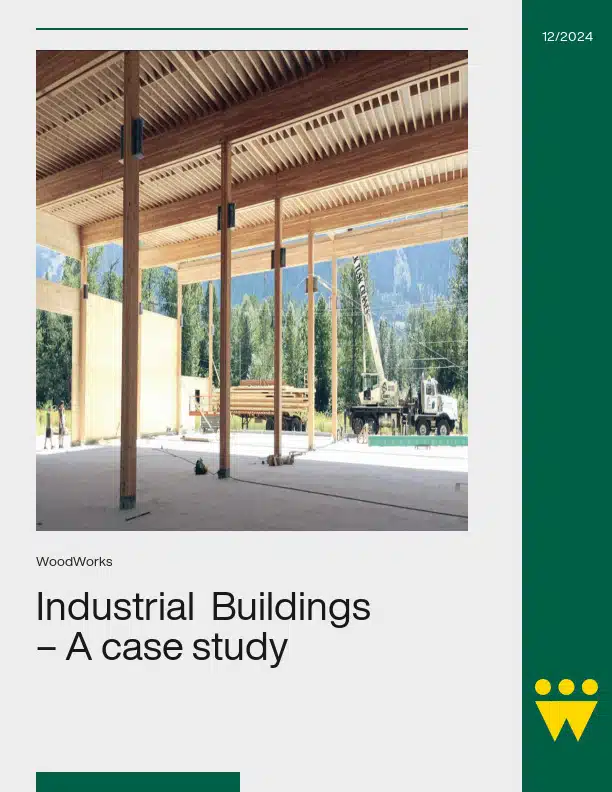
Over the past two decades, new engineered mass timber products and construction techniques have changed the way we think about wood as a building material. Historic perceptions about strength, durability and fire performance have been overturned by scientific evidence and full-scale testing of prototype structures. As a result, mass timber has begun to make its mark in the residential and commercial sectors, particularly on Canada’s West Coast. However, the market for industrial buildings continues to be dominated by tilt-up concrete and steel-frame construction, both of which have a significant environmental footprint. Tiltup concrete in particular has inherent disadvantages; concrete cannot be poured in the freezing conditions typical of Canadian winters, nor can it be easily insulated to reduce the operating energy requirements of the building. However, the National Building Code of Canada states that a roof assembly in a building of up to two storeys is permitted to be of heavy timber construction regardless of the building area or the type of construction required, provided the building is sprinklered. In addition, the structural members in the storey immediately below the roof assembly are also permitted to be of heavy timber construction. These requirements apply equally to industrial buildings, meaning that heavy timber is a viable alternative to the materials traditionally used, and single storey industrial buildings may be constructed entirely of heavy timber. This case study examines three recently completed industrial buildings in southern British Columbia, each of which uses engineered mass timber products and systems in a distinct and different way. Together, they offer insights into how industrial construction might evolve to offer greater environmental performance, speed and flexibility of construction, at little additional cost over traditional methods.
Design Example of Designing for Openings In Wood Diaphragm
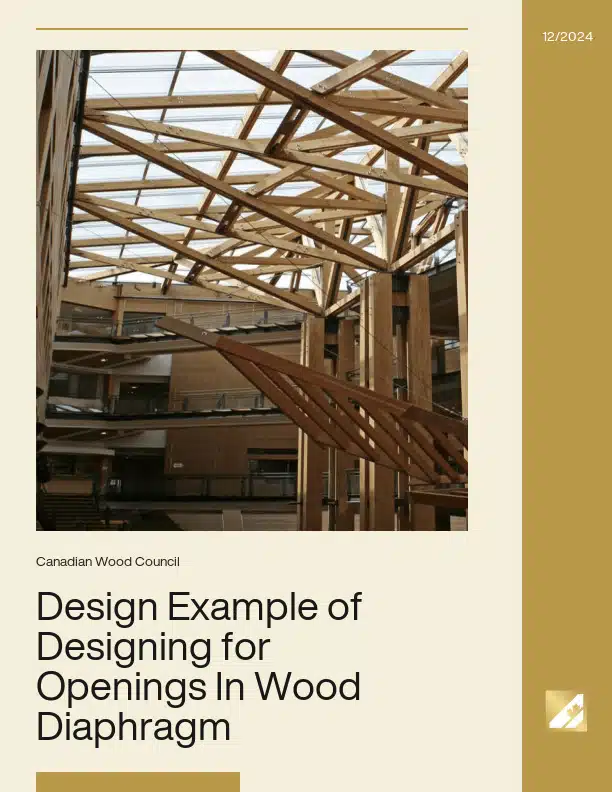
The effects of a single opening size and location on diaphragm shear, chord forces and framing member forces were investigated for a typical wood diaphragm. In conclusion, the maximum shear in the diaphragm with opening is greater than that in the diaphragm without opening. Increasing the distance between the edges of opening and diaphragm can reduce this increase in maximum shear significantly. When the dimension of the opening is no greater than 15% of the corresponding dimension of the diaphragm in both directions, and the distance of opening edge from diaphragm edge is no less than 3 times the larger dimension of the opening and that the portion of diaphragm alongside the opening satisfies the maximum aspect ratio requirement, the increase in maximum shear is less than 10%.


