en-ca

Searching for: Mass+Timber

Searching results for “Mass+Timber” | Search instead for “Mass Timber”
60 results found...
Sort By Dropdown Icon

Acoustic Comparative Study

In a context where wood construction is gaining momentum, acoustics remains a key challenge in ensuring occupant comfort and compliance with standards. With this in mind, AcoustiTECH, an expert in acoustic solutions, has partnered with FPInnovations, a leader in research and development in the wood sector, to conduct an in-depth comparative study in its laboratory facility.

Who We Are

AcoustiTECH is a broker specializing in acoustic solutions, supporting building professionals in selecting highperformance materials that meet and exceed industry standards. With 25 years of experience and unique expertise, we offer customized assemblies through a specialized brand ecosystem and reliable data. Our personalized service, backed by dedicated technical and engineering teams, ensures tailored and effective
solutions that enhance the acoustic comfort of occupants. FPInnovations is a globally recognized, private, non-profit organization specializing in research and development for the forestry sector. Its mission is to support businesses and building professionals in innovating and optimizing wood-based materials. With ISO 17025-accredited laboratories and state-of-the-art facilities, FPInnovations assesses the performance of wood structures in terms of acoustics, vibrations, fire resistance, and more.

Study Objective

At AcoustiTECH, our goal is to continuously innovate by delivering new data and acoustic solutions tailored to the specific requirements of each project. This collaboration with FPInnovations marks a significant milestone in our acoustic analysis of wood structures, as it represents our first large-scale data collection on a GLT masstimber slab and our second mass-timber campaign overall, building on a prior study.

Through this study, we obtain precise acoustic measurements for this structural system and conduct rigorous comparisons across numerous innovative market solutions. We take into account key project criteria such as acoustic performance, budget, thickness, weight, and even design, as different acoustic solutions can also influence the choice of floor coverings.

Grounded in a scientific approach and conducted in controlled environments with FPInnovations, this research aims to evaluate various acoustic configurations optimized for mass timber construction. By combining technical expertise, innovation, and in-depth analysis, we provide architects, engineers, and developers with high-performance solutions that meet and exceed the industry standards.

Wood Design & Building Magazine, vol 24, issue 98

What does it take to deliver better buildings? In this issue, we explore that question from a couple of different angles—primarily through a look at standout wood projects that demonstrate wood design excellence, but also through a thoughtful feature on offsite prefabrication that invites the construction industry to think critically about how we build and what it will take to build better. Through enhanced collaboration and the expanded use of technology, prefabricated construction—an approach especially well-suited to wood—is transforming the way we design and deliver buildings.

This fall, the Canadian Wood Council is proud to support Woodrise 2025, an international conference coming to Vancouver, British Columbia. As part of this event, the 5th International Congress on tall wood construction, we’ve curated nine immersive tours that offer attendees a unique opportunity to step inside some of the region’s most compelling wood projects for a firsthand look at the leadership and innovation happening here.

If you believe one of the best ways to learn about a building is to walk through it—this is your chance. The full tour lineup is available now at www.woodrise2025.com/offsite-tours. Join us to explore everything from sustainable forest management and advanced manufacturing to some of the region’s most iconic mass timber buildings – experiences that bring together the people, materials, and design approaches shaping the future of low-carbon construction in B.C. and beyond.

We hope this issue inspires you to keep exploring what’s possible with wood—whether in your own projects or out with us on tour.

Feasibility of Point-Supported Mass Timber

Tall wood buildings offer tremendous potential for low-carbon, high-performance construction, but they also introduce a distinct set of challenges not typically encountered in conventional approaches. Design teams new to this form of construction may be unfamiliar with the systematic approach needed to enhance affordability and efficiency in these buildings.

Within the spectrum of structural solutions for mass timber, point-supported CLT is a compelling option for tall building applications. Teams must understand how to harness its unique benefits and navigate its limitations to unlock its full potential. When applied effectively, point-supported approaches can improve efficiency, reduce material usage, and unlock new pathways to cost-competitive tall timber construction.

Case Study: Academic Tower University of Toronto

Setting a new standard in Canada’s tallest mass timber structure, Soprema Insonomat system provided an ideal balance of sustainability, safety, and superior sound insulation.

Case Study: 283 Greene Avenue

AcoustiTECH’s innovative and effective acoustic solutions made New York’s first mass timber residential project a triumph of modern design and sound comfort. Discover how the AcoustiTECH Lead 6 and  AcoustiTECH SOFIX system harmonized natural aesthetics with high acoustic performance.

Mass Timber Course of Construction Insurance Project Questionnaire + Checklist

Who can use this document:
Contractors, Developers, Owners and Design Teams.

How to use this document:
This document is an editable form that teams can fill out to aid in collecting mass timber project-specific information to share with their insurance team.

When to use this document:
A project team should engage a broker or underwriter as early as possible in the planning stages of a construction project, ideally during the initial design phase or when the project scope is being defined.

How will this help me:
The goal is to provide project-specific information about mass timber, pre-emptively addressing some of the common questions and concerns insurers may have to pave the way for a more efficient and informed process when working with your broker or underwriter. Keep in mind that this document is not intended to address all topics nor be a universally accepted form that provides all necessary information to insurers.

Mass Timber Construction Success Checklist

Mass timber construction offers speed, sustainability, and design flexibility – but it also requires a higher level of coordination than traditional structural systems. Its prefabricated components and tight tolerances call for early planning, clear communication, and a shared understanding across the project team. Ensuring that all partners – including those less familiar with timber construction – are aligned on these unique requirements helps avoid costly delays and, more importantly, positions the team to fully capitalize on the benefits mass timber has to offer.

Exploring the Role of Mass Timber – Industrial Buildings and Warehouse Construction

The emerging use of mass timber in industrial buildings presents promising opportunities that are shaping the future of construction in this sector. As a sustainable and economically competitive alternative, mass timber is redefining industrial construction, a field traditionally dominated by prefabricated steel. An analysis of two cutting-edge projects in Sudbury, Ontario, highlights key advantages, including cost competitiveness, reduced embodied carbon, and aesthetic appeal. The insights from these two projects present stakeholders with helpful considerations and valuable strategies for integrating mass timber into future developments.

Wood Design & Building Magazine, vol 24, issue 96

Buildings that stand the test of time aren’t just durable—they are cherished. When we invest in quality materials and good design, we can create buildings that people connect with. As you’ll discover in this issue, many heavy timber warehouses and factories constructed in the early 1900s remain a vital part of our cities today—not because they still serve their original purpose, but because people valued them enough to adapt, restore, and reuse them, giving them a new purpose.

Fast forward a hundred years and resilient structures include many new forms. Modular construction, for example, has seen significant growth in recent years as this form of construction has transformed from a building method once considered inferior, into a method relied upon to deliver high-performance durable buildings.

Alongside our features on historic timber buildings and modular construction, this issue also highlights notable projects and emerging trends shaping today’s built environment. From innovative mass timber structures to forward-thinking design solutions, we explore how thoughtful craftsmanship and smart engineering continue to define the spaces we build—and the ones we keep.

Guide to Encapsulated Mass Timber Construction in the Ontario Building Code

The Guide to Encapsulated Mass Timber Construction in the Ontario Building Code – Second Edition is a comprehensive resource designed to help designers, code officials, and building professionals understand and apply the latest Ontario Building Code provisions for Encapsulated Mass Timber Construction (EMTC), effective January 1, 2025. Developed by the Canadian Wood Council / WoodWorks Ontario in collaboration with Morrison Hershfield (now Stantec), the guide explains the technical requirements, fire safety principles, and design considerations unique to EMTC, with clear references to relevant OBC articles. It covers everything from structural mass timber element specifications and encapsulation materials, to use and occupancy limits, mixed-use scenarios, and related provisions for structural design, environmental separation, and fire safety during construction. Intended to be read in conjunction with the Ontario Building Code, this is not a design guide, but rather a tool to distill complex regulations into practical, accessible information—equipping professionals to confidently design, review, and approve EMTC projects while ensuring compliance and optimizing performance.

Notice of Correction: A previous version of this document contained a small error on page 19. In this electronic version of the document (updated August 12, 2025) the 3rd major bullet of Section 5.1.1 has been corrected.

Guideline to Insuring Timber in Canada

To ensure that the financial investment of a construction project can be protected in the event of unexpected circumstances and project derailment, builders are required to obtain Builder’s Risk Insurance, also known as “Course of Construction” insurance.

In Canada, timber construction is utilized primarily in the residential market, with notable applications in low-rise industrial, institutional, and commercial buildings. The insurance rates for timber, classified as combustible construction, are generally much higher than that of non-combustible alternatives. Since timber applications have been consistent in the aforementioned markets, the associated insurance has not been substantial relative to overall project budget. However, with recent code changes and advancements in mass timber products, we can build larger and taller with timber than ever before, leading to changes in insurance rates as well.

The methodology for determining insurance rates for taller wood buildings is similar to that of low-rise builds. Combine that with the relatively new nature of these building typologies and the nuances of a stressed insurance market, we are seeing policies that are becoming a significant cost of the overall project budget.

This document is intended to support your timber builds by outlining practical steps to ensure that your application for insurance is favourable, and that your project is maximizing the potential to mitigate risk. Developed with the input of insurance stakeholders, we are confident that this insider insight will increase the success of your project.

Historical Tall-Wood Toronto

Courtesy of the Mass Timber Institute

There is much to learn from the resilient and adaptable warehouse buildings that line the streets of Canada’s historic manufacturing districts. ‘Historical Tall-Wood Toronto’ is an evidentiary database of late 19th and early 20th century vernacular brick and beam buildings that were built using the fire restrictive specifications and construction technology of Heavy Timber Mill-Construction (mill-construction) in Toronto.

Mass Timber Insurance Action Plan Phase 1 Report
Mass Timber Insurance Action Plan – Phase 1 Report examines one of the most significant barriers to scaling mass timber construction in Canada: access to affordable and reliable insurance. While...
Tall Wood Feasibility Study
Tall Wood Feasibility Study: Mass Timber and Concrete explores the economic, construction, and environmental performance of a proposed 12-storey residential development in Dartmouth, Nova Scotia. Developed through a side-by-side comparison...
Webinar – Custom Steel Connections for Mass Timber: Understanding the Basics Step by Step
Wood Design & Building Magazine, vol 25, issue 102
...tall mass timber residential building constructed to the Passive House standard. It demonstrates how thoughtful wood design can both preserve cultural continuity and point toward the future of high-performance, low-carbon...
Wood Design & Building Magazine, vol 25, issue 101
...a barrier to wider adoption of mass timber construction. This issue features an overview of a new mass timber business case study published by WoodWorks BC, which presents detailed cost,...
Nordic X-Lam Technical Guide
...to support the effective specification and integration of Nordic X-Lam panels in mass timber buildings. The document details panel properties, structural performance, and typical applications, with guidance on sizing, spans,...
Nordic Lam+ Technical Guide
The Nordic Structures LAM+™ Technical Guide is a comprehensive reference for designers, engineers, and builders working with LAM+™ mass timber floor and roof systems. Developed by Nordic Structures, the guide...
Successful Delivery Methods for Procuring Mass Timber Buildings in Canada
This document provides guidance on common and effective procurement delivery methods for mass timber buildings in Canada, outlining how different approaches shape responsibility, decision-making, risk allocation, and communication across project...
Wood Design & Building Magazine, vol 24, issue 100
...editions captured early explorations in modern timber construction, the resurgence of adaptive reuse, and the steady shift toward high-performance, low-carbon buildings. Today, advances in mass timber systems, hybrid approaches, and...
Standard Connections, Issue 1: Gravity – Solutions Paper
Connection design variability is often considered to be a significant cost driver for mass timber projects, yet designers often lack clear guidance on what standard solutions could look like. The...
Wood Design & Building Magazine, vol 24, issue 99
...how a lightweight mass timber vertical addition can expand an existing apartment building, adding new units to help meet growing housing needs. Both illustrate how wood enables design solutions that...
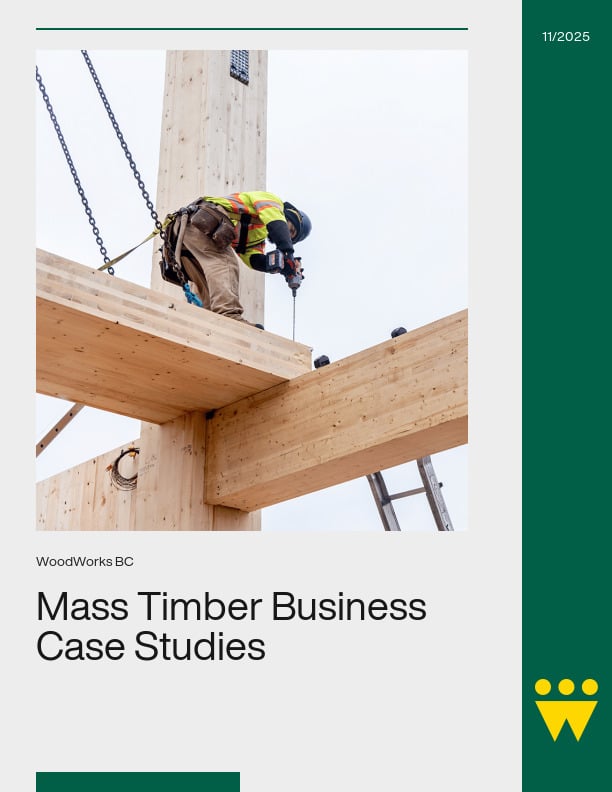
Mass Timber Business Case Studies
...case studies enable direct comparisons between mass timber and traditional construction methods. WoodWorks is seeking developers and owners with completed mass timber projects to share data for analysis, supporting education...

Get Access to Our Resources

Stay in the loop and don’t miss a thing!

1
2
3

Get Access to Our Resources

Stay in the loop and don’t miss a thing!

What’s Your Occupation?

Help us personalize the content for you.

What Interests You the Most?

Help us personalize the content for you.

Filters

Expertise Icon
Field of Expertise
Province Icon
Province
Member Type Icon
WoodWork National Partners

Filters

Post Type Icon
Post Type
Persona Icon
Persona
Language Icon
Language
Tags Icon
Tags
Mass Timber Plus Icon Environment Plus Icon Safety Plus Icon Durability Plus Icon Design Systems Plus Icon Budget Plus Icon Construction Management Plus Icon Fire Resistance Plus Icon Tall Buildings Plus Icon Short Buildings Plus Icon
Date Icon
Date
Line Separator