Introduction to Wood Design has been prepared to facilitate and encourage the instruction of wood engineering at Canadian universities and colleges. The publication is a supplement to the Wood Design Manual 2017.
Popular Topics: Mass Timber Fire Tests Sustainability Events
Filters
Introduction to Wood Design has been prepared to facilitate and encourage the instruction of wood engineering at Canadian universities and colleges. The publication is a supplement to the Wood Design Manual 2017.
Wood-frame construction is an important option for school buildings as well as an important choice toward meeting a sustainable future for Ontario. The facts behind this statement are demonstrated by first exploring how wood-frame construction addresses the three major components of sustainable development: what is best for the environment, what is best for the economy, and what is best for society. Factors that owners, funding partners and design teams must consider when developing a project will then be identified, above and beyond sustainability objectives. In practical terms, the impact of building code requirements, geography, and climate on budget and construction scheduling are explored.
Wood construction systems and their components available for use in low-rise school buildings in Ontario are introduced. Site-built and pre-fabricated options, including the innovative cross-laminated timber system, are explained along with the benefits that can be expected from each. The requirements of the Ontario Building Code (OBC) as they pertain to wood construction are elaborated upon.
All references to the Ontario Building Code are based on an extensive review of the OBC as it pertains to wood use in low-rise educational buildings undertaken by code experts Morrison Hershfield for Ontario Wood WORKS! Parts 3, 4 and 5 of the OBC were reviewed to identify pertinent conditions, limitations or restrictions. The report of their analysis is attached in its entirety as Appendix B (page 33).
Unsprinklered one and two-storey school buildings up to 2,400 m2 can be built entirely with wood construction systems, provided certain requirements are met; adding sprinklers to these buildings brings that maximum area up to 4,800 m2 . With the use of firewalls to compartmentalize a larger building into a series of connected smaller buildings, this maximum area can be considerably increased.
A requirement for non-combustible construction does not necessarily imply that school buildings must miss out completely on the benefits of wood construction systems, such as heavy timber roof systems or wood interior elements and finishes. There are also alternative options for complying with OBC requirements which allow for the use of developing wood technologies.
The importance of a wood construction system in terms of benefits to building users and to the environment is explored in detail. Beneficial attributes of wood as a building material include its renewability and its natural ability to capture CO2 from the atmosphere and lock it away in its fibres; that it is sourced from sustainably managed Ontario forests; that manufacturing efficiencies result in a more responsible use of energy and reduced pollutants to the atmosphere when compared with other major building materials; these attributes all help to mitigate climate change.
The benefits of a wood construction system during the construction phase, in terms of material delivery times and optimized construction scheduling are also explored, along with benefits during the life of the building. Some of these benefits are a result of wood’s natural thermal and acoustical properties; others, such as durability and adaptability, result from wood’s natural properties combined with the correct use of the products. There are also less quantifiable though equally important effects, such as the warmth of a natural system and its impact on the learning environment. Five case studies, four schools across the country, and one in the United States, are included to help demonstrate these benefits.

The target audience for this technical resource includes building officials, fire service, architects, engineers, builders, code consultants and developers and other parties involved in the design and approvals of tall wood noted in Table 1 below. This technical resource is expected to help illustrate to applicants how tall wood buildings could be designed as alternative solutions in a way that achieves the level of performance required by Ontario’s Building Code.
A tall wood building is defined as a building over six-storeys that uses wood for its structural system and is built using mass timber construction. Mass timber refers to large dimension solid lumber, gluedlaminated lumber, cross-laminated lumber or other large dimension wood products referenced in this technical resource as opposed to conventional stick-frame construction typically used in low-rise and midrise buildings in Ontario. Mass timber offers the advantages of improved dimensional stability and better fire performance during construction and occupancy. Tall wood buildings are not new to Ontario – many such buildings are still in use in Ontario after nearly 100 years in service, however over time, changes to building codes and the introduction of steel and concrete for high-rise construction resulted in a decline in construction of tall wood buildings over the decades. But with new wood products and modern means of fire engineering, modern tall wood buildings are now being built in Canada. The new products and the way in which they are pre-fabricated and constructed offer tremendous opportunities to improve quality and speed of construction for buildings in Ontario.
Mass timber products have environmental advantages as well. Trees get their energy from the sun and absorb carbon from the atmosphere. As they grow, trees store carbon and by sustainably harvesting trees, the carbon is sequestered, which helps to reduce greenhouse gas. The carbon stored in wood is not released into the atmosphere when it is harvested. As new trees are planted to replace the harvested trees, the new trees will continue the cycle of carbon storage. Ontario and Canada have significant forest resources which, combined with sustainable forestry management practices, make tall wood buildings an attractive alternate to other materials which do not have these attributes. This technical resource has two main sections: Fire Safety and Structural Design.
These two major topics are normally of most concern during design and review of tall wood buildings and are at times interrelated. Thus, it is expected that design teams and building departments will work together at the early stages of design since structural decisions can affect fire performance and vice versa. The sections go into detail on aspects of compliance, methods of analysis, methods of design and the expected performance requirements for fire and structure. Other topics such as thermal performance, acoustic performance and constructability are covered in other references as noted throughout this technical resource.
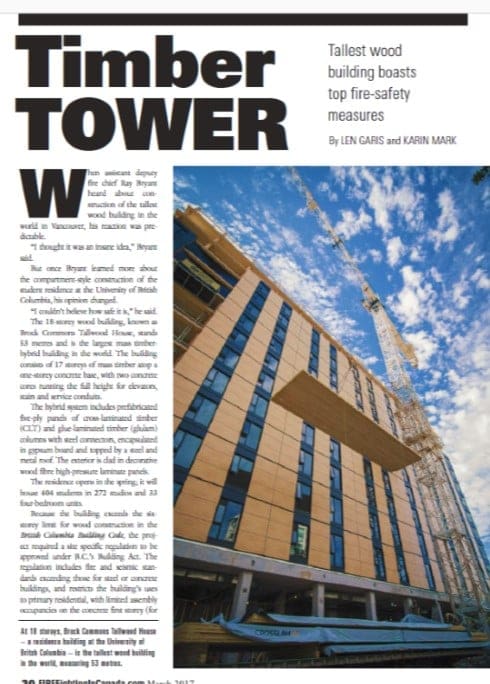
Article by Len Garis and Karin Mark.
When assistant deputy fire chief Ray Bryant heard about construction of the tallest wood building in the world in Vancouver, his reaction was predictable. “I thought it was an insane idea,” Bryant said. But once Bryant learned about the compartment-style construction of the student residence at the University of British Columbia, his opinion changed. “I couldn’t believe how safe it is,” he said. Read the article.
A building that is a good choice for the environment can often address broader social needs and offer higher economic value. People prefer to live, work, study and play in a well-designed and visually appealing building – and this is more likely to extend its life and make it a better investment. It also sends a signal that the building owner is environmentally responsible and cares about the well-being of occupants.
Individuals in the design and construction community are increasingly choosing materials, design techniques and construction procedures that improve a structure’s ability to withstand and recover from extreme events such as intense rain, snow and wind, hurricanes, earthquakes and wildfire. In addition, buildings are increasingly designed to be more adaptable in order to accommodate future occupancies and user needs. As a result, specifying robust materials and design details, and constructing flexible and easily repairable buildings are becoming important design criteria.
The intent of this document is to provide guidance on joist spans, built-up beam sizes, and supporting column sizes for exterior wood decks. The following items which are typically included in an exterior wood deck are not addressed and are beyond the scope of this document: deck footings; deck railings and guards; attachment of the deck to houses; lateral bracing of a deck. Design tables are provided for lumber which is not incised (Tables 2a, 2b, 4a, 4b, 6a and 6b) and lumber which is incised (Tables 3a, 3b, 5a, 5b, 7a and 7b). Tables are provided in both metric and imperial units.
This testing program was carried out by the Advanced Building Systems (ABS) Department of FPInnovations in response to a request made by Mrs. Julie Frappier of Nordic Engineered Wood and Mr. Étienne Lalonde of Canadian Wood Council (CWC) for the evaluation of the shear stress resistance of one hundred fifty two (152) cross-laminated timber (CLT) beams. All specimens were manufactured by Nordic Engineered Wood and delivered to FPInnovations’ testing facilities in Québec City. The main objective of this study was to evaluate the in-plane shear stress of CLT depending of its orientation and the number of plies. Specific Gravity and Moisture Content measurements were also determined for each specimen.
With a height of 29.5 metres, the Wood Innovation and Design Centre (WIDC) is the tallest contemporary wood building in North America. Located in the city of Prince George in northern British Columbia, the WIDC was conceived as a showcase for local wood products and as a demonstration of the province’s growing expertise in the design and construction of large wood buildings.
The building has eight levels (six storeys, plus a ground floor mezzanine and a rooftop mechanical penthouse). The lower levels will accommodate faculty and students enrolled in the new Master of Engineering in Integrated Wood Design (MEng), to be launched by the University of Northern British Columbia (UNBC) in January 2016 and the new Centre for Design Innovation and Entrepreneurship to be launched by Emily Carr University of Art and Design in fall 2016. Academic facilities include a research/teaching lab that will support the design, fabrication and testing of wood products; a 75-seat lecture theatre; classrooms; a student lounge; gathering and meeting areas; and a learning resource centre. The upper floors will provide office space for public and private sector organizations associated with the wood industry.
Over the long term, the WIDC will advance wood education and innovation in the province, enhance expertise in wood manufacturing, product development and engineering – all of which will help to expand opportunities for international exports of products and services. In addition, its striking presence in the heart of the city will assist in the revitalization of downtown Prince George.
This case study describes the most important innovations that were implemented to meet design and safety criteria in what is a new class of buildings for British Columbia. These innovations included:
A set of site-specific regulations to ensure life safety and structural integrity;
The use of vertical cross-laminated timber (CLT) elements (including mechanical, elevator and stair shafts) to provide lateral stability to the structure;
The use of double layer CLT floors to meet structural requirements and contribute to acoustic isolation and efficient services distribution;
The use of superimposed (end grain-to-end grain bearing) columns to control shrinkage over the height of the building; and,
The use of high strength proprietary connectors to speed construction and improve structural performance.


Subscribe to our newsletter today to stay informed and inspired!
Stay in the loop and don’t miss a thing!